
BPR Quote of the Day

“Can you imagine, Mr. President, billionaires, billionaires going to war against working people so that they and their kids cannot get health insurance? I mean I thing that is just obscene.”
Senator Bernie Sanders (I-VT)
BPR Quote of the Day
“Can you imagine, Mr. President, billionaires, billionaires going to war against working people so that they and their kids cannot get health insurance? I mean I thing that is just obscene.”
Senator Bernie Sanders (I-VT)

Is America an empire or not? It is a loaded question because in the modern age, that word — empire — is not a moniker citizens proudly embrace in the way we might imagine the Ottomans or the Romans did during their reigns. Instead, the word today evokes images of the Death Star. And so we shirk the term’s implications and insinuations, much as President Obama did this week at the United Nations.
“The United States has a hard-earned humility when it comes to our ability to determine events inside other countries,” he declared in his speech to the General Assembly. “The notion of American empire may be useful propaganda, but it isn’t borne out by America’s current policy.”
The rhetoric sounds nice and it deftly portrays the United States as the sympathetic victim of an international conspiracy. The problem is that it glosses over how current U.S. policies do, in fact, create an imperial footprint.
This is most easy to see when it comes to our military. According to a 2010 report by the Pentagon, the United States has 662 overseas bases in 38 different countries. Additionally, the United States recently invaded and occupied Iraq and Afghanistan and helped invade Libya. It is also prosecuting undeclared wars in Yemen and Pakistan, while propping up dictators in most of the Middle East. Oh, and we are also the world’s biggest exporter of weapons and spend more on our military than most of the world combined.
On the intelligence side of things, it is a similar story. The National Security Administration is not only collecting domestic communications, it is constructing a global surveillance system. That includes collecting communications data from countries across the world, surveilling heads of state in Brazil and Mexico, hacking computers at the Indian embassy, spying on the United Nations and wiretapping Brazil’s state-owned oil company. And that’s just what we know about.
To know if this is imperial behavior, simply ask yourself whether you would label another country an empire if it were doing this kind of thing. Of course you would (and you’d probably call that nation even worse things, too).
At his United Nations speech, though, President Obama justified this all as something wholly different from empire. In a signature Obama-ism, he portrayed the United States’ actions as a benevolent effort to prevent “a vacuum of leadership” — but not an imperial project worthy of international resentment.
Yet, that whole “vacuum” idea is, unto itself, an imperial concept — one straight out of the “Star Wars” trilogy. In the megalomanical words of Darth Vader, it assumes that there must be one dominant power to “bring order” to the world — and it further assumes that without such an empire, there will be unacceptable chaos.
Such presuppositions are a failure of both imagination and foresight. They outright reject the notion of a multipolar world of truly sovereign nations — and they ignore the fact that such a multipolar world will be a reality, whether we like it or not. Indeed, though we’ve been telling ourselves since the end of the Cold War that we are the world’s sole superpower, the rise of China, India and Brazil, the re-emergence of Russia and the persistent power of the European Union say otherwise.
The inability to acknowledge this changing reality, in fact, is the ultimate sign that for all the rhetoric to the contrary, the United States government does see itself as running an empire. Such intransigence and hubris, after all, have defined the decline of empires into the very chaos they so fear. Perhaps the only way to halt such a decline is to finally admit we are an empire — and then take the necessary steps to start shedding that label for good.
BPR Quote of the Day
The inability of the media and politicians to focus on the real issues never ceases to amaze.
The real crisis is not the “debt ceiling crisis.” The government shutdown is merely a result of the Republicans using the debt limit ceiling to attempt to block the implementation of Obamacare. If the shutdown persists and becomes a problem, Obama has enough power under the various “war on terror” rulings to declare a national emergency and raise the debt ceiling by executive order. An executive branch that has the power to inter citizens indefinitely and to murder them without due process of law, can certainly set aside a ceiling on debt that jeopardizes the government.
The real crisis is that jobs offshoring by US corporations has permanently lowered US tax revenues by shifting what would have been consumer income, US GDP, and tax base to China, India, and other countries where wages and the cost of living are relatively low. On the spending side, twelve years of wars have inflated annual expenditures. The consequence is a wide deficit gap between revenues and expenditures.
Under the present circumstances, the deficit is too large to be closed. The Federal Reserve covers the deficit by printing $1,000 billion annually with which to purchase Treasury debt and mortgage-backed financial instruments. The use of the printing press on such a large scale undermines the US dollar’s role as reserve currency, the basis for US power. Raising the debt limit simply allows the real crisis to continue. More money will be printed with which to purchase more new debt issues needed to close the gap between revenues and expenditures.
The supply of dollars or dollar denominated assets in foreign hands is vast. (The Social Security system’s large surplus accumulated over a quarter century was borrowed by the Treasury and spent. In its place are non-marketable Treasury IOUs. Consequently, Social Security is one of the largest creditors to the US government.)
If foreigners lose confidence in the dollar, the drop in the dollar’s exchange value would mean high inflation and the Federal Reserve’s loss of control over interest rates. It is possible that a drop in the dollar’s exchange value could initiate hyperinflation in the US.

The real crisis is the absence of intelligence among economists and policymakers who told us for 20 years not to worry about the offshoring of US jobs, because we were going to have a “New Economy” with better jobs.
As I report each month, not a single one of these “New Economy” jobs has appeared in the payroll jobs statistics or in the Labor Department’s projections of future jobs. Economists and policymakers simply gave away a good chunk of the US economy in order to enhance corporate profits. One result has been to create in the US the worst distribution of income of all developed countries and of many undeveloped ones.
In the scheme of things, the enhanced profits are a short-run thing, because by halting the growth in consumer income, jobs offshoring has destroyed the US consumer market. As I noted in a recent column, on September 19 the New York Times reported what I have reported for years: that US median family income has not increased for a quarter of a century. The lack of consumer income growth is why 5 years of massive monetary and fiscal stimulus have not brought economic recovery.
The real crisis cannot be addressed unless the jobs are brought back home and the wars are stopped. As powerful organized interests oppose any such measures, Congress will pass a new debt ceiling and the real crisis will continue.
Do you hear any mention of the real crisis in the media? Today I was on an international TV program for 25 minutes with the chief financial editor of one of England’s major newspapers. Little doubt but that he was a good-hearted and intelligent fellow, but he had no capability of thinking outside the box. He was unable to comprehend my explanations, and resorted to regurgitations of the media’s ignorance or subservience to Washington’s propaganda.
Among his regurgitations was the “solution” of cutting Social Security. The chief financial editor of a major UK newspaper did not know that for the past quarter of a century Social Security revenues exceeded Social Security payments, and that the Treasury spent the surplus to fund the annual operating expenses of the government, issuing non-marketable IOUs to the Social Security Trust Funds.
The chief financial editor also did not comprehend that cutting Social Security payments also cuts consumer spending or aggregate demand, and sends the economy down further, thus magnifying the deficit/debt problem.
Because of the serious decline in the US economy caused by jobs offshoring and financial deregulation, Social Security no longer adds to its surplus. Social Security payments need the supplement to the annual payroll revenues of repayments by the Treasury of the borrowed funds.
The only reasons that Social Security is in trouble is that jobs offshoring and wars have constrained the US Treasury’s ability to make good on its debts except by having the Federal Reserve print money. Every job that is sent abroad does not contribute payroll taxes to Social Security and Medicare.
Insouciant American economists say that manufacturing is an outmoded source of employment, but Chinese manufacturing employment is almost equal to the total US labor force in all occupations, including waitresses and bartenders and hospital orderlies. China’s economy is growing at a rate of 7.5% in real terms, while Western economies cannot move forward and some are regressing.
In order to appease Wall Street, the most corrupt institution in human history, and to prevent Wall Street-financed takeovers of their corporations, executives destroyed the American consumer market by offshoring American incomes in order to enhance profits by substituting cheap foreign labor for US labor.
In my opinion, the US economy is not salvageable in its present form. The economy is running out of water resources. The supply that remains is being decimated by fracking. The soil is depleted by glysophate, a requirement of GMO agriculture. The external costs of production are rising (the costs that the corporations impose on the environment and third parties) and possibly exceed the value of the increase in corporate output. Economists are incapable of independent thought, and elected representatives are dependent on the private interests that finance their campaigns.
It is difficult to imagine a more discouraging situation.
At this time, collapse seems the most likely forecast.
Perhaps out of the ruins, a new, intelligent beginning might occur.
If there are any leaders.
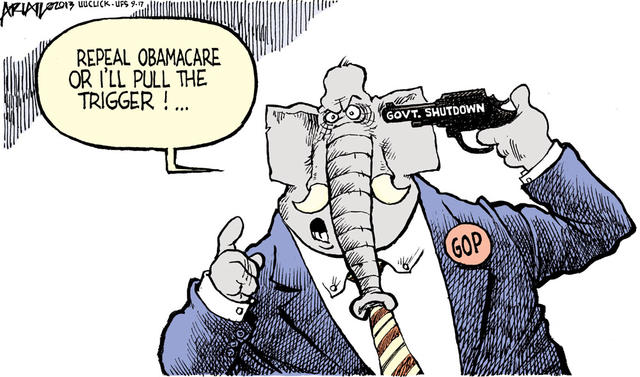
The mainstream GOP is so certain Republicans will be blamed for the government shutdown, the first in 17 years, it has been actively campaigning against its conservative base within government.
Sen. John McCain summed up the party line when he said that as much as he doesn’t like Obamacare, it’s the law, and shutting down the government won’t change that.
But the tea party has leverage over House Speaker John Boehner, who was nearly fired from that position, and Boehner has leverage over his caucus. Thus the House has refused to vote so far on any bill to fund the government unless some token strike against the Affordable Care Act is included. Republicans inched toward resolution Monday, first settling for a delay of the individual mandate and then attempting to negotiate their differences in conference, but it was too little too late and the maneuvering was not enough by the stroke of midnight.
So 1.8 million government employees will either stop working or work without pay.
Here’s the rub: As with the sequester, President Obama is the chief executive and, through his subordinates, can shape the impact of the shutdown. For example, the president signed a billensuring that enlisted military personnel will be paid on time. But he hinted Monday that veterans could be impacted through the shutdown. Certain emergency services and programs will stay available—Social Security checks will go out, the president promised—but there will be across the board inconveniences and real human suffering.
This is no game, but Obama will have an opportunity to control how the public experiences life without government. Put more accurately, the president will, more than any individual (except for Boehner, whom Senate Majority Leader Harry Reid blamed for the crisis), have the power to decide what kind of government Americans have.
Leaders in both parties are scrambling to present as the more reasonable negotiator in this political impasse. Since he came into office, the president has had nothing but opposition from Congress. It shouldn’t be too hard to pin this one on the GOP, given that history and the almost prideful stance political figures such as Sen. Ted Cruz, R-Texas, have adopted in championing the shutdown. It’s their idea, and they’re proud of it.
Faced with plummeting poll numbers, a sick economy and an NSA spying scandal that won’t go away, this is quite a gift Obama has received from the opposition.

Seymour Hersh has got some extreme ideas on how to fix journalism – close down the news bureaus of NBC and ABC, sack 90% of editors in publishing and get back to the fundamental job of journalists which, he says, is to be an outsider.
It doesn’t take much to fire up Hersh, the investigative journalist who has been the nemesis of US presidents since the 1960s and who was once described by the Republican party as “the closest thing American journalism has to a terrorist”.
He is angry about the timidity of journalists in America, their failure to challenge the White House and be an unpopular messenger of truth.
Don’t even get him started on the New York Times which, he says, spends “so much more time carrying water for Obama than I ever thought they would” – or the death of Osama bin Laden. “Nothing’s been done about that story, it’s one big lie, not one word of it is true,” he says of the dramatic US Navy Seals raid in 2011.
Hersh is writing a book about national security and has devoted a chapter to the bin Laden killing. He says a recent report put out by an “independent” Pakistani commission about life in the Abottabad compound in which Bin Laden was holed up would not stand up to scrutiny. “The Pakistanis put out a report, don’t get me going on it. Let’s put it this way, it was done with considerable American input. It’s a bullshit report,” he says hinting of revelations to come in his book.
The Obama administration lies systematically, he claims, yet none of the leviathans of American media, the TV networks or big print titles, challenge him.
“It’s pathetic, they are more than obsequious, they are afraid to pick on this guy [Obama],” he declares in an interview with the Guardian.
“It used to be when you were in a situation when something very dramatic happened, the president and the minions around the president had control of the narrative, you would pretty much know they would do the best they could to tell the story straight. Now that doesn’t happen any more. Now they take advantage of something like that and they work out how to re-elect the president.
He isn’t even sure if the recent revelations about the depth and breadth of surveillance by the National Security Agency will have a lasting effect.
Snowden changed the debate on surveillance
He is certain that NSA whistleblower Edward Snowden “changed the whole nature of the debate” about surveillance. Hersh says he and other journalists had written about surveillance, but Snowden was significant because he provided documentary evidence – although he is sceptical about whether the revelations will change the US government’s policy.
“Duncan Campbell [the British investigative journalist who broke the Zircon cover-up story], James Bamford [US journalist] and Julian Assange and me and the New Yorker, we’ve all written the notion there’s constant surveillance, but he [Snowden] produced a document and that changed the whole nature of the debate, it’s real now,” Hersh says.
“Editors love documents. Chicken-shit editors who wouldn’t touch stories like that, they love documents, so he changed the whole ball game,” he adds, before qualifying his remarks.
“But I don’t know if it’s going to mean anything in the long [run] because the polls I see in America – the president can still say to voters ‘al-Qaida, al-Qaida’ and the public will vote two to one for this kind of surveillance, which is so idiotic,” he says.
Holding court to a packed audience at City University in London’s summer school on investigative journalism, 76-year-old Hersh is on full throttle, a whirlwind of amazing stories of how journalism used to be; how he exposed the My Lai massacre in Vietnam, how he got the Abu Ghraib pictures of American soldiers brutalising Iraqi prisoners, and what he thinks of Edward Snowden.
Hope of redemption
Despite his concern about the timidity of journalism he believes the trade still offers hope of redemption.
“I have this sort of heuristic view that journalism, we possibly offer hope because the world is clearly run by total nincompoops more than ever … Not that journalism is always wonderful, it’s not, but at least we offer some way out, some integrity.”
His story of how he uncovered the My Lai atrocity is one of old-fashioned shoe-leather journalism and doggedness. Back in 1969, he got a tip about a 26-year-old platoon leader, William Calley, who had been charged by the army with alleged mass murder.
Instead of picking up the phone to a press officer, he got into his car and started looking for him in the army camp of Fort Benning in Georgia, where he heard he had been detained. From door to door he searched the vast compound, sometimes blagging his way, marching up to the reception, slamming his fist on the table and shouting: “Sergeant, I want Calley out now.”
1. President Obama’s opening lines at the U.N. on Tuesday looked down on people who would think to settle disputes with war. Obama was disingenuously avoiding the fact that earlier this month he sought to drop missiles into a country to “send a message” but was blocked by the U.S. Congress, the U.N., the nations of the world, and popular opposition — after which Obama arrived at diplomacy as a last resort.
2. “It took the awful carnage of two world wars to shift our thinking.” Actually, it took one. The second resulted in a half-step backwards in “our thinking.” The Kellogg-Briand Pact banned all war. The U.N. Charter re-legalized wars purporting to be either defensive or U.N.-authorized.
3. “[P]eople are being lifted out of poverty,” Obama said, crediting actions by himself and others in response to the economic crash of five years ago. But downward global trends in poverty are steady and long pre-date Obama’s entry into politics. And such a trend does not exist in the U.S. [1]
4. “Together, we have also worked to end a decade of war,” Obama said. In reality, Obama pushed Iraq hard to allow that occupation to continue, and was rejected just as Congress rejected his missiles-for-Syria proposal. Obama expanded the war on Afghanistan. Obama expanded, after essentially creating, drone wars. Obama has increased global U.S. troop presence, global U.S. weapons sales, and the size of the world’s largest military. He’s put “special” forces into many countries, waged a war on Libya, and pushed for an attack on Syria. How does all of this “end a decade of war”? And how did his predecessor get a decade in office anyway?
5. “Next year, an international coalition will end its war in Afghanistan, having achieved its mission of dismantling the core of al Qaeda that attacked us on 9/11.” In reality, Bruce Riedel, who coordinated a review of Afghanistan policy for President Obama said, “The pressure we’ve put on [jihadist forces] in the past year has also drawn them together, meaning that the network of alliances is growing stronger not weaker.” (New York Times, May 9, 2010.)
6. “We have limited the use of drones.” Bush drone strikes in Pakistan: 51. Obama drone strikes in Pakistan: 323 [2].
7. “… so they target only those who pose a continuing, imminent threat to the United States where capture is not feasible.” On June 7, 2013, Yemeni tribal leader Saleh Bin Fareed toldDemocracy Now that Anwar al Awlaki could have been turned over and put on trial, but “they never asked us.” In numerous other cases it is evident that drone strike victims could have been arrested if that avenue had ever been attempted. A memorable example was the November 2011 drone killing in Pakistan of 16-year-old Tariq Aziz, days after he’d attended an anti-drone meeting in the capital, where he might easily have been arrested — had he been charged with some crime. This weeks drone victims, like all the others, had never been indicted or their arrest sought.
8. “… and there is a near certainty of no civilian casualties.” There are hundreds of confirmed [2] civilian dead from U.S. drones, something the Obama administration seems inclined to [3] keep as quiet as possible.
9. “And the potential spread of weapons of mass destruction casts a shadow over the pursuit of peace.” In reality, President Obama is not pursuing peace or the control of such weapons or their reduction and elimination in all countries, only particular countries. And the United States remains the top possessor of weapons of mass destruction and the top supplier of weapons to the world.
10. “[In Syria, P]eaceful protests against an authoritarian regime were met with repression and slaughter. … America and others have worked to bolster the moderate opposition.” In fact, the United States has armed a violent opposition intent on waging war and heavily influenced if not dominated by foreign fighters and fanatics.
11. “[T]he regime used chemical weapons in an attack that killed more than 1,000 people, including hundreds of children.” Maybe, but where’s the evidence? Even Colin Powell brought (faked) evidence.
12. “How should we respond to conflicts in the Middle East?” This suggests that the United States isn’t causing conflicts in the Middle East or aggravating them prior to altering its position and “responding.” In fact, arming and supporting brutal governments in Bahrain, Egypt, Yemen, Jordan, Israel, etc., is behavior that could do a great deal of good simply by ceasing.
13. “How do we address the choice of standing callously by while children are subjected to nerve gas, or embroiling ourselves in someone else’s civil war?” That isn’t a complete list of choices, as Obama discovered when Russia called Kerry’s bluff and diplomacy became a choice, just as disarmament and de-escalation and pressure for a ceasefire are choices. Telling Saudi Arabia “Stop arming the war in Syria or no more cluster bombs for you,” is a choice.
14. “What is the role of force in resolving disputes that threaten the stability of the region and undermine all basic standards of civilized conduct?” Force doesn’t have a role in civilized conduct, the most basic standard of which is relations without the use of force.
15. “[T]he international community must enforce the ban on chemical weapons.” Except against Israel or the United States.
16. “… and Iranians poisoned in the many tens of thousands.” This was good of Obama to recognize Iran’s suffering, but it would have been better of him to recall where Iraq acquired some of its weapons of mass destruction.
17. “It is an insult to human reason — and to the legitimacy of this institution — to suggest that anyone other than the regime carried out this attack.” Really? In the absence of evidence, skepticism isn’t reasonable for this Colin-Powelled institution, the same U.N. that was told Libya would be a rescue and watched it become a war aimed at illegally overthrowing a government? Trust us?
18. “Now, there must be a strong Security Council Resolution to verify that the Assad regime is keeping its commitments, and there must be consequences if they fail to do so.” Meaning war? What about the U.N.’s commitment to oppose war? What about the United States’ violation of its commitments to destroy the chemical weapons sitting in Kentucky and Colorado? “Consequences” for the U.S. too?
19. “I do not believe that military action — by those within Syria, or by external powers — can achieve a lasting peace.” Yet, the U.S. government is shipping weapons into that action.
20. “Nor do I believe that America or any nation should determine who will lead Syria … Nevertheless, a leader who slaughtered his citizens and gassed children to death cannot regain the legitimacy to lead a badly fractured country.” The Syrians should decide their own fate as long as they decide it the way I tell them to.
21. “[N]or does America have any interest in Syria beyond the well-being of its people, the stability of its neighbors, the elimination of chemical weapons, and ensuring it does not become a safe-haven for terrorists.” That’s funny. Elsewhere, you’ve said [4] that weakening Syria would weaken Iran.
22. “[W]e will be providing an additional $340 million [for aid].” And vastly more for weapons.
23. “We will ensure the free flow of energy from the region to the world. Although America is steadily reducing our own dependence on imported oil…” That first remarkably honest sentence is only honest if you don’t think about what “free flow” means. The second sentence points to a real, if slow, trend but obscures the fact that only 40% [5] of the oil the U.S. uses comes from the U.S., which doesn’t count much of the oil the U.S. military uses while “ensuring the free flow.” Nor is switching to small domestic supplies a long-term solution as switching to sustainable energy would be.
 Political update: the annual showdown over the federal budget and associated topics is about to begin. Over the weekend, President Obama warned that he wouldn’t negotiate with Congressional Republicans about raising the debt ceiling, which is due to be breached sometime next month. But there’s widespread speculation that the G.O.P. will play hardball and shut down the federal government.If your eyes are already glazing over, don’t feel guilty. I get paid to track this stuff, and I, too, find it a struggle to keep up. If, as Marx said, history repeats itself, first as tragedy and then as farce, how do you describe a four-peat? In 2010, Congress failed to pass a budget. In 2011, we had a debt-ceiling crisis that resulted in the sequester and Standard & Poor’s downgrading treasuries. Last year, it was the fiscal-cliff crisis. And this year, we have a debt-ceiling crisis and a budget crisis—without a new spending resolution, the federal government will run out of money at the end of the month—with the added complication that some Republicans want to defund Obamacare. In short, it’s business as usual on the Potomac.
Why is Washington so screwed up? Some people blame the Tea Party, others blame the lobbyists; my culprit is the economy. Countries with healthy economic systems tend to have polities that function pretty well. (The United States of the postwar era is a good example.) Countries with dysfunctional economies tend to have dysfunctional political systems, in which radical groups look for someone to blame and rival interest groups fight over the spoils. And that, sadly, is where we are now.
On Monday, I wrote about the lopsided nature of the economic recovery that began in 2009. On Tuesday, the Census Bureau released its annual update on income, poverty, and health-insurance coverage, which showed that in 2012 the income of the typical American household held steady, at about fifty-one thousand dollars. The poverty rate also remained pretty much the same, at fifteen per cent. And the percentage of people who don’t have health coverage dipped a little bit, to 15.4 per cent.
Those were the headlines. But the really interesting stuff was in the body of report, which contains data on incomes going back half a century. What these numbers show, or rather confirm, is that in economic terms much of middle America has experienced four lost decades. Since its founding, the United States has been a country based on enterprise, hard work, and material progress. But for forty years now, the engine that generates across-the-board rises in living standards has been stalled, with incomes stagnating at the bottom and in the middle while growing rapidly at the top.
It’s not a new story, of course. Still, for anybody seeking to comprehend modern American politics, its importance can’t be overstated. Here are some of the Census Department’s figures:

 thebigpicturereport ™