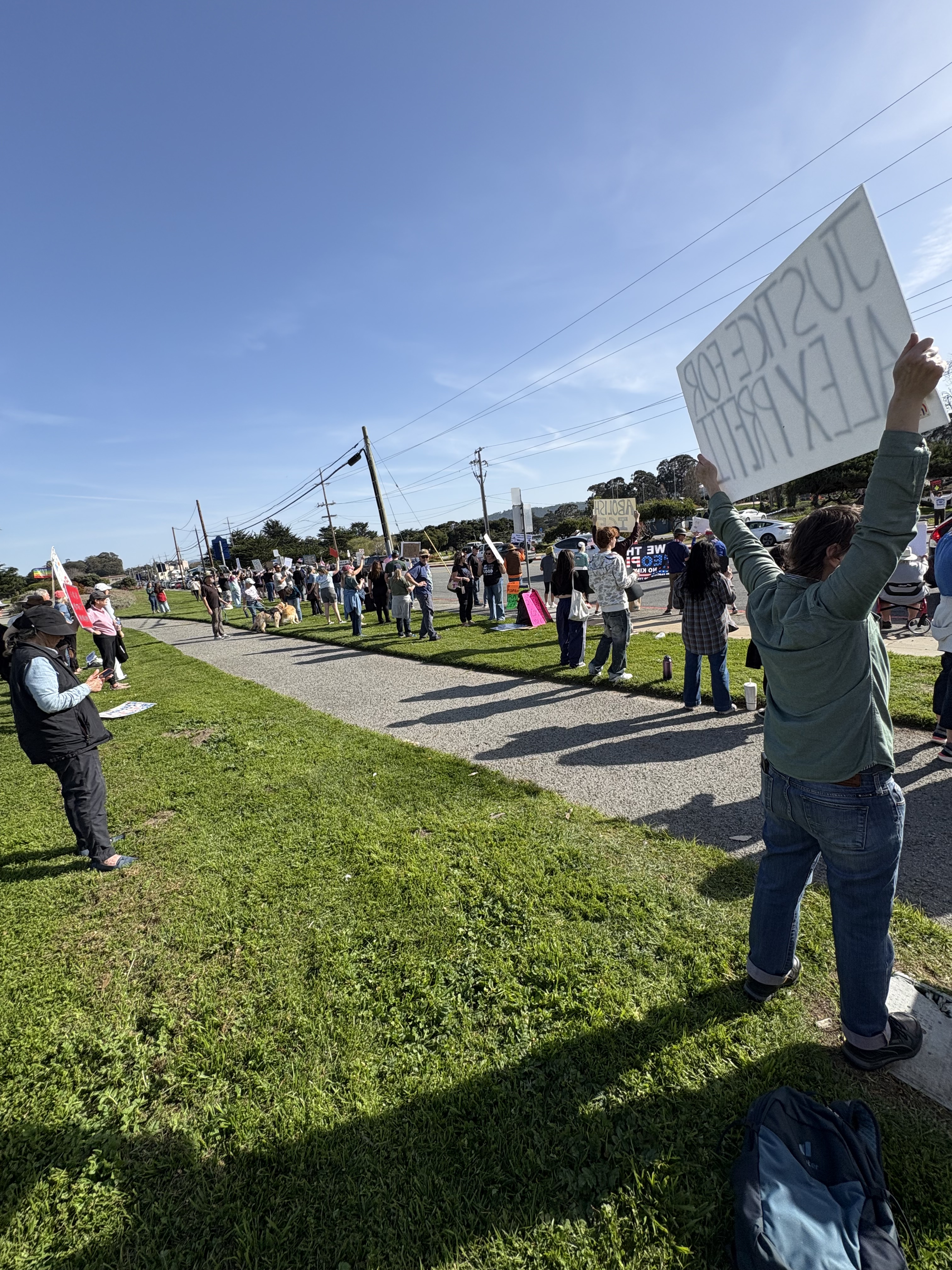
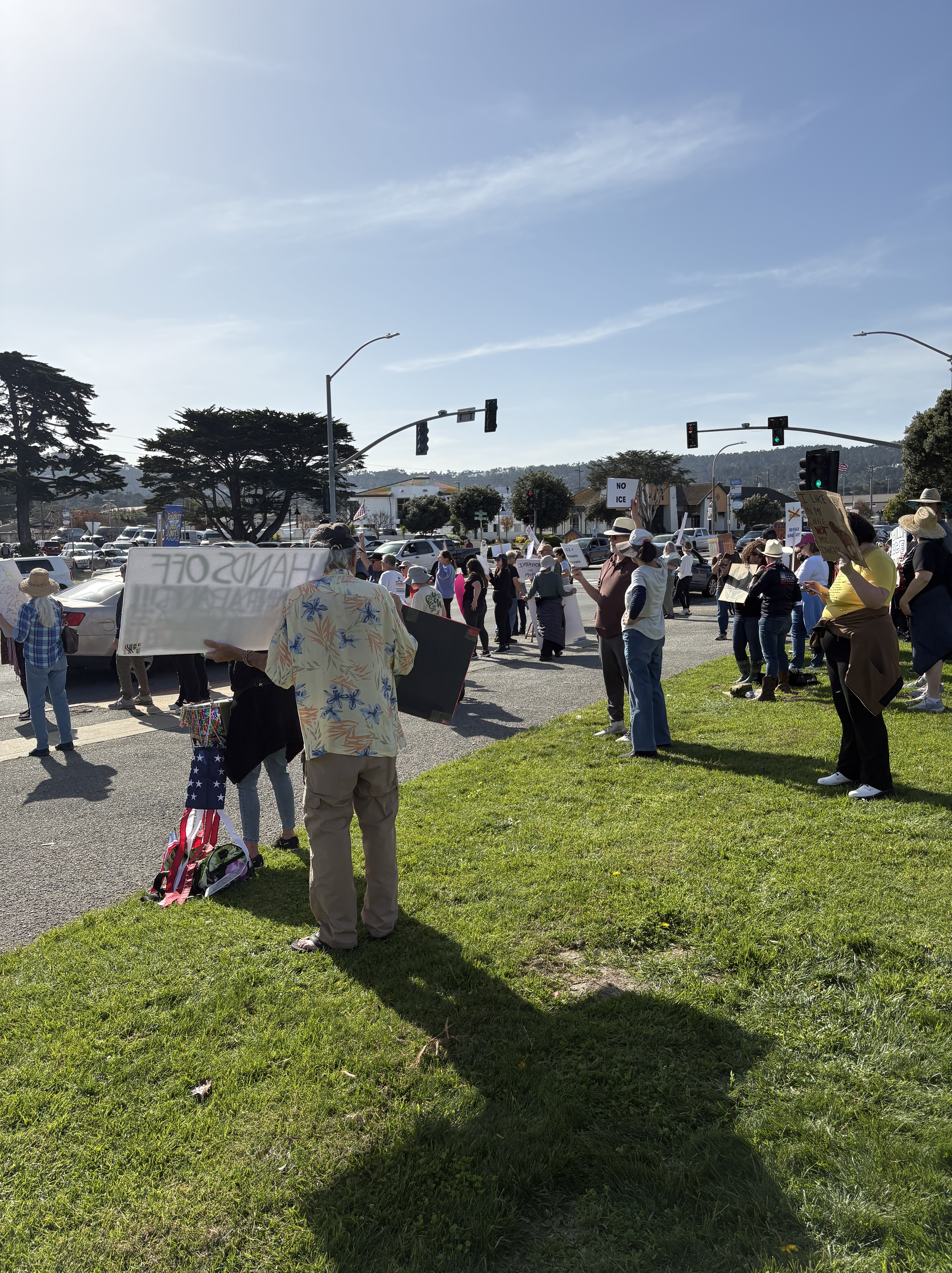
Anti-ICE Protest: Yes, we had one in Monterey Saturday at Window on the Bay……Several hundred of us and mostly positive beeps from the thousands of cars passing by on Del Monte Blvd……
Should we be surprised that someone like the pro-Trump billionaire CEO of Oracle, Larry Ellison is among the American investors with major influence over content of Tik Tok? Ellison is right-wing and very pro-Israel. Will that affect the content of Tik Tok? Don’t be surprised. –TBPR Editor
Well-known Gaza journalist Bisan Owda has been banned from TikTok, she says, just days after the finalization of the company’s sale to U.S. investors — including a firm headed by the notoriously pro-Israel Larry Ellison.
Owda announced the censorship of her account in a video on Instagram on Wednesday, saying that TikTok had banned her permanently. She had 1.4 million followers on the platform, she said, as a result of years of audience-building under Israeli occupation and genocide.
“I had 1.4 million followers there. I have been building that platform for four years now,” she said.
The account did appear to be banned on Wednesday and Thursday. However, late Thursday afternoon Eastern Time, Owda’s account appeared to be restored, but restricted. Some content seemed to not be available, and a banner appeared at the top of her feed that read: “Posts that some may find uncomfortable are unavailable.”
The Palestinian journalist has spent years documenting life in Gaza under Israeli occupation and, recently, amid Israel’s genocide. Her series with Al Jazeera’s AJ+ has won numerous awards, including a Peabody Award, an Edward R. Murrow Award, and even an Emmy. At the same time, pro-Israel voices have sought to silence Owda, including in a campaign in 2024 to pressure her Emmy nomination to be withdrawn.
In her Instagram video, Owda said that the ban was “expected” due to pressure from high-powered figures to censor Palestinian voices from TikTok.
She also shared a video with the company’s U.S. CEO, Adam Presser, saying that the company made a change to designate critically labelling someone as a “Zionist” as hate speech. “Over the course of 2024, we tripled the amount of accounts that we were banning for hateful activity,” Presser bragged at a conference last year.
Indeed, pro-Palestine advocates have said that TikTok’s role in exposing users to Israel’s genocide in Gaza is the reason that lawmakers and world leaders have sought its censorship — stretching back to Congress’s original bill to force its sale from Chinese owners in 2024.
On Thursday, that campaign finally reached its endpoint as the transfer to U.S. leadership was finalized. TikTok’s parent company, ByteDance, still retains 20 percent ownership, while 80 percent is now owned by investors. This includes Oracle, a tech company co-founded and still led by Ellison, a vehement advocate for Israel and billionaire who has spent recent years amassing more and more power over the American mediascape.
The censorship of Owda’s account lends credence to accusations by users in recent days that the app’s owners began restricting activities on their accounts nearly immediately after the app’s transfer. Users have said that they are being restricted from uploading content critical of Immigration and Customs Enforcement (ICE), in favor of Palestinian rights, or generally opposed to the Trump administration. The owners, however, have blamed bugs and a power outage at a U.S. data center.
Dr. Goddard is a professor of political science at Wellesley College. Dr. Newman is a professor of international affairs at Georgetown.
Understanding this president and his foreign policy is impossible, just as it is for any other of his policies. His mental health continues to deteriorate, and what he is thinking is often unpredictable and senseless. Of course, he knows his loyalists will back him no matter what. The rest of us will observe and complain, but he will do whatever he wants, no matter the consequences. Nevertheless, Goddard and Newman make a good case for what Trump and his people value most: whatever improves their bottom line. The rest of the world must accept the continuing inevitable chaos. –TBPR Editor
Negotiations around President Trump’s demand for U.S. ownership of Greenland have left officials from Denmark, Greenland and many other countries feeling confused and overwhelmed.
President Emmanuel Macron of France texted President Trump to say, “I do not understand what you are doing on Greenland.”
Indeed, for many people in the United States and abroad, Mr. Trump’s foreign policy seems incoherent, even irrational.
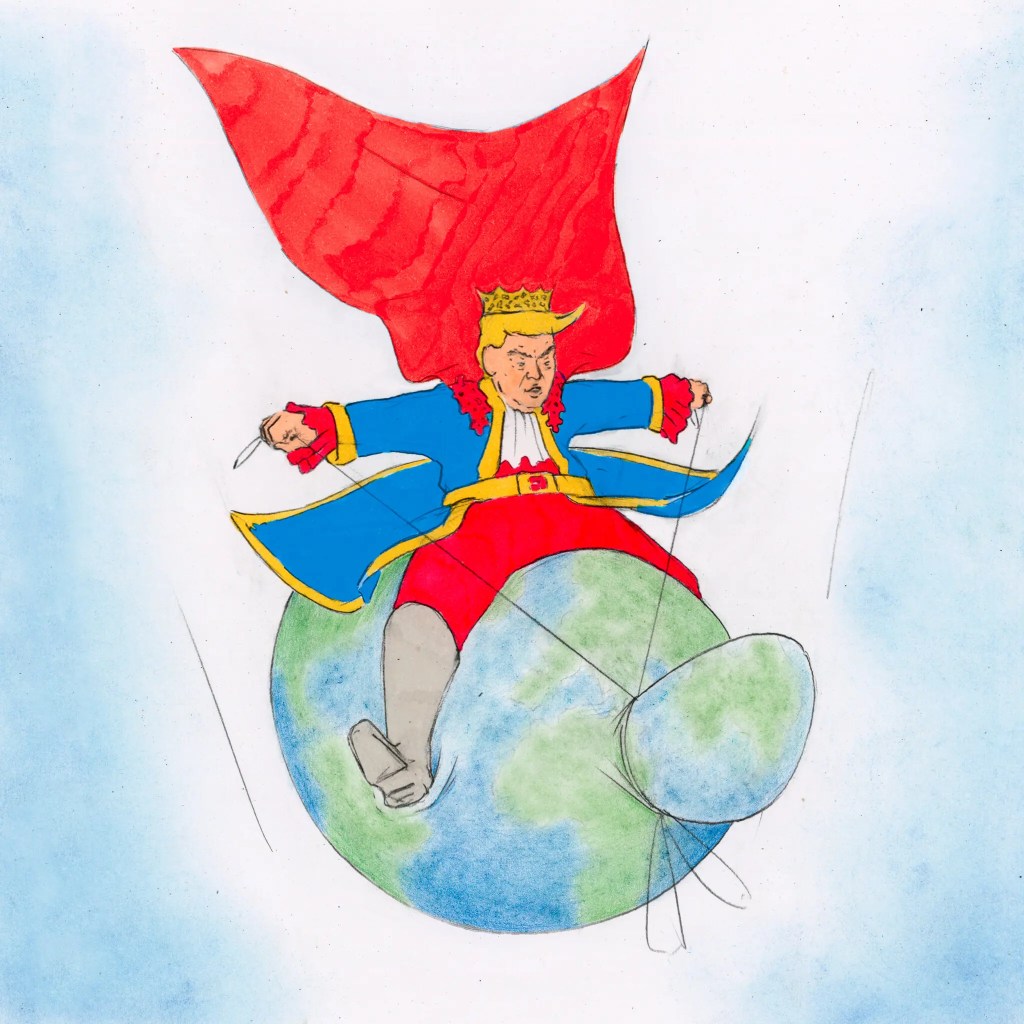
But that is because people are looking at it through the wrong historical lens. Mr. Trump’s approach is not just chaos or, as many people have commented, an updated version of 19th-century great-power competition. He is pursuing something more out of the 16th-century, what we call neoroyalist international politics.
Foreign policy has become a tool to channel money and status to Mr. Trump and his closest associates. National interests are eclipsed by those of elites. Rather than compete with rivals, Mr. Trump is willing to collude with them in order to advance his court’s parochial interests.
And if other countries do not act quickly to check Mr. Trump’s impulses, they are likely to enable a global order based on extraction and dominance.
For decades, the United States has championed a rules-based international order. Mr. Trump has wasted little time taking a wrecking ball to it and was typically blunt in declaring, “I don’t need international law.”
To interpret Mr. Trump’s approach, the administration and pundits have been quick to turn back the clock to 19th-century models of international affairs. The purported Donroe Doctrine (aping the Monroe Doctrine of 1823) aims to secure a sphere of influence in the Western Hemisphere to counter the influence of Russia and China. We are back to a world, the president’s deputy chief of staff, Stephen Miller, said, that is “governed by strength, that is governed by force, that is governed by power. ”
But what we are seeing is not great-power competition in any traditional sense. Instead of securing the region from narcotrafficking, Mr. Trump went after one autocrat in Venezuela and pardoned a former Honduran president who said he wanted to“stuff the drugs up the gringos’ noses.” Mr. Trump claims that taking over Greenland is “psychologically needed,” even though the United States already has a military presence on the island and an open invitation to expand its bases. And he has struck deals with great-power rivals that undermine U.S. influence, reportedly promising Vladimir Putin territorial gains in Ukraine and approving Nvidia’s bid to sell its high-end semiconductor chips to China.
Today, America’s foreign policy establishment has morphed from a set of staid bureaucracies into a royal family, such as the Tudors or Hapsburgs. Foreign policy is molded in the hands of the court clique — a small, exclusive network. Some are in Mr. Trump’s cabinet, like Marco Rubio, who is simultaneously the secretary of state, interim national security adviser, acting chief archivist and perhaps viceroy of Venezuela.
Mr. Trump’s clique also centers on his family members and individuals who donated to his 2024 campaign (like Elon Musk and Paul Singer, the billionaire founder and co-chief executive of the hedge fund Elliott Investment Management). Ukraine peace negotiations continue to be led by Mr. Trump’s fellow real estate magnate Steve Witkoff and Mr. Trump’s son-in-law Jared Kushner.
While Mr. Trump boasts that the Venezuela intervention will increase American prosperity, there is actually little promise of national benefit. Instead, the gains appear to be flowing to Mr. Trump and his insiders. Amber Energy, an affiliate of Mr. Singer’s hedge-fund company, won an auction for Citgo, the U.S. subsidiary of the Venezuelan state-owned oil company, a few months ago and is now strategically positioned to play a key role in refining and distributing that oil. As a down payment, Mr. Trump announcedthat up to 50 million barrels would be sold and that “that money will be controlled by me.” The first sale was routed through the company of another megadonor, leading Senator Chris Murphy to conclude, “Trump took Venezuela’s oil at gunpoint and gave it to one of his biggest campaign donors.” Fifty million barrels is a mere two and a half days’ worth of domestic consumption, but it would be well more than what Mr. Trump spent on his 2024 election campaign — a pot of patronage rather than a national investment.
Mr. Trump’s trade policy follows a similar script. While not delivering a rebirth in U.S. manufacturing jobs, tariffs have served as a ready-made tool to get countries and companies to tithe. South Korea and Japan have collectively pledged hundreds of billions in investment funds operated under opaque governance rules. Vietnam fast-tracked the approval of a $1.5 billion Trump family golf course at the same time that it sought to reduce its tariff rate.
Private companies, too, pay the king a benevolence. Apple’s chief executive, Tim Cook, delivered a gold-based plaque and a donation to Mr. Trump’s planned ballroom. And the spoils system has paid off for members of the Trump family, with their personal wealth reportedly increasing by at least $4 billion since the election.
Looked at through a neoroyalist lens, the irrational becomes rational. The shift in U.S. semiconductor policy can be read as an effort by Mr. Trump and his insiders to place themselves at the center of huge sums of economic activity. For roughly a decade, U.S. policy sought to limit the sale of advanced chips to countries or companies that might leak U.S. technology to China. This made a ready pool of players willing to pay tribute to get that access, particularly in the Middle East.
A few months after coming to office, Mr. Trump traveled to the United Arab Emirates, reversing U.S. policy and arranging a preliminary deal that would open up the flow of half a million Nvidia chips to that country. The unprecedented deal steamrolled security concerns surrounding ties between the Emirati company G42 and the Chinese Communist Party. Shortly before the finalized deal was announced, Emirati-backed investors plowed $2 billion into World Liberty Financial, a cryptocurrency start-up founded by the Trump and Witkoff families.
As with all royal houses, the goal is not only money but also status. Mr. Trump seems to think that perceptions of power mean actual power. Some have quickly adapted to the game. It is not random that when he arrived for his state visit to South Korea, the government gave him a golden crown or that King Charles of Britain offered a royal visit draped in pageantry and tech titans.
This status game is far from costless. Just ask India’s prime minister, Narendra Modi. In 2025, as trade talks dragged on between India and the United States and after he refused to credit Mr. Trump for playing a key role in a cease-fire between India and Pakistan and nominate Mr. Trump for the Nobel Peace Prize, India was slapped with unprecedented tariffs. Greenland follows a similar logic. Mr. Trump’s various threats and interest in a Nobel have loomed over his demands about the semiautonomous island.
The reaction of most of the world to Mr. Trump’s neoroyalism had been muted. Last week at Davos, Mr. Trump’s threats finally prompted European leaders to openly rebuke his claims to Greenland. Yet Europe has said little about the U.S. intervention in Venezuela. Even on Ukraine, leaders like Mr. Macron and Germany’s Friedrich Merz seem more inclined to flatter than outright oppose him. Mr. Macron might claim that Europe “prefers respect to bullies,” but he also went as far as to defend Mr. Trump’s demand for Ukraine’s minerals, seeing it as a way to buy United States support for Kyiv.
Perhaps everyone hopes that it is fine if Mr. Trump wants to style himself as a Hapsburg emperor, as long as the world eventually returns to the rules-based normal. This is a dangerous bet. A group of Swiss billionaires took a gold bar and a Rolex desk clock to the Oval Office. Then Switzerland got some tariff relief, but at what cost? And what about next time? The more foreign public and private leaders appease Mr. Trump, the more those behaviors become the norm of international politics.
To resist neo-royalism the first step is to “name the reality,” as Canadian Prime Minister Mark Carney warned at Davos. He noted that those who “compete with each other to be the most accommodating. This is not sovereignty. It’s the performance of sovereignty while accepting subordination.”
Mr. Carney is right. A neoroyalist world is not inevitable. Countries — including America’s closest partners — now need to offer a coherent alternative, mobilizing their own sizable collective resources to counter Mr. Trump and support a system based on fair rules and predictable diplomacy.
A potential deal between the European Union and the countries of the South American trade bloc Mercosur would be a good start, creating one of the largest free trade zones in the world and a bulwark against U.S. economic bullying. The European Union should continue to accelerate trade integration in Asia and Africa, offering a clear alternative to a system based on tithing and threats. And European nations must be willing to make a coordinated financial injection into their defense industries and reduce dependence on the United States.
Domestically, businesspeople must understand that the short-term payoff of patronage is less valuable than the long-term value of the stable rule of law. Major U.S. oil companies are not diving headfirst back into Venezuelan oil. Capital does not want to end up in the same position as an oligarch in Mr. Putin’s Russia, constantly fearing arbitrary punishment and open windows.
A neoroyalist world is not good for the United States, and it is not good for humanity. Its primary goal is extraction for the few rather than safety or prosperity for the many.
Bipartisan legislation to fund a broad swath of the government and avert a shutdown at the end of the week appeared to be in grave danger on Saturday, as key Senate Democrats vowed to oppose it after federal agents shot and killed a Minneapolis resident.
The rapidly escalating opposition to the measure, which includes $64.4 billion for the Department of Homeland Security, including $10 billion for ICE, amplified the likelihood of a partial government shutdown at the end of the month. The legislation requires the support of Democrats to muster the 60 votes needed to avoid a filibuster and advance in the Senate.
“Senate Democrats will not provide the votes to proceed to the appropriations bill if the D.H.S. funding bill is included,” Senator Chuck Schumer, Democrat of New York and the minority leader, said in a statement, calling what is unfolding in Minnesota “appalling” and “unacceptable in any American city.”
Recognizing the depth of Democratic outrage, Senate Republicans immediately began examining whether they could separate the homeland security funding from the rest of the package and preserve the bulk of what had been a bipartisan deal to fund a large chunk of the government. The measure also funds the Pentagon and State Department, as well as health, education, labor and transportation programs.
“I’m exploring all options,” said Senator Susan Collins, the Maine Republican who is the chairwoman of the Appropriations Committee, adding that she had been in touch with Senator John Thune, the South Dakota Republican and majority leader. “We have five other bills that are really vital, and I’m relatively confident they would pass.”
A planned vote on the package next week had already promised to pose an agonizing dilemma for many Democrats. They have been eager to avoid another shutdown but have grown increasingly infuriated by the scenes of chaos and violence coming out of Minnesota and facing intense pressure not to fund ICE. Some had already announced they would not support the package as a result, but a substantial bloc had been expected to swallow their reservations and back it.
But hours after the killing on Saturday, a flood of Democrats who had previously been seen as likely to support the deal declared that they simply could not do so.
“The Trump administration and Kristi Noem are putting undertrained, combative federal agents on the streets with no accountability,” Senator Catherine Cortez Masto, Democrat of Nevada, said in a statement announcing her opposition. “They are oppressing Americans and are at odds with local law enforcement. This is clearly not about keeping Americans safe. It’s brutalizing U.S. citizens and law-abiding immigrants.”
Senator Mark Warner, Democrat of Virginia, wrote on social media: “I cannot and will not vote to fund D.H.S. while this administration continues these violent federal takeovers of our cities.”
The spending measure that senators are set to take up includes six bills to fund the government that Democrats and Republicans negotiated, and that the House already passed.
The House considered the homeland security portion separately, given the depth of Democratic opposition, and all but seven House Democrats voted against it.
The measure rejects President Trump’s request for an $840 million increase in funding for ICE, instead leaving it roughly the same as the previous year, when the agency was operating off funds provided in a stopgap measure.
While other departments and agencies would most likely shutter if Senate Democrats filibuster the spending package, ICE could potentially tap the $75 billion Republicans allocated to it in their marquee domestic policy bill. That legislation largely contained tax cuts and spending reductions for programs including Medicaid and food assistance, but also included $190 billion for the Department of Homeland Security.
During negotiations on the homeland security bill, Republicans rejected a series of proposals by Democrats to rein in ICE, including barring funds from being used to to detain or deport U.S. citizens. Democrats succeeded in winning the addition of $20 million for purchasing body cameras for ICE agents.
They also won the inclusion of a provision to reduce funding for Ms. Noem’s office by $29.5 million and require the secretary to pay for any travel on government aircraft — in this case private jets the Coast Guard bought — out of the budget for her own office.
Ms. Collins, who called for an investigation into the shooting, noted that the spending measure also includes some new guardrails on ICE, included money for de-escalation training and added authority for the agency’s inspector general to investigate disputed accounts of ICE activities. Those provisions would be lost if Congress ended up not approving the new bill, she said.
But a number of Senate Democrats said on Saturday that those measures fell far short of what was necessary in the current moment.
“I am voting against funding for D.H.S. until and unless more controls are put in place to hold ICE accountable,” said Senator Brian Schatz of Hawaii, a member of the Appropriations Committee. “These repeated incidents of violence across the country are unlawful, needlessly escalatory and making all of us less safe.”
Mr. Schumer also said he would vote no.
“Democrats sought common sense reforms in the Department of Homeland Security spending bill, but because of Republicans’ refusal to stand up to President Trump, the D.H.S. bill is woefully inadequate to rein in the abuses of ICE,” he said.
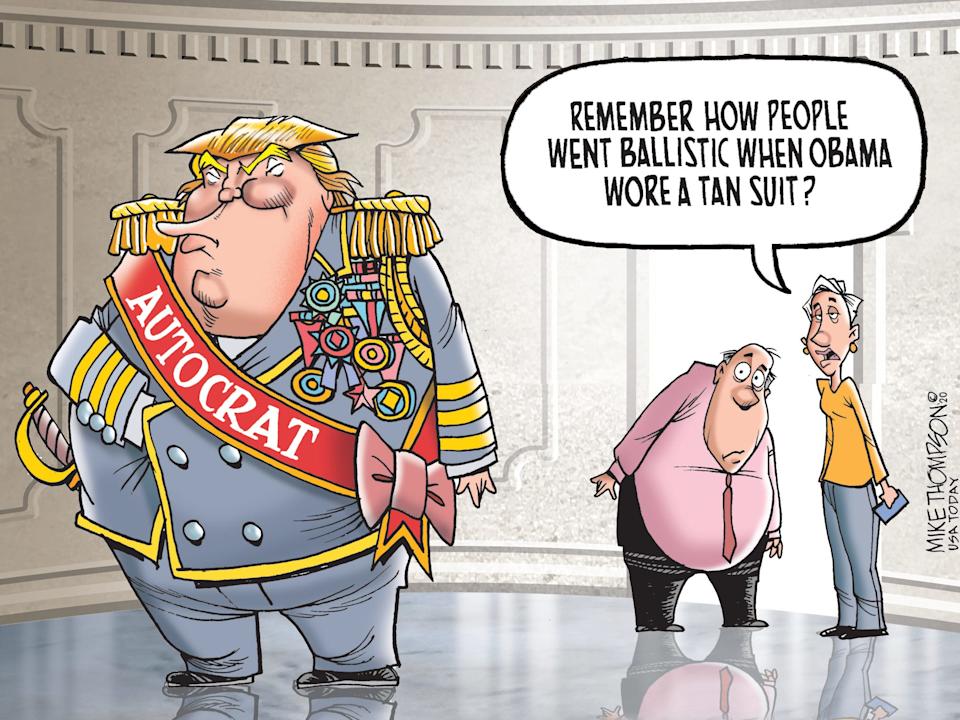
How much longer can our country self-destruct? With President Trump’s dementia (like his father’s) worsening, seemingly every day, the signs of his psychological breakup are more apparent than ever. His endless retributions, his fantasies, his insane desires, his easily apparent ego slights, his more frequent racist policies, and so much more are damaging America’s democratic values and decency. David Brooks explains the historical context of Trump’s increasing breakdown and what it is doing to our country and inevitably, because of our wealth, influence and military power, the rest of the world.–the TBPR editor
Last week Minneapolis’s police chief, Brian O’Hara, said the thing he fears most is the “moment where it all explodes.” I share his worry. If you follow the trajectory of events, it’s pretty clear that we’re headed toward some kind of crackup.
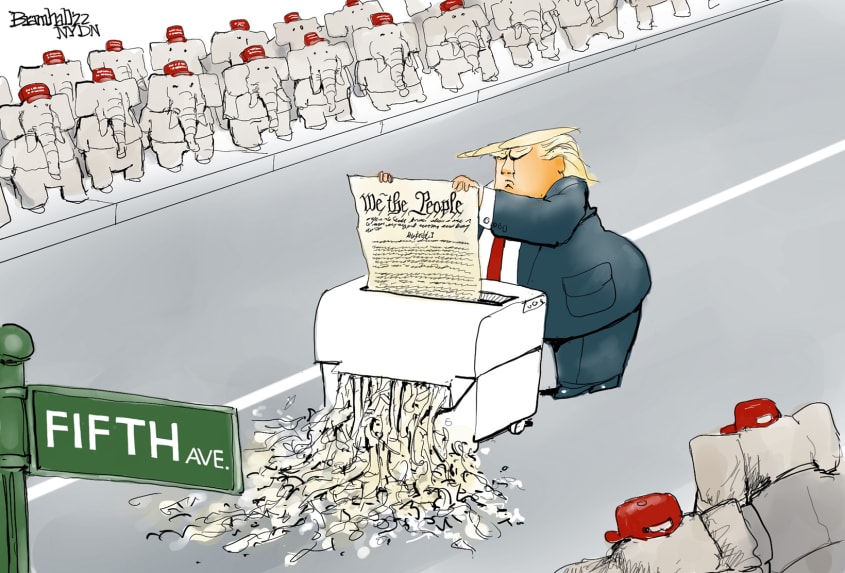
We are in the middle of at least four unravelings: The unraveling of the postwar international order. The unraveling of domestic tranquillity wherever Immigration and Customs Enforcement agents bring down their jackboots. The further unraveling of the democratic order, with attacks on Fed independence and — excuse the pun — trumped-up prosecutions of political opponents. Finally, the unraveling of President Trump’s mind.
Of these four, the unraveling of Trump’s mind is the primary one, leading to all the others. Narcissists sometimes get worse with age, as their remaining inhibitions fall away. The effect is bound to be profound when the narcissist happens to be president of the United States.
Every president I’ve ever covered gets more full of himself the longer he remains in office, and when you start out with Trump-level self-regard, the effect is grandiosity, entitlement, lack of empathy and ferocious overreaction to perceived slights.
Furthermore, over the past year, Trump has been quicker and quicker to resort to violence. In 2025 the U.S. carried out or contributed to 622 overseas bombing missions, killing people in places ranging from Venezuela to Iran, Nigeria and Somalia — not to mention Minneapolis.
The arc of tyranny bends toward degradation. Tyrants generally get drunk on their own power, which progressively reduces restraint, increases entitlement and self-focus and amps up risk taking and overconfidence while escalating social isolation, corruption and defensive paranoia.
I have found it useful these days to go back to the historians of ancient Rome, starting with the originals like Sallust and Tacitus. Those fellows had a front-row look at tyranny, with case studies strewed before them — Nero, Caligula, Commodus, Domitian, Tiberius. They understood the intimate connection between private morals and public order and that when there is a decay of the former, there will be a collapse of the latter.
“Of all our passions and appetites, the love of power is of the most imperious and unsociable nature, since the pride of one man requires the submission of the multitude,” Edward Gibbon wrote in his 1776 classic, “The Decline and Fall of the Roman Empire.” He continued: “In the tumult of civil discord, the laws of society lose their force, and their place is seldom supplied by those of humanity. The ardor of contention, the pride of victory, the despair of success, the memory of past injuries and the fear of future dangers all contribute to inflame the mind and to silence the voice of pity. From such motives almost every page of history has been stained with civil blood.”
The 18th-century English historian Edward Wortley Montagu distinguished between ambition and the lust for domination. Ambition can be a laudable trait, since it can drive people to serve the community in order to win public admiration. The lust for domination, he wrote, is a different passion, a form of selfishness that causes us to “draw every thing to center in ourselves, which we think will enable us to gratify every other passion.”
“The insatiable lust for domination, “he continues, “banishes all the social virtues.” The selfish tyrant attaches himself only to those others who share his selfishness, who are eager to wear the mask of perpetual lying. “His friendship and his enmity will be alike unreal, and easily convertible, if the change will serve his interest.”
Those historians were impressed by how much personal force the old tyrants could generate. The man lusting for power is always active, the center of the show, relentless, vigilant, distrustful, restless when anything stands in his way.
Tacitus was especially good at describing the effect the tyrant has on the people around him. When the tyrant first takes power, there is a “rush into servitude” as great swarms of sycophants suck up to the great man. The flattery must forever escalate and grow more fawning, until every follower’s dignity is shorn away. Then comes what you might call the disappearance of the good, as morally healthy people lie low in order to survive. Meanwhile, the whole society tends to be anesthetized. The relentless flow of appalling events eventually overloads the nervous system; the rising tide of brutality, which once seemed shocking, comes to seem unremarkable.
As the disease of tyranny progresses, citizens may eventually lose the habits of democracy — the art of persuasion and compromise, interpersonal trust, an intolerance for corruption, the spirit of freedom, the ethic of moderation. “It is easier to crush men’s spirits and their enthusiasm than to revive them,” Tacitus wrote. “Indeed, there comes over us an attachment to the very enforced inactivity, and the idleness hated at first is finally loved.”
I don’t have enough imagination to know where the next crackup will come — through perhaps some domestic, criminal or foreign crisis? Though I was struck by a sentence Robert Kagan wrote in an essay on the effects of Trump’s foreign policy in The Atlantic: “Americans are entering the most dangerous world they have known since World War II, one that will make the Cold War look like child’s play and the post-Cold War world like paradise.”
And no, I don’t think America is headed toward anything like a Rome-style collapse. Our institutions are too strong, and our people, deep down, still have the same democratic values.
But I do know that events are being propelled by one man’s damaged psyche. History does not record many cases in which a power-mad leader careening toward tyranny suddenly regained his senses and became more moderate. On the contrary, the normal course of the disease is toward ever-accelerating deterioration and debauchery.
And I do understand why America’s founding fathers spent so much time reading historians like Tacitus and Sallust. Thomas Jefferson called Tacitus “the first writer in the world, without a single exception.” They understood that the lust for power is a primal human impulse and that even all the safeguards they built into the Constitution are no match for this lust when it is not restrained ethically from within.
As John Adams put it in a letter in 1798, “We have no government armed with power capable of contending with human passions unbridled by morality and religion. Avarice, ambition, revenge or gallantry would break the strongest cords of our Constitution as a whale goes through a net.”
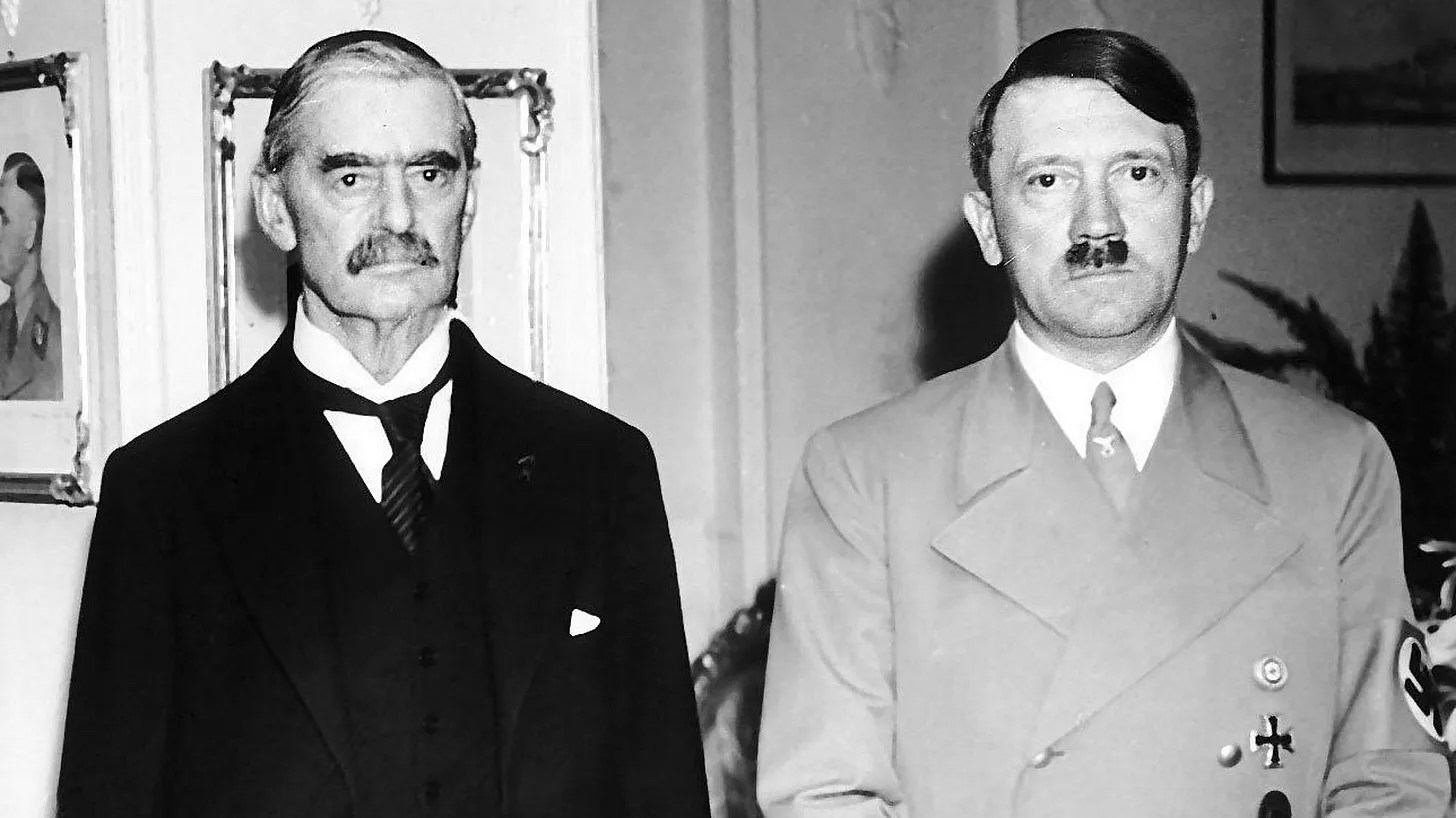
You know this better than most. I need not remind you of Neville Chamberlain’s interactions with Adolf Hitler in 1938. Chamberlain met Hitler three times, culminating in the infamous Munich Agreement, which allowed Germany to annex Czechoslovakia’s Sudetenland in exchange for Hitler’s promise of peace. Returning to London, Chamberlain waved a signed Anglo-German declaration, and famously declared “peace for our time.” Instead, Chamberlain had merely emboldened Hitler’s aggression. Hitler soon broke his promise, leading to World War II.
Today, on his “Truth Social,” Trump reposted a comment saying, “China and Russia are the boogeymen when the real threat is the U.N., NATO and [Islam].”
This is madness.
You struck a trade deal with Trump last year. He is now threatening to rip it up and apply economic coercion and even military force if you do not allow him to annex Greenland. He is also on the brink of allowing Russia to annex part of Ukraine.
Most Americans are as opposed to Trump’s wild and illegal actions as you are. But we have no means of expressing our opposition because Trump’s Republicans control Congress and, in effect, the Supreme Court. You do have means.
I urge you to activate your so-called anti-coercion instrument, colloquially known as the “trade bazooka,” which will block some of America’s access to EU markets or impose export controls, among a broader list of potential countermeasures.
The latest gauge on inflation, released this morning, showed prices increasing 2.7 percent in December compared with the same period a year ago. Food prices were up 3.1 percent. (Reminder: Trump was elected on two issues: bringing prices down, especially food, and avoiding foreign entanglements.)
Today, Trump traveled to Detroit to deliver an address to the Detroit Economic Club. It was about “affordability” and he filled it with lies — such as Americans aren’t paying for his tariffs (of course they are) and inflation was “way, way, down” (it’s about the same as it was when he took office).
And he insisted that “affordability” is a “fake word by Democrats.” Unfortunately for Trump, “affordability” has become even more politically potent than immigration or crime. And in his first year at the helm, he’s made America less affordable.
He’s also been putting forward some ass-backward ideas for bringing down prices that will actually increase them. His biggest: Fire the current chair of the Federal Reserve Board and install a chair who’ll lower interest rates — and thereby, in Trump’s addled brain, bring down the costs of borrowing to buy homes and cars. (In his speech today, he called Fed chair Jerome Powell Powell, a “jerk.”)
Trump’s decision to open up a criminal investigation of Powell is a bizarre escalation of his pressure campaign against the central bank to cut interest rates. And it’s truly ass-backwards. Without an independent Fed committed to using interest rates to fight inflation, everyone who buys or sells or invests will have to assume the risk of runaway prices in the future. The result is a risk “premium” that makes everything more expensive instead of more affordable.
What should be done to make America more affordable? Ten commonsense initiatives:
1. Get rid of Trump’s tariffs
Trump’s blanket, unpredictable, on-again-off-again, gigantic and then sometimes modest tariffs have caused prices to jump on just about everything. That’s because tariffs are import taxes that are paid by the companies that do the importing and by their consumers.
Tariffs can be a tool to create American jobs, but only if they’re used in a targeted and responsible way. Targeted and responsible are two adjectives that no one uses in describing Trump’s tariffs.
The first step to make life more affordable for the average American is to get rid of them.
2. Bust up monopolies
Trump’s overriding goal is to boost share prices. He doesn’t seem to understand that most Americans aren’t directly affected by share prices: Over 90 percent of the value of shares held by Americans is held by the richest 10 percent; over half by the richest 1 percent.
In pursuit of high share prices, Trump has essentially given up on antitrust enforcement. Big corporations are now merging and buying up potential competitors at a rapid rate. But this means less competition, and less competition results in higher prices.
It’s another ass-backward approach to affordability. Trump’s overriding goal of high share prices collides with what should be the real goal: keeping prices low.
A real affordability agenda would bust up big corporations that dominate their industries and prohibit price gouging.
3. Fight for stronger unions
Trump hates unions and has done everything he can do to weaken the National Labor Relations Board and the Labor Department. He’s given free rein to corporate union-busting.
Here again, Trump’s goal of high share prices and corporate profitability is at direct odds with the needs of average workers for higher wages, which are necessary if the goods and services they require are to become more affordable to them.
Workers need more bargaining power to get higher wages. Unions do that. A real affordability agenda therefore would make it easier for workers to start or join them.
4. Raise the national minimum wage
For the same reason Trump believes unions and higher wages are bad for the economy — that is, his definition of the economy, which is the stock market — he’s been dead set against raising the national minimum wage.
But the federal minimum wage has been stuck at a measly $7.25 since 2009. Raise the damn wage. And raise it even higher for employees of big corporations that pay their top executives hundreds of times more than their workers.
5. Pass Medicare For All
Trump has been trying to destroy the Affordable Care Act because it was passed under his predecessor, Barack Obama. His latest gambit has been to block any extension of the subsidies that Americans need to be able to afford health insurance under the ACA. (The fight over this issue resulted in the longest government shutdown in history.)
Without those subsidies, the typical American will be paying 30 to 100 percent more for health insurance this year than last — which is already driving many people out of the ACA marketplace and forcing them to live without health insurance at all.
Extending ACA subsidies is necessary but not sufficient. A real affordability agenda would make Medicare available to all Americans. This will bring down health care costs for everyone, because Medicare is cheaper and more efficient than for-profit health insurance.
6. Make housing more affordable
Last Wednesday, Trump called for a ban on institutional investors buying single-family housing. I suppose it’s nice that he’s finally gotten around to this, but I’ll believe it when he actually signs the legislation.
A real affordability agenda would ban Wall Street firms from buying up housing, crack down on corporate landlords that collude to jack up rent prices, get rid of zoning laws that make it harder to build homes, and increase funding to boost the construction of housing in cities that need it most.
7. Make child care and elder care more affordable
The costs of child care take a third of the incomes of parents with young children, on average. The costs of elder care can be even higher for working people with elderly parents. Both are essential for working families.
An affordability agenda would include a universal child care program for parents and boost funding for caregivers of aging parents.
8. Give Americans paid leave
Here again, the goal of fat corporate profits and high share prices collides with what American workers need. Trump consistently opts for the former and argues that the nation “can’t afford” paid family leave.
Baloney. We’re the richest country in the world. Every other advanced nation provides paid leave. Working Americans need it. We should provide it, too.
9. Stop Big Finance from siphoning off people’s incomes
Trump has deregulated big banks and allowed them to charge up to 30 percent interest on credit cards. (The banks love it because credit cards provide them with four times the return of any other line of business.) Trump has gotten rid of the Consumer Financial Protection Bureau, which stopped other sleazy financial practices. And he’s allowed more consolidation of big financial institutions, which means even less competition, higher prices, and shadier deals. (His Justice Department recently approved the merger of Capital One and Discover, which will pile even more debt on low-income consumers.)
The captains of Wall Street have never had it so good. JPMorgan CEO Jamie Dimon made $770 million last year. But average working people are being shafted.
A real affordability agenda would cap credit card interest rates at 5 percent, stop the banks from charging late fees on unsuspecting consumers (Trump’s OMB director, Russ Vought, withdrew the late fee rule in April), and bust up the biggest banks whose market power is allowing them to charge absurdly high interest rates on all borrowing.
10. Raise taxes on the wealthiest Americans and corporations
Besides tariffs, Trump’s economic policy has cut taxes mainly on wealthy individuals and big corporations. He’s imbibed the “trickle-down” Kool-Aid that assumes tax cuts at the top make everyone better off.
The reality, as we’ve learned since Trump’s first tax cut mostly benefiting the wealthy and big corporations (as we should have learned from Ronald Reagan’s and George W. Bush’s trickle-down tax cuts also mainly benefiting the rich and big corporations) is that nothing trickles down. Trickle-down economics is a cruel sham.
The cumulative effects of all these tax cuts has been to make America’s rich far richer — now owning a record share of the nation’s wealth — and big corporations far more profitable (corporate profits are also near record levels), while dramatically enlarging the national debt.
And what do we get with a bigger debt? More inflation, which makes everything less affordable. Again, Trump has it ass-backward.
It’s time we ended the trickle-down hoax once and for all.
Besides, it’s only fair that the super rich pay more in taxes so that the rest of America can afford what Americans need: housing, health care, child care and elder care.
And by the way, even after paying more in taxes, the rich will still be richer than they’ve ever been, and giant corporations will still be exceedingly profitable.
***
These 10 steps are crucial for making America affordable again. Don’t fall for Trump’s ass-backward agenda, which will only make the rich richer and big corporations more profitable. You and I and everyone who wants to lower the cost of living for Americans should back the real affordability agenda.
Please share this with any Democrat or independent (hell, share it with any Republican) interested in running for office and improving Americans’ standard of living.
Over the past few months, President Trump has deployed an imposing military force in the Caribbean to threaten Venezuela. Until now, the president used that force — an aircraft carrier, at least seven other warships, scores of aircraft and 15,000 U.S. troops — for illegal attacks on small boats that he claimed were ferrying drugs. On Saturday, Mr. Trump dramatically escalated his campaign by capturing President Nicolás Maduro of Venezuela as part of what he called “a large scale strike” against the country.
Few people will feel any sympathy forMr. Maduro. He is undemocratic and repressive, and has destabilized the Western Hemisphere in recent years. The United Nations recently issued a report detailing more than a decade of killings, torture, sexual violence and arbitrary detention by henchmen against his political opponents. He stole Venezuela’s presidential election in 2024. He has fueled economic and political disruption throughout the region by instigating an exodus of nearly eight million migrants.
If there is an overriding lesson of American foreign affairs in the past century, however, it is that attempting to oust even the most deplorable regime can make matters worse. The United States spent 20 years failing to create a stable government in Afghanistan and replaced a dictatorship in Libya with a fractured state. The tragic consequences of the 2003 war in Iraq continue to beset America and the Middle East. Perhaps most relevant, the United States has sporadically destabilized Latin American countries, including Chile, Cuba, Guatemala and Nicaragua, by trying to oust a government through force.
Mr. Trump has not yet offered a coherent explanation for his actions in Venezuela. He is pushing our country toward an international crisis without valid reasons. If Mr. Trump wants to argue otherwise, the Constitution spells out what he must do: Go to Congress. Without congressional approval, his actions violate U.S. law.
The nominal rationale for the administration’s military adventurism is to destroy “narco-terrorists.” Governments throughout history have labeled the leaders of rival nations as terrorists, seeking to justify military incursions as policing operations. The claim is particularly ludicrous in this case, given that Venezuela is not a meaningful producer of fentanyl or the other drugs that have dominated the recent epidemic of overdoses in the United States, and the cocaine that it does produce flows mostly to Europe. While Mr. Trump has been attacking Venezuelan boats, he also pardoned Juan Orlando Hernández, who ran a sprawling drug operation when he was president of Honduras from 2014 to 2022.
A more plausible explanation for the attacks on Venezuela may instead be found in Mr. Trump’s recently released National Security Strategy. It claimed the right to dominate Latin America: “After years of neglect, the United States will reassert and enforce the Monroe Doctrine to restore American pre-eminence in the Western Hemisphere.” In what the document called the “Trump Corollary,” the administration vowed to redeploy forces from around the world to the region, stop traffickers on the high seas, use lethal force against migrants and drug runners and potentially base more U.S. troops around the region.
Venezuela has apparently become the first country subject to this latter-day imperialism, and it represents a dangerous and illegal approach to America’s place in the world. By proceeding without any semblance of international legitimacy, valid legal authority or domestic endorsement, Mr. Trump risks providing justification for authoritarians in China, Russia and elsewhere who want to dominate their own neighbors. More immediately, he threatens to replicate the American hubris that led to the invasion of Iraq in 2003.
As a presidential candidate, Mr. Trump seemed to recognize the problems with military overreach. In 2016, he was the rare Republican politician to call out the folly of President George W. Bush’s Iraq war. In 2024, he said: “I’m not going to start a war. I’m going to stop wars.”
He is now abandoning this principle, and he is doing so illegally. The Constitution requires Congress to approve any act of war. Yes, presidents often push the boundaries of this law. But even Mr. Bush sought and received congressional endorsement for his Iraq invasion, and presidents since Mr. Bush have justified their use of drone attacks against terrorist groups and their supporters with a 2001 law that authorized action after the Sept. 11 attacks. Mr. Trump has not even a fig leaf of legal authority for his attacks on Venezuela.
Congressional debates over military action play a crucial democratic role. They check military adventurism by forcing a president to justify his attack plans to the public and requiring members of Congress to tie their own credibility to those plans. For years after the vote on the Iraq war, Democrats who supported Mr. Bush, including Hillary Clinton and John Kerry, paid a political price, while those who criticized the war, like Bernie Sanders and Barack Obama, came to be seen as prophetic.
In the case of Venezuela, a congressional debate would expose the thinness of Mr. Trump’s rationale. His administration has justified his attacks on the small boats by claiming they pose an immediate threat to the United States. But a wide range of legal and military experts reject the claim, and common sense refutes it, too. An attempt to smuggle drugs into the United States — if, in fact, all the boats were doing so — is not an attempt to overthrow the government or defeat its military.
We suspect Mr. Trump has refused to seek congressional approval for his actions partly because he knows that even some Republicans in Congress are deeply skeptical of the direction in which he is leading this country. Already, Senators Rand Paul and Lisa Murkowski and Representatives Don Bacon and Thomas Massie — Republicans all — have backed legislation that would limit Mr. Trump’s military actions against Venezuela.
A second argument against Mr. Trump’s attacks on Venezuela is that they violate international law. By blowing up the small boats that Mr. Trump says are smuggling drugs, he has killed people based on the mere suspicion that they have committed a crime and given them no chance to defend themselves. The Geneva Conventions of 1949 and every subsequent major human rights treaty prohibit such extrajudicial killings. So does U.S. law.
The administration appears to have killed defenseless people. In one attack, the Navy fired a second strike against a hobbled boat, about 40 minutes after the first attack, killing two sailors who were clinging to the boat’s wreckage and appeared to present no threat. As our colleague David French, a former U.S. Army lawyer, has written, “The thing that separates war from murder is the law.”
The legal arguments against Mr. Trump’s actions are the more important ones, but there is also a cold-eyed realist argument. They are not in America’s national security interest. The closest thing to an encouraging analogy is President George H.W. Bush’s invasion of Panama 36 years ago last month, which drove the dictator Manuel Noriega from power and helped set Panama on a path toward democracy. Yet Venezuela is different in important ways. Panama is a much smaller country, and it was a country where American officials and troops had operated for decades because of the Panama Canal.
The potential for chaos in Venezuela seems much greater. Despite Mr. Maduro’s capture, the generals who have enabled his regime will not suddenly vanish. Nor are they likely to hand power to María Corina Machado, the opposition figure whose movement appears to have won the country’s most recent election and who accepted the Nobel Peace Prize last month.
Among the possible bad outcomes are a surge in violence by the left-wing Colombian military group the ELN, which has a foothold in Venezuela’s western area, or by the paramilitary groups known as “colectivos” that have operated on the periphery of power under the Maduro dictatorship. Further unrest in Venezuela could unsettle global energy and food markets and drive more migrants throughout the hemisphere.
So how should the United States deal with the continuing problem that Venezuela poses to the region and America’s interests? We share the hopes of desperate Venezuelans, some of whom have made a case for intervention. But there are no easy answers. By now, the world should understand the risks of regime change.
We will hold out hope that the current crisis will end less badly than we expect. We fear that the result of Mr. Trump’s adventurism is increased suffering for Venezuelans, rising regional instability and lasting damage for America’s interests around the world. We know that Mr. Trump’s warmongering violates the law.
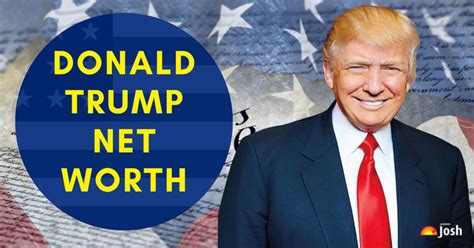
Everyone has an opinion, but Forbes has the answer: $7.3 billion, according to our most recent tally, updated in September. Trump added $3 billion over the last year, leveraging the presidency for profit. His cryptocurrency ventures, stalled out before the election, exploded after his victory, adding an estimated $2 billion to his fortune in 10 months. Another $500 million came in court, where Trump’s legal team succeeded in eliminating a half-billion judgement against him. His once-dormant licensing business surged by another $400 million, as foreign developers clamored to do business with an American president. With most of Trump’s second term remaining, expect billions more to head his way.
There have been many labels describing President Trump: hateful, racist, criminal, ignorant, fascist, abuser of women, greedy, angry, narcissistic, demented, cowardly, self-serving, dictator…the list goes on forever. In this commentary, Robert Reich focuses on one of his worst, but sometimes overlooked traits, his wanton cruelty. In so many ways, the hurt and pain of people–other than perhaps his family. friends, and social and economic class–seem irrelevant and of no interest to him and those around him. Reich supplies the newest evidence.–TBPR editor.
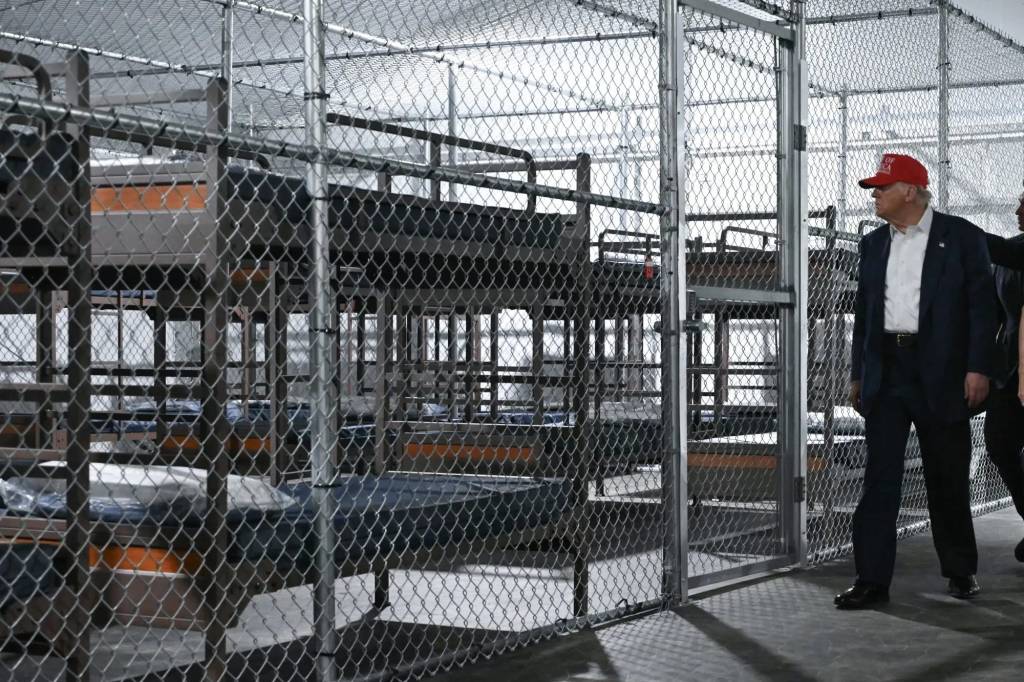
According to today’s Washington Post,the Trump regime plans to renovate industrial warehouses to hold more than 80,000 immigrant detainees at a time.
The plan is for newly arrested detainees to be funneled — let me remind you, with no due process, or independent magistrate or judge checking on whether they are in fact in the United States illegally — into one of seven large-scale warehouses holding 5,000 to 10,000 people each, where they would be “staged” for deportation.
The large warehouses would be located close to major logistics hubs in Virginia, Texas, Louisiana, Arizona, Georgia and Missouri. Sixteen smaller warehouses would hold up to 1,500 people each.
America’s immigrant detention system is already the largest in the world.
With the $45 billion Congress appropriated for locking up immigrants, the regime has revived dormant prisons, repurposed sections of military bases, and partnered with Republican governors to build immigrant tent encampments in remote regions.
“We need to get better at treating this like a business,” ICE acting director Todd M. Lyons said at a border security conference in April, according to the Arizona Mirror. The administration’s goal, he said, was to deport immigrants as efficiently as Amazon moves packages: “Like Prime, but with human beings.”
The logistical problems of converting warehouses into detention camps are significant. Warehouses are designed for storage and shipping of things, not people. They are often poorly ventilated and without precise temperature controls, and they lack access to the plumbing and sanitation systems needed to support thousands of full-time residents.
Beyond logistics is the dehumanization.
Ninety-three years ago, in March 1933, the Nazis established their first concentration camp in what is now Dachau, Poland. Other camps were soon established in Buchenwald and Sachsenhausen.
Initially, the Nazi’s put into these camps Communists, Social Democrats, trade unionists, and others deemed a threat to the Nazi regime.
After the Kristallnacht pogrom of November 9-10, 1938, approximately 30,000 Jewish men were arrested and sent to these camps in a mass, large-scale action that targeted them for being Jewish. The systematic mass murder of Jews in camps designed as extermination camps did not begin until late 1941 and early 1942, as part of the “Final Solution.”
The U.S. began forcibly moving Japanese Americans into America’s own camps in early 1942, following President Roosevelt’s signing of Executive Order 9066 of February 19, 1942, which authorized military exclusion zones. Initial roundups of Japanese Americans, deemed “enemy aliens,” started immediately after Japan’s attack on Pearl Harbor attack on December 7, 1941.
Around 120,000 people of Japanese descent, mostly U.S. citizens from the West Coast, were incarcerated in ten camps in remote inland states and temporary Assembly Centers. Hundreds more were imprisoned in Hawaii.
Once dehumanization begins, it’s hard to end.
As I noted, ICE is arresting, imprisoning, and deporting people it accuses of being in the United States illegally — but there is no due process, no third-party validation of ICE’s accusations.
ICE now holds more than 68,000 people in detention facilities, according to agency data. Nearly half — 48 percent — have no criminal convictions or pending criminal charges, ICE data shows.
ICE’s biggest current facility is a tent encampment at the Fort Bliss U.S. Army base in Texas, which now holds around 3,000 people but was expected to have a capacity of 5,000 by year’s end.
The largest proposed ICE warehouse would hold up to 10,000 detainees in Stafford, Virginia. Another with capacity for up to 9,500 is planned for Hutchins, near Dallas. A third, with space for 9,000, in Hammond, east of Baton Rouge.
There is no place in a civilized society for the warehousing of people.
There is no justification in a society putatively organized under the rule of law to imprison people without due process.
There is no decency in removing hardworking members of our communities from their families and neighbors and imprisoning them and then deporting them to other countries, some of which are brutal dictatorships.
When the history of this cruel era is written, the shame should be no less than the shame we now feel about the roundups and detention of Japanese Americans in World War II.
Hopefully, the dehumanization of the people that the Trump regime aims to warehouse will not result in the sadistic cruelties of the Nazi’s starting ninety-three years ago.


 thebigpicturereport ™