BPR Quote of the Day: Suppose They Gave a War…..

 “Patriotism is the willingness to kill and be killed for trivial reasons.”

Bertrand Russell

Posted in military, Quotations, war | Tagged , | Leave a comment

Oil Speculation and the Price of Gas

With gas prices soaring of late, this seems like a good time to re-post an article I wrote last summer about the reasons for fluctuation in the price of oil. I’ve added some additional material at the bottom of this post…..

Why You Are Going Broke Filling Up Your Car

by Arlen Grossman/ The Big Picture Report/ August 24, 2011

“There has been a major debate over the last several years as to whether spikes in oil prices are caused by the fundamentals of supply and demand or whether excessive speculation in the oil futures market is playing a major role…It seems to me that debate has finally ended. We now know that excessive oil speculation is a major reason why oil prices have risen so sharply.”

Senator Bernie Sanders (I-VT)  in a letter to Gery Gensler, the Chairman of the Commodity Futures Trading Commission, August 22, 2011

If you have wondered what causes gas prices to go up and down (more often up than down) you are not alone. Americans have been digging deeper into their wallets to keep the fuel tanks of their vehicles full, and wondering about the daily fluctulations in gas prices.

After all, why is the price for gasoline almost a dollar more per gallon than it was two years ago when oil supplies were lower and demand was higher?

The answer is now clearer than ever.

Senator Bernie Sanders released secret information compiled from the Commodity Futures Trading Commission (CFTC) shedding light on the major role that financial speculators–the same ones that brought on the  meltdown of our economy in 2007-2008–play in determining how much you are paying at the gas pumps.

According to Senator Sanders, “This report clearly shows that in the summer of 2008 when gas prices spiked to more than $4 a gallon, Goldman Sachs, Morgan Stanley, and other speculators on Wall Street dominated the crude oil futures market causing tremendous damage to the entire economy, The CFTC has kept this information hidden from the American public for nearly three years. That is an outrage.”  He  believes these speculators “are playing the same games in 2011.”  Statement by Senator Sanders

Senator Maria Cantwell (D-WA), during a Senate Finance Committee hearing last May, pointed out that the oil futures market was set up to moderate the price and risk of petroleum for those who use it, but at this time “70 percent of the market being driven by speculators that are not the end-takers of any product.” Senator Cantwell Press Release


Senator Sanders introduced the “End Excessive Oil Speculation Now Act of 2011”  (S . 1200) last June that would require the CFTC chairman to impose strict limits on the trading of oil speculators.

In his August 22 letter to CFTC Chairman Gensler, Senator Sanders urged the chairman to convene an emergency meeting of the CFTC “to impose strong position limits that would eliminate excessive oil speculation as soon as possible.”

The Dodd-Frank Wall Street reform law enacted last year required the CFTC to impose strict  limits on oil speculators by January 17, 2011. The CFTC is “breaking the law” by not doing so, Senator Sanders wrote to Gensler.   Letter to CFTC Commissioner

The Commission claims it lacks enough information. Senator Sander, despite three years of collecting data. Senator Sanders called their excuses “laughable.”

“The American people have a right to know exactly who caused gas prices to skyrocket in 2008 and who is causing them to spike today.”  Reuters article

                                            Senators  Cantwell and Sanders
 
POSTED IN OPEDNEWS.COM 08/26/2011

Addendum:

According to a Seattle Times story from April 17, 2011,

About 64 cents a gallon can be attributed to overspeculation, according to an analysis by Cantwell’s staff and a CFTC commissioner, Bart Chilton.

At the time, gas prices in Seattle were averaging $3.93 a gallon.

And from CNN Money (10/14/2011):

“Speculation will add $600 to the average household expenditures on gasoline in 2011,” a report released Thursday by the Consumer Federation of America said, “resulting in the highest level of spending ever of almost $2,900.

 
Posted in economy | Tagged , , , , , , , , , , , | Leave a comment

The Advantages of Being in the Final Four (of Big Banks)

In researching some bank-related questions for my friend edray, I came across some fascinating information from a ThinkProgress.org article last October…..

11 Facts You Need to Know About the Nation’s Biggest Banks

by Pat Garofalo/ ThinkProgress/ October 7, 2012

AP090507014372

The Occupy Wall Street protests that began in New York City more than three weeks ago have nowspread across the country. The choice of Wall Street as the focal point for the protests — as even Federal Reserve Chairman Ben Bernanke said — makes sense due to the big bank malfeasance that led to the Great Recession.

While the Dodd-Frank financial reform law did a lot to ensure that a repeat of the 2008 financial crisis won’t occur — through regulation of derivatives, a new consumer protection agency, and new powers for the government to dismantle failing banks — the biggest banks still have a firm grip on the financial system, even more so than before the 2008 financial crisis. Here are eleven facts that you need to know about the nation’s biggest banks:

– Bank profits are highest since before the recession…: According to the Federal Deposit Insurance Corp., bank profits in the first quarter of this year were “the best for the industry since the $36.8 billion earned in the second quarter of 2007.” JP Morgan Chase is currently pulling in record profits.

– …even as the banks plan thousands of layoffs: Banks, including Bank of America, Barclays, Goldman Sachs, and Credit Suisse, are planning to lay off tens of thousands of workers.

– Banks make nearly one-third of total corporate profits: The financial sector accounts for about 30 percent of total corporate profits, which is actually downfrom before the financial crisis, when they made closer to 40 percent.

– Since 2008, the biggest banks have gotten bigger: Due to the failure of small competitors and mergers facilitated during the 2008 crisis, the nation’s biggest banks — including Bank of America, JP Morgan Chase, and Wells Fargo — are now bigger than they were pre-recession. Pre-crisis, the four biggest banks held 32 percent of total deposits; now they hold nearly 40 percent.

– The four biggest banks issue 50 percent of mortgages and 66 percent of credit cards: Bank of America, JP Morgan Chase, Wells Fargo and Citigroup issue one out of every two mortgages and nearly two out of every three credit cards in America.

– The 10 biggest banks hold 60 percent of bank assets: In the 1980s, the 10 biggest banks controlled 22 percent of total bank assets. Today, they control 60 percent.

– The six biggest banks hold assets equal to 63 percent of the country’s GDP: In 1995, the six biggest banks in the country held assets equal to about 17 percent of the country’s Gross Domestic Product. Now their assets equal 63 percent of GDP.

– The five biggest banks hold 95 percent of derivatives: Nearly the entire market in derivatives — the credit instruments that helped blow up some of the nation’s biggest banks as well as mega-insurer AIG — is dominated by just five firms: JP Morgan Chase, Goldman Sachs, Bank of America, Citibank, and Wells Fargo.

– Banks cost households nearly $20 trillion in wealth: Almost $20 trillion in wealth was destroyed by the Great Recession, and total family wealth is still down “$12.8 trillion (in 2011 dollars) from June 2007 — its last peak.”

– Big banks don’t lend to small businesses: The New Rules Project notes that the country’s 20 biggest banks “devote only 18 percent of their commercial loan portfolios to small business.”

– Big banks paid 5,000 bonuses of at least $1 million in 2008: According to the New York Attorney General’s office, “nine of the financial firms that were among the largest recipients of federal bailout money paid about 5,000 of their traders and bankers bonuses of more than $1 million apiece for 2008.”

In the last few decades, regulations on the biggest banks have been systematically eliminated, while those banks engineered more and more ways to both rip off customers and turn ever-more complex trading instruments into ever-higher profits. It makes perfect sense, then, that a movement calling for an economy that works for everyone would center its efforts on an industry that exemplifies the opposite.

Posted in Economics, economy, Occupy Wall Street | Tagged , , , , , , | Leave a comment

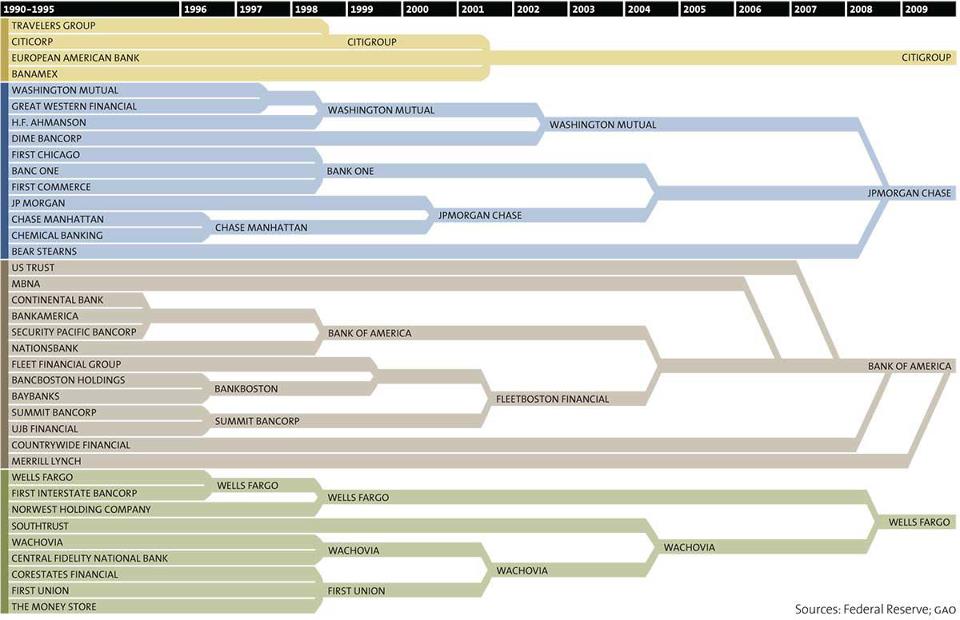
The Final Four Brackets: Big Banks

from Too Big to Fail/ Mother Jones
Posted in Economics, economy | Tagged , , , , , , | 1 Comment

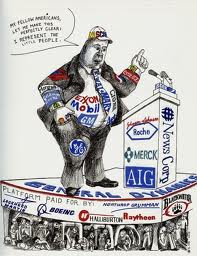
BPR Quote of the Day: Corporations Are Out of Control, My Friend

“There can be no effective control of corporations while their political activity remains. To put an end to it will be neither a short nor an easy task, but it can be done.”

President Theodore Roosevelt


President Theodore Roosevelt’s 1910 “New Nationalism” speech in Osawatomie, Kansas, has been described as one of the early cornerstones of 20th-century progressivism. Last December, President Obama went there to honor TR and to deliver a major economic address in which he set out a number of his administration’s progressive policy goals.

Posted in Economics, economy, government, inequality, politics | Tagged , , , , , | Leave a comment

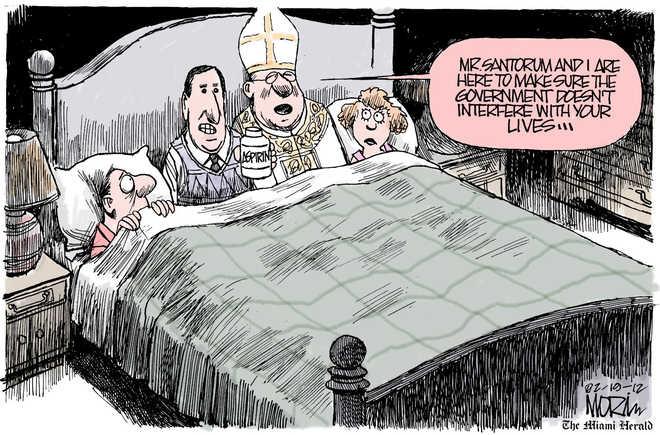
Separation of Church and State….Except in the Bedroom

Posted in civil liberties, religion | Tagged , , , | 3 Comments

Robert Reich: Where Are the Good Jobs?

Manufacturing Illusions

by Robert Reich,  Feb. 17, 2012

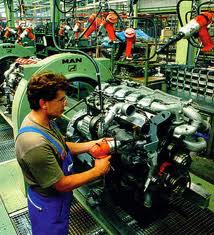
Suddenly, manufacturing is back – at least on the election trail. But don’t be fooled. The real issue isn’t how to get manufacturing back. It’s how to get good jobs and good wages back. They aren’t at all the same thing.

Republicans have become born-again champions of American manufacturing. This may have something to do with crucial primaries occurring next week in Michigan and the following week in Ohio, both of them former arsenals of American manufacturing.

Mitt Romney says he’ll “work to bring manufacturing back” to America by being tough on China, which he describes as “stealing jobs” by keeping value of its currency artificially low and thereby making its exports cheaper.

Rick Santorum promises to “fight for American manufacturing” by eliminating corporate income taxes on manufacturers and allowing corporations to bring their foreign profits back to American tax free as long as they use the money to build new factories.

President Obama has also been pushing a manufacturing agenda. Last month the President unveiled a six-point plan to eliminate tax incentives for companies to move offshore and create new lures for them to bring jobs home. “Our goal,” he says, is to “create opportunities for hard-working Americans to start making stuff again.”

Meanwhile, American consumers’ pent-up demand for appliances, cars, and trucks have created a small boomlet in American manufacturing – setting off a wave of hope, mixed with nostalgic patriotism, that American manufacturing could be coming back. Clint Eastwood’s Super Bowl “Halftime in America” hit the mood exactly.

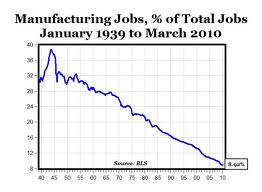
But American manufacturing won’t be coming back. Although 404,000 manufacturing jobs have been added since January 2010, that still leaves us with 5.5 million fewer factory jobs today than in July 2000 – and 12 million fewer than in 1990. The long-term trend is fewer and fewer factory jobs.

Even if we didn’t have to compete with lower-wage workers overseas, we’d still have fewer factory jobs because the old assembly line has been replaced by numerically-controlled machine tools and robotics. Manufacturing is going high-tech.

Bringing back American manufacturing isn’t the real challenge, anyway. It’s creating good jobs for the majority of Americans who lack four-year college degrees.

Manufacturing used to supply lots of these kind of jobs, but that was only because factory workers were represented by unions powerful enough to get high wages.

That’s no longer the case. Even the once-mighty United Auto Workers has been forced to accept pay packages for new hires at the Big Three that provide half what new hires got a decade ago. At $14 an hour, new auto workers earn about the same as most of America’s service-sector workers.

GM just announced record profits but its new workers won’t be getting much of a share.
In the 1950s, more than a third of American workers were represented by a union. Now, fewer than 7 percent of private-sector workers have a union behind them. If there’s a single reason why the median wage has dropped dramatically for non-college workers over the past three and a half decades, it’s the decline of unions.

How do the candidates stand on unions? Mitt Romney has done nothing but bash them. He vows to pass so-called “right to work” legislation barring job requirements of union membership and payment of union dues. “I’ve taken on union bosses before, ” he says,” and I’m happy to take them on again.” When Romney’s not blaming China for American manufacturers’ competitive problems he blames high union wages. Romney accuses the President of “stacking” the National Labor Relations Board with “union stooges.”

Rick Santorum says he’s supportive of private-sector unions. While in the Senate he voted against a national right to work law (Romney is now attacking him on this) but Santorum isn’t interested in strengthening unions, and he doesn’t like them in the public sector.

President Obama praises “unionized plants” – such as Master Lock, the Milwaukee maker of padlocks he visited last week, which brought back one hundred jobs from China. But the President has not promised that if reelected he’d push for the Employee Free Choice Act, which would make it easier for workers to organize a union. He had supported it in the 2008 election but never moved the legislation once elected.

The President has also been noticeably silent on the labor struggles that have been roiling the Midwest – from Wisconsin’s assault on the bargaining rights of public employees, through Indiana’s recently-enacted right to work law – the first in the rust belt.

The fact is, American corporations – both manufacturing and services – are doing wonderfully well. Their third quarter profits (the latest data available) totaled $2 trillion. That’s 19 percent higher than the pre-recession peak five years ago.

But American workers aren’t sharing in this bounty. Although jobs are slowly returning, wages continue to drop, adjusted for inflation. Of every dollar of income earned in the United States in the third quarter, just 44 cents went to workers’ wages and salaries — the smallest share since the government began keeping track in 1947.

The fundamental problem isn’t the decline of American manufacturing, and reviving manufacturing won’t solve it. The problem is the declining power of American workers to share in the gains of the American economy.

from RobertReich.org

Boldface added by BPR editor
Posted in Barack Obama, economy, labor, Republican Party | Tagged , , , , , , , , , | Leave a comment

BPR Quote of the Day: Uterus-Size Government


“Texas is going to shrink government until it fits in a woman’s uterus.” 

State Sen. Leticia Van de Putte (D-San Antonio) in Feb. 2011 debating a Texas law that would force women  to obtain a sonogram and listen to fetal heartbeat sounds, as well as wait 24 hours before being able to obtain an abortion. The bill went into effect last month.

Posted in government, law, Quotations | Tagged , , | Leave a comment

Lesser of Two Evils

Posted in elections, humor, politics | Tagged | Leave a comment

Is Iran the Next Iraq?

My letter-to-the-Editor published in today’s Monterey County Herald:

Why the near-hysteria over the possibility that Iran might build its first nuclear weapon? Iran appears to be our newest “imminent threat,” now that we’ve disposed of Saddam Hussein, Osama bin Laden and Muammar Gaddafi.
 
How dangerous is Iran? The United States and Russia have thousands of nuclear weapons. At least seven other countries, including Israel, havetheir own stockpiles. So why are these countries allowed to have nukes, but Iran, surrounded by hostile neighbors already possessing such weapons, isn’t? Surely Iran knows it would be suicidal for it to use a nuke against Israel or anyone else.
 
So why the urgency to attack Iran ? Most likely it comes from those who might  benefit from another Middle East  war: defense contractors, the news networks, the Pentagon, hawkish politicians, oil companies, etc. There’s plenty of frightening talk about Iran’s threat to us and the world, but just like with Iraq, Afghanistan, and Libya, the evidence is lacking.
 

Posted in Afghanistan, foreign policy, Iran, Iraq, Israel, media, military, war | Tagged , , , , , , , | Leave a comment