
BPR Quote of the Day
“Men fight for liberty and win it with hard knocks. Their children, brought up easy, let it slip away again, poor fools. And their grandchildren are once more slaves.”
D.H. Lawrence
Studies in Classic American Literature, 1922
BPR Quote of the Day
“Men fight for liberty and win it with hard knocks. Their children, brought up easy, let it slip away again, poor fools. And their grandchildren are once more slaves.”
D.H. Lawrence
Studies in Classic American Literature, 1922
This song by Roger Waters is from Pink Floyd’s 1979 double album, “The Wall.”
by Arlen Grossman
“Why Can’t Obama Bring Wall Street to Justice?” ask Peter Boyer and Peter Schweizer in Newsweek this week. It’s a question a lot of Americans are asking, but the answers so far have been less than satisfying.
“It’s perplexing at best, it’s deeply troubling at worst,” complains Phil Angelides, a former California treasurer who chaired Congress’s Financial Crisis Inquiry Commission. The FCIC reported that reckless Wall Street firms and weak federal regulators were to blame for the 2008 financial crisis. But we have yet to see any prosecutions of high-ranking financial executives.
In reality, the lack of accountability and prosecution is not perplexing at all. It’s all very predictable. The important fact to understand is that the biggest contributors to Obama’s 2008 presidential campaign were financial firms. Wall Street gave him $16 million compared to $9 million for his Republican rival. Goldman Sachs executives alone donated $1 million to Obama’s campaign.

That turned out to be a great investment for the Big Banks. Instead of having to face a tough Attorney General, their quid pro quo was the nomination of corporate lawyer Eric Holder, who spent ten years at the Covington & Burling, a law firm whose clients happen to include Goldman Sachs, Bank of America, Citigroup and all the other major financial institutions. Not surprisingly, Holder went after Wall Street with the vengeance of a toothless chihuhua. By the time he finished spitting them out, Obama’s Justice Department had racked up a total of zero criminal charges against the major banks.
That compares with the thousand or so prosecutions (90 percent ending in convictions) resulting from the Savings and Loan scandals in the 1980s. One of the government regulators back them was William Black, now a professor at the University of Missouri. Newsweek quotes Black as saying the difference between then and now is a matter of will and priorities. President Obama has talked tough, but has failed to deliver.
“There hasn’t been any serious investigation of any of the large financial entities by the Justice Department” notes Black. Financial-fraud prosecutions are down 39 percent since 2003 under both the Bush and Obama Justice Departments. Professor Black also points to the revolving-door between the Justice Department and law firms representing Wall Street. “Everybody knows there is a problem with that.”
Three different government investigations led to Justice Department referrals for possible criminal investigation that so far have led nowhere. A Newsweek inquiry determined that, in the weeks prior to and after a scathing 2011 Senate committee report formally recommended a criminal inquiry into suspicious Goldman Sachs transactions, several company executives, some donating for the first time, made maximum-limit contributions to the President’s re-election campaign. For Goldman Sachs, it was one more investment that paid excellent dividends, i.e. no prosecution.
Attorney General Holder has tried to explain that as bad as Wall Street’s behavior has been, proving that they’ve broken laws is not an easy task. But Professor Black posits a number of possible federal charges: “securities fraud for false disclosures, wire and mail fraud for making false representations about the quality of the loans and derivatives they were selling, bank fraud for false representations to the regulators.” But to make them stick would require a strong prosecutor and an administration willing to go to battle. So far, neither one has showed up.

A New York Times article quotes David A. Skeel, a law professor at the University of Pennsylvania: “If you look at the last couple of years and say, ‘This is the big-ticket prosecution that came out of the crisis,’ you realize we haven’t gotten very much.” Many Americans worried that different rules would be applied to this financial crisis, and that appears to be the case. “It goes to the whole perception that Wall Street was taken care of, and Main Street was not.”
In spite of the kid glove treatment from the Obama Administration, Wall Street looks forward to even better treatment from a Romney administration and has poured money into the Republican’s campaign at Obama’s expense. Apparently the President’s occasional scoldings and minor rule changes annoy the bankers enough to drive them into his rival’s camp. Any fears of major prosecutions have apparently dissipated, leaving the banksters confident that even more goodies will be forthcoming from their traditional GOP allies.
The world of Big Finance continues its high-flying lifestyle and powerful grip on the eager politicians eyeing the bottomless supply of contributions that Wall Street is happy to provide. It’s a win-win for the banksters and politicians, while the rest of America waits impatiently for their so-far elusive economic recovery.
BPR Quote of the Day
“One should respect public opinion insofar as is necessary to avoid starvation and keep out of prison, but anything that goes beyond this is voluntary submission to an unnecessary tyranny, and is likely to interfere with happiness in all kinds of ways.”
Bertrand Russell
by Danny Schechter/ Huffington Post/ May 7, 2012
I keep thinking of that clear April night 100 years ago when the unsinkable HMS Titanic steamed towards New York. It was actually on its way to dock just a few blocks from where I live at what are now the Chelsea Piers. There was a sense of optimism abroad as a new record for a speedy transatlantic passage was about to be set.
There was music, dancing and fine wine. That is, until they saw that iceberg high in the water. The Captain and his mates were aware that 80 percent of it was underwater and out of sight.
They didn’t react in time.
Everyone knows the story — most recently recreated in 3-D — but the lesson is really not just about that great ship that went down, or even the company that bypassed safety regulations, or even the hubris of the owners whose greed sent so many passengers to that legendary “watery grave.”
It was also about not seeing the dangers in front of us.
That’s the real story of this moment in our political lives, as the 2012 elections begin in earnest, and we ignore, to our detriment, that vast iceberg of money, stacked in the billions, that threatens to sink what’s left of our democracy.
It is hard to wrap your head around the scale and immediacy of this danger.
And it’s not just about the Citizens United decision of the Supreme Court. It’s about the way Democrats think and Republicans act. It’s about the growing way money has been allowed to dominate politics in a game both parties play.
It is an outgrowth of our vast economic inequality and the policies that promoted it. It’s about State laws limiting the franchise in the name of fighting voter fraud with so-called Voter ID laws, and ordinary Americans becoming so tired of electoral lies and the arrogance of power that they don’t vote.
Mary Boyle, a vice president of Common Cause is concerned about that, telling me:
One of the dangers, particularly around this campaign, is you read these headlines from people who aren’t really engaged in politics. You just read headlines about ‘Super PACS raking in millions of dollars’ or ‘outside groups spending ten million dollars on negative ads.’ And for a lot of Americans that’s just kind of background noise that makes them go, ‘Uh, they’re at it again.’ And it does make people cynical. It makes them tune out an that is a huge concern because then that leads to people not voting and that’s a bad thing.
This information overload is a product of a media ecology that tunes us out and a news business that avoids truth at all costs. It’s about analysis that leads to paralysis and cynicism that allows political manipulators to prevail in league with a media system that simplifies, scandalizes and spins news to advance partisan agendas.
I recently sat in a lecture at the New School on “The Anatomy Of Campaign Finance,”
featuring two experts, Professor Jacob Hacker of Yale and journalist Joe Hagan who writes for New York Magazine and described what he saw in Karl Rove’s living room.
They painted a picture of a vast organizational imbalance between the parties.
The lectures took place on May Day just as the impressive citizen “armies” of Occupy Wall Street were leaving Union Square for the trek to Wall Street
Obama’s funding base is not, said Hacker, even comparable to the treasure chest that Rove has mobilized.
One factor: The Bush Tax cuts have permitted the right to amass a major war chest, in part, because the average Republican leaning millionaire became $300,000 to $500,000 richer, 53 percent of all after tax gains went to the rich, the top 10 percent of 1 percent. Sixty percent of corporate money comes from the finance sector.
The beneficiaries of this transfer of wealth to the top understood that their windfall came about through politics, and, to keep it, they have to invest more in politics. Says Hacker, “Everyone can vote but not everyone can donate. Money changes the relationship between the politicians and donors Money has a ‘distortion effect; on what politicians focus on.”
This is why the former Obama Chief of Staff, and now Chicago Mayor Rahm Emanuel said famously, you need three things to win in politics; Money, Money and Money. (Continued Here)

Justices Scalia, Thomas, Roberts, Alito and Kennedy might not agree……
BPR Quote of the Day
“We lost fifteen men killed outright. ..The enemy numbered six hundred, including women and children — and we abolished them utterly, leaving not even a baby alive to cry for its dead mother. This is incomparably the greatest victory that was ever achieved by the Christian soldiers of the United States.”
Mark Twain
on an incident in the Philippine-American War
THE WAR PRAYER….
In 1904, disgusted by the aftermath of the Spanish-American War and the subsequent Philippine-American War, Mark Twain wrote a short anti-war prose poem called “The War Prayer.” His family begged him not to publish it, his friends advised him to bury it, and his publisher rejected it, thinking it too inflammatory for the times. Twain agreed, but instructed that it be published after his death, saying famously:
None but the dead are permitted to tell the truth.
“The War Prayer” was eventually published after World War I, when its message was more in tune with the times.
by Steven Benen, Washington Monthly
WarPrayer.org (the words)

In the wake of Osama bin Laden’s summary execution one year ago, many predicted that the War on Terror would finally begin to recede. Here’s what has happened since then:
*With large bipartisan majorities, Congress renewed the once-controversial Patriot Act without a single reform, and it was signed into law by President Obama; Harry Reid accused those urging reforms of putting the country at risk of a Terrorist attack.
* For the first time, perhaps ever, a U.S. citizen was assassinated by the CIA, on orders from the President, without a shred of due process and far from any battlefield; two weeks later, his 16-year-old American son was also killed by his own government; the U.S. Attorney General then gave a speech claiming the President has the power to target U.S. citizens for death based on
* With large bipartisan majorities, Congress enacted, and the President signed, a new law codifying presidential powers of worldwide indefinite detention and an expanded statutory defintion of the War on Terror.
* Construction neared completion for a sprawling new site in Utah for the National Security Agency to enable massive domestic surveillance and to achieve “the realization of the ‘total information awareness’ program created during the first term of the Bush administration.”
* President Obama authorized the use of “signature” drone strikes in Yemen, whereby the CIA can target people for death “even when the identity of those who could be killed is not known.”
* The U.S. formally expanded its drone attacks in Somalia, “reopening a base for the unmanned aircraft on the island nation of Seychelles.”
* A U.S. drone killed 16-year-old Pakistani Tariq Aziz, along with his 12-year-old cousin, Waheed, three days after the older boy attended a meeting to protest civilian deaths from U.S. drones (another of Tariq’s cousins had been killed in 2010).
* NATO airstrikes continued to extinguish the lives of Afghan children; in just the last 24 hours, 5 more Afghan children were killed by the ongoing war.
* The FBI increased its aggressive attempts to recruit young Muslim-American males into Terror plots which the FBI concocts, funds, encourages, directs and enables, while prosecuting more and more Muslims in the U.S. for crimes grounded in their political views and speech.
Does it sound like the War on Terror and its accompanying civil liberties erosions are ending, or going in the opposite direction? The morning after the bin Laden killing, I wrote that the killing of bin Laden would likely re-ignite American excitement over militarism and would thus likely further fuel, rather than retard, the War and its various implications. As always: combatting Terrorism is not the end of the War on Terror; the War on Terror is the end in itself, and Terrorism is merely its pretext.
by Arlen Grossman
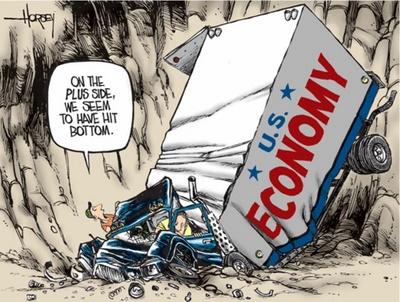
Newsweek’s America: “Like the world’s first bionic man, the U.S. economy has come back—better, stronger, and faster than most analysts expected, and than most of its peers. In fact, the lows of March 2009 marked the beginning of an unexpected recovery—not the beginning of an era of irreversible stagnation…The stock market has doubled since March 2009, while corporate profits and exports have surged to records. The U.S. economy has regained its 2007 peak, and is now growing at a 3 percent annual clip—a more rapid pace than any other developed economy.”
Reich’s America: “The Dow Jones Industrial Average hit 13,338 Tuesday, its highest since December, 2007. The S&P 500 added 16 points. Wall Street will remember May 1 as a great day. But most of these gains are going to the richest 10 percent of Americans who own 90 percent of the shares traded on Wall Street. And the lion’s share of the gains are going to the wealthiest 1 percent.”
Newsweek’s America: “It took the U.S. just 18 months to conduct the aggressive fiscal and monetary actions that Japan waited 12 years to carry out after its credit bubble burst. But America’s recovery since then has been fueled by a resilient and nimble private sector. Rather than sit around and wait for salvation, U.S. companies quickly moved to restructure operations and debt.”
Reich’s America: “Shares are up because corporate profits are up, and profits are up largely because companies have figured out how to do more with less.”
Newsweek’s America: “Rather than sink deeper into a financial morass, the American private sector emerged better: better equipped to meet obligations, to save, to invest, to spend, and, ultimately, to grow …And rather than throw in the towel and surrender to Chinese competitors, U.S. companies figured out how to get more out of existing resources….From the fourth quarter of 2008 to the fourth quarter of 2009, productivity rose 5.4 percent. And it rose an impressive 4.1 percent in 2010.”
Reich’s America: “One of the most striking legacies of the Great Recession has been the decline of full-time employment – as companies have substituted software or outsourced jobs abroad (courtesy of the Internet, making outsourcing more efficient than ever), or shifted them to contract workers also linked via Internet and software. That’s why most of the gains from the productivity revolution are going to the owners of capital, while typical workers are either unemployed or underemployed, or else getting wages and benefits whose real value continues to drop.”
Newsweek’s America: “For U.S. companies, focusing on efficiency and productivity has been the equivalent of a runner strengthening her core. But companies now run farther and faster because of their ability to engage external forces. Declinists believe that the structural forces transforming the global economy are arrayed against us. But in fact, many of them work in America’s favor. The U.S. remains the largest, richest, most secure market in the world, full of valuable resources.”
Reich’s America: “{Owners of capital are} now advocating austerity economics, on the false basis that cuts in public spending – including education, infrastructure, and safety nets – will generate more “confidence” and “certainty” among lenders and investors, and also lead to more jobs and better wages. None of this is sustainable, economically or socially.”
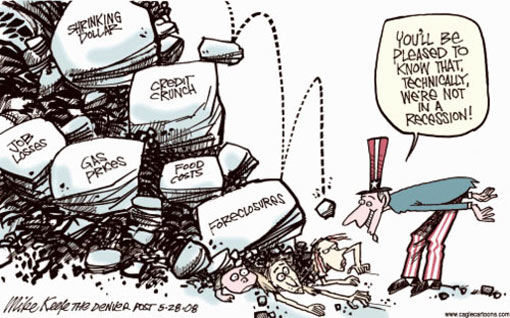
Newsweek’s America: “The U.S. is losing primacy in geopolitics, but it remains the indispensable economic nation. The systems that American companies have invented are being put to vital use.”
Reich’s America: “{Austerity measures are} not sustainable economically because it has resulted in chronically inadequate demand for goods and services. That’s meant anemic growth punctuated by recessions. Without a larger share of the economic gains, the vast middle class doesn’t have the purchasing power to buy the goods and services an ever-more productive economy can generate.”
Newsweek’s America: “It’s easy to look at the record of the past few years and despair. The U.S. has a very long way to go to make up for lost ground in housing and, especially, in jobs. The resurgence of the corporate sector, which provides ample reason for optimism, hasn’t translated into new positions for the legions of unemployed. But here, too, there’s positive news. Since February 2010, the private sector… has added nearly 4.1 million jobs, or about 160,000 per month. That’s not sufficient, but it’s a sign that the jobs machine is clearly working again.”
Reich’s America: “The Commerce Department reports that the economy as a whole has slowed from the last quarter of 2011 when it was expanding at an annual rate of 3 percent, to 2.2 percent for the first quarter of this year. And last month’s unemployment report showing only 120,000 new jobs in March was downright alarming… In Europe and America, 30 to 50 percent of recent college graduates are unemployed or underemployed.”
Newsweek’s America: “In the months since the Lehman debacle, the U.S. has no more lost its ability to grow and innovate than reality-TV producers have lost their ability to coax skanky behavior out of New Jersey’s youth. And despite all the headwinds, there’s no reason the expansion that started in July 2009 can’t go on as long as the previous three, which lasted 73 months, 120 months, and 92 months, respectively. When the definitive history of this period is written, it is possible—no, likely—that this post-bust era will go down not as a time of economic decline, but as one of regeneration.”
Reich’s America: “Absent real wage gains, that spending pace can’t possibly continue. Consumer savings are down and their debt is up. Consumer confidence dropped last week to a two-month low. The only people left spending are in the top 5 percent, whose stock portfolios have been doing so well they feel even richer. But the top 5 percent can’t pull the entire economy out of the doldrums. Besides, if demand continues to slide the stock market will follow.”
A furious Senator Ted Kennedy goes on the floor of the Senate in January 2007 to berate Republicans for filibustering a vote on raising the minimum wage (unchanged for ten years) from $5.15 to $7.25 per hour.

 thebigpicturereport ™