Must Be a Different Constitution Now

BPR Quote of the Day:

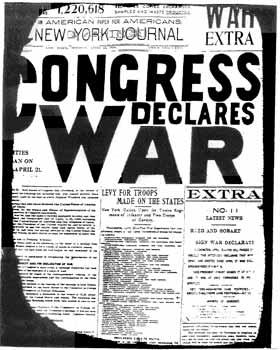
“…The power to declare war, including the power of judging the causes of war, is fully and exclusively vested in the legislature…the executive has no right, in any case, to decide the question, whether there is or is not cause for declaring war.”

James Madison

280_DeclareWar


Posted in government, Quotations, Uncategorized, war | Tagged , | Leave a comment

Place Your Bets

6545_525990904112936_1400597643_n

Posted in poster, religion | Tagged , , , | Leave a comment

Permanent Get Out of Jail Card

BPR Quote of the Day:

426456_10151334973031275_738752674_n

Senator Warren is referring to the bank officials at HSBC who helped launder hundreds of millions of dollars to Mexican drug cartels and terrorist groups.

Posted in drugs, economy, finance, government, inequality, Justice, law, Quotations | Tagged , , , , | Leave a comment

What Are We Saving?

Daylight Savings Time 2013: Little Actual Savings

get-attachment.aspx

By Andrea Ayres/ Policymic/ March 9, 2013

Daylight Savings Time (DST) begins this Sunday, March 10 at 2 a.m. That means that most of us will lose an hour of sleep as we spring forward an hour. Aside from making Monday particularly difficult, does it actually do any good?

Well, Washington, D.C. likes to think so. That’s why it extended DST by a month in the 2005Energy Policy Act. It turns out, though, that lighting only accounts for 12 percent of our energy consumption. That means that the total energy savings in energy consumption from DST ends up being around 0.03 percent. If that doesn’t seem like a lot, it’s because it isn’t.

Ryan Kellogg and Hendrik Wolff, two economists at Berkeley, conducted a study about DST in Australia. What they found was that any possible energy savings that might occur at night is offset by the additional energy people must use in the morning darkness.

The U.S. first adopted DST in 1918 as a way to help individuals go to work and school during daylight hours and as a means to save electricity. It actually worked for energy savings at that time because Americans’ primary source of energy came from electricity. That is no longer thecase.

In addition to not actually providing us with any worthwhile energy savings, it also reaps havoc on our bodies.

We rely on circadian rhythm to help regulate our bodies systems; they help determine our sleep patterns. When we are forced out of that 24-hour cyclical rhythm our bodies tend to respond negatively.

To put it another way. Our body is made up of nearly 100 trillion cells. Each of these cells possess a little biological clock. Now, imagine each of those clocks being abruptly disrupted. That’s what DST does to us and it can take weeks for our bodies to recover.

That’s why in the weeks after DST doctors see an influx of heart attacks and many of us experience disruptions in our sleep patterns.

Until it is decided once and for all that DST is arbitrary and that it doesn’t actually save energy, we will be forced to listen to news broadcasters remind us about it every hour until 2:00 a.m. this Sunday, March 10.

Posted in government, health | Tagged , , , | Leave a comment

Is the Game Over?

By Arlen Grossman/ The Big Picture Report

“All resistance must recognize that the corporate d’etat is complete.” — Chris Hedges

Is Hedges correct? Have we as a nation and a world gone so far overboard into global corporate capitalism that it’s too late to recover?

In his 2010 book The Death of the Liberal Class, Chris Hedges makes a strong case that the once influential “liberal class” has allowed corporations to gain massive influence in all aspects of our society: politics, education, finance, health care, media, etc. Liberalism was at its height during the New Deal, but we have since watched the dismantling of democracy as ordinary citizens have lost their rights and power to ever-expanding corporate control over all aspects of our lives. The liberal class has been bought off by corporate money and cushy jobs. Bill Clinton and Barack Obama are examples of “liberal” presidents unable to stand up to the powerful forces of American and multi-national corporations. By allowing unfettered capitalism and globalism to grow so powerful, liberalism has lost power, and true progressives and radicals have been marginalized.

Wall-Street-Elephant-forcing-a-rethink

Hedges says that “corporate interests have seized all mechanisms of power, from government to mass propaganda.” Now we have permanent war, broken labor unions, an increasingly concentrated corporate media, a repressive security state, a bought-off Democratic Party, an ultra-conservative Republican Party, staggering income inequality, a decimated environment,  and a disappearing middle class.

In his final chapter, Hedges says “all resistance must recognize that the corporate d’etat is complete. We must not waste our energy trying to reform or appeal to systems of power. This does not mean the end of resistance, but it does mean very different forms of resistance…the economic devastation of global capitalism will soon be matched by ecological devastation.”

He goes on to say “We must direct our energies toward building sustainable, local communities to weather the coming crisis, since we will be unable to survive and resist without a cooperative effort.”

Hedges paints a very bleak picture of our future. He says the corporate coup d’etat we have undergone is beginning to fuel unrest and discontent but that revolt will likely come from the right, not the left. He claims the idea of wide-spread popular revolts and mass movements against the corporate state are just fantasies.

Is Hedges too pessimistic, too radical, too unrealistic? He makes a strong case for his point of view.  If he is wrong, if there is still hope of getting this country back on track, then how will it happen and who will do it?  How will we find a way to return control of this country to its citizens. President Obama is unable or unwilling to take on the powerful banks or the Military Industrial and Security complex. So scratch him off the list. The Democratic Party is mostly bought off by corporate interests, and the Occupy and other left-wing  movements and organizations have weakened as corporate control has strengthened. How can we ever turn it around? Right now the answer eludes me.

Posted in Barack Obama, civil liberties, government, law, politics, Terrorism | Tagged , , , , | 5 Comments

“The Devil Came Here Yesterday”

Hugo Chavez’s famous 2006 U.N. speech when he called President Bush “the devil.”

Posted in foreign policy | Tagged , , , | 2 Comments

Opinions = Facts

BPR Quote of the Day:

“Print-based culture, in which fact and assertion could be traced and distinguished, has ceded to a culture of emotionally driven narratives where facts and opinions are interchangeable. This is a decline and a degeneration that has crippled the reality-based culture, in which fact was the foundation for opinion and debate, and ushered in a culture in which facts, opinions, lies, and fantasy are interchangeable.”

Chris Hedges

from Death of the Liberal Class (2010)

section_social_media_marketing

Posted in media, Quotations | Tagged , , , | 2 Comments

Wall Street Giants

Eric Holder Admits Some Banks Are Just Too Big To Prosecute

 By Mark Gongloff/ Huffington Post/ March 6, 2013

When the Attorney General of the United States admits some banks are simply too big to prosecute, it might be time to admit we have a problem — and that goes for both the financial and justice systems.

Eric Holder made this rather startling confession in testimony before the Senate Judiciary Committee on Wednesday, The Hill reports. It could be a key moment in the debate over whether to do something about the size and complexity of our biggest banks, which have only gotten bigger and more systemically important since the financial crisis.

“I am concerned that the size of some of these institutions becomes so large that it does become difficult for us to prosecute them when we are hit with indications that if you do prosecute, if you do bring a criminal charge, it will have a negative impact on the national economy, perhaps even the world economy,” Holder saidaccording to The Hill. “And I think that is a function of the fact that some of these institutions have become too large.”

Holder’s comments don’t come as a total surprise. His underlings had already made similar confessions to The New York Times last year, after they declined to prosecute HSBC for flagrant, years-long violations of money-laundering laws, out of fear that doing so would hurt the global economy. Lanny Breuer, formerly in charge of doling out the Justice Department’s wrist slaps to banks, told Frontline as much in the documentary “The Untouchables,” which aired in January.

big-banks

Some observers have defended the Justice Department, suggesting that prosecuting law-breaking banks would amount to a death penalty that could upset the financial system and trigger another recession — although nobody really knows if it would do any such thing. But by not prosecuting law-breaking banks, and confessing to its terror of prosecuting those banks, the Justice Department has waved a big checkered flag to the biggest banks to go ahead and break all of the laws they want.

Holder’s confession comes after several weeks of criticism from lawmakers about the Justice Department’s failure to prosecute banks not only for potentially hard-to-prove cases involving the financial crisis, but also for cases in which proof wasn’t as hard to find, as in HSBC’s case.

It is significant that Holder’s confession — cry for help, really — comes at the one place that could possibly help, the U.S. Congress. So now you have the Obama administration joining a growing, bipartisan group of lawmakers speaking out about the problem of banks being too big to fail and/or jail. Sens. Sherrod Brown (D-Ohio) and David Vitter (R-La.) last week announced they were working together on bipartisan legislation to address it.

That doesn’t mean you should hold your breath for anything to be done about it right away, or ever. It is far easier to talk about breaking up the big banks than to do it, particularly given that they will lobby hard against it every step of the way. But the tide of public opinion is turning against them a little more every day.

Boldface added by BPR Editor
Posted in economy, finance, government, Justice, law, Wall Street | Tagged , , , , , , , | 3 Comments

…And We Are Screwed

We Are Bradley Manning

By Chris Hedges/ Truthdig/ March 3, 2012

I was in a military courtroom at Fort Meade in Maryland on Thursday as Pfc. Bradley Manning admitted giving classified government documents to WikiLeaks. The hundreds of thousands of leaked documents exposed U.S. war crimes in Iraq and Afghanistan as well as government misconduct. A statement that Manning made to the court was a powerful and moving treatise on the importance of placing conscience above personal safety, the necessity of sacrificing careers and liberty for the public good, and the moral imperative of carrying out acts of defiance. Manning will surely pay with many years—perhaps his entire life—in prison. But we too will pay. The war against Bradley Manning is a war against us all.
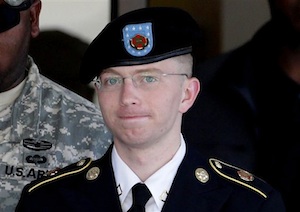
Bradley Manning

This trial is not simply the prosecution of a 25-year-old soldier who had the temerity to report to the outside world the indiscriminate slaughter, war crimes, torture and abuse that are carried out by our government and our occupation forces in Iraq and Afghanistan. It is a concerted effort by the security and surveillance state to extinguish what is left of a free press, one that has the constitutional right to expose crimes by those in power. The lonely individuals who take personal risks so that the public can know the truth—the Daniel Ellsbergs, the Ron Ridenhours, the Deep Throats and the Bradley Mannings—are from now on to be charged with “aiding the enemy.” All those within the system who publicly reveal facts that challenge the official narrative will be imprisoned, as was John Kiriakou, the former CIA analyst who for exposing the U.S. government’s use of torture began serving a 30-month prison term the day Manning read his statement. There is a word for states that create these kinds of information vacuums: totalitarian.

The cowardice of The New York Times, El Pais, Der Spiegel and Le Monde, all of which used masses of the material Manning passed on to WikiLeaks and then callously turned their backs on him, is one of journalism’s greatest shames. These publications made little effort to cover Manning’s pretrial hearings, a failure that shows how bankrupt and anemic the commercial press has become. Rescuing what honor of our trade remains has been left to a handful of independent, often marginalized reporters and a small number of other individuals and groups—including Glenn Greenwald, Alexa O’Brien, Nathan Fuller, Kevin Gosztola (who writes for Firedog Lake), the Bradley Manning Support Network, political activist Kevin Zeese and the courtroom sketch artist Clark Stoeckley, along with The Guardian, which also published the WikiLeaks documents. But if our domesticated press institutions believe that by refusing to defend or report on Manning they will escape the wrath of the security and surveillance state, they are stunningly naive. This is a war that is being played for keeps. And the goal of the state is not simply to send Manning away for life. The state is also determined to extradite WikiLeaks founder Julian Assange and try him in the United States on espionage or conspiracy charges. The state hopes to cement into place systems of information that will do little more than parrot official propaganda. This is why those with the computer skills to expose the power elite’s secrets, such as Aaron Swartz, who committed suicide in January, and Jeremy Hammond, who is facing up to 30 years in prison for allegedly hacking into the corporate security firm Stratfor, have been or are being ruthlessly hunted down and persecuted. It is why Vice President Joe Biden labeled Assange a “high-tech terrorist,”and it is why the Bradley Manning trial is one of the most important in American history.

The government has decided to press ahead with all 22 charges, including aiding the enemy (Article 104), stealing U.S. government property (18 USC 641), espionage (18 USC 793(e)) and computer crimes (18 USC 1030(a)(1))—the last notwithstanding the fact that Manning did not hack into government computers. The state will also prosecute him on charges of violating lawful general regulations (Article 92). The government has refused to settle for Manning’s admission of guilt on nine lesser offenses. Among these lesser offenses are unauthorized possession and willful communication of the video known as “Collateral Murder”; the Iraq War Logs; the Afghan War Diary; two CIA Red Cell Memos,including one entitled “Afghanistan: Sustaining West European Support for the NATO-Led Mission—Why Counting on Apathy Might Not Be Enough”; Guantanamo files; documents of a so-called Article 15-6 investigation into the May 2009 Garani massacrein Afghanistan’s Farah province; and a Department of Defense counterintelligence report, “WikiLeaks.org—An Online Reference to Foreign Intelligence Services, Insurgents, or Terrorist Groups?” as well as one violation of a lawful general order by wrongfully storing information.

Manning’s leaks, the government insists, are tantamount to support for al-Qaida and international terrorism. The government will attempt to prove this point by bringing into court an anonymous witness who most likely took part in the raid on Osama bin Laden’s compound in Pakistan. This witness will reportedly tell the court that copies of the leaked documents were found on bin Laden’s computer and assisted al-Qaida. This is an utterly spurious form of prosecution—as if any of us have control over the information we provide to the public and how it is used. Manning, for substantial amounts of money, could have sold the documents to governments or groups that are defined as the enemy. Instead he approached The Washington Post and The New York Times. When these newspapers rejected him, he sent the material anonymously to WikiLeaks.

The short, slightly built Manning told the military court Thursday about the emotional conflict he experienced when he matched what he knew about the war with the official version of the war. He said he became deeply disturbed while watching a video taken from an Apache helicopter as it and another such craft joined in an attack on civilians in Baghdad in 2007. The banter among the crew members, who treated the murder and wounding of the terrified human beings, including children, in the street below as sport, revolted him. Among the dead was Reuters photojournalist Namir Noor-Eldeen and his driver, Saeed Chmagh. Reuters had repeatedly asked to see the video, and the Army had repeatedly refused to release it. [Click here to see the “Collateral Murder” video.]

“Using Google I searched for the event by its date and general location,” Manning said in reading from a 35-page document that took nearly an hour to deliver. “I found several new accounts involving two Reuters employees who were killed during the aerial weapon team engagement. Another story explained that Reuters had requested a copy of the video under the Freedom of Information Act, or FOIA. Reuters wanted to view the video in order to be able to understand what had happened and to improve their safety practices in combat zones. A spokesperson for Reuters was quoted saying that the video might help avoid the reoccurrence of the tragedy and believed there was compelling need for the immediate release of the video.” [Alexa O’Brien, another journalist who attended Thursday’s proceedings, has provided a full transcript of Manning’s statement: Click here.]

“Despite the submission of the FOIA request, the news account explained that CENTCOM [Central Command] replied to Reuters stating that they could not give a time frame for considering a FOIA request and that the video might no longer exist,” Manning said. “Another story I found written a year later said that even though Reuters was still pursuing their request [the news organization] still did not receive a formal response or written determination in accordance with FOIA. The fact neither CENTCOM or Multi National Forces Iraq, or MNF-I, would not voluntarily release the video troubled me further. It was clear to me that the event happened because the aerial weapons team mistakenly identified Reuters employees as a potential threat and that the people in the bongo truck [van] were merely attempting to assist the wounded. The people in the van were not a threat but merely ‘good Samaritans.’ The most alarming aspect of the video to me, however, was the seemly delightful bloodlust they [the helicopter crew members] appeared to have.

“They dehumanized the individuals they were engaging and seemed to not value human life by referring to them as quote ‘dead bastards’ unquote and congratulating each other on the ability to kill in large numbers,” Manning said, speaking into a court microphone while seated at the defense table. “At one point in the video there is an individual on the ground attempting to crawl to safety. The individual is seriously wounded. Instead of calling for medical attention to the location, one of the aerial weapons team crew members verbally asks for the wounded person to pick up a weapon so that he can have a reason to engage. For me, this seems similar to a child torturing ants with a magnifying glass.

(Continued/ Read Entire Article Here)

Boldface Added by BPR Editor
Posted in civil liberties, Justice, law, media, military, Terrorism | Tagged , , | Leave a comment

WEALTH INEQUALITY: IT’S WORSE THAN YOU THINK

Posted in Economics, economy, inequality | Tagged , , | Leave a comment