They revel in their efforts to end Obamacare and cut millions of Americans off healthcare.
They celebrate last night’s resumption of federal executions.
They enthusiastically authorize the use of formerly banned pesticides that cause cancer and neurological damage to children.
Trump’s first official action was to allow coal and oil companies to dump more waste in our rivers, poisoning people downstream.
As children were being slaughtered in classrooms across America, trump doubled down on supporting the NRA.
As Black people across America continue to be regularly murdered by police, Trump calls those asking for change “terrorists” and “thugs.” He refers to Nazis as “very fine people” and retweets calls for “white power.”
Over international objections and in violation of US law, they’re selling weapons to Saudi Arabia to continue bombing civilians in Yemen.
Numerous children have died in their detention facilities, yet they continue to give millions of dollars to Trump’s contributor corporations to continue holding these children in deplorable, disgusting conditions.
They’re fighting all efforts to extend more unemployment relief to American families, further stressing out people in ways that inevitably, history tells us, lead to domestic violence and suicide.
The simple fact is that Donald Trump and the people he has surrounded himself with, like chief racist Steven Miller, appear to love causing other people pain.
Trump even encouraged police to rough up people who have not yet been convicted of a crime, and told his followers that if they injured protesters he would pay their legal expenses.
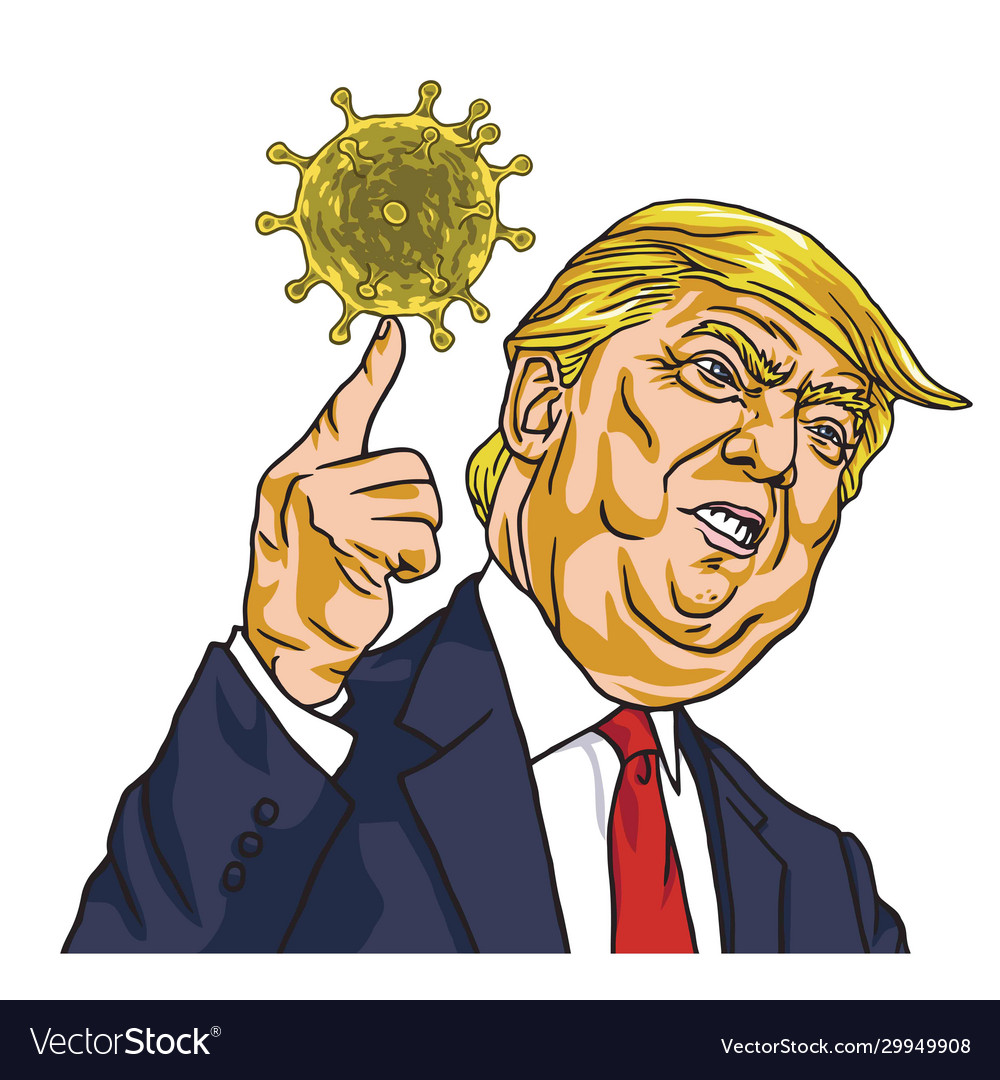
But the coronavirus is their crowning achievement.
Simply by discouraging people from wearing masks or social distancing and raising doubts about science, Trump and his buddies have caused the deaths of over a hundred thousand Americans, with more dead bodies to come if they continue on this path.
Trump goes to states with massive Covid outbreaks and holds indoor rallies, knowing that it will lead to the death of many of the people attending. What is he thinking as he is looking out on his little crowds, knowing that some of those people will be dead in a matter of weeks because of his desperate need for adulation?
Trump refuses to use the Defense Production Act to build up our stockpiles of testing equipment and PPE, making the situation for people in states where the virus is exploding right now a death-dealing crisis.
Betsy DeVos, who has spent her lifetime trying to destroy public schooling, is joining with Trump in trying to punish public school teachers and families who send their kids to public school by bringing disease and death into their homes.
And none of this had to happen.
All over the world, country after country have responded to the coronavirus in ways that have defeated it.
New Zealand hasn’t had a new case in weeks, and normalcy has largely returned to that nation.
Taiwan, similarly, has mostly beat the virus and recently had a baseball game with over 10,000 people in attendance.
All over Europe, countries have kept their unemployment rates well below 10% by aggressive government actions, and have beaten the virus through extensive testing and contact tracing, and mandating masks and social distancing.
Over at the New York Times, Economist Paul Krugman asks a simple question:
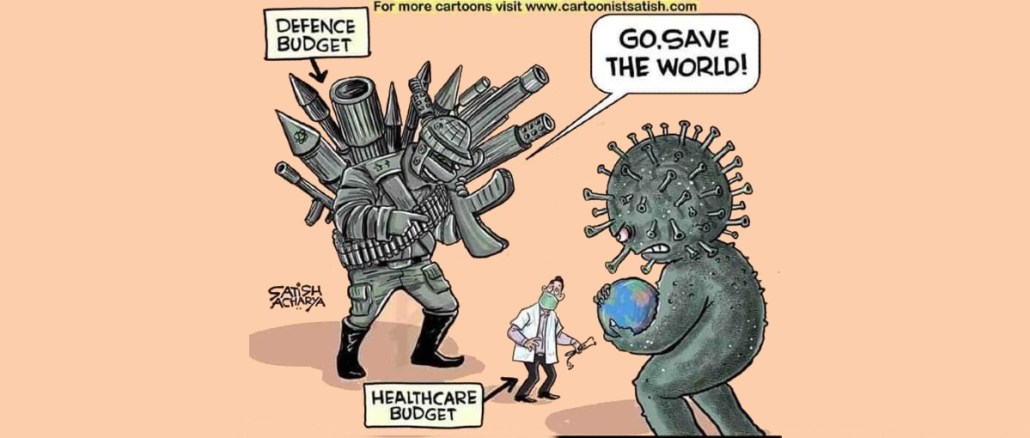
“At its most severe, the lockdown seems to have reduced G.D.P. by a little over 10 percent.
During World War II, America spent more than 30 percent of G.D.P. on defense, for more than three years. Why couldn’t we absorb a much smaller cost for a few months?”
The answer, of course, is that Donald Trump has no interest in saving American lives. He and his Republican buddies just want average Americans back at work to make their billionaire friends and donors even richer, no matter how many workers die in the process.
Trump appears to delight in knowing that because he and his Party have opposed expanding America’s social safety net for decades, there’s an almost endless supply of poor and low-income people desperate enough for a paycheck that they’ll take their lives in their hands to feed their families.
The Trump administration is a death cult. The Republican Party is a death cult.
And Americans and their children are, overwhelmingly, not enthusiastic about dying.
Will November bring the kind of change necessary to put an end to unnecessary death as a routine part of the American way of life?
All told, Donald Trump is a bit of an expert at blurting things that force the markets to bend to his will. And he’s engaging in similar shenanigans now, while Americans are dying by the thousands.
Before the pandemic and accompanying economic calamity hit us, it’s possible, while not proven, that Trump used his inexplicable trade war to seize control over the indexes. Since Trump launched the trade war with China in early 2018, whenever he’d announce good news about negotiations with Beijing — which were probably lies — the markets would rise. Whenever he’d announce bad news along those lines, the markets would collapse. We can see it in the charts: Since 2018, we’ve observed wildly unprecedented whiplash swings by hundreds of points in single days of trading, and most of those gains or declines were linked to the trade war.
Last year, Vanity Fair’s William Cohan published a mind-blowing item that closely examined several “chaos trades” and the linkage between Trump’s blurts and the movement of the S&P 500. Sure enough, someone — or a connected group of someones — was making colossal trades just prior to Trump’s announcements about the trade war. When I say “colossal,” I’m understating the magnitude of the windfalls these trades Read morex
This year, the question we’re all asking is why the hell the markets are doing so well in the face of the coronavirus pandemic, not to mention the existence of a recession and a record-high budget deficit. As I write this on Monday, July 13, the Dow is up 452 points despite everything else collapsing around us. (At the end of the day, the Dow closed up just 10 points, due to bad news about the virus. More on this presently.) Astonishingly, the Dow has climbed 8,000 points since its pandemic low point on March 23.
Why?
Trump desperately wants to be re-elected this fall to avoid being prosecuted, not to mention getting crushed under an avalanche of incoming lawsuits. The presidency serves as his last best shield against true accountability. He knows as well as anyone that the economy is the only thing keeping him from an approval poll average in the low 20s, and a landslide victory for Joe Biden in November, similar to Barack Obama’s resounding victory in 2008. Consequently, Trump’s returning to some of his old tricks to try to keep the major market indexes happy, at the very least. Only this time, his tricks are exacerbating the pandemic and literally killing Americans, all for the sake of his re-election.Advertisement:
Many of the biggest upside days for the markets have come as a result of Trump’s insistence upon prematurely reopening the economy, a process he moronically kicked off while the rate of daily infections was at its then-high point. Since irresponsibly and catastrophically pulling the trigger way too soon, the markets have moved higher every time it looks as if the reopening will continue despite the worsening coronavirus numbers. Good news for Trump. (Examples: Here, here, here and here.) Conversely, when the possibility of another shutdown emerges, the markets fall. (Examples: Here, here and here.) And that’s bad news for Trump.
In other words, Trump’s constant rose-colored blurts about the economy and the reopening process have artificially resurrected the markets, for now, helping Trump politically while leaving the rest of the economy behind. Advertisement:
To be clear: No, the markets aren’t the economy. But the incongruous rise in the markets since March have been enough to provide Trump with some much-needed fuel for his perpetual bullshit machine, allowing him to repeatedly brag about the “record” heights of the indexes, keeping smiles on the faces of everyone with skin in the Wall Street game, while appeasing his aspirational fanboys who are only interested in winning no matter who dies.
Speaking of which, the federal budget deficit could climb to a record-smashing $4 trillion this year. That’s more than $2.6 trillion higher than it was in 2009 in the midst of the Great Recession. Meanwhile, the unemployment rate is 11 percent, or a full point higher than it was during the 2008-2009 collapse. At least 135,000 Americans are dead, with no ceiling in sight, all due to the pandemic and Trump’s apocalyptic response. Indeed, everything’s becoming more apocalyptic by the day, with the threat of another lockdown emerging in several large states, while more and more Americans follow Trump’s frenetic lead, shirking the use of masks and other safety measures meant to end the crisis responsibly.
Yet the markets are still merrily climbing, thanks to Trump’s policy of death-for-the-Dow. As long as Trump continues this policy, the jacked-up white guys in lower Manhattan will keep buying. It’s ghoulish to the extreme.Advertisement:
Everything else in America is nearing hellscape status, and, despite his manipulations, the markets aren’t out of the woods yet. Georgia appears to be on the verge of entirely shutting down again, with other states, including Texas, soon to follow. On Monday, California Gov. Gavin Newsom ordered the closure of all bars, indoor restaurants and virtually every other form of indoor recreation. And because life tends to find a way, it’s likely that other states still on the low end of their curves, will see the numbers begin to climb again.
Trump could have called for more stimulus legislation to keep the economy afloat until the infection curves dropped toward zero. He could have taken responsible steps to remain closed while keeping the economy above water, at least. Had he done all that, the pandemic might have been over by now, or at least on a downward trajectory. Instead, he did the worst possible thing at the worst possible time: He sacrificed thousands of lives to the Wall Street meat-grinder, and the economy might have to shut down again anyway. More whiplash at the hands of a professional conman.
Trump, a real life Patrick Bateman, is just soulless enough to be unconcerned about the bloody consequences of his malicious behavior. By ignoring the pandemic for the sake of the Dow, and hence his re-election campaign, he’s risking the distinct and calamitous possibility that thousands more Americans will die, or suffer from lifelong pre-existing conditions, all to serve his blindingly irresponsible re-election strategy — and the way it looks right now, he might not even win. Losing the election anyway, despite sacrificing all those lives, is a risk he’s willing to take. He’s willing to balance the outcome of the election on a pile of American bodies — including the bodies of American soldiers targeted by his paymaster Vladimir Putin, by the way. This isn’t the behavior of a servant of the people, it’s the behavior of a genocidal tyrant, which he surely is. That’s exactly how history ought to remember him after he’s gone.
Donald Trump will do anything to be re-elected. His opponents are limited because they believe in democracy. Trump has no limits because he doesn’t.
Here’s Trump’s re-election playbook, in 25 simple steps:
1) Declare yourself above the law.
2) Use racist fearmongering. Demand “law and order” and describe protesters as “thugs”, “lowlife” and “rioters and looters”. Describe Covid-19 as “kung-flu”. Retweet posts from white supremacists. In your campaign ads, use a symbol associated with Nazis.
3) Appoint an attorney general more loyal to you than to America,and politicize the Department of Justice so it’s lenient on your loyalists and comes down hard on your enemies. Have it lighten the sentence of a crony convicted of lying under oath. Order investigations of industries you dislike.
4) Fire US attorneys who are investigating you.
5) Fire independent inspectors general who are looking into what you’ve done. Crush any whistleblowers you find.
6) Demean and ignore the intelligence community. Appoint a director of national intelligence more loyal to you than to America. Demand that the head of the FBI pledge loyalty to you.
7) Pack the federal courts with judges and justices more loyal to you than to the constitution.
8) Politicize the Department of Defense so generals will back whatever you order. Refer to them as “my generals”. Have them help clear out protesters. Order the military to surveil protesters. Tell governors you’ll bring in the military to stop protesters.
9) Purge your party of anyone disloyal to you and turn it into a mindless, brainless, spineless cult.
10) Get rid of accumulated experience and expertise in government. Demean career public servants. Hollow out the state department, the Departments of Justice, Health and Human Services, and public health.
11) Reward donors and cronies with bailouts, tax breaks, subsidies, government contracts, regulatory rollbacks and plum jobs. Put their lobbyists in charge of your agencies. Distribute $500bn in pandemic assistance to corporations in secret, without any oversight.
12) Coddle dictators. Don’t criticize their human rights abuses. Refuse to work with the leaders of other democracies. Withdraw from international treaties.
13) Create scapegoats. Demonize migrants and lock up asylum seekers at the border, even if they’re children. Put a whitenationalist in charge of immigration policy. Blame Muslims, Mexicans and Chinese.
14) Denigrate and ridicule all critics. Describe opponents as “human scum”. Attack the mainstream media as purveyors of “fake news” and “enemies of the people”.
15) Conjure up conspiracies supposedly led by your predecessor and your opponent in the last election. Without any evidence, accuse your predecessor of “treason”. Fabricate a “deep state” out to get you.
16) Downplay real threatsto the nation, such as a rapidly spreading pandemic. Lie about your utter failure to contain it. Muzzle public health experts. Urge people to go back to work even as the pandemic worsens in parts of the country.
17) Encourage armed supporters to “liberate” states from elected officials who disagree with you.
18) Bribe other nations to investigate your electoral opponent and flood social media with lies about him.
19) Use rightwing propaganda machines like Fox News and conspiracy-theory-peddling One America News to inundate the country with your lies. Ensure that the morally bankrupt chief executive of Facebook allows you to spread your lies on the biggest media machine in the world.
20) Suppress the votes of people likely to vote against you. Intimidate voters of color. Encourage Republican governors to purge voter rolls, demand voter ID and close polling places.
21) Seek to prevent mail-in ballots during the pandemic. Claim they will cause voter fraud, without evidence. Threaten to close the US postal service.
23) If it still looks like you’ll be voted out, try to postpone the election.
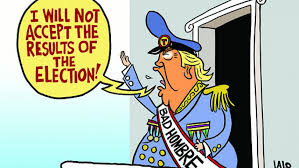
24) If you’re voted out of office notwithstanding all this, refuse to leave. Contest the election, claim massive fraud, say it’s a conspiracy, get your cult of a political party to support your lies, get your propaganda machine to repeat them, get your justice department to back you, get your judges and justices to affirm you, get your generals to suppress any subsequent rebellion
25) Declare victory.
Memo to America: beware Trump’s playbook. Spread the truth. Stay vigilant. Fight for our democracy.
After the capitulation, the Liberal Class finally died. It faded away after decades of being morbidly dysfunctional. It was often out of its mind with delirium, and with periods of being semi-comatose. It had suffered from physical deterioration, mental depression and hallucinations of its former gradeur.
An autopsy was performed to determine the exact cause of death. Political scientists wanted to examine the corpse for underlying pathologies and their progression. The information may prove useful to future social movements. Hopefully, future generations can be saved from the tragic fate of the Old Liberal Class. The peaceful protests against riotous police violence gives one some hope for the next generation.
Survivors of the Liberal Class are Identity Politics and Political Correctness. The relatives were left squabbling over Liberal’s legacy. The Biden faction claims that it is the sole legitimate heir. The Sanders faction is begging for some table scraps. The pro-maskers and anti-maskers are in an angry Twitter feud. Identity politics, political correctness, incrementalists, and mainstream Democrats are demanding their share of the estate. The middle class was left with nothing but broken promises. The working class and the poor had become estranged for many years, and were cut out of the will entirely.
The 100 years old body of the Liberal Class had many wounds. In its younger days it had won some milestone battles: organizing labor, the 40-hour work week, a minimum wage, women suffrage, child labor laws, Social Security, Medicare, the Civil Rights Movement, and protests against the Vietnam War were just a few. Battles lost were to McCarthyism, COINTELPRO, the wars on drugs and crime, mass incarceration, Latin American death squads, corporatism, and international imperialism.
In later years the Liberal Class grew fat, dull and lazy. Fast-food, slow metabolism, consumerism, too much screen time and its decrepit age had severely weakened its immune system. A gelatinized brain caused ambivalence, confusion, and senility. The heart was broken from waiting for hope and change, which never came. Psychologically the Liberal Class simply lost all its will to fight.
Chris Hedges, in his book The Death of the Liberal Class, had speculated that the cause of death was gullibility. This was a contributing factor. Liberalism had been foolish enough to believe that it could change the political class from within the system. It had believed that elections and voting for the lesser evil would buy it time. The priority was always to vote for the lesser evil in “this” election, while waiting for the messiah to appear in the “next” election.
The Liberal Class believed in many false messiahs. In 1976 it elected Jimmy Carter. The 1976 election took place when the Vietnam War and Watergate were still fresh in the political mind. The economy was in a shambles, and there was an oil crisis. Hyper-inflation and recession were a new phenomenon called stagflation. Liberalism hoped Carter would be the Promised One.
Carter attacked the energy crisis by calling for conservation and solar energy. He wore a sweater and turned off the lights. He put solar panels on the White House roof. Carter acted as if he was a God-fearing pious man. He talked about peace in the Middle East, and nuclear arms reduction.
In the end, Carter was undone by a feud with his own liberal political party, and he was angry with the American people whom he berated for having a “moral malaise”. A hostile mainstream media ridiculed him and made him a laughing stock. On top of that was the Iran Hostage Crisis—
Despite Carter’s come-to-Jesus lecturing he was defeated in the 1980 election by a Hollywood “B” movie actor, pitchman for General Electric and drugstore cowboy named Ronald Reagan. Undiagnosed at the time, Carter left the Liberal Class with a malignant tumor. It metathesized in the twenty-first century into the War on Terror.
Carter and his National Security Advisor, the great-game aficionado, Zbigniew Brzezinski armed a band of terrorist in Afghanistan. Brzezinski later bragged that he and Carter egged the Soviet Union into a Vietnam-style war. Revenge seemed so sweet at the time. Instead the U.S. was later hoist by its own petard into wars that would never end.
Carter’s Afghan war lead to the destruction of that developing nation. Afghan women were launched back into the future of the 13th century, and the war killed over a million Afghan men, women and children. Carter’s chickens hatched into the attacks on the U.S. of September 11, 2001. For over forty years Afghanistan has been a humanitarian disaster, because of a liberal president’s meddling.
After 12 years in the wilderness of Reaganomics, Thatcherism, and Papa Bush, the Liberal Class thought that it had been sent another messiah by the name of William Jefferson Clinton. Ironically, Clinton was from Hope— Hope, Arkansas. Hope was the Liberal Class’s drug of choice. It kept looking for higher-highs, and instead got lower-lows.
Clinton was a New Democrat. What the New Democratic Coalition called being committed to pro-economic growth, pro-innovation, and fiscally responsible policies. In other words, Clinton was a neoliberal in sheep’s clothing. It was even said that Clinton was the first black president, even though he was as white as sliced bread. [2]
Clinton slashed welfare for the poor, and flooded the prison population with African Americans. Clinton waxed eloquent about the middle class, and the Liberal Class stopped caring about the downtrodden. There was a Democrat in the White House, and the Liberal Class was loyal to the Democratic Party. Liberalism stopped caring about the problems that society caused. As Senator Joe Biden said of his 1994 crime bill, “I don’t care; LOCK THEM UP”. The words “PREDITORS” and “THEM” were code for young Black American men.
If recent weeks have shown us anything, it’s that the world is not just flat. It’s fragile.
And we’re the ones who made it that way with our own hands. Just look around. Over the past 20 years, we’ve been steadily removing man-made and natural buffers, redundancies, regulations and norms that provide resilience and protection when big systems — be they ecological, geopolitical or financial — get stressed. We’ve been recklessly removing these buffers out of an obsession with short-term efficiency and growth, or without thinking at all.
At the same time, we’ve been behaving in extreme ways — pushing against, and breaching, common-sense political, financial and planetary boundaries.
And, all the while, we’ve taken the world technologically from connected to interconnected to interdependent — by removing more friction and installing more grease in global markets, telecommunications systems, the internet and travel. In doing so, we’ve made globalization faster, deeper, cheaper and tighter than ever before. Who knew that there were regular direct flights from Wuhan, China, to America?
Put all three of these trends together and what you have is a world more easily prone to shocks and extreme behaviors — but with fewer buffers to cushion those shocks — and many more networked companies and people to convey them globally.
This, of course, was revealed clearly in the latest world-spanning crisis — the coronavirus pandemic. But this trend of more frequent destabilizing crises has been building over the past 20 years: 9/11, the Great Recession of 2008, Covid-19 and climate change. Pandemics are no longer just biological — they are now geopolitical, financial and atmospheric, too. And we will suffer increasing consequences unlesswe start behaving differently and treating Mother Earth differently.
Note the pattern: Before each crisis I mentioned, we first experienced what could be called a “mild” heart attack, alerting us that we had gone to extremes and stripped away buffers that had protected us from catastrophic failure. In each case, though, we did not take that warning seriously enough — and in each case the result was a full global coronary.
“We created globalized networks because they could make us more efficient and productive and our lives more convenient,” explained Gautam Mukunda, the author of “Indispensable: When Leaders Really Matter.” “But when you steadily remove their buffers, backup capacities and surge protectors in pursuit of short-term efficiency or just greed, you ensure that these systems are not only less resistant to shocks, but that we spread those shocks everywhere.”
The collapse of the south tower of the World Trade Center on Sept. 11, 2001.Credit…Susan Meiselas/Magnum Photos
Sept. 11, 2001
Let’s start with 9/11. You could view Al Qaeda and its leader, Osama bin Laden, as political pathogens that emerged out of the Middle East after 1979. “Islam lost its brakes in 1979” — its resistance to extremism was badly compromised — said Mamoun Fandy, an expert on Arab politics.
That was the year that Saudi Arabia lurched backward, after Islamist extremists took over the Grand Mosque in Mecca and an Islamic revolution in Iran brought Ayatollah Ruhollah Khomeini to power. Those events set up a competition between Shiite Iran and Sunni Saudi Arabia over who was the real leader of the Muslim world. That battle coincided with a surge in oil prices that gave both fundamentalist regimes the resources to propagate their brands of puritanical Islam, through mosques and schools, across the globe.
In doing so, they together weakened any emerging trends toward religious and political pluralism — and strengthened austere fundamentalism and its violent fringes.
Remember: The Muslim world was probably at its most influential, culturally, scientifically and economically, in the Middle Ages, when it was a rich and diverse polyculture in Moorish Spain.
Diverse ecosystems, in nature and in politics, are always more resilient than monocultures. Monocultures in agriculture are enormously susceptible to disease — one virus or germ can wipe out an entire crop. Monocultures in politics are enormously susceptible to diseased ideas.
Thanks to Iran and Saudi Arabia, the Arab-Muslim world became much more of a monoculture after 1979. And the idea that violent Islamist jihadism would be the engine of Islam’s revival — and that purging the region of foreign influences, particularly American, was its necessary first step — gained much wider currency.
This ideological pathogen spread — through mosques, cassette tapes and then the internet — to Pakistan, North Africa, Europe, India and Indonesia.
The warning bell that this idea could destabilize even America rangon Feb. 26, 1993, at 12:18 p.m., when a rental van packed with explosives blew up in the parking garage below the 1 World Trade Center building in Manhattan. The bomb failed to bring down the building as intended, but it badly damaged the main structure, killing six people and injuring more than 1,000.
The mastermind of the attack, Ramzi Ahmed Yousef, a Pakistani, later told F.B.I. agents that his only regret was that the 110-story tower did not collapse into its twin and kill thousands.
What happened next we all know: The direct hits on both twin towers on Sept. 11, 2001, which set off a global economic and geopolitical crisis that ended with the United States spending several trillion dollars trying to immunize America against violent Islamic extremism — via a massive government-directed surveillance system, renditions and airport metal detectors — and by invading the Middle East.
The United States and its allies toppled the dictators in Iraq and Afghanistan, hoping to stimulate more political pluralism, gender pluralism and religious and educational pluralism — antibodies to fanaticism and authoritarianism. Unfortunately, we didn’t really know how to do this in such distant lands, and we botched it; the natural pluralistic antibodies in the region also proved to be weak.
Either way — as in biology, so, too, in geopolitics — the virus of Al Qaeda mutated, picking up new elements from its hosts in Iraq and Afghanistan. As a result, violent Islamic extremism became even more virulent, thanks to subtle changes in its genome that transformed it into ISIS, or the Islamic State.
This emergence of ISIS, and parallel mutations in the Taliban, forced the United States to remain in the area to just manage the outbreaks, but nothing more.
Traders on the floor of the New York Stock Exchange in 2008.Credit…Mario Tama/Getty Images
The Great Recession
The 2008 global banking crisis played out in similar ways. The warning was delivered by a virus known by the initials LTCM — Long-Term Capital Management.
LTCM was a hedge fund set up in 1994 by the investment banker John Meriweather, who assembled a team of mathematicians, industry veterans and two Nobel Prize winners. The fund used mathematical models to predict prices and tons of leverage to amplify its founding capital of $1.25 billion to make massive, and massively profitable, arbitrage bets.
It all worked — until it didn’t.
“In August 1998,” recalled Business Insider, “Russia defaulted on its debt. Three days later, markets all over the world started sinking. Investors began pulling out left and right. Swap spreads were at unbelievable levels. Everything was plummeting. In one day, Long-Term lost $553 million, 15 percent of its capital. In one month it lost almost $2 billion.”
Hedge funds lose money all the time, default and go extinct. But LTCM was different.
The firm had leveraged its bets with so much capital from so many different big global banks — with no trading transparency, so none of its counterparties had a picture of LTCM’s total exposure — that if it were allowed to go bankrupt and default, it would have exacted huge losses on dozens of investments houses and banks on Wall Street and abroad.
More than $1 trillion was at risk. It took a $3.65 billion bailout package from the Federal Reserve to create herd immunity from LTCM for the Wall Street bulls.
The crisis was contained and the lesson was clear: Don’t let anyone make such big, and in some ways extreme, bets with such tremendous leverage in a global banking system where there is no transparency as to how much a single player has borrowed from many different sources.
A decade later, the lesson was forgotten, and we got the full financial disaster of 2008.
This time we were all in the casino. There were four main financial vehicles (that became financial pathogens) that interacted to create the global crisis of 2008. They were called subprime mortgages, adjustable rate mortgages (ARMs), commercial mortgage-backed securities (C.M.B.S.) and collateralized debt obligations (C.D.O.s).
Banks and less-regulated financial institutions engaged in extremely reckless subprime and adjustable rate mortgage lending, and then they and others bundled these mortgages into mortgage-backed securities. Meanwhile, rating agencies classified these bonds as much less risky than they really were.
The whole system depended on housing prices endlessly rising. When the housing bubble burst — and many homeowners could not pay their mortgages — the financial contagion infected huge numbers of global banks and insurance companies, not to mention millions of mom-and-pops.
We had breached the boundaries of financial common sense. With the world’s financial system more hyper-connected and leveraged than ever, only huge bailouts by central banks prevented a full-on economic pandemic and depression caused by failing commercial banks and stock markets.
In 2010, we tried to immunize the banking system against a repeat with the Dodd-Frank Wall Street Reform and Consumer Protection Act in America and with the Basel III new capital and liquidity standards adopted by banking systems around the world. But ever since then, and particularly under the Trump administration, financial services companies have been lobbying, often successfully, to weaken these buffers, threatening a new financial contagion down the road.
This one could be even more dangerous because computerized trading now makes up more than half of stock trading volume globally. These traders use algorithms and computer networks that process data at a thousandth or millionth of a second to buy and sell stocks, bonds or commodities.
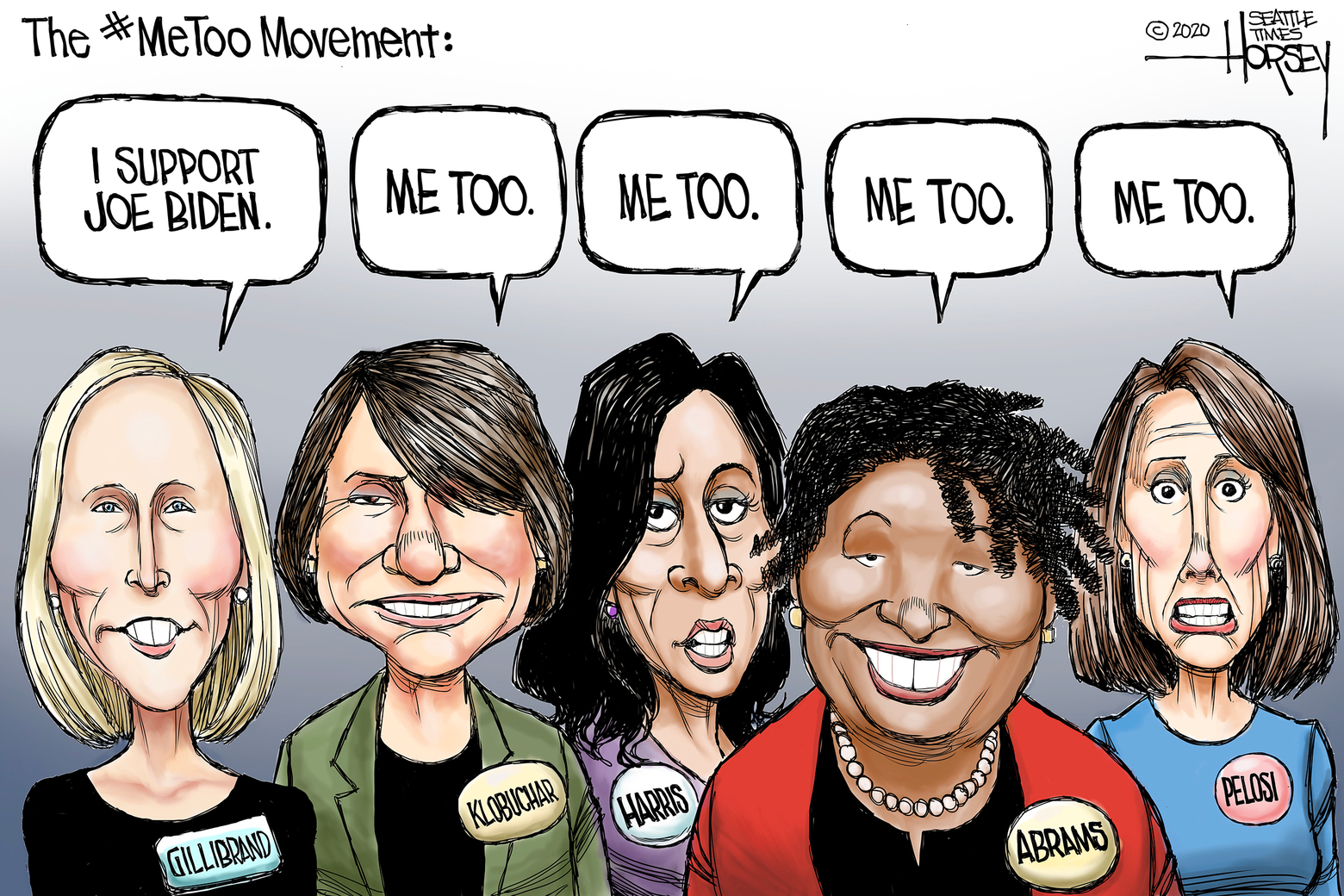
Joe Biden needs to pick a progressive woman for his VP nomination. Here’s why: 1) It would spark enthusiasm for Democrats (especially for progressives let down by Biden as the candidate, and 2) The woman he picks will have a great shot of becoming our next president, especially if Joe only wants one term (he will be 83 if he wins a second term and takes office in 2025).
He has some formidable women to choose as his running mate. Elizabeth Warren would be one of the strongest candidates. Kamala Harris, Gretchen Whitmer (governor of Michigan), Stacy Abrams, Val Demings (representative from Florida), Tammy Baldwin (senator from Wisconsin), and Michelle Lujan Grisham (governor of New Mexico) are progressives who would enhance the Democratic ticket. And that probably doesn’t exhaust the field of potential running mates.
Biden will do himself, and the Democratic Party, a big favor if he nominates one of these fine progressive women candidates as his vice-presidential choice. It just might help him win the election.
Donald Trump and Jair Bolsonaro, presidents of the United States and Brazil, are essentially refusing to do anything consequential about an epidemic that is killing massive numbers of their own countries’ citizens.
For this, they should be brought before the International Criminal Court at The Hague and charged with crimes against humanity.
To compound the situation here, Trump is now ridiculing people who wear masks, including Joe Biden.
Wearing masks is one of the most simple, low cost and effective ways to slow down the spread of this pandemic and reduce the numbers of deaths.
But Donald Trump doesn’t want to smear his makeup, and so is suggesting to his insecure white male followers that wearing a mask makes a man seem less manly. He’s also refusing to do anything about testing at the national level other than ordering some swabs.
This isn’t just an abrogation of his duties as president. It is a crime. It is intentional disinformation being put forward purely for political purposes, and it will kill people.
Even worse was his ignoring and lying about the coming pandemic when he was first informed of it back in November and December. Trump and Bolsonaro knew what was coming, both from their own intelligence agencies and from news reports of the situations in China, Italy, and Spain.
While countries from Taiwan to New Zealand to Norway have gotten the virus under control, Trump and Bolsonaro did worse than nothing by spreading lies and disinformation while the virus exploded through their populations
Many of the families of people who have died of COVID-19 here in the United States have considered suing Trump, but it is nearly impossible to sue a sitting president, and Bill Barr has made it clear that the Justice Department will not hold Trump accountable for anything, up to and including shooting somebody on Fifth Avenue.
Therefore, we here in the United States, who are the victims of his criminal malfeasance, and the rest of the world who are victims of the United States and Brazil becoming the uncontrolled epicenters of a worldwide explosion of disease, must act.
It’s time to bring Donald Trump, and his mini Trump, Jair Bolsonaro, before the international criminal court at The Hague and convict them of crimes against humanity.
“Why do some British people not like Donald Trump?” Nate White, an articulate and witty writer from England wrote the following response:
A few things spring to mind. Trump lacks certain qualities which the British traditionally esteem. For instance, he has no class, no charm, no coolness, no credibility, no compassion, no wit, no warmth, no wisdom, no subtlety, no sensitivity, no self-awareness, no humility, no honour and no grace – all qualities, funnily enough, with which his predecessor Mr. Obama was generously blessed. So for us, the stark contrast does rather throw Trump’s limitations into embarrassingly sharp relief.
Plus, we like a laugh. And while Trump may be laughable, he has never once said anything wry, witty or even faintly amusing – not once, ever. I don’t say that rhetorically, I mean it quite literally: not once, not ever. And that fact is particularly disturbing to the British sensibility – for us, to lack humour is almost inhuman. But with Trump, it’s a fact. He doesn’t even seem to understand what a joke is – his idea of a joke is a crass comment, an illiterate insult, a casual act of cruelty.
Trump is a troll. And like all trolls, he is never funny and he never laughs; he only crows or jeers. And scarily, he doesn’t just talk in crude, witless insults – he actually thinks in them. His mind is a simple bot-like algorithm of petty prejudices and knee-jerk nastiness.
There is never any under-layer of irony, complexity, nuance or depth. It’s all surface. Some Americans might see this as refreshingly upfront. Well, we don’t. We see it as having no inner world, no soul. And in Britain we traditionally side with David, not Goliath. All our heroes are plucky underdogs: Robin Hood, Dick Whittington, Oliver Twist. Trump is neither plucky, nor an underdog. He is the exact opposite of that. He’s not even a spoiled rich-boy, or a greedy fat-cat. He’s more a fat white slug. A Jabba the Hutt of privilege.
And worse, he is that most unforgivable of all things to the British: a bully. That is, except when he is among bullies; then he suddenly transforms into a snivelling sidekick instead. There are unspoken rules to this stuff – the Queensberry rules of basic decency – and he breaks them all. He punches downwards – which a gentleman should, would, could never do – and every blow he aims is below the belt. He particularly likes to kick the vulnerable or voiceless – and he kicks them when they are down.
So the fact that a significant minority – perhaps a third – of Americans look at what he does, listen to what he says, and then think ‘Yeah, he seems like my kind of guy’ is a matter of some confusion and no little distress to British people, given that: • Americans are supposed to be nicer than us, and mostly are. • You don’t need a particularly keen eye for detail to spot a few flaws in the man.
This last point is what especially confuses and dismays British people, and many other people too; his faults seem pretty bloody hard to miss. After all, it’s impossible to read a single tweet, or hear him speak a sentence or two, without staring deep into the abyss. He turns being artless into an art form; he is a Picasso of pettiness; a Shakespeare of shit. His faults are fractal: even his flaws have flaws, and so on ad infinitum. God knows there have always been stupid people in the world, and plenty of nasty people too. But rarely has stupidity been so nasty, or nastiness so stupid. He makes Nixon look trustworthy and George W look smart. In fact, if Frankenstein decided to make a monster assembled entirely from human flaws – he would make a Trump.
And a remorseful Doctor Frankenstein would clutch out big clumpfuls of hair and scream in anguish: ‘My God… what… have… I… created?’ If being a twat was a TV show, Trump would be the boxed set.
If you wish to understand better the damage we are inflicting on our home planet and how far we are from fixing it, I highly recommend watching this new documentary. For me, everything I thought I knew about alternative energy and the sustainability movement was turned on its head. If this movie is correct, I can no longer believe in the environmental movement and its leaders the same way I once did, The answers lie elsewhere. We seem far from being able to protect and fix the damage we have done to Mother Earth. A very sobering documentary and important to see–TBPR Editor.
CORRECTION: Never mind, I retract my hasty opinion. Upon further review, encouraged by my environmentally-minded son, I see there were many issues that call into question the accuracy of the film. Well, it sounded good at the time….TBPR Editor