U.S. Nuclear Plants To Be “Built With Steel and Cement and Lies and Fraud”

“A nuclear plant is built with steel and cement and lies and fraud – and that’s the take-a-way for today”

THE FUKUSHIMA STORY YOU DIDN’T HEAR ON CNN

by Greg Palast/ FreePress.org/ March 8, 2012

I’ve seen a lot of sick stuff in my career, but this was sick on a new level.

Here was the handwritten log kept by a senior engineer at the nuclear power plant:

Wiesel was very upset. He seemed very nervous. Very agitated. . . . In fact, the plant was riddled with problems that, no way on earth, could stand an earth- quake. The team of engineers sent in to inspect found that most of these components could “completely and utterly fail” during an earthquake.

“Utterly fail during an earthquake.” And here in Japan was the quake and here is the utter failure.

The warning was in what the investigations team called The Notebook, which I’m not supposed to have.  Good thing I’ve kept a copy anyway, because the file cabinets went down with my office building ….

WORLD TRADE CENTER TOWER 1, FIFTY-SECOND FLOOR
NEW YORK, 1986

[This is an excerpt in FreePress.org from Vultures’ Picnic: In Pursuit of Petroleum Pigs, Power Pirates and High-Finance Fraudsters, to be released this Monday.  Click here to get the videos and the book.]

Two senior nuclear plant engineers were spilling out their souls and files on our huge conference table, blowing away my government investigations team with the inside stuff about the construction of the Shoreham, New York, power station.

The meeting was secret. Very secret. Their courage could destroy their careers: No engineering firm wants to hire a snitch, even one who has saved thousands of lives. They could lose their jobs; they could lose everything. They did. That’s what happens. Have a nice day.

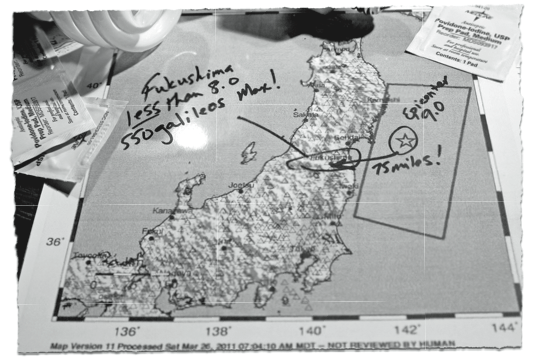
On March 12 this year, as I watched Fukushima melt, I knew:  the “SQ” had been faked.  Anderson Cooper said it would all be OK.  He’d flown to Japan, to suck up the radiation and official company bullshit.  The horror show was not the fault of Tokyo Electric, he said, because the plant was built to withstand only an 8.0 earthquake on the Richter scale, and this was 9.0.  Anderson must have been in the gym when they handed out the facts.  The 9.0 shake was in the middle of the Pacific Ocean, 90 miles away.  It was barely a tenth of that power at Fukushima.

I was ready to vomit.  Because I knew who had designed the plant, who had built it and whom Tokyo Electric Power was having rebuild it:  Shaw Construction.  The latest alias of Stone & Webster, the designated builder for every one of the four new nuclear plants that the Obama Administration has approved for billions in federal studies.

But I had The Notebook, the diaries of the earthquake inspector for the company.  I’d squirreled it out sometime before the Trade Center went down.  I shouldn’t have done that.  Too bad.

All field engineers keep a diary. Gordon Dick, a supervisor, wasn’t supposed to show his to us. I asked him to show it to us and, reluctantly, he directed me to these notes about the “SQ” tests.
SQ is nuclear-speak for “Seismic Qualification.” A seismically qualified nuclear plant won’t melt down if you shake it. A “seismic event” can be an earthquake or a Christmas present from Al Qaeda. You can’t run a nuclear reactor in the USA or Europe or Japan without certified SQ.

This much is clear from his notebook: This nuclear plant will melt down in an earthquake. The plant dismally failed to meet the Seismic I (shaking) standards required by U.S. and international rules.

Here’s what we learned: Dick’s subordinate at the nuclear plant, Robert Wiesel, conducted the standard seismic review. Wiesel flunked his company. No good. Dick then ordered Wiesel to change his report to the Nuclear Regulatory Commission, change it from failed to passed. Dick didn’t want to make Wiesel do it, but Dick was under the gun himself, acting on direct command from corporate chiefs. From The Notebook:

Wiesel was very upset. He seemed very nervous. Very agitated. [He said,] “I believe these are bad results and I believe it’s reportable,” and then he took the volume of federal regulations from the shelf and went to section 50.55(e), which describes reportable deficiencies at a nuclear plant and [they] read the section together, with Wiesel pointing to the appropriate paragraphs that federal law clearly required [them and the company] to report the Category II, Seismic I deficiencies.

Wiesel then expressed his concern that he was afraid that if he [Wiesel] reported the deficiencies, he would be fired, but that if he didn’t report the deficiencies, he would be breaking a federal law. . . .

The law is clear. It is a crime not to report a safety failure. I could imagine Wiesel standing there with that big, thick rule book in his hands, The Law. It must have been heavy. So was his paycheck. He weighed the choices: Break the law, possibly a jail-time crime, or keep his job.

What did Wiesel do? What would you do?

Why the hell would his company make this man walk the line? Why did they put the gun to his head, to make him conceal mortal danger? It was the money. It’s always the money. Fixing the seismic problem would have cost the plant’s owner half a billion dollars easy. A guy from corporate told Dick, “Bob is a good man. He’ll do what’s right. Don’t worry about Bob.”

That is, they thought Bob would save his job and career rather than rat out the company to the feds.

But I think we should all worry about Bob. The company he worked for, Stone & Webster Engineering, built or designed about a third of the nuclear plants in the United States.

From the fifty-second floor we could look at the Statue of Liberty. She didn’t look back.

***

Greg Palast is the author of Vultures’ Picnic: In Pursuit of Petroleum Pigs, Power Pirates and High-Finance Carnivores.
Posted in Energy, environment | Tagged , , , , , | Leave a comment

The Meaning of War

Billy Joel/ Goodnight Saigon

This song originally appeared on Billy Joel’s 1982 album The Nylon Curtain
Posted in war | Tagged , , , | Leave a comment

Student Debt: “Growing at a Remarkable Rate”

Student Debt in the U.S. Continues to Blow Up

by Philip Pilkington/ Naked Capitalism/ March 9, 2012

Perhaps the most obvious indicator that the US has become a society of debtors is the ever-expanding market for student loans. Recently clocked at $870 billion and rising quickly, this market has been a focal point for the recent Occupy movements. The White House knows that this is a key issue among potential voters and recently tried to provide some relief to debtors by placing a cap of 10% of discretionary income on the repayment of such loans – down from a previous cap of 15%. But of course placing a cap on how much needs to be repaid is hardly a solution to what appears to be a much larger problem.

Student loans are growing at a remarkable rate. Between the second and third quarter of 2011 they grew from an estimated $852m to an estimated $870 billion – that’s an increase of 2.1% in only one quarter; and this while other types of consumer debt either declined or remained flat. And even these estimates are pretty fuzzy because, as the New York Fed highlights, the market is highly complex and difficult to gauge:

Student loans support the education of millions of students nationwide, yet much is unknown about the student loan market. Relevant data are limited and, for the most part, anecdotal. Also, sources tend to focus on recent college graduates and do not reveal much information about the indebtedness of parents, graduate students, and those who drop out of school.

The rapid expansion of student debt appears to be due in large part to the increasing numbers of Americans enrolling in third-level (what Americans call “advanced”) education. This is not surprising given the slack and therefore highly competitive jobs market that doesn’t appear to be going away any time soon.

The market for student debt has also become remarkably complex. Again, the New York Fed gives us the details:

Unlike other types of household debt such as credit cards and auto loans, the student loan market is incredibly complex. Numerous players and institutions hold stakes at each level of the market, including federal and state governments, colleges and universities, financial institutions, students and their families, and numerous servicers and guarantee facilitators.

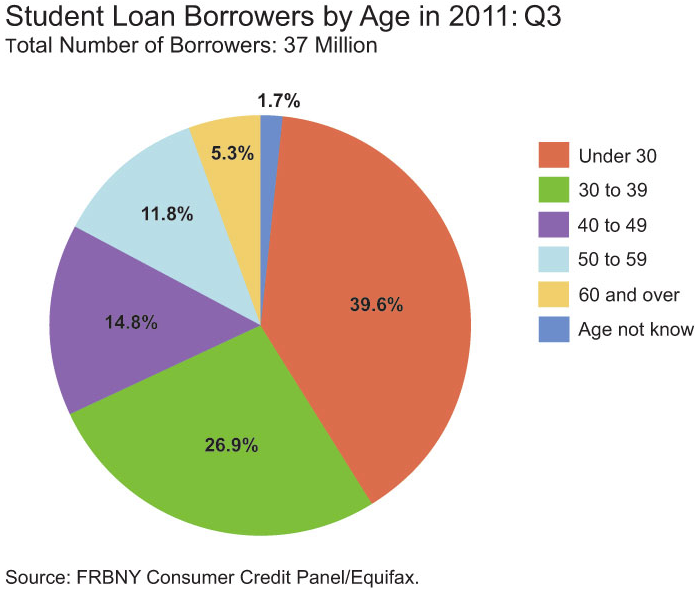
Unsurprisingly, the burden of this debt – at least, that which is counted – is falling on the shoulders of the young, as the chart below indicates.

Delinquency rates are already high and appear to be rising. Previous calculations indicated that some 10% of those with student loans should be considered delinquent. But due to the complexity of the market this is probably far too conservative an estimate and recent calculations by the New York Fed indicate that the actual figure is probably closer to 21%. That’s pretty whopping by any standard. (Continued)

Read the entire article at Naked Capitalism

Philip Pilkington is a writer and journalist based in Dublin, Ireland.

Posted in economy, Education | Tagged , , , | 3 Comments

Macho Man Competition

Posted in Barack Obama, elections, humor, Iran, military, politics, Republican Party, war | Tagged , | Leave a comment

BPR Quote of the Day: We Don’t Have to Follow Any Stinking Fifth Amendment!

“This is a monumental pile of crap that should embarrass every Democrat who ever said an unkind word about John Yoo.”

Charles Pierce/ Politics Blog/ Esquire.com/ March 5, 2012

Pierce (author of Idiot America) was reacting to a speech by Attorney General Eric Holder, justifying the authority of the president to assassinate American citizens without charges, trial, or judicial oversight. Holder told an audience at the Northwestern University School of Law:

“The American people can be – and deserve to be – assured that actions taken in their defense are consistent with their values and their laws…Some have argued that the president is required to get permission from a federal court before taking action against a United States citizen who is a senior operational leader of Al Qaeda or associated forces. This is simply not accurate. “Due process” and “judicial process” are not one and the same, particularly when it comes to national security. The Constitution guarantees due process, not judicial process.”

Glenn Greenwald in Salon.com interprets the administrations view of “due process” as:

“the President and his underlings are your accuser, your judge, your jury and your executioner all wrapped up in one, acting in total secrecy and without your even knowing that he’s accused you and sentenced you to death, and you have no opportunity even to know about, let alone confront and address, his accusations.”

Image: snooperreport.com

Here is the text of the Fifth Amendment to the U.S. Constitution:

“No person shall be held to answer for a capital, or otherwise infamous crime, unless on a presentment or indictment of a grand jury, except in cases arising in the land or naval forces, or in the militia, when in actual service in time of war or public danger; nor shall any person be subject for the same offense to be twice put in jeopardy of life or limb; nor shall be compelled in any criminal case to be a witness against himself, nor be deprived of life, liberty, or property, without due process of law; nor shall private property be taken for public use, without just compensation.”

I suspect the authors of the Bill of Rights thought their wording and intentions were clear. It’s hard to imagine they would have taken kindly to Eric Holder’s slippery rationalizations.

Boldface added by BPR Editor
PUBLISHED IN OPEDNEWS.COM 03/07/2012
Posted in Barack Obama, civil liberties, foreign policy, Justice, law, Quotations, Terrorism, war | Tagged , , , , , , , , , , | 1 Comment

BPR Quote of the Day: There’s a Tomorrow?

“To people who think of themselves as God’s houseguests, American enterprise must seem arrogant beyond belief.  Or stupid.  A nation of amnesiacs, proceeding as if there were no other day but today.  Assuming the land could also forget what had been done to it.”  

Barbara Kingsolver

from her 1990 novel Animal Dreams

Posted in Economics, environment, Quotations | Tagged , | Leave a comment

Advertising’s High Cost to Society! Read This Now! You’ll Like It!

 by Arlen Grossman

“Advertising is a racket, like the movies and the brokerage business. You cannot be honest without admitting that its constructive contribution to humanity is exactly minus zero.”

                             –F. Scott Fitzgerald

How much commercialism are we willing to tolerate? Advertising in America continues to grow and permeate nearly every aspect of our culture. It’s hard to be or go anywhere without someone trying to sell you something.

Commercials multiply and nibble away more time from our favorite TV shows and radio stations. The internet flashes countless pop-ups and pulsating ads from every direction. Movie theaters run commercials before the trailers, newspapers run ads right on the front page, and colorful advertising covers supermarket floors and the insides of  our shopping carts.


Good luck finding the table of contents as you scan the endless pages of advertising in the front of your favorite magazine. Ads and commercials cover more and more space inside athletic stadiums, on gas station pumps, and even in public restrooms. Advertising has infiltrated schools, and product placements are surreptitiously slipped into movies and TV shows. Ad agencies are working overtime creating newer and more invasive ways of promoting their products.

“We never know where the consumer is going to be at any point in time, so we have to find a way to be everywhere,” explains Linda Kaplan Thaler, a New York ad agency executive. “Ubiquity is the new exclusivity.”

So fasten your seat belts, American consumer. Advertising in the United States has grown eighty-fold since the 1920s, with 2011 revenue predicted to be $173 billion out of a global total of $474 billion.

But is all this advertising a good or a bad thing? Last October the United Kingdom-based World Wildlife Federation and the Public Interest Research Centre tackled that question with a report titled “Think of Me As Evil? Opening the Ethical Debates in Advertising.” It presented considerable evidence that “advertising may be encouraging society to save less, borrow more, work harder and consume greater quantities of material goods,” and concluded that we as a society need to be paying more attention to these issues.

According to the report, there exists a “work-spend cycle whereby advertising heightens the expectations about the acceptable material standard of living, leading people to work longer hours in order to attain a disposable income that allows them to meet those expectations.”

The study points out that advertising encourages materialism and consumption, values detrimental to our sense of family and community, and diminishes interest in preserving the environment.

The report contains recommendations for minimizing “the negative impact that advertising has on cultural values,” and reducing “the pervasiveness of advertising, reversing the trend to communicate with us as consumers in every facet of our lives.” One of the co-authors of the study noted that usage of the word “consumer” began to eclipse the word “citizen” during the mid-1970s.

Even harsher criticism comes from Kalle Lasn, co-founder of Adbusters, the Canadian magazine which helped launch Occupy Wall Street, when he describes advertising as  “the most prevalent and toxic of the mental pollutants. From the moment your radio alarm sounds in the morning to the wee hours of late-night TV microjolts of commercial pollution flood into your brain at the rate of around 3,000 marketing messages per day. Every day an estimated twelve billion display ads, 3 million radio commercials and more than 200,000 television commercials are dumped into North America’s collective unconscious.”

The growth of advertising and our consumer culture appears unending and, to this point in time, so is our tolerance of it.

PUBLISHED IN OPEDNEWS.COM 03/07/2012
Posted in Economics, economy, environment, media | Tagged , , , , , , , , , , , , , , | Leave a comment

Why We Keep Getting Screwed

Posted in Barack Obama, Economics, economy, elections, government, politics | Tagged , , , , , , , , | Leave a comment

Too Rich and Powerful to Fail

Posted in Economics, economy, inequality | Tagged , , | Leave a comment

New Sign at Your Gas Station

Posted in economy, humor | Tagged , | Leave a comment