
Distracting the American People Is the Goal
By Arlen Grossman
Does it seem as if our invasion of Iran was poorly planned? It doesn’t matter. Most likely it wasn’t planned at all.
Just a few weeks ago, the Epstein files dominated headline news. Every day, new evidence related to Epstein’s crimes—often lost, suppressed, or heavily redacted—was being uncovered. The most damaging information, potentially implicating Trump in the rape of underage girls, seemed on the verge of being made public.
Even a president with diminished capacity would realize that such evidence would threaten his hold on the presidency, a role that brings Donald Trump what he thrives on: prestige, power, and wealth. To avoid losing it all, he figured the most effective strategy would be to shift America’s focus elsewhere.
Trump appeared to understand, at least on some level, that initiating a war would reliably distract the American public. Historically, U.S. military action has captured national attention and pushed other scandals and problems to the background. With this nation’s short attention span and appetite for war news, the Epstein files were quickly overshadowed by the sudden invasion of Iran.
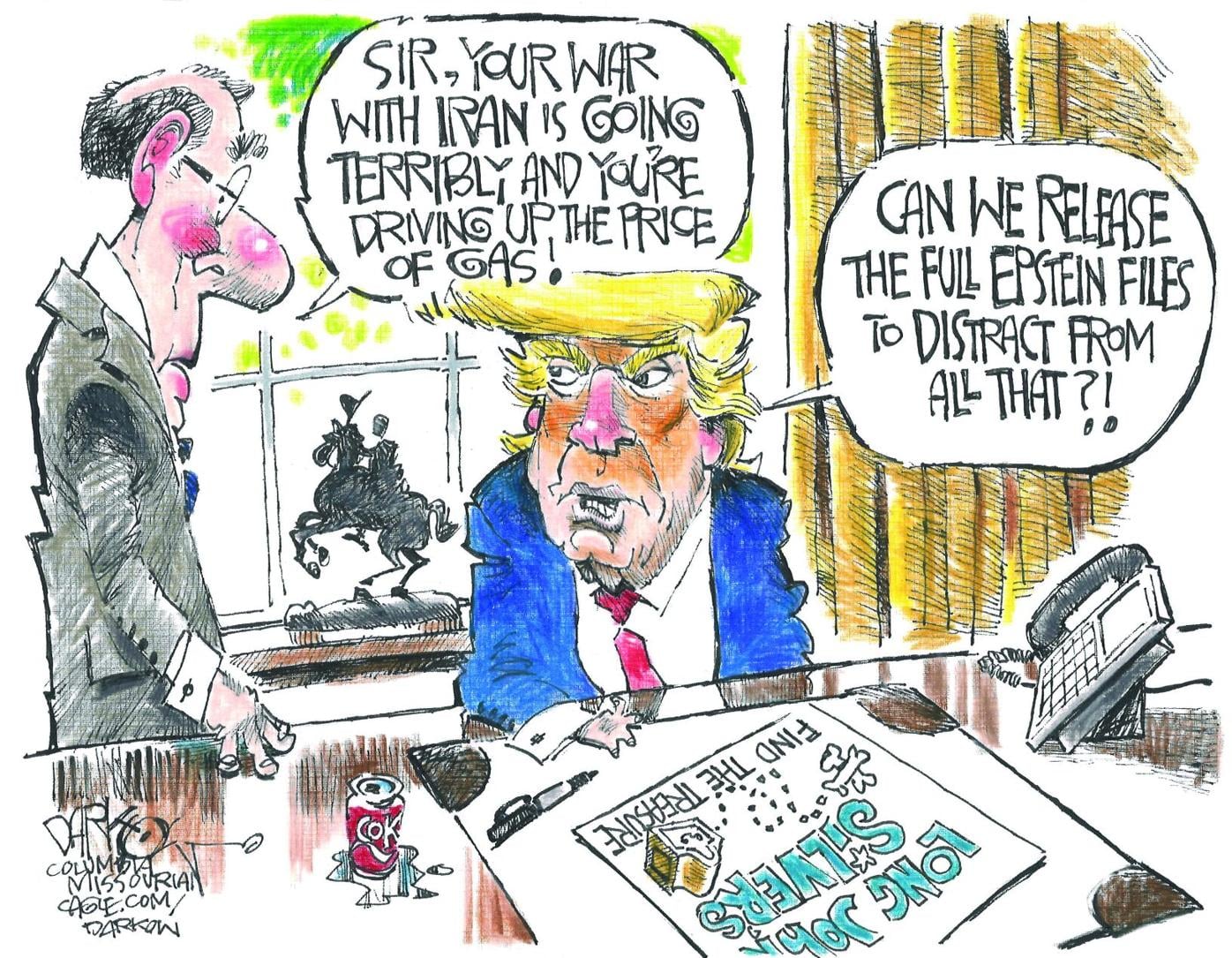
It is unclear who Trump consulted before acting, perhaps Secretary of War Pete Hegseth (and maybe no one else), but he made a decisive executive decision—similiar to his action in Venezuela—to initiate war against Iran, a nation already unpopular with Americans and the rest of the world.
Known for acting impulsively, Trump made a quick decision. Empowered by the authority of his office, he realized that nobody could prevent him from taking action, so he ordered the assault with minimal, if any, consultation or advice from his Republican friends in Congress or anywhere else.
That scenario couldn’t be more obvious, because you would expect that anyone who worked with or was consulted by Trump would at least get their stories straight, but they couldn’t and didn’t. Reasons for the invasion were all over the map. Confusion reigned.
Trump invoked several justifications, referencing the 1979 hostage crisis, militant groups like Hezbollah and Hamas, Iranian-backed militias, and “47 years of Iranian aggression.” He encouraged the Iranian people to rise up and overthrow their government.
He also framed the campaign as an effort to “eliminate the imminent nuclear threat.” (Never mind that when Trump ordered strikes on Iran last summer, he and his administration repeatedly declared that the attacks had obliterated the Middle Eastern country’s nuclear program and set back its ability to make a nuclear weapon for years.)
Secretary of “War” Hegseth said the conflict in Iran was not about regime change. “The goal, is to unleash death and destruction from the sky all day long.” He explained that the justification for the offensive was Iran’s “swelling arsenal of ballistic missiles and killer drones, which he said they were using to “create a conventional shield for their nuclear blackmail ambitions.”
Secretary of State Marco Rubio said. “The imminent threat was that we knew that if Iran was attacked, and we believed they would be attacked, that they would immediately come after us, and we were not going to sit, sit there and absorb a blow before we respond.” He said the Trump administration chose to attack preemptively because Israel was planning to strike Iran, and “we knew that that would precipitate an attack against American forces.”
House Speaker Mike Johnson backed Rubio’s new rationale, saying the consequences would have been staggering if the U.S. didn’t attack at the same time as Israel, saying the consequences of inaction on our part could have been devastating…. this operation needed to happen.”
Trump and his advisors were unable to articulate a convincing case for an immediate war with Iran, because they had no chance to think of one. Trump had left them, and virtually everyone else, out of the loop. They weren’t expecting Trump’s premature invasion. His spontaneous decision was to protect his reputation and delay any surfacing of evidence of involvement with any sex crimes by going to war immediately even without a real plan.
The war in Iran has been a colossal mistake because every aspect of it was ill-prepared, unplanned and uncoordinated. Forget about placing blame on any other individual or country. The blame goes to President Trump. His fear of being caught in the Epstein crimes led him to panic and act in haste.
And in the end, what is most likely to happen is that he has just wasted time for the inevitable, the evidence of his abusing underage girls, and because of that, being forced to give up his presidency.

