-
Recent Posts
-
Join 441 other subscribers
Categories
Archives
- October 2026
- September 2026
- August 2026
- July 2026
- June 2026
- May 2026
- April 2026
- March 2026
- February 2026
- January 2026
- December 2025
- November 2025
- October 2025
- September 2025
- August 2025
- July 2025
- June 2025
- May 2025
- April 2025
- March 2025
- February 2025
- January 2025
- December 2024
- November 2024
- October 2024
- September 2024
- August 2024
- July 2024
- June 2024
- May 2024
- April 2024
- March 2024
- February 2024
- January 2024
- December 2023
- November 2023
- October 2023
- September 2023
- August 2023
- July 2023
- June 2023
- May 2023
- April 2023
- March 2023
- February 2023
- January 2023
- December 2022
- November 2022
- October 2022
- September 2022
- August 2022
- July 2022
- June 2022
- May 2022
- April 2022
- March 2022
- February 2022
- January 2022
- December 2021
- November 2021
- October 2021
- September 2021
- August 2021
- August 2020
- July 2020
- June 2020
- May 2020
- April 2020
- March 2020
- February 2020
- January 2020
- December 2019
- November 2019
- October 2019
- September 2019
- August 2019
- July 2019
- June 2019
- May 2019
- April 2019
- March 2019
- February 2019
- January 2019
- December 2018
- November 2018
- October 2018
- September 2018
- August 2018
- July 2018
- June 2018
- May 2018
- April 2018
- March 2018
- February 2018
- January 2018
- December 2017
- November 2017
- October 2017
- September 2017
- August 2017
- July 2017
- June 2017
- May 2017
- April 2017
- March 2017
- February 2017
- January 2017
- December 2016
- November 2016
- October 2016
- September 2016
- August 2016
- July 2016
- June 2016
- May 2016
- April 2016
- March 2016
- February 2016
- January 2016
- December 2015
- November 2015
- October 2015
- September 2015
- August 2015
- July 2015
- May 2015
- April 2015
- March 2015
- February 2015
- January 2015
- November 2014
- October 2014
- September 2014
- August 2014
- July 2014
- June 2014
- February 2014
- January 2014
- December 2013
- November 2013
- October 2013
- September 2013
- August 2013
- March 2013
- February 2013
- January 2013
- December 2012
- November 2012
- October 2012
- September 2012
- August 2012
- July 2012
- June 2012
- May 2012
- April 2012
- March 2012
- February 2012
- January 2012
- December 2011
- November 2011
- October 2011
- September 2011
- August 2011
- July 2011
- June 2011
- May 2011
- April 2011
- March 2011
- January 2011
- December 2010
Blogroll
Meta
Suddenly the Supreme Court Begins to Pay Attention
Posted in civil liberties, government, health care, law, Supreme Court
Tagged drones, Matt Wuerker, Politico, Roberts court
2 Comments
What We Don’t Know Can’t Hurt Us, Right?
Posted in Economics, environment, government, health care, law, politics, science
Tagged food labeling, France, Germany, GMOs, Italy, LabelGMOs.org, UrbanOrganicGardener.com
Leave a comment
Charlie Chaplin, exploitation, factories, industrialization, and sticking up for the working man…
The famous factory scene in Charlie Chaplin’s film Modern Times in which his character goes mad, is probably one of my favorite scenes ever filmed. Chaplin plays a factory worker who’s mind turns to mush after longs days spent working on a fast moving conveyor belt. After taking a much needed break, he finds himself reluctant to return to the grueling labor he abhors. He pretends to tend to his nails while a co-worker takes over for him. His short break doesn’t last long. He ends up being sucked down the belt and into the guts of the beastly machine.
In real life, Chaplin made the film as a dig towards factories and their owners, particularly Henry Ford. Chaplin was convinced that most factory workers were treated poorly and overworked. I believe he felt as though there was a loss of individualism, which is always dangerous. Anti-authoritism is a motif that…
View original post 132 more words
Posted in Uncategorized
2 Comments
Fox News Isn’t Enough?
BPR Editor’s Note: Another George Orwell Big Brother nightmare may be on its way to unsuspecting Americans….
Congressmen Seek To Lift Propaganda Ban
Propaganda that was supposed to target foreigners could now be aimed at Americans, reversing a longstanding policy.
By Michael Hastings/ Buzzfeed/ May 18, 2012
Amy Sly for BuzzFeed
An amendment that would legalize the use of propaganda on American audiences is being inserted into the latest defense authorization bill, BuzzFeed has learned.
The amendment would “strike the current ban on domestic dissemination” of propaganda material produced by the State Department and the Pentagon, according to the summary of the law at the House Rules Committee’s official website.
The tweak to the bill would essentially neutralize two previous acts—the Smith-Mundt Act of 1948 and Foreign Relations Authorization Act in 1987—that had been passed to protect U.S. audiences from our own government’s misinformation campaigns.
The bi-partisan amendment is sponsored by Rep. Mac Thornberry from Texas and Rep. Adam Smith from Washington State.
In a little noticed press release earlier in the week — buried beneath the other high-profile issues in the $642 billion defense bill, including indefinite detention and a prohibition on gay marriage at military installations — Thornberry warned that in the Internet age, the current law “ties the hands of America’s diplomatic officials, military, and others by inhibiting our ability to effectively communicate in a credible way.”
The bill’s supporters say the informational material used overseas to influence foreign audiences is too good to not use at home, and that new techniques are needed to help fight Al-Qaeda, a borderless enemy whose own propaganda reaches Americans online.
Critics of the bill say there are ways to keep America safe without turning the massive information operations apparatus within the federal government against American citizens.
“Clearly there are ways to modernize for the information age without wiping out the distinction between domestic and foreign audiences,” says Michael Shank, Vice President at the Institute for Economics and Peace in Washington D.C. “That Reps Adam Smith and Mac Thornberry want to roll back protections put in place by previously-serving Senators – who, in their wisdom, ensured limits to taxpayer–funded propaganda promulgated by the US government – is disconcerting and dangerous.”
“I just don’t want to see something this significant – whatever the pros and cons – go through without anyone noticing,” says one source on the Hill, who is disturbed by the law. According to this source, the law would allow “U.S. propaganda intended to influence foreign audiences to be used on the domestic population.”
The new law would give sweeping powers to the State Department and Pentagon to push television, radio, newspaper, and social media onto the U.S. public. “It removes the protection for Americans,” says a Pentagon official who is concerned about the law. “It removes oversight from the people who want to put out this information. There are no checks and balances. No one knows if the information is accurate, partially accurate, or entirely false.”
According to this official, “senior public affairs” officers within the Department of Defense want to “get rid” of Smith-Mundt and other restrictions because it prevents information activities designed to prop up unpopular policies—like the wars in Iraq and Afghanistan.
Critics of the bill point out that there was rigorous debate when Smith Mundt passed, and the fact that this is so “under the radar,” as the Pentagon official puts it, is troubling.
The Pentagon spends some $4 billion a year to sway public opinion already, and it was recently revealed by USA Today the DoD spent $202 million on information operations in Iraq and Afghanistan last year.
In an apparent retaliation to the USA Today investigation, the two reporters working on the story appear to have been targeted by Pentagon contractors, who created fake Facebook pages and Twitter accounts in an attempt to discredit them.
(In fact, a second amendment to the authorization bill — in reaction to the USA Today report — seeks for cuts to the Pentagon’s propaganda budget overseas, while this amendment will make it easier for the propaganda to spread at home.)
The evaporation of Smith-Mundt and other provisions to safeguard U.S. citizens against government propaganda campaigns is part of a larger trend within the diplomatic and military establishment.
In December, the Pentagon used software to monitor the Twitter debate over Bradley Manning’s pre-trial hearing; another program being developed by the Pentagon would design software to create “sock puppets” on social media outlets; and, last year, General William Caldwell, deployed an information operations team under his command that had been trained in psychological operations to influence visiting American politicians to Kabul.
The upshot, at times, is the Department of Defense using the same tools on U.S. citizens as on a hostile, foreign, population.
A U.S. Army whistleblower, Lieutenant Col. Daniel Davis, noted recently in his scathing 84-page unclassified report on Afghanistan that there remains a strong desire within the defense establishment “to enable Public Affairs officers to influence American public opinion when they deem it necessary to “protect a key friendly center of gravity, to wit US national will,” he wrote, quoting a well-regarded general.
The defense bill passed the House Friday afternoon.
Boldface added by BPR Editor
Too Hot For TED: Multi-Billionaire’s Banned Speech
Don’t Miss This One! The Speech TED Didn’t Want You to See…..
BPR Editor’s Note: Multi-Billionaire venture capitalist Nick Hanauer appeared at a TED conference (invitation-only for powerful and creative business and political leaders) in March, and said things that this kind of audience was not used to hearing.
“Rich people don’t create jobs,” he told the TED audience. “An ordinary middle-class consumer is far more of a job creator than a capitalist like me.” His point: if the rich–who, since 1980, have increased their wealth three times faster than the rest of us, while having their taxes cut in half– haven’t been creating jobs, then clearly that “rich job-creators” theory is bogus. If we want the economy to grow, the answer is obvious: tax the wealthy.
TED officials initially told Hanauer they would post the talk online, as they do most other speeches. But then they changed their minds, calling his remarks about income inequality too “political.” While not aired on the TED website, they finally released Hanauer’s talk this week, and it has quickly has gone viral.
Time Business article “Was Nick Hanauer’s TED Talk on Income Inequality Too Rich for Rich People?”
Posted in Economics, economy, inequality, taxes
Tagged Nick Hanauer, TED, Time Business, venture capitalist
3 Comments
Our Real Choices
Posted in elections, government, politics
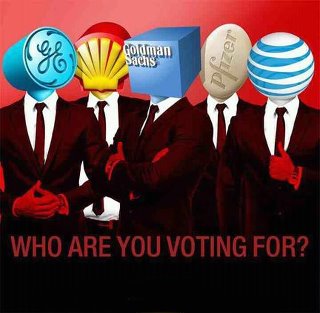
Tagged AT&T, GE, Goldman Sachs, Pfizer, Shell, voting
Leave a comment
WHY OCCUPY? WHY NOW?
Plutonomy and the Precariat:
On the History of the US Economy in Decline
by Noam Chomsky/ TomDispatch.com/ May 8, 2012
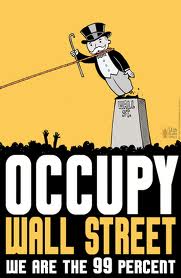
The Occupy movement has been an extremely exciting development. Unprecedented, in fact. There’s never been anything like it that I can think of. If the bonds and associations it has established can be sustained through a long, dark period ahead — because victory won’t come quickly — it could prove a significant moment in American history.
The fact that the Occupy movement is unprecedented is quite appropriate. After all, it’s an unprecedented era and has been so since the 1970s, which marked a major turning point in American history. For centuries, since the country began, it had been a developing society, and not always in very pretty ways. That’s another story, but the general progress was toward wealth, industrialization, development, and hope. There was a pretty constant expectation that it was going to go on like this. That was true even in very dark times.
I’m just old enough to remember the Great Depression. After the first few years, by the mid-1930s — although the situation was objectively much harsher than it is today — nevertheless, the spirit was quite different. There was a sense that “we’re gonna get out of it,” even among unemployed people, including a lot of my relatives, a sense that “it will get better.”
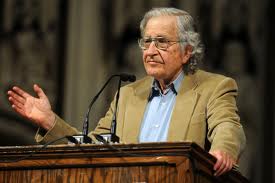
Noam Chomsky
There was militant labor union organizing going on, especially from the CIO (Congress of Industrial Organizations). It was getting to the point of sit-down strikes, which are frightening to the business world — you could see it in the business press at the time — because a sit-down strike is just a step before taking over the factory and running it yourself. The idea of worker takeovers is something which is, incidentally, very much on the agenda today, and we should keep it in mind. Also New Deal legislation was beginning to come in as a result of popular pressure. Despite the hard times, there was a sense that, somehow, “we’re gonna get out of it.”
It’s quite different now. For many people in the United States, there’s a pervasive sense of hopelessness, sometimes despair. I think it’s quite new in American history. And it has an objective basis.
On the Working Class
In the 1930s, unemployed working people could anticipate that their jobs would come back. If you’re a worker in manufacturing today — the current level of unemployment there is approximately like the Depression — and current tendencies persist, those jobs aren’t going to come back.
The change took place in the 1970s. There are a lot of reasons for it. One of the underlying factors, discussed mainly by economic historian Robert Brenner, was the falling rate of profit in manufacturing. There were other factors. It led to major changes in the economy — a reversal of several hundred years of progress towards industrialization and development that turned into a process of de-industrialization and de-development. Of course, manufacturing production continued overseas very profitably, but it’s no good for the work force.
Along with that came a significant shift of the economy from productive enterprise — producing things people need or could use — to financial manipulation. The financialization of the economy really took off at that time.
On Banks
Before the 1970s, banks were banks. They did what banks were supposed to do in a state capitalist economy: they took unused funds from your bank account, for example, and transferred them to some potentially useful purpose like helping a family buy a home or send a kid to college. That changed dramatically in the 1970s. Until then, there had been no financial crises since the Great Depression. The 1950s and 1960s had been a period of enormous growth, the highest in American history, maybe in economic history.
And it was egalitarian. The lowest quintile did about as well as the highest quintile. Lots of people moved into reasonable lifestyles — what’s called the “middle class” here, the “working class” in other countries — but it was real. And the 1960s accelerated it. The activism of those years, after a pretty dismal decade, really civilized the country in lots of ways that are permanent.
When the 1970s came along, there were sudden and sharp changes: de-industrialization, the off-shoring of production, and the shift to financial institutions, which grew enormously. I should say that, in the 1950s and 1960s, there was also the development of what several decades later became the high-tech economy: computers, the Internet, the IT Revolution developed substantially in the state sector.
The developments that took place during the 1970s set off a vicious cycle. It led to the concentration of wealth increasingly in the hands of the financial sector. This doesn’t benefit the economy — it probably harms it and society — but it did lead to a tremendous concentration of wealth.
On Politics and Money
Concentration of wealth yields concentration of political power. And concentration of political power gives rise to legislation that increases and accelerates the cycle. The legislation, essentially bipartisan, drives new fiscal policies and tax changes, as well as the rules of corporate governance and deregulation. Alongside this began a sharp rise in the costs of elections, which drove the political parties even deeper into the pockets of the corporate sector.
The parties dissolved in many ways. It used to be that if a person in Congress hoped for a position such as a committee chair, he or she got it mainly through seniority and service. Within a couple of years, they started having to put money into the party coffers in order to get ahead, a topic studied mainly by Tom Ferguson. That just drove the whole system even deeper into the pockets of the corporate sector (increasingly the financial sector).
This cycle resulted in a tremendous concentration of wealth, mainly in the top tenth of one percent of the population. Meanwhile, it opened a period of stagnation or even decline for the majority of the population. People got by, but by artificial means such as longer working hours, high rates of borrowing and debt, and reliance on asset inflation like the recent housing bubble. Pretty soon those working hours were much higher in the United States than in other industrial countries like Japan and various places in Europe. So there was a period of stagnation and decline for the majority alongside a period of sharp concentration of wealth. The political system began to dissolve.
There has always been a gap between public policy and public will, but it just grew astronomically. You can see it right now, in fact. Take a look at the big topic in Washington that everyone concentrates on: the deficit. For the public, correctly, the deficit is not regarded as much of an issue. And it isn’t really much of an issue. The issue is joblessness. There’s a deficit commission but no joblessness commission. As far as the deficit is concerned, the public has opinions. Take a look at the polls. The public overwhelmingly supports higher taxes on the wealthy, which have declined sharply in this period of stagnation and decline, and the preservation of limited social benefits.
The outcome of the deficit commission is probably going to be the opposite. The Occupy movements could provide a mass base for trying to avert what amounts to a dagger pointed at the heart of the country.
Plutonomy and the Precariat
For the general population, the 99% in the imagery of the Occupy movement, it’s been pretty harsh — and it could get worse. This could be a period of irreversible decline. For the 1% and even less — the .1% — it’s just fine. They are richer than ever, more powerful than ever, controlling the political system, disregarding the public. And if it can continue, as far as they’re concerned, sure, why not? (Continued)
(excerpted from Chomsky’s book “Occupy,” Zuccotti Park Press)
Boldface added by BPR Editor
Noam Chomsky is Institute Professor (retired) at MIT. He is the author of many books and articles on international affairs and social-political issues, and a long-time participant in activist movements.
Posted in Economics, economy, finance, inequality, Occupy, Occupy Wall Street, protest, protests, Wall Street
Tagged banks, Noam Chomsky, Plutonomy, Precariat, TomDispatch, wealth, Zuccatti Park Press
Leave a comment
This Campaign is Going Strong
BPR Quote of the Day
“The war on privilege will never end. Its next great campaign will be against the privileges of the underprivileged.”
H.L. Mencken
“THE ‘WAR ON TERROR’ IS A HOAX”
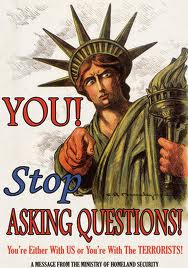
BPR Editor’s Note: Hardly anyone with credentials will speak the truth: the “War on Terror” is a hoax. A hoax perpetrated by the Military/Industrial/Security structure in order to rake in billions of dollars and decimate our civil liberties by keeping Americans in a constant state of fear and insecurity.
Paul Craig Roberts is that rare individual with government experience and credibility not afraid to speak what he sees as the truth, even though it guarantees that what he says will be ignored by the corporate media and those with power in Washington.
The reality is that the threat from terrorism in the future will more likely come from frustrated and angry young Muslim men–here and abroad– enraged by the continuing military misadventures of the United States: the drone attacks, wars and occupations, permanent military bases, and death of civilians all over the globe.
The Case of the Missing Terrorists
by Paul Craig Roberts/ Institute for Political Economy/ May 14, 2012
If there were any real terrorists, Jose Rodriguez would be dead.
Who is Jose Rodriguez? He is the criminal who ran the CIA torture program. Most of his victims were not terrorists or even insurgents. Most were hapless individuals kidnapped by warlords and sold to the Americans as “terrorists” for the bounty paid.
If Rodriguez’s identity was previously a secret, it is no more. He has been on CBS “60 Minutes” taking credit for torturing Muslims and using the information allegedly gained to kill leaders of al Qaeda. If terrorists were really the problem that Homeland Security, the FBI and CIA claim, Rodriguez’s name would be a struck through item on the terrorists’ hit list. He would be in his grave.
So, also, would be John Yoo, who wrote the Justice (sic) Department memos giving the green light to torture, despite US and International laws prohibiting torture. Apparently, Yoo, a professor at the Boalt School of Law at the University of California, Berkeley, was ignorant of US and international law. And so was the US Department of Justice (sic).
Notice that Rodriguez, “The Torturer of the Muslims,” does’t have to hide. He can go on national television, reveal his identity, and revel in his success in torturing and murdering Muslims. Rodriguez has no Secret Service protection and would be an easy mark for assassination by terrorists so capable as to have, allegedly, pulled off 9/11.
Another easy mark for assassination would be former Secretary of Defense Donald Rumsfeld, who staffed up the Pentagon with neoconservative warmongers such as Paul Wolfowitz and Douglas Feith, who in turn concocted the false information used to justify the invasions of Iraq and Afghanistan. Rumsfeld himself declared members of al Qaeda to be the most vicious and dangerous killers on earth. Yet Rumsfeld, Wolfowitz, Feith, Richard Perle, together with neoconservative media propagandists, such as William Kristol and Max Boot, have been walking around safe for years unmolested by terrorists seeking revenge or bringing retribution to those responsible for as many as 1,000,000 Muslim deaths.
Condi Rice, Colin Powell, who delivered the Speech of Lies to the UN inaugurating the invasion of Iraq, and Dick Cheney, whose minimal Secret Service protection could not withstand a determined assassination attempt, also enjoy lives unmolested by terrorists.
Remember the deck of cards that the Bush regime had with Iraqi faces? If terrorists had a similar deck, all of those named above would be “high value targets.” Yet, there has not been a single attempt on any one of them.
Strange, isn’t it, that none of the above are faced with a terrorist threat. Yet, the tough, macho Navy Seals who allegedly killed Osama bin Laden must have their identity kept hidden so that they don’t become terrorist targets. These American supermen, highly trained killers themselves, don’t dare show their faces, but Rodriguez, Rumsfeld, and Condi Rice can walk around unmolested. Indeed, the Seals’ lives are so endangered that President Obama gave up the enormous public relations political benefit of a White House ceremony with the heroic Navy Seals. Very strange behavior for a politician. A couple of weeks after the alleged bin Laden killing, the Seals unit, or most of it, was wiped out in a helicopter crash in Afghanistan.
If you were a Muslim terrorist seeking retribution for Washington’s crimes, would you try to smuggle aboard an airliner a bomb in your underwear or shoe in order to blow up people whose only responsibility for Washington’s war against Muslims is that they fell for Washington’s propaganda? If you wanted to blow up the innocent, wouldn’t you instead place your bomb in the middle of the mass of humanity waiting to clear airport security and take out TSA personnel along with passengers? Terrorists could coordinate their attacks, hitting a number of large airports across the US at the same minute. This would be real terror. Moreover, it would present TSA with an insolvable problem: how can people be screened before they are screened?
Or coordinated attacks on shopping malls and sports events?
Why should terrorists, if they exist, bother to kill people when it is easy to cause mayhem by not killing them? There are a large number of unguarded electric power substations. Entire regions of the country could be shut down. The simplest disruptive act would be to release large quantities of roofing nails in the midst of rush hour traffic in Boston, New York, Washington DC, Atlanta, Dallas, Chicago, Los Angeles, San Francisco. You get the picture: thousands and thousands of cars disabled with flat tires blocking the main arteries for days.
Before some reader accuses me of giving terrorists ideas, ask yourself if you really think people so clever as to have allegedly planned and carried out 9/11 couldn’t think of such simple tactics, plots that could be carried out without having to defeat security or kill innocent people? My point isn’t what terrorists, if they exist, should do. The point is that the absence of easy-to-do acts of terrorism suggests that the terrorist threat is more hype than reality. Yet, we have an expensive, intrusive security apparatus that seems to have no real function except to exercise power over American citizens.
Image: schnews.org.uk
In place of real terrorists carrying out easy plots, we have “terrorist” plots dreamed up by FBI and CIA agents, who then recruit some hapless or demented dupes, bribing them with money and heroic images of themselves, and supplying them with the plot and fake explosives. These are called “sting operations,” but they are not. They are orchestrations by our own security agencies that produce fake terrorist plots that are then “foiled” by the security agencies that hatched the plots. Washington’s announcement is always: “The public was never in danger.” Some terrorist plot! We have never been endangered by one, but the airports have been on orange alert for 11.5 years.
The federal judiciary and brainwashed juries actually treat these concocted plots as real threats to American security despite the government’s announcements that the public was never in danger.
The announcements of the “foiled” plots keep the brainwashed public docile and amenable to intrusive searches, warrantless spying, the growth of an unaccountable police state, and endless wars.
The “War on Terror” is a hoax, one that has been successfully used to destroy the US Constitution and to complete the transformation of law from a shield of the people into a weapon in the hands of the state. By destroying habeas corpus, due process, and the presumption of innocence, the “War on Terror” has destroyed our security.
Paul Craig Roberts was an editor of the Wall Street Journal and an Assistant Secretary of the U.S. Treasury under the Reagan Administration.
Boldface added by BPR Editor
Posted in civil liberties, law, media, Terrorism, war
Tagged CIA, Donald Rumsfeld, FBI, homeland security, Institute for Political Economy, John Yoo, Jose Rodriguez, Muslims, Navy Seals, Paul Craig Roberts, TSA, war on terror
7 Comments