
BPR Quote of the Day

“Say what you will about the sweet miracle of unquesting faith. I consider the capacity for it terrifying.”
Kurt Vonnegut
BPR Quote of the Day
“Say what you will about the sweet miracle of unquesting faith. I consider the capacity for it terrifying.”
Kurt Vonnegut
To paraphrase Mark Twain, the reports of the death of the Occupy movement are greatly exaggerated. Chris Hedges makes the case that Occupy is lying dormant, ready to return in an as yet unknown form, to continue what it started. Hedges does not see the answer for what ails us coming through electoral politics. Because of the money and power of the One Percent, I believe his assessment is correct. Hedges and others believe the solution lies in a mass global movement. The seeds were planted here by Occupy Wall Street. Before it’s too late, we need Occupy to regenerate, in whatever form it needs to survive and grow, to continue the fight to recapture what the ruling elite has stolen. –The BPR Editor

In every conflict, insurgency, uprising and revolution I have covered as a foreign correspondent, the power elite used periods of dormancy, lulls and setbacks to write off the opposition. This is why obituaries for the Occupy movement are in vogue. And this is why the next groundswell of popular protest—and there will be one—will be labeled as “unexpected,” a “shock” and a “surprise.” The television pundits and talking heads, the columnists and academics who declare the movement dead are as out of touch with reality now as they were on Sept. 17 when New York City’s Zuccotti Parkwas occupied. Nothing this movement does will ever be seen by them as a success. Nothing it does will ever be good enough. Nothing, short of its dissolution and the funneling of its energy back into the political system, will be considered beneficial.
Those who have the largest megaphones in our corporate state serve the very systems of power we are seeking to topple. They encourage us, whether on Fox or MSNBC, to debate inanities, trivia, gossip or the personal narratives of candidates. They seek to channel legitimate outrage and direct it into the black hole of corporate politics. They spin these silly, useless stories from the “left” or the “right” while ignoring the egregious assault by corporate power on the citizenry, an assault enabled by the Democrats and the Republicans. Don’t waste time watching or listening. They exist to confuse and demoralize you.
The engine of all protest movements rests, finally, not in the hands of the protesters but the ruling class. If the ruling class responds rationally to the grievances and injustices that drive people into the streets, as it did during the New Deal, if it institutes jobs programs for the poor and the young, a prolongation of unemployment benefits (which hundreds of thousands of Americans have just lost), improved Medicare for all, infrastructure projects, a moratorium on foreclosures and bank repossessions, and a forgiveness of student debt, then a mass movement can be diluted. Under a rational ruling class, one that responds to the demands of the citizenry, the energy in the street can be channeled back into the mainstream. But once the system calcifies as a servant of the interests of the corporate elites, as has happened in the United States, formal political power thwarts justice rather than advances it.
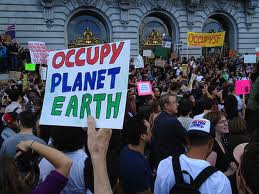
Our dying corporate class, corrupt, engorged on obscene profits and indifferent to human suffering, is the guarantee that the mass movement will expand and flourish. No one knows when. No one knows how. The future movement may not resemble Occupy. It may not even bear the name Occupy. But it will come. I have seen this before. And we should use this time to prepare, to educate ourselves about the best ways to fight back, to learn from our mistakes, as many Occupiers are doing in New York, Washington, D.C., Philadelphia and other cities. There are dark and turbulent days ahead. There are powerful and frightening forces of hate, backed by corporate money, that will seek to hijack public rage and frustration to create a culture of fear. It is not certain we will win. But it is certain this is not over.
“We had a very powerful first six months,” Kevin Zeese, one of the original organizers of the Occupy encampment in Freedom Plaza in Washington, D.C., said when I reached him by phone. “We impacted the debate. We impacted policy. We showed people they are not alone. We exposed the unfair economy and our dysfunctional government. We showed people they could have an impact. We showed people they could have power. We let the genie out of the bottle. No one will put it back in.”
The physical eradication of the encampments and efforts by the corporate state to disrupt the movement through surveillance, entrapment, intimidation and infiltration have knocked many off balance. That was the intent. But there continue to be important pockets of resistance. These enclaves will provide fertile ground and direction once mass protests return. It is imperative that, no matter how dispirited we may become, we resist being lured into the dead game of electoral politics.
“The recent election in Wisconsin shows why Occupy should stay out of the elections,” Zeese said. “Many of the people who organized the Wisconsin occupation of the Capitol building became involved in the recall. First, they spent a lot of time and money collecting more than 1 million signatures. Second, they got involved in the primary where the Democrats picked someone who was not very supportive of union rights and who lost to [Gov. Scott] Walker just a couple of years ago. Third, the general election effort was corrupted by billionaire dollars. They lost. Occupy got involved in politics. What did they get? What would they have gotten if they won? They would have gotten a weak, corporate Democrat who in a couple of years would be hated. That would have undermined their credibility and demobilized their movement. Now, they have to restart their resistance movement.
“Would it not have been better if those who organized the occupation of the Capitol continued to organize an independent, mass resistance movement?” Zeese asked. “They already had strong organization in Madison, and in Dane County as well as nearby counties. They could have developed a Montreal-like movementof mass protest that stopped the function of government and built people power. Every time Walker pushed something extreme they could have been out in the streets and in the Legislature disrupting it. They could have organized general and targeted strikes. They would have built their strength. And by the time Walker faced re-election he would have been easily defeated.
“Elections are something that Occupy needs to continue to avoid,” Zeese said. “The Obama-Romney debate is not a discussion of the concerns of the American people. Obama sometimes uses Occupy language, but he puts forth virtually no job creation, nothing to end the wealth divide and no real tax reform. On tax reform, the Buffett rule—that the secretary should pay the same tax rate as the boss—is totally insufficient. We should be debating whether to go back to the Eisenhower tax rates of 91 percent, the Nixon tax rate of 70 percent or the Reagan tax rate of 50 percent for the top income earners—not whether secretaries and CEOs should be taxed at the same rate!”
The Occupy movement is not finally about occupying. It is, as Zeese points out, about shifting power from the 1 percent to the 99 percent. It is a tactic. And tactics evolve and change. The freedom rides, the sit-ins at segregated lunch counters, the marches in Birmingham and the Montgomery bus boycott were tactics used in the civil rights movement. And just as the civil rights movement often borrowed tactics used by the old Communist Party, which long foughtsegregation in the South, the Occupy movement, as Zeese points out, draws on earlier protests against global trade agreements and the worldwide protests over the invasion of Iraq. Each was, like the Occupy movement, a global response. And this is a global movement. (Continued Here)
BPR Quote of the Day
“Emperor Obama obviously could not care less about helping the Latino population. When Democrats had control of both houses of Congress he did absolutely nothing for them. Now he’s doing to Latinos what Penn State coach Jerry Sandusky allegedly did to the children of Pennsylvania — using and abusing them.“
Michael Reagan, in his June 21 column, “It’s Nice to be Emperor.”
I have three major problems with drone warfare: (1) Assassinating real people in a video-game format with no risk to the killer strikes me as immoral. (2) Drone warfare makes war too simple to wage. We can send drones so effortlessly and without risk to American troops, thereby encouraging our government to use them more often and in more countries. And since we’re not sending soldiers, we can claim we’re not violating international law. (3) By using drones in civilian areas, and inevitably killing innocent people, we are creating enemies and future terrorists faster than we are killing them. —BPR Editor
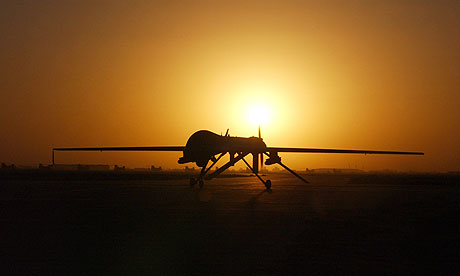
The US policy of using aerial drones to carry out targeted killings presents a major challenge to the system of international law that has endured since the second world war, a United Nations investigator has said.
Christof Heyns, the UN special rapporteur on extrajudicial killings, summary or arbitrary executions, told a conference in Geneva that President Obama’s attacks in Pakistan, Yemen and elsewhere, carried out by the CIA, would encourage other states to flout long-established human rights standards.
In his strongest critique so far of drone strikes, Heyns suggested some may even constitute “war crimes”. His comments come amid rising international unease over the surge in killings by remotely piloted unmanned aerial vehicles (UAVs).
Addressing the conference, which was organised by the American Civil Liberties Union (ACLU), a second UN rapporteur, Ben Emmerson QC, who monitors counter-terrorism, announced he would be prioritising inquiries into drone strikes.
The London-based barrister said the issue was moving rapidly up the international agenda after China and Russia this week jointly issued a statement at the UN Human Rights Council, backed by other countries, condemning drone attacks.
If the US or any other states responsible for attacks outside recognised war zones did not establish independent investigations into each killing, Emmerson emphasised, then “the UN itself should consider establishing an investigatory body”.
Also present was Pakistan’s ambassador to the UN in Geneva, Zamir Akram, who called for international legal action to halt the “totally counterproductive attacks” by the US in his country.
Heyns, a South African law professor, told the meeting: “Are we to accept major changes to the international legal system which has been in existence since world war two and survived nuclear threats?”
Some states, he added, “find targeted killings immensely attractive. Others may do so in future … Current targeting practices weaken the rule of law. Killings may be lawful in an armed conflict [such as Afghanistan] but many targeted killings take place far from areas where it’s recognised as being an armed conflict.”
If it is true, he said, that “there have been secondary drone strikes on rescuers who are helping (the injured) after an initial drone attack, those further attacks are a war crime”.
Heyns ridiculed the US suggestion that targeted UAV strikes on al-Qaida or allied groups were a legitimate response to the 9/11 attacks. “It’s difficult to see how any killings carried out in 2012 can be justified as in response to [events] in 2001,” he said. “Some states seem to want to invent new laws to justify new practices.
“The targeting is often operated by intelligence agencies which fall outside the scope of accountability. The term ‘targeted killing’ is wrong because it suggests little violence has occurred. The collateral damage may be less than aerial bombardment, but because they eliminate the risk to soldiers they can be used more often.”
Heyns told the Guardian later that his future inquiries are likely to include the question of whether other countries, such as the UK, share intelligence with the US that could be used for selecting individuals as targets. A legal case has already been lodged in London over the UK’s alleged role in the deaths of British citizens and others as a consequence of US drone strikes in Pakistan.
Emmerson said that protection of the right to life required countries to establish independent inquiries into each drone killing. “That needs to be applied in the context of targeted killings,” he said. “It’s possible for a state to establish an independent ombudsman to inquire into every attack and there needs to be a report to justify [the killing].”
Alternatively, he said, it was “for the UN itself to consider establishing an investigatory body. Drones attacks by the US raise fundamental questions which are a direct consequence of my mandate… If they don’t [investigate] themselves, we will do it for them.”
It is time, he added, to end the “conspiracy of silence” over drone attacks and “shine the light of independent investigation” into the process. The attacks, he noted, were not only on those who had been killed but on the system of “international law itself”. (Continued Here)
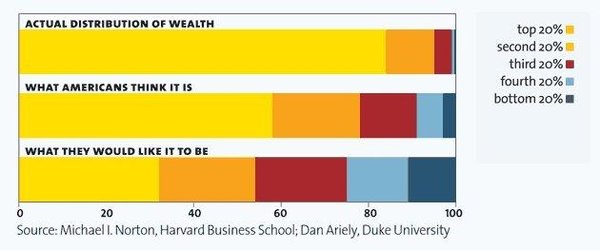
A Harvard business prof and a behavioral economist recently asked more than 5,000 Americans how they thought wealth is distributed in the United States. Most thought that it’s more balanced than it actually is. Asked to choose their ideal distribution of wealth, 92% picked one that was even more equitable. – From “It’s the Inequality, Stupid,” Mother Jones, March/April 2011
By Arlen Grossman/ The Big Picture Report
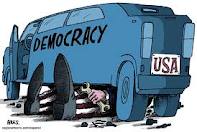
Once a shining beacon of democracy, the United States of America has lost its way. To be sure, this country didn’t start out as a democracy. If you were white, over 21 and owned property, you could vote. If not, you were out of luck–and rights. When George Washington became our first president, only 6% of the population could vote. The voting base expanded considerably since then, and this country thrived as a democracy (or a republic, if you want to be technical) through the middle years of the 20th Century.
Unfortunately, the influence of the average voter has steadily eroded in recent decades, culminating in the 2010 Citizens United decision by a conservative Supreme Court, allowing wealthy Americans and big corporations to spend unlimited amounts of money to influence elections. That is when the last vestiges of American Democracy went up in smoke, when the traditional “one man, one vote” concept of democracy ended, that vacuum filled by the powerful influence of unlimited special interest money. Politics in the U.S. today runs by legalized bribery, in which wealthy special interests promote and help elect candidates, who for their self-preservation, willingly do the bidding of their benefactors.
There is no way average voters can compete with millions of dollars of campaign spending by millionaires, billionaires and multi-national corporations. Call it oligarchy and/or plutocracy, but don’t pretend it’s democracy. If it were, our troops would leave Afghanistan, the rich would pay higher taxes, and we would enjoy universal health care, positions supported by large majorities of the American people.
In his farewell speech from the White House, President Dwight Eisenhower warned us: “In the councils of government, we must guard against the acquisition of unwarranted influence, whether sought or unsought, by the military-industrial complex. The potential for the disastrous rise of misplaced power exists and will persist.” Our leaders didn’t listen and the problem has gotten considerably worse in the more than half-century since Eisenhower’s ominous premonition.
The United States military has at least 700 and perhaps more than 1000 overseas bases and is deployed in probably over 150 countries around the world. Our military budget nearly dwarfs the rest of the world combined. We are the only military superpower, in addition to being the biggest arms dealer in the world. We desire to shape the world to our economic and strategic benefit and no other nation is capable of stopping us.
Where once the U.S. military’s mission was to defend this country, we have decided we have the right to invade any sovereign country, wage pre-emptive wars, and disregard international law. We are increasingly sending unmanned drones to kill anybody we want anywhere in the world. We are making enemies and future terrorists faster than we can kill them. Not incidentally, the military-industrial-national security complex is accumulating enormous wealth from these ventures.
Thomas Jefferson said “…were it left to me to decide whether we should have a government without newspapers or newspapers without a government, I should not hesitate a moment to prefer the latter.” Jefferson understood that without an informed citizenry democratic government would not function in the best interests of the people.
While in theory we have freedom of the press in this country, the vast majority of Americans receive their information from the major media outlets. In 1983, 90% of American media was owned by over 50 companies. That number has shrunk now to six huge corporations. Their primary interest is maximizing profit, not working for the public interest (and one of the Big Six, Rupert Murdoch’s News Corp, is widely known as a propaganda arm of the Republican Party). Information detrimental to the interests of multinational corporations is seldom reported in the major news media.
Independent, critical journalism is de-emphasized in favor of popular, titillating, high-ratings pablum: celebrity and crime news, superficial political controversies, and interviews with establishment business, political, government and military figures. Controversial social issues, frightening stories and other forms of sensationalism are covered for ratings boosts. Rarely is our economic system or our never-ending military conflicts ever seriously questioned. This narrow news programming is antithetical to the free flow of important information critical for a functioning democracy.
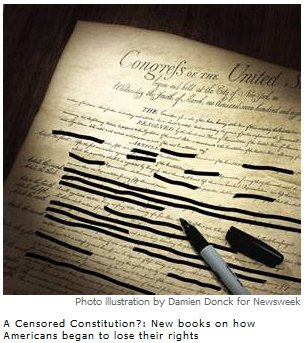
All it took was one elaborate terrorist attack to transform the Constitution and the Bill of Rights from the law of the land to a loose and weakened anachronism. Following 9/11, the fear of terrorism allowed the quick passage of the Patriot Act, and other laws and policies that greatly undercut our long history of freedom and civil liberties.
Some examples of our lost liberties and protections: search and seizure of homes and businesses without the owner’s consent or court order, warrantless wiretapping of U.S. citizens, indefinite detention of citizens and even assassination of citizens by the government without a court order, torture and/or rendition to countries who will torture for us, greater restrictions on peaceful protest and assembly. The government can legally obtain your library and other records, and prosecute librarians and record keepers if they let you know. The list goes on and on. All it takes is the mention of the word “terrorism,” and more of our established hard-fought Constitutional rights and protections crumble into dust.
Remember the American Dream: Anybody can succeed in this country. Work hard, live right, and at the very least you will be rewarded with a secure middle class life, with a home and cars, and a college education for your children. That dream is turning into a fantasy. Recent studies have found that upward economic mobility in the U.S. is less likely here than in Canada and most European countries.
The widening gap in economic inequality is a big factor in our fall from grace. America is heading down a path toward third-world status, ranking close to the bottom of income disparity among all nations. As Occupy Wall Street has pointed out, the top one percent earn about 24% of the nation’s income, and 40% of the nation’s wealth. The wealthiest 400 Americans are worth more than the entire bottom half of the country. And the inequality gap continues to widen as the wealthy accumulate more money while paying less taxes.
American Exceptionalism was a case convincingly made through much of the 20th Century, but a much harder sell today. The forward-looking, compassionate America I grew up in during the 1950s, 60s and 70s has disappeared, replaced by a greedier, meaner nation, afflicted with fear, distrust and callousness.
Our political and economic systems are seriously broken. Our freedoms and constitutional rights, once taken for granted, are disappearing; our military empire is expanding, and the middle class is shrinking away, its wealth shifting upward into the bloated, low-taxed portfolios of the One Percent.
I would like to think the exceptional America I knew as a youngster is still salvageable, that it still holds the great promise its founders envisioned: an optimistic nation that cares about people more than profits, and treats everyone, here and abroad, including the most disadvantaged, with dignity and respect. If that now-dormant spirit can be revived and re-energized, then that America is worth fighting for.
A massive restructuring of American society is necessary if there is to be any hope of recapturing the greatness that previously existed. It will require the active commitment and effort of massive numbers of angry and frustrated citizens taking to the streets and demanding it, because the traditional political system has broken down. Whether the boots on the ground come from Occupy or elsewhere, American culture and society requires significant reforming and revitalizing, which won’t happen until millions of Americans march in the streets and demand it. The American people may not be ready yet, but as conditions worsen, eventually they will be.
BPR Quote of the Day
“…the worst decision of the United States Supreme Court in the 21st century– uninformed, arrogant, naïve.”
Senator John McCain on the Citizens United decision
NY Times: John McCain’s Three Little Words


 thebigpicturereport ™