The Strangling of Traditional Agriculture

Seeds of Freedom, narrated by Jeremy Irons, charts the story of seed from its roots at the heart of traditional, diversity rich farming systems across the world, to being transformed into a powerful commodity, used to monopolise the global food system.The film highlights the extent to which the industrial agricultural system, and genetically modified (GM) seeds in particular, has impacted on the enormous agro-biodiversity evolved by farmers and communities around the world, since the beginning of agriculture.

seedsoffreedom.info

Posted in environment, Food, law, poverty, science | Tagged , , , , , | Leave a comment

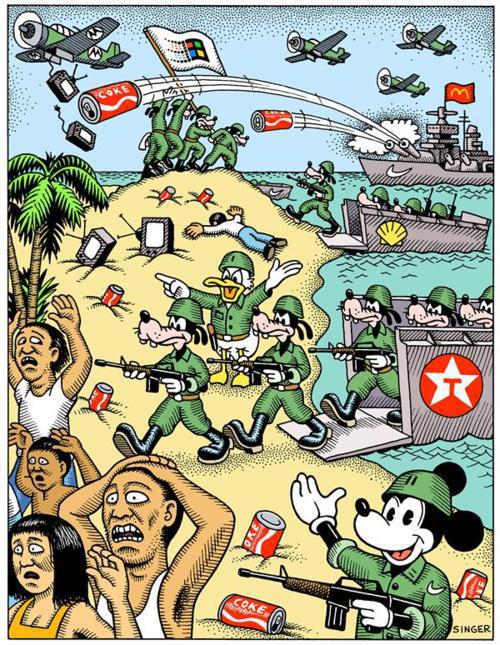
Exporting Democracy–American Style

Posted in Economics, economy, foreign policy, humor, military | Tagged | Leave a comment

Big Brother On The March

Glenn Greenwald delivered a powerful speech last week at the Socialism 2012 conference about the growth and danger of the American surveillance state. This is a scary but important examination of the pervasiveness of the growing violations of our privacy and civil liberties by government and by corporations. The speech is long but well worth reading, as this kind of information will certainly not be found anywhere in the corporate media. If this doesn’t convince you we are descending (or have descended) into an intimidating police state, then you probably don’t want to know. – BPR Editor

How America’s Surveillance State Breeds Conformity and Fear

Once the government is able to monitor everything we do and say, we will be unable to fight back.

By Glenn Greenwald/ AlterNet/ July 4, 2012

Seal of Information Awareness Office, 2002-2003

Last year was my maiden trip to the Socialism 2012 world. I started off by standing up and saying — I was actually surprised by this, pleasantly surprised, because I didn’t know what to expect — how amazingly inspirational I actually found this conference to be. The energy of activism and the sophisticated level of the conversation and the commitment that people displayed and the diversity of the attendees, really is unlike any other conference. And so when I was asked back this year, I was super excited to come back and accept. Not only because of that, but also because the conference organizers asked if I could speak about challenging the Surveillance State.

The reason that I was so eager to come and do that is because I really think that this topic is central to all of the other activism that’s being discussed here this weekend.

The Surveillance State hovers over any attacks that meaningfully challenge state-appropriated power. It doesn’t just hover over it. It impedes it, it deters it and kills it.  That’s its intent. It does that by design.

And so, understanding what the Surveillance State, how it operates — most importantly, figuring out how to challenge it and undermine it, and subvert it — really is, I think, an absolute prerequisite to any sort of meaningful activism, to developing strategies and tactics for how to challenge state and corporate power.

To begin this discussion, I want to begin with a little story that I think is illustrative and significant in lots of ways.

The story begins in the mid-1970s when there were scandals that were erupting, arising out of the Watergate investigation in the Nixon administration and/or scandals surrounding the fact that, as it turned out, the Nixon administration and various law enforcement officials in the federal government were misusing their eavesdropping powers. They were listening in on people who were political opponents, they were doing so purely out of political self-interest, having nothing to do with legal factors or the business of the nation, and this created a scandal, and unlike today, a scandal 40 years ago in the mid-1970s resulted in at least some relatively significant reactions.

In particular, a committee was formed in the Congress and the Senate, and it was headed by someone named Frank Church, who was a Democratic Party of the United States senator from Idaho who had been, in the Senate, at this time, for 20 years as one of the most widely regarded senators, and was chosen because of that. And he led this investigation into these eavesdropping abuses and tried to get into the scandal. One of the things that he discovered was that these eavesdropping abuses were radically more pervasive and egregious than anything that had been known at the start of the investigation.

It was by no means confined to the Nixon administration. In fact, it went all the way back to the 1920s, when the government first began developing the detective audio capability to eavesdrop on American citizens and heightened as the power heightened through the 1940s, when WWII would justify it; into the ’50s when the Cold War did, and the 1960s when the social unrest justified surveillance. What Senator Church found was that literally every single administration under both Democratic and Republican presidents had seriously abused this power.

And not in isolated ways, but systematically. This committee documented all the ways in which that was true, and the realization quickly emerged that, allowing government officials to eavesdrop on other people, on citizens, without constraints or oversight, to do so in the dark, is a power that gives so much authority and leverage to those in power that it is virtually impossible for human beings to resist abusing that power.  That’s how potent of a power it is.

But the second thing that he realized beyond just the general realization that this power had been systematically abused was that, there was an agency that was at the heart of this abuse, and it was the National Security Agency. And what was really amazing about the National Security Agency was that it had been formed 20 years ago back in 1949 by President Truman, and it was formed as part of the Defense Department. It was so covert that literally, for two decades, almost nobody in the government even knew that it existed, let alone knew what it did. Including key senators like Frank Church.

And part of his investigation — and actually, it was a fairly radical investigation, fairly aggressive even looking at it through cynical eyes and realizing that the ultimate impact wasn’t particularly grand, but the investigation itself was pretty impressive — and he forced his way into the National Security Agency and found out as much as he possibly could about it.

And after the investigation concluded, he issued all sorts of warnings about the Surveillance State and how it was emerging, and the urgency of only allowing government officials to eavesdrop on citizens, that they have all kinds of layers of oversight in the courts and Congress, but he issued a specific warning about the National Security Agency that is really remarkable in terms of what he said. And this is what he said — and you can find this anywhere online, in the New York Times, everywhere — he said, as part of a written report, and in an interview:

The National Security Agency’s capability at any time could be turned around on the American people, and no American would have any privacy left, such is the capability to monitor everything: telephone conversations, telegrams, it doesn’t matter.

He continued,

There would be no place to hide. If a dictator takes over the United States, the NSA could enable it to impose total tyranny, and there would be no way to fight back.

Now, there are several things that I find extraordinary about that statement. For one, the language that he uses. I mean, this is not somebody who is a speaker at the Socialism conference 2012. This was literally one of the people who was the most established institutional figures in American politics. I mean, he was in the liberal way of the Democratic Party but very much, he was mainstream for many years [ … ] And here he is warning the country of the dangers, not just of the U.S. government but specifically about the National Security Agency using words like “dictator” and “total tyranny” and warning of the way in which this power can be abused such that, essentially it would be irreversible. That once the government is able to monitor everything we do and everything we say, there’s no way to fight back because fighting back requires doing it away from their prying eyes.

And if you look now, 30 years later to where we are, not only would you never, ever hear a U.S. senator stand up and insinuate that the National Security State poses this great danger or use words like “tyranny” and “dictators” to describe the United States the way that Frank Church did only 30 years ago. Now it’s virtually a religious obligation to talk about the National Security State and its close cousin, the Surveillance State, with nothing short of veneration.

Just a few weeks ago, Chris Hayes, who’s an MSNBC host on the weekends, used the opportunity of Memorial Day to express this view in this very tortured, careful and pre-apologetic way that maybe it’s the case that not every single person who has ever served as an American soldier or enlisted in the American military is a hero. Maybe we can think about them in ways short of that. And this incredible controversy erupted, condemnation poured down on him from Democrats and conservatives, liberals and the like, and he was forced in multiple venues in the course of the next week to issue one, increasingly sheepish apology after the next. That’s how radically our discourse has changed, so that you cannot talk about the National Security State or the Surveillance State in these kinds of nefarious terms, the way that Frank Church, who probably knew more about it, did just a few decades ago.

The second remarkable aspect of that story, of that quote to me, is that the outcome of that investigation was a series of laws that were grounded in the principle that, as I said earlier, that we cannot allow government officials to eavesdrop on American citizens or in any way to engage in surveillance without all kinds of oversights and checks. The most illustrative of which was the FISA law, which said that no government official can eavesdrop on the occasion without first going through a court and proving to a court that we’re actually doing something wrong and getting the court permission before they can eavesdrop.

There was a similar controversy in the mid 2000s and in 2005 when the New York Times revealed that the Bush administration had been using the NSA to do exactly what Frank Church warned against — which is spying on the communication of American citizens. And the outcome of that was not new laws or new safeguards to constrain these sorts of abuses, it was exactly the opposite. In 2008, the Democratic-led Congress, with the support of President Obama, most of his supporters in the Democratic party and almost all Republicans basically gutted that law. Repealed it in its core and made it much, much easier for the government to eavesdrop on American citizens without constraint, and then immunized the nation’s telecoms that had participated in that illegal program.

So you see the radically different attitudes that the United States has to surveillance just some 30 years ago, when abuses resulted in a whole variety of a weak, but still meaningful legal constraint, versus what we do now when we find out that the government is lawlessly spying on us, which is act as quickly as possible to make it legal.

But the third part of why I think Church’s statements are so remarkable and important: If you look at what he said, he phrased his warning in a conditional sense. He said, If A happens, then B. A was: If the NSA starts using its eavesdropping capabilities and not directing them at foreign, nationals we suspect of spying, but instead at the American people, then B will happen. B being, we’ll essentially live under a dictatorship. There will be total tyranny where the American people will be unable to fight back because this net of surveillance will cover what we do.

And what’s really remarkable is that that conditional that he warned against — the apparatus of the NSA being directed domestically and inwardly rather than outwardly — has absolutely come to pass. That is the current situation, that is the current circumstance of the United States. The NSA, beginning 2001, was secretly ordered to spy domestically on the communications of American citizens. It has escalated in all sorts of lawless, and now lawful ways, such that it is now an enormous part of what that agency does. Even more significantly, the technology that it has developed is now shared by a whole variety of agencies, including the FBI, so that this surveillance net that Frank Church warned so stridently about, in a way that if we stood up now, we’d be immediately be branded a sort of shrill, submarginalized radical, has come to be, in all sorts of entrenched and legal ways.

Now there’s a few ways to think about the Surveillance State and try to understand its scope and magnitude. I think the most effective way to do that is to look at a couple of numbers. And to use the most mainstream sources to do that in terms of where we are, in terms of the American Surveillance State.

In 2010 the Washington Post published a three-part series called “Top Secret America” written by their Pulitzer Prize-winning investigative reporters Dana Priest and William Arkin. The first installment in that series looked at the National Security State and the Surveillance State, how it functions in the United States, and this was one of the sentences that appeared in this article. Listen to this, it said, “Every day — every day, collections systems at the National Security Agency intercept and store 1.7 billion e-mails, phone calls, and other types of comunication.”

That’s every day, they intercept and store, and keep for as long as they want, 1.7 billion e-mails and other forms of telephonic communications.

(Continued Here)

Boldface added by BPR Editor
Posted in civil liberties, government, law, law enforcement, media, military, Terrorism | Tagged , , , , , , , , , , , | Leave a comment

And John Boehner Is No Wizard

Posted in government, humor | Tagged , , , | Leave a comment

The BPR Suggestion Box

The Big Picture Report has been online for one year and it’s been a totally worthwhile and enjoyable experience for me. I’m not a techie and still feel like a bit of a novice when it comes to blogging (though I’m much farther along than I used to be).

I would very much appreciate any suggestions from the readers of this blog about how it can be improved or attract more readers. Would you like to see more of something?  Less of something?  Whatever you think, I would appreciate the feedback (and don’t spare my feelings!). If you don’t want to publicly comment, my email is agross408@aol.com.

–Arlen

Posted in Announcements | 4 Comments

We’re Number…….37?

Posted in health care, music | Tagged , | Leave a comment

The Light At the End of This Economic Tunnel Is a Train

In an interview with AlterNet, economist Joseph Stiglitz points to a dismal future for this country if we continue the current path of widening economic inequality. Deregulation, government downsizing, and an unfair tax system is making things worse. The middle class has already lost 20 years of gains, and young people are coming out of school with huge student loans, few decent job prospects, and little hope of repaying their debt. — BPR Editor

Joseph Stiglitz Sees Terrifying Future for America If We Don’t Reverse Inequality

By Lynn Parramore/ AlterNet/ June 24, 2012

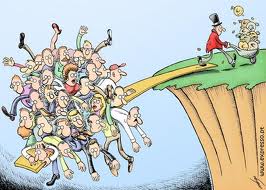
Nobel Prize-winning economist Joseph Stiglitz, one of America’s most prescient voices, wrote an article for Vanity Fair several months before Occupy Wall Street was born. “Of the 1%, by the 1%, for the 1%” called attention to the widening gap between rich and poor and its deadly impact on our society and its democratic institutions. In his newly released book, The Price of Inequality, Stiglitz returns to this theme of a divided society, delving into the origins and consequences of economic unfairness. I caught up with Professor Stiglitz and talked to him about how the persistent myths and beliefs associated with our capitalist system help to drive this trend, turning America from a land of opportunity to a land of broken dreams.
Lynn Parramore: An argument has been made, particularly since the end of the Cold War, that capitalism is great at producing things that can improve our lives, and so we ought to therefore tolerate some unfairness. What’s wrong with that narrative?

Joseph Stiglitz: Well, capitalism does have a lot of strengths, including producing things that are very innovative. But what drives capitalism is the profit motive. You can profit not only by making good things, but also by exploiting people, by exploiting the environment, by doing things that are not so good. The narrative that you describe ignores the extent to which a lot of the inequalities in the United States are not the result of creative activity but of exploitive activity. And if you look at the people at the top, what is so striking is that the people who’ve made the most important creative contributions are not there.

By that I mean the really foundational things like the computer, the transistor, the laser. And how many people at the top are people who made their money out of monopoly — exercising monopoly power? Like bankers who exploited through predatory lending practices and abusive credit card practices. Or CEOs who took advantage of deficiencies in corporate governance to get a larger share of the corporate revenues for themselves without any regard to the extent to which they have actually contributed to increasing the the sustainable well-being of the firm.

LP: How does our current situation compare to other eras in terms of the differences between ordinary Americans and the richest among us?

JS: Doing a precise comparison is difficult because we don’t have data sets that go back that far. But we do have data sets that go back more than 30 years and what is clear is that the share of the top 1 percent has almost tripled since 1980. So, this kind of inequality at the top has unambiguously gotten much, much, much worse. We also have data on the extent to which there’s been a hollowing out of the middle class. The data that recently came out from the Fed indicated that we’ve wiped out 20 years of increases and wealth for the middle American.

LP: So for most of us, 20 years of economic progress just went up in smoke. But the super-rich are doing very well. What happened?

JS: It’s the peculiar nature of the American economy, which is that’s it’s a very powerful machine that is working for a very few people, and has not been delivering for most Americans. If you had an economic machine that worked the way it was supposed to, everybody would be getting better. And an economy that’s normally growing, say, 3 percent, even over a 20-year period. Steady accumulation would lead to their wealth more than doubling in that period. And it clearly hasn’t happened. And adjusted for inflation, it would have even increased even before, unadjusted for inflation, would have increased it even more. And that clearly hasn’t happened.

LP: There’s a persistent myth that America is still the “land of opportunity.” Why is that myth so prevalent, even in the face of so much evidence to the contrary?

JS: Well, there are two reasons for this. One of them is that the myth is so much part of our sense of identity as Americans that it is devastating for us to give it up — for us to say we are less of a land of opportunity than old ossified Europe. It was one of the things we were most proud of, and clearly, it’s not true. When you have something that’s so inconsistent with your self image, it’s really, really hard to face the facts.

The second reason has to do with the nature of evidence. Everybody know examples of people who make it from the bottom or the middle-bottom to the top. And our press talks about them. The media calls attention to the successes. But when they call attention to successes they don’t say this is one of a million or one of a thousand. In fact, the reason they write about it is because they are so unusual. If most people did it, it wouldn’t be an unusual story. So, in a sense that’s how our media works. It encourages us to think of the exceptions as the norm.
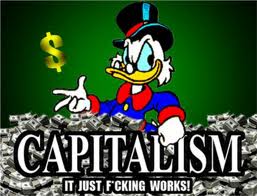
LP: Some say that if we redistribute income in a more equitable way, people won’t want to work as hard. Is that true? What happens to our motivation to work when things are so inequitable?

JS: One of the myths that I try to destroy is the myth that if we do anything about inequality it will weaken our economy. And that’s why the title of my book is The Price of Inequality. What I argue is that if we did attack these sources of inequality, we would actually have a stronger economy. We’re paying a high price for this inequality. Now, one of the mischaracterizations of those of us who want a more equal or fairer society, is that we’re in favor of total equality, and that would mean that there would be no incentives. That’s not the issue. The question is whether we could ameliorate some of the inequality — reduce some of the inequality by, for instance, curtailing monopoly power, curtailing predatory lending, curtailing abusive credit card practices, curtailing the abuses of CEO pay. All of those kinds of things, what I generically call “rent seeking,” are things that distort and destroy our economy.

So in fact, part of the problem of low taxes at the top is that since so much of the income at the very top is a result of rent seeking, when we lower the taxes, we’re effectively lowering the taxes on rent seeking, and we’re encouraging rent-seeking activities. When we have special provisions for capital gains that allow speculations to be taxed at a lower rate than people who work for a living, we encourage speculation. So that if you look at the design bit of our tax structure, it does create incentives for doing the wrong thing.

LP: When ordinary people see this speculation and unfairness, do you think it disincentivizes them to work harder, to take risks?

JS: Oh, very much so. It has a very enervating effect on our society and our economy. I describe experimental results in in my book where peoples’ incentives to work hard are reduced when they believe they are part of an unfair system.

LP: We also hear that deregulation and downsizing government is somehow supposed to make capitalism work better for all of us. Why has that persistent belief failed us?

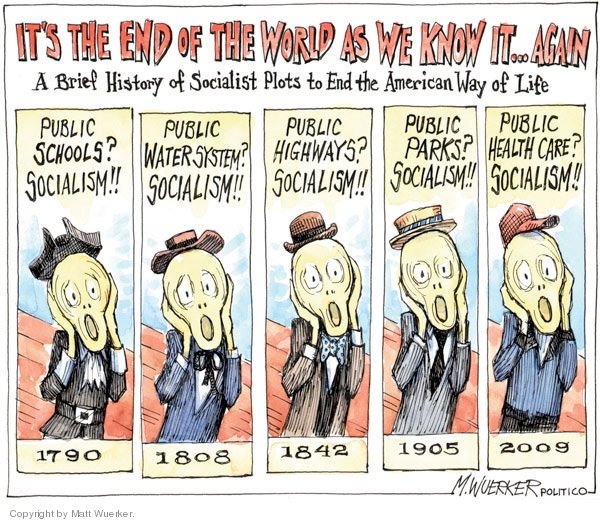
JS: A lot of these are questions about perception. To the extent that we can see waste, obviously we say that if we could get rid of that waste, we would be a better economy. By definition, waste is waste. The Republican rhetoric has focused on waste in the public sector. But waste, at some level, is an inherent consequence of human fallibility. We’re going to make mistakes, and that’s going to be true in the public and the private sector. No government program has ever wasted resources on the scale of America’s private financial sector in the run-up to the crisis. So the first thing you realize is there is waste everywhere including in the private sector.

Now if you ask people about things there are important to them … obviously they care a lot about the school their children go to. They worry about too-large classes. They worry about police protection. Those are all things that people value a lot. They value the Internet, which was created by government-funded research. Health care and drugs were are all based on government-funded research. So the bottom line is that government services have proved highly valuable. And this is where the big lie, the big distortion is.  By talking about the few instances of inefficiency, they try to direct the attention away from the teachers, the policeman, the fireman, the researchers, the people building the roads to make our society function. And they turn our attention away from the failures in the private sector.
(Continued Here)

Posted in Economics, economy, inequality, taxes, Wall Street | Tagged , , , | Leave a comment

The Robin Hood Tax

Professor Richard D. Wolff explains how a tiny “Robin Hood” or transaction tax on financial trades can raise enormous revenue for governments. 

Richard D. Wolff is Professor of Economics Emeritus, University of Massachusetts, Amherst where he taught economics from 1973 to 2008. He is currently a Visiting Professor in the Graduate Program in International Affairs of the New School University, New York City.

Robin Hood Tax Explained

Posted in Economics, economy, finance, government, inequality, taxes, Wall Street | Tagged , , | Leave a comment

Will We Survive ObamaCare?

Posted in cartoon, health care, humor | Tagged , | 2 Comments

Making the World a Better Place

Posted in Economics, economy, environment, humor, inequality, poverty | Tagged , | Leave a comment