
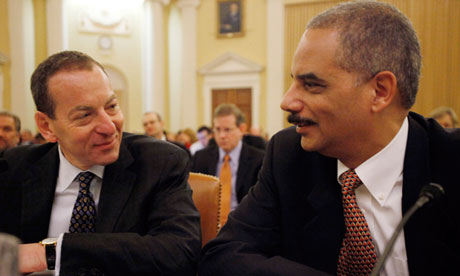
Eric Holder talks to DOJ Criminal Chief Lanny Breuer in 2010. Photograph: Jason Reed/Reuters
PBS‘ Frontline program on Tuesday night broadcast a new one-hour report on one of the greatest and most shameful failings of the Obama administration: the lack of even a single arrest or prosecution of any senior Wall Street banker for the systemic fraud that precipitated the 2008 financial crisis: a crisis from which millions of people around the world are still suffering. What this program particularly demonstrated was that the Obama justice department, in particular the Chief of its Criminal Division, Lanny Breuer, never even tried to hold the high-level criminals accountable.
What Obama justice officials did instead is exactly what they did in the face of high-level Bush era crimes of torture and warrantless eavesdropping: namely, acted to protect the most powerful factions in the society in the face of overwhelming evidence of serious criminality. Indeed, financial elites were not only vested with immunity for their fraud, but thrived as a result of it, even as ordinary Americans continue to suffer the effects of that crisis.
Worst of all, Obama justice officials both shielded and feted these Wall Street oligarchs (who, just by the way, overwhelmingly supported Obama’s 2008 presidential campaign) as they simultaneously prosecuted and imprisoned powerless Americans for far more trivial transgressions. As Harvard law professor Larry Lessig put it two weeks ago when expressing anger over the DOJ’s persecution of Aaron Swartz: “we live in a world where the architects of the financial crisis regularly dine at the White House.” (Indeed, as “The Untouchables” put it: while no senior Wall Street executives have been prosecuted, “many small mortgage brokers, loan appraisers and even home buyers” have been).
As I documented at length in my 2011 book on America’s two-tiered justice system, With Liberty and Justice for Some, the evidence that felonies were committed by Wall Street is overwhelming. That evidence directly negates the primary excuse by Breuer (previously offered by Obama himself) that the bad acts of Wall Street were not criminal.
 Numerous documents prove that executives at leading banks, credit agencies, and mortgage brokers were falsely touting assets as sound that knew were junk: the very definition of fraud. As former Wall Street analyst Yves Smith wrote in her book ECONned: “What went on at Lehman and AIG, as well as the chicanery in the CDO [collateralized debt obligation] business, by any sensible standard is criminal.” Even lifelong Wall Street defender Alan Greenspan, the former Federal Reserve Chair, said in Congressional testimony that “a lot of that stuff was just plain fraud.”
A New York Times editorial in August explained that the DOJ’s excuse for failing to prosecute Wall Street executives – that it was too hard to obtain convictions – “has always defied common sense – and all the more so now that a fuller picture is emerging of the range of banks’ reckless and lawless activities, including interest-rate rigging, money laundering, securities fraud and excessive speculation.” The Frontline program interviewed former prosecutors, Senate staffers and regulators who unequivocally said the same: it is inconceivable that the DOJ could not have successfully prosecuted at least some high-level Wall Street executives – had they tried.
What’s most remarkable about all of this is not even Wall Street had the audacity to expect the generosity of largesse they ended up receiving. “The Untouchables” begins by recounting the massive financial devastation the 2008 crisis wrought – “the economy was in ruins and bankers were being blamed” – and recounts:
“In 2009, Wall Street bankers were on the defensive, worried they could be held criminally liable for fraud. With a new administration, bankers and their attorneys expected investigations and at least some prosecutions.”
Indeed, the show recalls that both in Washington and the country generally, “there was broad support for prosecuting Wall Street.” Nonetheless: “four years later, there have been no arrests of any senior Wall Street executives.”
In response to the DOJ’s excuse-making that these criminal cases are too hard to win, numerous experts – Senators, top Hill staffers, former DOJ prosecutors – emphasized the key point: Obama officials never even tried. One of the heroes of “The Untouchables”, former Democratic Sen. Ted Kaufman, worked tirelessly to provide the DOJ with all the funds it needed to ensure probing criminal investigations and even to pressure and compel them to do so. Yet when he and his staff would meet with Breuer and other top DOJ officials, they would proudly tout the small mortgage brokers they were pursuing, in response to which Kafuman and his staff said: “No. Don’t show me small-time mortgage guys in California. This is totally about what went on in Wall Street. . . . We are talking about investigating senior level Wall Street executives, even at the Board level”. (The same Lanny Breuer was recently seen announcing that the banking giant HSBC would face no criminal prosecution for its money laundering of funds for designated terrorist groups and drug networks on the ground that the bank was too big to risk prosecuting).
As Kaufman and his staffers make clear, Obama officials were plainly uninterested in pursuing criminal accountability for Wall Street. One former staffer to both Biden and Kaufman, Jeff Connaughton, wrote a book in 2011 – “The Payoff: Why Wall Street Always Wins” – devoted to alerting the nation that the Obama DOJ refused even to try to find criminal culprits on Wall Street. In the book, this career-Democratic-aide-turned-whistleblower details how the levers of Washington power are used to shield and protect high-level Wall Street executives, many of whom have close ties to the leaders of both parties and themselves are former high-level government officials. This is a system, he makes clear, that is constituted to ensure that those executives never face real accountability even for their most egregious and destructive crimes.
The reason there have been no efforts made to criminally investigate is obvious. Former banking regulator and current securities Professor Bill Black told Bill Moyers in 2009 that “Timothy Geithner, the Secretary of the Treasury, and others in the administration, with the banks, are engaged in a cover up to keep us from knowing what went wrong.” In the documentary “Inside Job”, the economist Nouriel Roubini, when asked why there have been no such investigations, replied: “Because then you’d find the culprits.” Underlying all of that is what the Senate’s second-highest ranking Democrat, Dick Durbin, admitted in 2009: the banks “frankly own the place”.
The harms from this refusal to hold Wall Street accountable are the same generated by the general legal immunity the US political culture has vested in its elites. Just as was true for the protection of torturers and illegal eavesdroppers, it ensures that there are no incentives to avoid similar crimes in the future. It is an injustice in its own right to allow those with power and wealth to commit destructive crimes with impunity. It subverts democracy and warps the justice system when a person’s treatment under the law is determined not by their acts but by their power, position, and prestige. And it exposes just how shameful is the American penal state by contrasting the immunity given to the nation’s most powerful with the merciless and brutal punishment meted out to its most marginalized.
The real mystery from all of this is that it has not led to greater social unrest. To some extent, both the early version of the Tea Party and the Occupy movements were spurred by the government’s protection of Wall Street at the expense of everyone else. Still, Americans continue to be plagued by massive unemployment, foreclosures, the threat of austerity and economic insecurity while those who caused those problems have more power and profit than ever. And they watch millions of their fellow citizens be put in cages for relatively minor offenses while the most powerful are free to commit far more serious crimes with complete impunity. Far less injustice than this has spurred serious unrest in other societies.
UPDATE
The New York Times’ Dealbook section hosted a Q-and-A today with Martin Smith, the producer of “The Untouchables”. Here is one quite revealing exchange from that (via@QuietAmerican55):
The Obama administration is not accustomed to actual adversarial journalism that sheds light on their malfeasance. They do not like it. And when they see it, they respond about as petulantly as possible: we will never cooperate with you again! It’s not Frontline’s fault that the Obama administration actively shielded Wall Street from all forms of criminal accountability. If, as seems to be the case, that fact embarrasses them, they should blame those responsible (themselves), not those reporting it.
UPDATE II
The Washington Post is reporting this afternoon that Breuer is planning to leave the DOJ. Don’t worry: he’ll be fine. Given how valiantly he protected Wall Street and HSBC, one need not be Nate Silver to predict with a fair degree of confidence that he’ll land on his feet. When public officials use their government power to serve the interests of private sector elites, they are often lavishly rewarded by the faction they served upon leaving government. That’s one of the key dynamics greasing the sleazy revolving door of Washington. Beyond that, Breuer’s contacts in and influence with the DOJ will be in high demand by corporations, banks and other assorted oligarchs seeking to exercise the legal immunity which US political culture has bestowed on them.







 thebigpicturereport ™