Elon Musk launched a scathing attack on President Donald Trump‘s marquee spending proposal Tuesday, calling the so-called “big, beautiful bill” a “disgusting abomination” in a series of posts on X. Musk, who leads the White House’s Deficit Optimization & Government Efficiency (DOGE) office, said the bill is packed with “outrageous pork” and accused lawmakers of knowingly voting for legislation that would balloon the federal deficit.
The comments were posted just as White House Press Secretary Karoline Leavitt held a press briefing. She dismissed Musk’s earlier remarks to CBS about his disapproval of the bill, saying, “The president already knows where Elon Musk stood on this bill.” The Committee for a Responsible Federal Budget estimates the legislation would add $2.5 trillion to the deficit over the next decade.
Tesla CEO Elon Musk speaks alongside U.S. President Donald Trump to reporters in the Oval Office of the White House on May 30, 2025 in Washington, DC.
Musk’s public rebuke marks a rare and obvious break with the Trump administration’s legislative agenda. His opposition complicates GOP efforts to unify support behind the spending bill. His criticism also raises questions about the direction of federal budget policy and the credibility of cost-cutting efforts led by DOGE.
The controversy could deepen divisions within the Republican Party, as fiscal conservatives weigh the political risk of crossing Trump against mounting concerns over national debt.
In a string of posts, Musk didn’t mince words. “I’m sorry, but I just can’t stand it anymore,” he wrote. “This massive, outrageous, pork-filled Congressional spending bill is a disgusting abomination. Shame on those who voted for it: you know you did wrong.”
According to the Committee for a Responsible Federal Budget, the proposed legislation would increase the federal deficit by $2.5 trillion over 10 years, largely due to tax cut extensions and campaign pledges such as eliminating taxes on tips.
“Congress is making America bankrupt,” Musk wrote, warning that the bill will leave American taxpayers saddled with “crushingly unsustainable debt.”
It’s hard to believe many Americans think this guy has a fully functioning brain……{TBPR Editor}
President Trump shared an outlandish conspiracy theory on social media on Saturday night saying former President Joseph R. Biden had been “executed in 2020” and replaced by a robotic clone, the latest example of the president amplifying dark, false material to his millions of followers.
Mr. Trump reposted a fringe rant that another user had made on the president’s social media platform, Truth Social, just after 10 p.m. on Saturday. The White House did not respond to requests for comment on the post about Mr. Biden, whom Mr. Trump has targeted for criticism almost daily since the start of his second term.
The president has blamed Mr. Biden for all manner of societal ills and assailed his mental acuity, including with the specious theory that Mr. Biden’s aides used an autopen to enact policies and issue pardons without Mr. Biden’s knowledge. (Mr. Trump has acknowledged that his administration uses the autopen system on occasion.)
Mr. Trump has long had a penchant for sharing debunked or baseless theories online, but his embrace of conspiracies is not limited to social media. He has also elevated false claims inside the White House and surrounded himself with cabinet officials promoting such theories.
Last month, while sitting next to the president of South Africa in the Oval Office, Mr. Trump claimed that white South African farmers were victims of mass killings and displayed an image intended to back up his assertion; the image was actually of the conflict in eastern Congo. Mr. Trump has falsely asserted that white South Africans are victims of genocide, even though police statistics do not show that white people in the nation are any more vulnerable than other groups.
Mr. Trump’s first four years in the White House were filled with false or misleading statements — according to one tally, he made 30,573 of them, or 21 a day on average — and he repeatedly shared conspiracy theories in the lead-up to the 2024 election.
A New York Times analysis of thousands of Mr. Trump’s social media posts and reposts over a six-month period in 2024 found that at least 330 of them described both a false, secretive plot against Mr. Trump or the American people and a specific entity supposedly responsible for it. They included suggestions that the F.B.I. had ordered his assassination and accusations that government officials had orchestrated the Capitol riot on Jan. 6, 2021.
Mr. Trump’s repost of the robot conspiracy theory came a day after Mr. Biden told reporters that he was feeling good after beginning treatment for an aggressive form of prostate cancer. Mr. Trump has suggested that Mr. Biden’s diagnosis last month was not new and had been concealed from the public.
As House Republicans continued their efforts to advance what President Donald Trump calls his “big, beautiful bill” of tax and spending cuts, White House Press Secretary Karoline Leavitt played down the bill’s expected federal deficit impact.
At a May 19 press briefing, a reporter asked Leavitt, “Is the president OK with this bill adding to the deficit?”
Leavitt disagreed with the question’s premise.
“This bill does not add to the deficit,” she said. “In fact, according to the Council of Economic Advisors, this bill will save $1.6 trillion. … There’s $1.6 trillion worth of savings in this bill. That’s the largest savings for any legislation that has ever passed Capitol Hill in our nation’s history.”
A deficit is the annual amount by which spending exceeds revenues; the accumulation of all past annual deficits, minus any annual surpluses, is called the federal debt.
The bill is still being negotiated, so its potential deficit impact is a moving target. However, numerous independent analyses agree that the bill is on track to add significantly to the federal deficit. That’s because the bill’s tax cuts would reduce incoming federal revenue by more than it restricts spending.
Leavitt’s “$1.6 trillion worth of savings” appears to refer only to the bill’s proposed spending cuts without factoring in the lost tax revenue that will increase the annual deficit and the federal government’s cumulative debt, experts said.
“Bottom line — because that is what matters — is that simple math of all the additions and subtractions equals nearly $3 trillion in additional debt” during the standard budget time frame of 10 years, said Steve Ellis, president of Taxpayers for Common Sense, a nonpartisan group that tracks the federal budget.
The White House did not respond to inquiries for this article.
Analyses of the bill show it increasing the deficit and adding to the debt
The reconciliation bill, as it is called, must pass the House and the Senate in identical form by simple majorities, then be signed by the president. So the measure’s provisions are subject to change, making any point-in-time analysis somewhat uncertain.
That said, no expert assessment has shown that the bill will add nothing to the deficit.
Congress’ official scorekeepers — the nonpartisan Congressional Budget Office and the bipartisan Joint Committee on Taxation — have analyzed parts of the bills but have not produced a unified figure for its deficit effect. But, building on CBO and JCT’s work, multiple organizations have compiled assessments of the bill’s potential deficit impact.
These assessments show increased deficits from $3 trillion to $4 trillion over the next 10 years.
How President Trump is changing government, the country and its politics
When it comes to pardons, presidents are able to use unlimited power to give pardons to anyone the president wants to, even to those who have been declared guilty in fair jury trials, to those who have given that president huge financial donations, and even to those who attack outnumbered peace officers during illegal assaults on our nation’s capital. Could we ever have a president who would abuse this kind of power? We do now!–TBPR Editor
By Jess Bidgood/ New York Times/ May 28, 2025
Before he left office in 1953, President Harry Truman handed out a number of pardons to politically connected convicts — and, perhaps to avoid blowback, he did so entirely in secret.
In 2001, Bill Clinton waited until the final day of his presidency to issue a pardon he knew would go off like a political bomb: to Marc Rich, the oil trader and fugitive indicted in a sprawling tax evasion case, whose former wife had made donations to the Clinton presidential library and the Democratic Party.
And around Christmas in 2008, President George W. Bush rescinded a pardonhe had granted to a Brooklyn developer, Isaac Toussie, after The New York Post reported that Toussie’s father had donated $28,500 to the Republican National Committee and another $2,300 to Senator John McCain.
“This is a good decision,” a Justice Department lawyer told the White House aide who went to retrieve Toussie’s pardon grant before it could be delivered to him, according to my colleague Peter Baker’s book on the Bush presidency, “Days of Fire.” “Because I don’t know if anybody could survive this.”
The power of the pardon is so absolute that the only way to punish a president for how he uses it is to impeach him or to vote him out. Most presidents have wanted to avoid those things. So they’ve granted pardons carefully, even furtively, often saving what might prove scandalous until the very last days of their terms.
“The pardon power for a president is virtually unlimited,” said Alberto Gonzales, who served under Bush as White House counsel and then as the attorney general. “In almost every case at the federal level, the question is not a concern over the authority to grant clemency, but whether clemency is appropriate given history, the circumstances of the offender and the politics.”
This week, though, President Trump has shown he has no intention of allowing such an unchecked executive power to go unexploited over as trifling a concern as the ordinary rules of politics. Rules that say, among other things, that doling out favors to donors and allies might carry an odor of impropriety.
My colleague Ken Vogel reported Tuesday that the president had pardoned Paul Walczak, a convicted tax cheat, after Walczak’s mother raised millions of dollars for Trump’s presidential campaigns and those of other Republicans.
The same day, the White House announced pardons for two reality-television stars, Todd and Julie Chrisley, who had been convicted of evading taxes and defrauding banks of more than $30 million, after their daughter depicted them as persecuted conservatives in a speech at last summer’s Republican National Convention.
And this week, the president’s new pardon attorney, Ed Martin, told The Wall Street Journal that he had personally fast-tracked a pardon for Scott Jenkins, a Virginia sheriff convicted of bribery who has been an outspoken supporter of Trump’s immigration agenda.
This is scarcely the first time Trump has defied political gravity. But it still represents something new.
Trump knows that his first-term pardons of political allies like Roger Stone, Paul Manafort and Michael Flynn didn’t cost him much if any political support.
Since that first term, he has pressed so hard and for so long to demonize and undo the work of the Biden administration’s Justice Department — claiming that it was weaponized against him and his supporters — that he may have conditioned much of the public to believe him if he says that the recipient of a pardon was indeed a fellow victim.
He appears to be counting on his having changed the weather, hoping that the old rules won’t apply to him in this term, either.
Donald Trump is the greatest president ever, according to millions of Americans. But millions of others will say he is easily the worst. I’m in the latter camp, andHalitics host Hal Ginsberg, on his YouTube videocast, won’t dispute my opinion. Hal thinks the Democratic Party is much to blame, and I am emphatic that our political system, increasingly dominated by wealthy Americans, has got to change. Both of us see this country’s present and future on a downhill trajectory.
Our president is all about enriching himself and acting like a king. The Gaza and the Ukraine war, economic uncertainty, partisan anger, distrust of our fellow citizens, the breakdown of institutions–Trump appears to only make these problems worse. Political analysts, Hal and I included, seek answers, but solutions seem beyond our grasp.
“If a foreign adversary snuck into our Federal budget and cut science research and education the way we’re cutting it ourselves — strategically undermining America’s long-term health, wealth, and security — we would likely consider it an act of war.”
Trump’s administration just said you can’t get the Covid vaccine unless you’re over 65 or sick, setting up America for more death and disease. As Noah Berlatsky notesin his great Substack newsletter:
“This is the latest effort by Trump to try to kick start a major US pandemic and degrade the health and welfare of the country. Trump has also rolled back food testing, including testing for bacteria in infant formula. He’s made major cuts at the FAA, leading to fears for airline safety—and a number of dramatic airline safety failures already may be related to the destruction of capacity. Cuts at the NOAA may diminish the ability to warn about dangerous weather events. The Republican proposals for Medicaid cuts are likely to lead to tens of thousands of deaths. And of course Trump’s senseless tariffs are increasing inflation, destroying jobs, and could still easily end us in a recession.“
But why? What the hell is going on here?
Almost two-thirds of us Americans can’t afford the basic necessities of life, according to a new report from the Ludwig Institute for Shared Economic Prosperity (LISEP) reported by CBS News. They point out that if unemployment numbers included the underemployed and those stuck in “poverty-wage jobs,” it would be around 24%, not the 4.2% recently reported, leading to an acknowledgement of a widespread misery that’s largely hidden by the way we currently calculate unemployment.
Income for the bottom 60% of Americans, for example, actually declined by 4% in the years 2001 to 2023 while costs — particularly for healthcare, housing, food, and education (college tuition, for example, is up 122% since 2001) — have exploded.
Before the pandemic, half of all homes on the market were affordable to a family earning $75,000 a year; today it’s only one out of five houses that such a family could afford to purchase.
The initial result of this post-Reagan Revolution economy was to kneecap the middle class and working class; now Republicans are using the same strategy they employed to destroy our middle class to dismantle our nation’s government and its core functions to leave us vulnerable to the predation of foreign nations, vulture capitalists, and the morbidly rich.
And nobody’s sure why.
The history of how we got here is shocking. And the place it’s taking us — gutting government functions while handing our role in the world over to China and Russia — is downright scandalous.
At first, it was simply a political strategy to claim the mantle of Santa Claus from the Democrats by “gifting” America with tax breaks. Then it became a program to force Dems to kill off their own social programs by driving up the national debt. And now it’s being used to disassemble the American government itself, abandoning what’s left of the middle class while handing America’s dominant role in the world to China and Russia.
You could call it treason, except that it’s become so normalized and institutionalized that most Americans wouldn’t even understand the reason for the label.
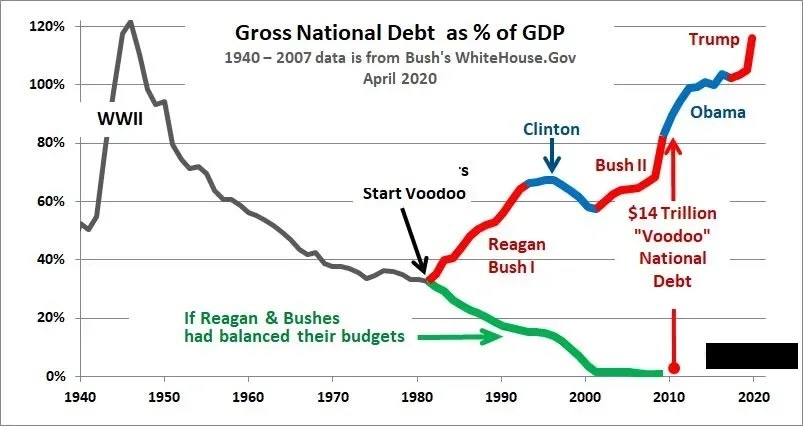
Republican policy weirdness that brought us to this moment began around the national debt in 1981.
The United States was significantly in debt following our Revolutionary War, the Civil War, World War I, and World War II. Following the philosophy that a large national debt should only exist during a time of national emergency, in each case, after the end of each war, we began a serious effort to pay down that debt.
Andrew Jackson finished paying off the entire debt from the Revolutionary War in the 1830s. We’d largely paid off the debt from the Civil War by the end of the 19th century, and, as the Treasury Department notes on its debt history site, our “government ended the century with its finances in very good order.”
We paid the national debt for WWI down to a mere $17 billion by the time the Republican Great Depression hit, but between the cost of the New Deal and World War II, we entered the post-WWII era in 1946 with a debt equal to 106% of GDP, a ratio we hit again in 2015.
Republicans and Democrats quickly united around the idea of paying off our national debt in the post-war years, driving it down to a mere $800 billion ($0.8 trillion) between 1945 and 1981 when Reagan came into office.
And then, following Jude Wanniski’s “Two Santas” plan, the GOP embarked on an experiment that had never been intentionally tried in the US or any other developed country in world history: drive up the national debt as high as possible with massive tax breaks for the very richest among us.
Reagan did this for two reasons:
— First, deficit spending with trillions in borrowed money (he ran the debt up to $2.4 trillion in a mere 8 years) stimulates the economy, so people thought Reagan had produced good times. (Give me a $2 trillion credit card, and I’ll show you what it looks like to live large, too!)
— Second, the rising debt gave Republicans the perfect excuse to follow Wanniski’s advice to force the Democrats to “shoot their Santa [of programs like Social Security and Medicaid] in the face.” Whenever a Republican is in the White House, Wanniski argued, Republicans should run up the debt as hard and fast as possible, so when a Democrat is in the White House they can squeal about “the debt our children will inherit! Oh, the humanity!”
The GOP has stuck to this strategy for 44 years now, running up $36 trillion in debt (and our entire Gross Domestic Product was a mere $27.7 trillion last year) and now, finally, we’ve reached the point where this unsustainable debt is not only costing us a trillion dollars a year in debt service (interest payments) but has led to a downgrade of our nation’s credit score.
At first, the main effect of the Two Santas strategy was merely to make the morbidly rich among us fabulously richer, while extracting much of that wealth from the homes, retirement plans, and savings of the middle class. It was, quite simply, a planned and successful transfer of roughly $50 trillion into the money bins of the rich, almost all of it coming out of the hides and lives of the rest of us.
When Reagan came into office in 1981, about two-thirds of Americans were solidly middle class with a single paycheck being able to buy a home, a car, raise a family, put the kids through school, and provide for a decent retirement.
Today, that same standard of living requires a bit more than two full-time jobs, and only about 47% of us are in the middle class (with two wage earners instead of just one in 1981).
“‘The middle class has been declining — we just haven’t recognized it fully,’ LISEP Chairman Gene Ludwig told CBS MoneyWatch. ‘It’s really dangerous because it’s the kind of thing that leads to social unrest, and it’s not fair. The American dream is not that it’s given to you — it’s that if you work hard, you have a chance to get ahead and achieve the things in life that you want to achieve. It’s not living in a tent, not having to steal.”
But now Trump, Musk, Vance, and congressional Republicans — having first crushed the American middle class — are doing everything they can to destroy America’s preeminent position in the world along with our social safety net.
— Instead of investing in education and science, they’re making it harder for students to get an education. — Instead of promoting democracy around the world, they’re embracing murderous dictators while broadcasting rightwing neofascist propaganda on Voice of America. — Instead of lifting up Americans by helping our veterans and providing food, healthcare, and shelter to the poor and disabled, they’re gutting the VA and the social safety net.
As a result, today nearly half of American children (45% or 34 million kids) rely on food and medical programs that are now targeted by “Christian” Mike Johnson’s House Republicans in their Big Brutal Bill providing trillions in tax breaks to billionaires. The proposed cuts to SNAP (food stamps) and Medicaid, for example, would be the largest in the history of the United States.
Reagan’s Two Santas strategy has done serious harm to America, collapsing the economic futures of two entire generations.
And now they’re going after our government itself.
But, why? Nobody’s sure.
— Did Putin, Xi, or both tell Trump and/or Musk to destroy America? — Are our country’s billionaires so psychopathically greedy that they’re willing to sell us all out for another few billion dollars in tax breaks? — Do Trump’s allies believe that if they can impoverish Americans we’ll be more willing to go along with their authoritarian agenda the way Germans did after being immiserated by the Republican Great Depression of the 1930s? — Are they following the “Dark Enlightenment” philosophers of Silicon Valley who argue that democracy is outdated and “we need to get over our dictator phobia” and let the tech giants run the country?
Nobody knows for sure. Nobody can really explain it.
Republicans are aren’t even pretending anymore; they’re not even bothering to proclaim BS like “trickle down” or the “need to support the job creators.“
Most distressing, there’s virtually no discussion of any of this in the mainstream press.
— The Two Santas strategy is easily documented, but never mentioned. — The explosion of our national debt is all over economists’ websites, but when the American media mentions it, it’s always in the context of Democrats needing to “reduce spending” rather than the fact that virtually 100% of our debt today was put there exclusively by Reagan, Bush, and Trump tax cuts and Bush’s two illegal wars. — Nobody, it seems, is speculating about why Trump and Musk would want to kill offUSAID or kneecap the FAA and the National Weather Service. Qui bono (who benefits?) other than Putin and Xi? The savings are a drop in the billionaire’s bucket; there must be a larger agenda than just funding tax cuts for billionaires. — And, they’re now holding their votes in the middle of the night; I think we all know what they are hiding and the credulous press is letting pass.
I don’t know why Republicans have been so enthusiastic about first destroying the American middle class and now our government itself, but the consequences have driven the explosion of rightwing anger, racism, and misogyny that’s been sweeping the nation since Trump’s appearance on the scene in 2015.
And now they’re threatening our position in the world, as well as possibly leading us all into a third world war.
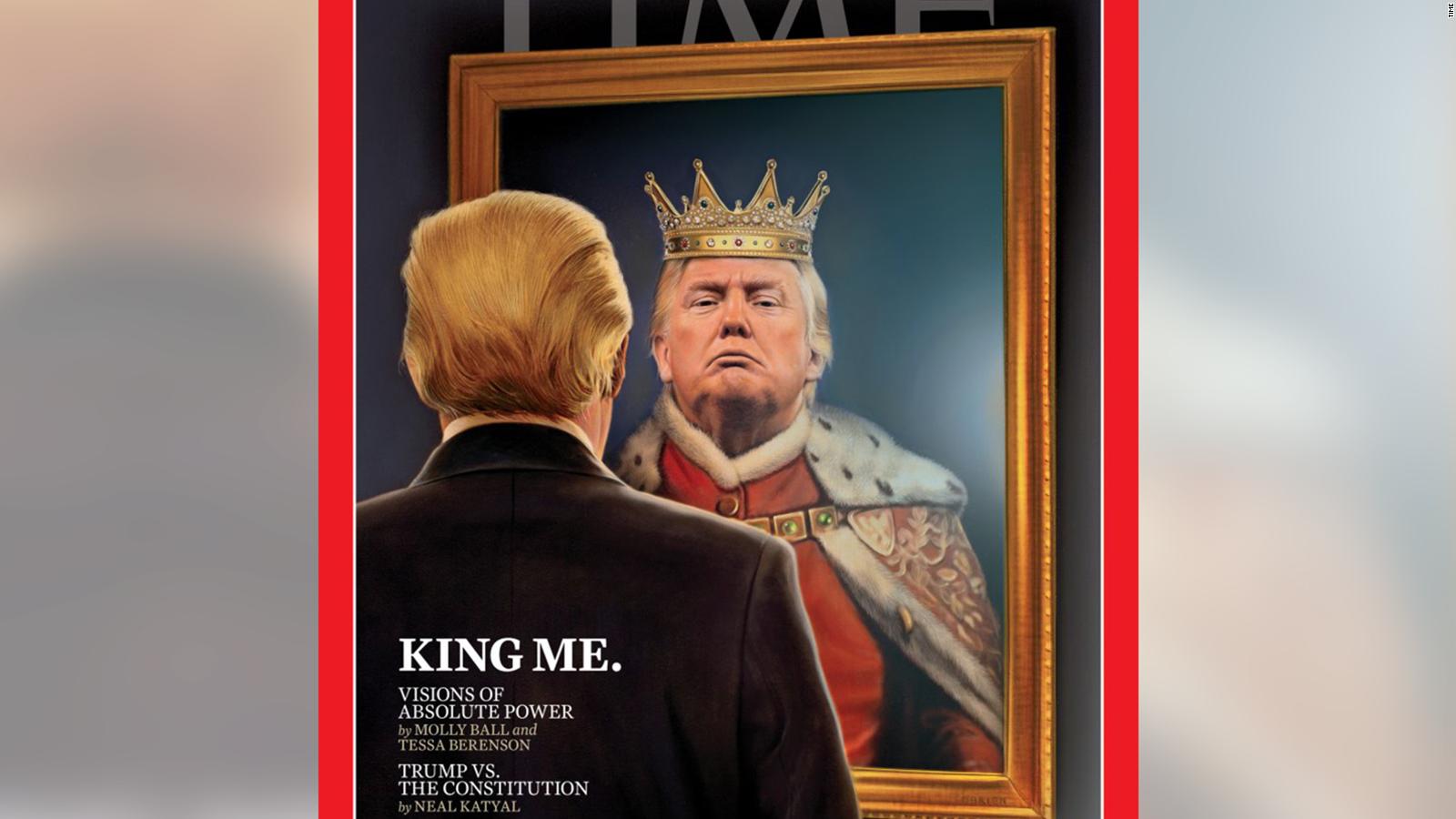
There can be no doubt that Donald Trump wants to be king, and with the help of the fearful and weak Republicans in Congress, we are on course to be his subjects. His people are chipping away at what’s left of American democracy (what remains is essentially American fascism). The opposition party, the Democrats, should be fighting back. But sadly, they have no power and no way to stop the indignities coming from the top. The U.S. Constitution is useless and gives us no solutions. The executive branch, the House, the Senate, and increasingly the judiciary are unable to stop his dictatorial onslaught. Trump acts as king now, and is moving to destroy what few roadblocks remain to his total control.–TBPR Editor
By Khaleda Rahman/ Newsweek/ May 24, 2025
A provision “hidden” in the sweeping budget bill that passed the U.S. House on Thursday seeks to limit the ability of courts—including the U.S. Supreme Court—from enforcing their orders.
“No court of the United States may use appropriated funds to enforce a contempt citation for failure to comply with an injunction or temporary restraining order if no security was given when the injunction or order was issued,” the provision in the bill, which is more than 1,000 pages long, says.
The provision “would make most existing injunctions—in antitrust cases, police reform cases, school desegregation cases, and others—unenforceable,” Erwin Chemerinsky, the dean of the University of California Berkeley School of Law, told Newsweek. “It serves no purpose but to weaken the power of the federal courts.”
Why It Matters
The provision would prohibit courts from enforcing contempt citations for violations of injunctions or temporary restraining orders—the main types of rulings that have been used to rein in President Donald Trump‘s administration—unless the plaintiffs have paid a bond, something that rarely happens when someone sues the government.
President Donald Trump arrives for a House Republican meeting at the U.S. Capitol on May 20, 2025, in Washington, D.C. TASOS KATOPODIS/GETTY IMAGES
What To Know
If enacted, it would be a “stunning” restriction on the power of federal courts, Chemerinsky wrote in an article for Just Security.
“The Supreme Court has long recognized that the contempt power is integral to the authority of the federal courts,” he wrote. “Without the ability to enforce judicial orders, they are rendered mere advisory opinions which parties are free to disregard.”
Chemerinsky wrote that federal courts rarely require a bond to be posted by “those who are restraining unconstitutional federal, state, or local government actions” as those seeking such orders “do not have the resources to post a bond, and insisting on it would immunize unconstitutional government conduct from judicial review.”
Representative Joe Neguse, a Colorado Democrat, said in an interview that the provision was added because the Trump administration is “losing in virtually every court in the land.”
Dozens of lawsuits have been filed since Trump returned to office, challenging his executive orders and actions taken by his administration. Judges have partially or fully blocked the president in at least 82 cases, according to a tally by The Associated Press.
The administration has been pushing back against court rulings it doesn’t like, with the president lashing out at judges who rule against him and seeking an end to nationwide injunctions.
The Supreme Court earlier in May barred the administration from quickly resuming deportations of Venezuelans under the Alien Enemies Act of 1798.
Meanwhile, U.S. District Judge Paula Xinis has expressed frustration that the administration has yet to provide information that adequately explained how it was complying with her order—which was upheld by the Supreme Court—to “facilitate” the return of Kilmar Abrego Garcia, a man who was wrongly deported to El Salvador.
And last month, another federal judge said he found probable cause to hold the administration in criminal contempt after ignoring his order to turn around planes carrying deportees to El Salvador.
District Judge James E. Boasberg said he would initiate hearings and may refer the matter for prosecution if the administration does not act to remedy the violation. The administration has also removed immigrants against court orders in other cases.
The provision in the House bill “would make the court orders in these cases completely unenforceable,” according to Chemerinsky.
“Indeed, the bill is stunning in its scope. It would apply to all temporary restraining orders, preliminary injunctions, and even permanent injunctions ever issued.”
Chemerinsky also wrote: “Without the contempt power, judicial orders are meaningless and can be ignored. There is no way to understand this except as a way to keep the Trump administration from being restrained when it violates the Constitution or otherwise breaks the law. The House and the Senate should reject this effort to limit judicial power.”
A spokesperson for the House Ways and Means Committee told CNN that the goal is to stop frivolous lawsuits.
Neguse said on X, formerly Twitter, that the provision “basically would attempt to try to stop federal courts or limit the ability of federal courts to enforce contempt orders. Why? Because they know that they are, the Trump administration, losing in virtually every court in the land, and as a result, in their effort, in terms of the campaign that they’re waging against the judiciary and the Article Three branch of our government, they’ve decided that this would be the latest salvo in that effort. It’s plainly unconstitutional, but they’re going to go forward anyway.”
Robert Reich, a former Labor Secretary and a professor of public policy at the University of CaliforniaBerkeley, wrote in a Substack post that the “hidden” provision “makes Trump King.”
He wrote: “No congress and no court could stop him. Even if a future Congress were to try to stop him, it could not do so without the power of the courts to enforce their hearings, investigations, subpoenas, and laws. What can you do? To begin with, call your members of Congress and tell them not to pass Trump’s One Big Ugly Bill.”
President Donald Trump wrote in Truth Social on Thursday that the bill is “arguably the most significant piece of Legislation that will ever be signed in the History of our Country!”
He added: “Great job by Speaker Mike Johnson, and the House Leadership, and thank you to every Republican who voted YES on this Historic Bill! Now, it’s time for our friends in the United States Senate to get to work, and send this Bill to my desk AS SOON AS POSSIBLE!”
What’s Next
The House approved the bill in a 215-214 vote early Thursday. It now heads to the Senate, where it could face revisions before a final vote.
The old professor in me thinks the best way to convey to you how utterly awful the so-called “one big beautiful bill” passed by the House last night actually is would be to give you this short ten-question exam. (Answers are in parenthesis, but first try to answer without looking at them.)
1. Does the House’s “one big beautiful bill” cut Medicare? (Answer: Yes, by an estimated $500 billion.)
2. Because the bill cuts Medicaid, how many Americans are expected to lose Medicaid coverage? (At least 8.6 million.)
3. Will the tax cut in the bill benefit the rich or the poor or everyone?(Overwhelmingly, the rich.)
4. How much will the top 0.1 percent of earners stand to gain from it? (Nearly $390,000per year).
5. If you figure in the benefit cuts and the tax cuts, will Americans making between about $17,000 and $51,000 gain or lose? (They’ll lose about $700 a year).
6. How about Americans with incomes less than $17,000? (They’ll lose more than $1,000 per year on average).
7. How much will the bill add to the federal debt? ($3.8 trillion over 10 years.)
8. Who will pay the interest on this extra debt? (All of us, in both our tax payments and higher interest rates for mortgages, car loans, and all other longer-term borrowing.)
9. Who collects this interest? (People who lend to the U.S. government, 70 percent of whom are American and most of whom are wealthy.)
10. Bonus question: Is the $400 million airplane from Qatar a gift to the United States for every future president to use, or a gift to Trump for his own personal use? (It’s a personal gift because he’ll get to use it after he leaves the presidency.)
Most Americans are strongly opposed to all of these things, according to polls. But if you knew the answers to these ten questions, you’re likely to be in a very tiny minority. That’s because of (1) distortions and cover-ups emanating from Trump and magnified by Fox News and other rightwing outlets. (2) A public that’s overwhelmed with the blitzkrieg of everything Trump is doing, and can’t focus on this. (3) Outright silencing of many in the media who fear retaliation from the Trump regime if they reveal things that Trump doesn’t want revealed.
Please do your part: Share this as widely as possible.
How President Trump is changing government, the country and its politics.
By Jess Bidgood/ NYTimes/ May 21, 2025
The America First president was bent on doing something we have rarely seen him do: declaim for a full hour about a travesty he said was unfolding in a country other than his own.
On Wednesday, President Trump — who has backed away from negotiations over the war in Ukraine and written off Gaza as a future resort — wanted to talk about land seizures and mass killings that he said were victimizing white Afrikaners in South Africa. He had printouts of news articles and a video cued up, seemingly determined to embarrass President Cyril Ramaphosa, who had come to “reset” his country’s relations with the United States.
The problem? The human tragedy Trump was describing wasn’t grounded in fact, and Ramaphosa was determined to tell him so.
While white South Africans have been killed, police statistics show that they are no more likely to be victims of violent crime than any other citizens of the country. Yet Trump doubled down on his fringe assertions, echoing claims that Afrikaner lobbyists and right-wing figures like Tucker Carlson have been making for years.
The face-off, as my colleagues wrote, offered a window onto Trump’s conviction that the world is unfair to white people. “Dead white people, dead white farmers,” he said to Ramaphosa.
It also pointed up his selective concerns for human rights, just a week after he made nice with a series of repressive regimes in the Middle East. Trump’s body language in the room also made it abundantly clear whom he wanted to hear from the most: the white golfers Ramaphosa had brought with him.
The display may have shocked Ramaphosa. But if Trump’s goal was to bait the South African leader, it didn’t work. Where Volodymyr Zelensky was essentially kicked out of the White House after being dressed down in the Oval Office, Ramaphosa held his ground. He stated the facts. He even joked.
“I am sorry I don’t have a plane to give you,” Ramaphosa said to Trump, in an apparent reference to the luxury jet the Qatari government has given the United States.
“I wish you did,” Trump replied. “I’d take it.”
Land in Donna, Texas, near the U.S.-Mexico border. Ilana Panich-Linsman for The New York Times
When Trump was the one taking land from farmers
At the heart of today’s showdown between President Trump and President Cyril Ramaphosa of South Africa was Trump’s claim that South Africa is seizing the land of persecuted white farmers who are Afrikaners, the ethnic minority that dominated the country under apartheid.
That accusation reminded my colleague Zolan Kanno-Youngs that Trump hasn’t always been so hostile to the idea of governments taking private land. I asked him to explain.
“You can take away land for no payment,” Trump claimed, making an accusation that skipped over the facts.
Ramaphosa pushed back, seeking to clarify the details of his country’s law while pointing out that the United States government, too, has the right “to expropriate land for public use.”
What Ramaphosa did not add was that Trump himself has used that power. And that’s a story I happen to know well.
This did not happen in South Africa. It was in South Texas, and it was because of Trump.
And it’s a reminder of how a president who has railed against the state’s power to seize land overseas has long been quick to embrace similar tools at home, both as a developer and then in the White House.
‘Take the land’
At the root of Trump’s claims of discrimination is a law Ramaphosa signed this year that allows the government to seize privately held land — without providing compensation — when it’s in the public interest. The law is part of the South African government’s efforts to chip away at the racial inequities shaped by decades of apartheid rule.
Legal experts say the seizures are likely to be rare. And the law provides for judicial review, giving property owners an opportunity to challenge any effort to take their land. That has not stopped Trump from falsely accusing South Africa of “confiscating land” as he cut off foreign aid to the nation this year.
But Trump himself used government-sanctioned land grabs in recent years to build his promised wall along the United States-Mexico border, albeit through a system that works differently from South Africa’s.
“Take the land,” Trump told his aides in 2019, as he pushed them to accelerate construction — years before he would accuse the African National Congress of confiscating land.
By the end of Trump’s first term, his administration filed more than 110 lawsuitsagainst landowners in Texas as it sought to secure space for his border wall, turning to eminent domain even though many conservatives view it as an excess of government power that violates the sanctity of private property. (In the United States, when the government takes land by eminent domain, it offers compensation, though it is not always as much as landowners would like.)
Trump’s interest in eminent domain didn’t start there. As a casino developer in Atlantic City, N.J., he urged local officials to use eminent domain to seize the home of an older widow that stood in the way of a parking lot he wanted to build. She prevailed.
“Eminent domain is very interesting,” Trump said in a speech in 2019 in the Rose Garden. “But without eminent domain, you wouldn’t have any highways, you wouldn’t have any schools, you wouldn’t have any roadways. What we’re doing with eminent domain is, in many cases, we’ll make a deal up front.”
That is not how the farmers I interviewed in South Texas felt.
‘That damn wall’
Richard Drawe on his property in Donna, Texas, in 2019. Ilana Panich-Linsman for The New York Times
Take Richard Drawe, who supports Trump and his goal of bolstering border security. After years of living on the border with Mexico, Drawe did not believe a wall was worth the cost, given the existing barriers and technology at the border to deter migration. And he wanted to hold on to farmland that had been in his family for a century.
Landowners like Drawe could acquiesce, allowing the authorities to use and survey their land and accepting a monetary offer for it. Or they could go to court, where the government would argue that the construction of the wall was an emergency. Lawyers told me at the time that legal action almost always ended with the government getting the land anyway.
The Trump administration accelerated its efforts to seize private property for the wall during the coronavirus pandemic, bringing a flurry of lawsuits at the start of 2020. Some landowners refused initial payment from the administration and tried to fight the land grabs in court.
Drawe reluctantly agreed to allow the government to build on his land because he did not believe he had much of a choice.
“It just kind of screwed up my whole idyllic living, out in the country, having that damn wall there,” he said in an interview on Wednesday. “I’m never happy with eminent domain laws, being a landowner.”
The administration paid him about $42,000 for the 12 acres needed for the wall project and about $197,000 to compensate for depressing the value of his farm. It limited views of the sunsets that he and his wife used to savor after a day’s work. Drawe told me at the time in 2019 that he felt that Trump’s taking of farmland would “ruin” his life.
But he is now resigned to waking up and seeing the wall on his land.
“I really don’t give it a hoot anymore,” Drawe said.
Is there no limit to the corruption and dictatorial power that get worse almost every day from the Trump White House? My weekly appearance on Hal Ginsberg’s YouTube videocast Halitics delves into our dwindling democracy and Trump’s limitless violations of the Constitution, especially his disregard for the emoluments clause seen blatantly his week with his desire to obtain the $400 million jet offered by Qatar, as well as the crypto currency sales offered to his donors. We also talk about this week’s revelations that Joe Biden’s age-related disabilities were kept from the American people and probably played a major role in the outcome of the election.






 thebigpicturereport ™