The Reason ’60 Minutes’ Sucks These Days

The Fox ‘News’-ification of CBS news and ’60 Minutes’: The Cleantech Crash

By Brad Friedman/ The Brad Blog/January 6, 2014

60Minutes_CleanTechCrash_LesleyStahl_010513_med

The President of CBS News is David Rhodes. He was hired in February 2011. He was formerly the Vice President of News at Fox “News”.

Again, the current President of CBS News was formerly the VP of News at Fox “News”.

According to his bio posted at CBS: “Rhodes began his career as a Production Assistant at the newly-launched Fox News Channel in 1996, where he later became Vice President of News. At the network he managed coverage of three presidential elections, wars in Afghanistan and Iraq, hurricanes including Katrina, and was the channel’s Assignment Manager on the news desk the morning of September 11, 2001.”

That means, as The Nation’s Greg Mitchell pointed out at the height of the recent CBS News/60 Minutes Benghazi report controversy (before CBS was finally forced toretract the entire fake story), that Rhodes “was the guy who worked hand-in-glove on the biased, often propagandistic, Fox ‘coverage’ of the run-up to the Iraq war, the 2000/2004/2008 elections, the Plame affair, the worst years in Iraq, and all other things Bush and Cheney, and so on.”

Again, the guy who cut his teeth in the news business, beginning as a Production Assistant and working his way up to become VP at Fox “News”, is now the President of CBS News.

That bears both highlighting and repeating as many have been asking, once again, over the past 24 hours, “What’s the Matter with 60 Minutes?” after yet another report last night that is being described as a “hit job” by some and, more charitably, as“puzzling” by others — including by some who were interviewed both on-air and off for the once-great news magazine’s bizarre segment titled “The Cleantech Crash”…

Fail and Unbalanced

The complete segment, with correspondent Lesley Stahl, is posted at the bottom of this article, so feel free to judge for yourself. But coming on the heels of 60 Minutes’Benghazi hoax debacle last November, a soft-ball, one-sided puff piece on the NSA in December, and a number of other similar missteps, Sunday’s piece on the failures — and largely, only the failures — of the so-called “cleantech revolution” suggests that while it hasn’t yet become Fox “News” proper, the once-venerable news magazine no longer seems to be serving the public interest, but rather…some other interest.

The general premise of this week’s segment was that investment — both public and private — in the cleantech sector since Obama has taken office has been nothing but a disaster. While there have certainly been failures in the sector, it was not noted during the segment, as several critics of Sunday’s piece have pointed out since, that the U.S. Dept. of Energy’s loan program to green startups has a 97% success rate.

“In July 2012, the former head of the loan guarantee program testified to Congress that funds that went to bankrupt companies represented less than 3 percent of the total Department of Energy portfolio,” Media Matters’ Shauna Theel notes. “In other words, the program so far has a 97-percent success rate, far better than that of venture capitalists.”

60-minutes-KOS

            Brian McFadden

“Clean technology is booming by every key indicator,” Climate Progress’ Joe Romm said in opening his piece lambasting the 60 Minutes report just after it aired, “but you would never know that from Sunday’s absurd 60 Minutes piece touting an imaginary ‘Cleantech Crash.'”

He also notes the 97% success rate cited for the DOE Loan Guarantee Program, “while the companies CBS focuses on such as Solyndra and Abound Solar were just 3 percent of the portfolio.”

“The piece was puzzling for several reasons,” Dana Hull, clean tech and energy policy reporter for the San Jose Mercury News’ writes, citing the fact that [emphasis hers] “there was absolutely no mention of climate change. None. That’s the whole point of cleantech, after all: using the promise of technology and innovation to try to wean our economy off of fossil fuels.”

(Continued–Read Entire Article Here)

POSTSCRIPT: On January 6, 2019, Susan Zirinsky was named President of CBS News, replacing David Rhodes.[2][3] Rhodes will be leaving on March 1, 2019, “after overseeing Zirinsky’s transition and have an advisory role after that.”

Posted in media, politics, scandals | Tagged , , , , , , , , | Leave a comment

Republican Jesus

republican-jesus

By Justin “Filthy Liberal Scum” Rosario/ Addicting Info

Posted in politics, poster, religion, Republican Party | Tagged , , | 17 Comments

Ready to Burst?

Zombie Economy – Living Bubble

By Chris Kanthan/ Nation of Change/ December 4, 2013

us_economy

Imagine the reaction you would get if you walked into an off-the-hook fraternity party and shouted, “Stop this party! There are too many drunk people and some of you are going to get hurt.” That’s the same reaction you get when you try to tell people about an economic bubble. It doesn’t matter if people were burned before because it is different this time. Actually, it is very different this time. We have a zombie economy that is artificially kept alive through blood transfusion, or if you prefer something more benign, think of the movie “Weekend at Bernie’s.” And there is a living, growing bubble that is ripe for a big burst.

Of course, one might retort, “We are the wealthiest nation in the world, the stock market just reached record highs, the housing is booming, the inflation is low and the unemployment is reasonable. What are you talking about?”

Let’s take a look at the economy first.

Zombie Economy

If you look at the overall GDP, yes, the U.S. is still #1. And even under the GDP per Capita, the U.S. is ranked 10th or so in the world, depending on the metrics. Not bad. However, the “average” statistics can be misleading. If I have $999 and you have $1, then on the average, we have $500 each, but that fact is not going to help you buy a coffee at Starbucks.

If you have not watched the viral video on wealth/income inequality in the U.S., please do so.

This inequality has only grown more rapidly since the crash of 2008, as Paul Krugman explains in the New York Times. To understand what is happening, imagine $1000 being distributed to 1000 people. In a socialist world, everyone will get $1. In the current version of the capitalist system, this is what is happening:

1 guy gets $600, 9 other people get $39 each, and the remaining 990 peasants get 5 cents each.

If the Forbes 400 move to an island and establish their own country, it will have the 9thlargest GDP in the world, ahead of Russia, Canada, Australia and 185 other countries.

If all the 2200 billionaires of the world decide to move to that island, it will be the wealthiest country in the world with a GDP twice that of the U.S.

So how are the American workers doing? About 25% of workers make $10 or less an hour. Another 25% make under $15/hr. Thus, half of all American workers make under $28,000 per year.

Good jobs are hard to come by. About 60% of the jobs created since the Wall Street crash of 2008 are low-wage jobs. Consider that more than 300,000 college graduates are working for minimum wage.  In 2013 alone, 75% of the jobs created were part-time jobs. The real unemployment rate, including those who have stopped looking for jobs, is closer to 14%, twice the official rate. Another factor that is helping the government rate is the fact that about10,000 baby boomers are retiring every day and dropping out of the labor force.

With all these facts, it is not surprising that about 75% of all Americans are living from paycheck to paycheck. Half of the households carry an average of $15,000 in credit card debt. Americans are also saving at an abysmal rate of less than 3% of their disposable income.

Young Americans are in deep trouble as well. The total student debt is now more than $1 trillion, even more than the total national credit card debt.

In a nutshell, you can safely say that 0.1% of Americans are swimming in money, 1% are wealthy, 9% are comfortable and another 15% are truly middle class. The next 25% think they are middle class, but they are not. The rest – 50% – are just financially screwed.

Adding pain to all of this is the rising cost of living. Gas, health care expenses, rents, college tuitions have all been rising briskly every year. Even the famous “Big Mac Index” has gone up by 5% every year since 2008. According to some experts, the real inflation rate is around 11%. Thus, Americans have less and less disposable income every year. However, ask the Fed, they will tell you the inflation rate is about 2%. Fuggedaboutit.

Whoa! If we really have an anemic economy, how do we explain the stock market setting records day after day? And the booming housing market?

Fed-Fueled Frenzy

To understand that, we have to understand “quantitative easing” or “QE” – the unusual and monetary policy that the Federal Reserve Bank (Fed) has been engaging in for the last five years.

The official goal of quantitative easing is to inject money into the flailing economy to give it some life. What would you do if you had the task of giving more money to Americans? The simplest way would have been to enact a payroll tax cut since people would immediately see their paychecks go up.

But that would have been too logical. It will also violate the dogma that everything must involve the banks who would act as the middlemen skimming some cream off the top.

In a nutshell, the Fed has been doing two things: A) Buying government bonds and thus letting the government get into more debt, and B) giving free money – at 0% interest – to banks who have been primarily passing it on to billionaires and corporations at low interest.

(By the way, where does the Fed get all the money from? In the Bible, God said, “Let there be light.” In our world, the Fed says, “Let there be trillions of dollars.”)

Even when it has to buy bonds from the U.S. Treasury, the Fed does not buy them directly. Instead, it goes through Goldman Sachs who takes a cut of $45 billion every month just for a few clicks on the computer to buy and sell those bonds.

Corporations have been using the low-interest money in one big way: buying back their own shares. Since 2008, they have been buying back their own shares at a rate of about $1 trillion every year. Of course, regardless of who buys the shares, the rules of supply-demand make the share prices go up. Also, reducing the number of shares automatically makes the value of existing shares go up. So, the math is simple: borrow a few billion dollars at 3%, buy back your shares and make the price go up by 100%. See, you really don’t need an MBA from Harvard.

(Continued–Read Entire Article Here)

Posted in Economics, economy, finance, government, inequality, politics, Wall Street | Tagged , , , , , , , , , , , , | Leave a comment

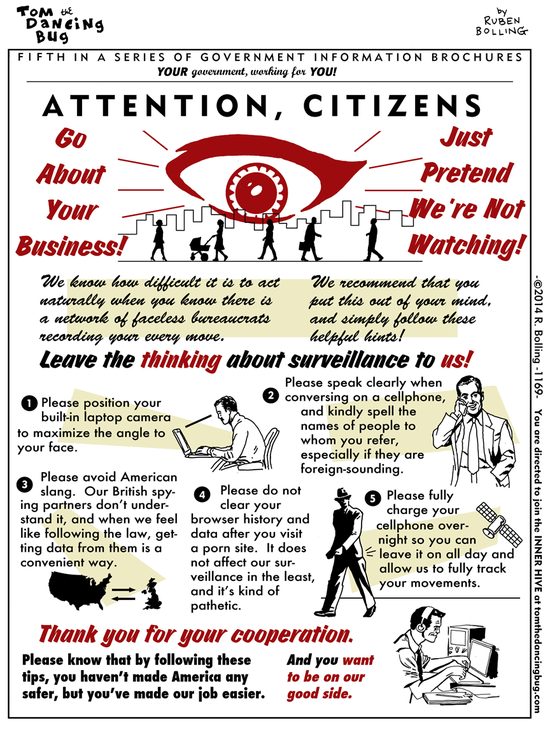
How To Be a Helpful Citizen

1169ckCOMIC-surveillance

Posted in cartoon, civil liberties, government, political cartoon, political humor | Tagged , , , | 3 Comments

Moyers: Political System Bought: Lock, Stock & Pork Barrel

Bill Moyers: The End of Democracy

Posted in government, media, politics | Tagged , , , | 1 Comment

The American Injustice System

By Arlen Grossman/ The Big Picture Report

** Willie Smith Ward, 43, a habitual offender, attempted to steal a $35 rack of pork ribs from a grocery store in Waco, Texas. SENTENCE:  50 years in prison. He must serve at least a quarter of his sentence before he is eligible for parole.

**John Horner, 46, a Florida fast food restaurant worker and father of three, sold $1800 worth (four bottles) of painkillers prescribed for him after he lost an eye in an accident. He is a non-violent first-time drug offender. SENTENCE:  A mandatory minimum of 25 years in prison.

**Patrick Matthews, a Louisiana father of two, was 22 when convicted of helping a friend steal tools, a generator and a welding machine. He had a prior record of two unarmed burglaries while high on meth at age 17. SENTENCE: Under Louisiana’s Habitual Offender law, he was sentenced to life in prison.

**Sharanda Jones, 32, a Texas mother of a 9-year-old daughter, arrested for a nonviolent crime of conspiracy to distribute crack cocaine. She had no prior arrests. SENTENCE:  A mandatory minimum sentence of life without the possibility of parole.

**Ricky Minor, a Florida father of three and a meth addict, was caught with 1.2 grams of meth in his home, along with decongestants that could be used to make meth. He was 38 when convicted, with a record of several prior nonviolent offenses.  SENTENCE: Federal law required he serve life in prison without parole.

.

unfair-justice

voiceofdetroit.net

**Wall Street bank executives, sometimes referred to as “too big to jail,” were instrumental in causing the 2008 Financial Crisis and Great Recession that crashed the American and global economy.  SENTENCE:  No prison time or criminal prosecution.

**The George W. Bush Administration illegally invaded Iraq based on the false claim that it possessed weapons of mass destruction, leading to the death and injuries of thousands of people and the devastation of the country. In addition, the Administration ordered torture techniques that were used on numerous Iraqi and Afghanistani detainees. SENTENCE: No high-ranking officials have been imprisoned or prosecuted.

Also Published at OpEd News (Headline Status) December 17, 2013
Posted in crime, Justice, law, prisons, Uncategorized | Tagged , , , , , , , , , , , , , | Leave a comment

NOT TOO BIG TO JAIL

Iceland’s jailed bankers ‘a model’ for dealing with ‘financial terrorists’

RT/ December 14, 2013

iceland-court_n

By jailing four top officers of Iceland’s failed Kaupthing Bank, the country showed the world the right way to deal with the people largely responsible for the 2008 financial crisis, said Charlie McGrath, founder of news website, Wide Awake News.

The US and other nations must take it as a model for the next time the too-big- to-fail corporations screw things up and ask for a bailout with taxpayers’ money, he added.

RT: The jail terms are the biggest penalty for such crimes in Iceland’s history. What is the significance of the precedent?

Charlie McGrath: It’s significant in regards to the 2008 crisis, if you happen to be living here in the United States, where the majority of these too-big-to-fail institutions are headquartered, where the true corporates are, where the CEOs and COOs of these massive corporations live. Not one of them went to jail. Not one of them has been indicted. There’s been a handful of token fines, that had been paid by these corporations – and let me reiterate ‘by the corporations’, not by these individuals themselves.

So we see an actual government, an actual people and nation stepping up and saying: “I’m sorry, you committed fraud. You screwed over a nation. And you are going to pay for it by your butt being put behind bars.”

This is exactly what needed to happen in the United States and in the rest of the world. And my hat is off to Iceland for standing up to these bankers.

RT: Could there be broader ramifications of this case. Is Iceland setting a new bar for prosecution of financial fraud?

CMcG: I hope so, but I am not optimistic of that. Unfortunately I myself and lots of other people – Jim Rogers, Mark Favors, Harry Dent – we all believe that there is another mega-collapse coming.

And let’s face it, these institutions that we called too big to fail in 2008 – the six largest of them are 37 percent bigger than they were in 2008. They hold sway over the economy. They hold sway over the government. And we are doing the exact same things that led to a collapse in 2008.

I truly believe that 2008 was a financial terrorist event. It was a financial 9/11 committed by these institutions, and when we go into the next crisis that is going to affect the entire globe. I hope that Iceland is held up as a model on how you deal with this scum!

RT: In light of this scandal, how much involvement do you think governments should have over the dealings of financial institutions?

CMcG: Here in the United States, we pretend that it is socialism when you start talking about government control over financial institutions. But we have something far worse here.

We take the so-called private corporations, these free-market capitalist corporations –they are in control of the economy here – we take these corporations and put them on a pedestal, and when they fail, we spread their debt to the people of this country.

That’s something far worse than socialism. It’s the worst form of fascism! So to pretend that government has no place in overseeing these institutions is to sit back and say: “Go ahead, bankers! Go ahead and take over the future of this nation and lead us into financial ruin!” And that’s exactly what happened.

What happened in Iceland is what the people demanded of the government. In 2009 they marched on the parliament and said: “We are not going to take the fraudulent failures of these banks lying down.”

They cordoned off these institutions. They’ve formed state banks. And they hit at the problem head on. They helped the people rather than the banking institutions. So I again hope this is the model that we are looking forward to.

Posted in Economics, economy, finance, government, law, politics, scandals | Tagged , , , , , | 1 Comment

One-Sided Battle

WAR ON THE POOR

The Shameful Ways the GOP Makes It Bad To Be Poor in 21st-Century America

By Sasha Abramsky/Monterey County Weekly/ December 5, 2013

6a00d8341c90b153ef0162fbee4787970d-320wi

The past year hasn’t been a good one for poor people in America.

First, the “sequester” cuts automatically sliced billions of dollars from services such as Head Start – which provides early educational opportunities to young kids from poor families – nutritional programs and job-training grants.

Then, the government shut down – over GOP opposition, in John Boehner’s House of Representatives, to expanding health-care coverage to the poor. And, while it was shut down, programs like Women, Infants, and Children – also called WIC – which provides vital nutritional assistance to mothers and babies, began turning away new applicants in several states.

Now, the government is open again – but the GOP is doubling down. For this story, I tried to ponder the worst policies – ideas now in play that will push poor Americans, and in particular, poor women and kids, ever deeper into poverty – but I realize the choices are legion.

Republicans are still pushing for $40 billion of cuts to food stamps over the next decade. The Supreme Court gutted the Voting Rights Act, and states such as Texas and North Carolina, led by GOP-run legislatures and governors, immediately responded by passing laws that make it harder for poor people to vote. These voter ID laws also make it harder for women who have changed their names because of marriage or divorce to prove that they are who they say they are.

And, despite the Affordable Care Act and the health-insurance exchanges coming online (albeit it in a particularly shoddy, dysfunctional manner), for millions of Americans too poor to qualify for government subsidies, their own state governments ensured that they would still remain without access to health care by refusing to expand Medicaid. Even though the feds agreed to pick up almost the entirety of this expansion’s costs.

This is in an era where, by the government’s own measure, 15 percent of Americans – roughly 50 million people – live in poverty. An age in which we no longer do a double take when we hear that nearly one in four American kids nationally – and in much of the South, one in three children – live at or below the poverty line. The failure of our political leaders to tackle this rampant hardship, and their willingness to instead propose ever-harsher austerity measures, represents a moral catastrophe.

When the U.S. House of Representatives had the chance to vote on a $10-an-hour minimum wage in March – a rate that California’s legislature has since voted to adopt, using the somewhat sensible logic that a minimum wage ought to provide workers with enough income to pay their basic bills – every single GOP congressman voted “no.”

Yet the same Republican majority supports a budget plan that would reduce the top tax rate – paid by wealthy Americans – from 39.6 percent to 25 percent, presumably further denuding the government’s ability to fund basic public infrastructure and safety-net programs.

Around the country, elected officials have been pushing proposals aimed either at humiliating those in poverty or ensuring that more people end up impoverished. These policies aren’t always enacted, but, cumulatively, they are shifting the needle rightward in how we as a nation think about, and respond to, poverty. Designing methods to hurt vulnerable people seems to have become something of a national sport these days, and not only in bastions of conservatism like Alabama and Mississippi.

Liberal California, for example, has seen its fair share of awful ideas – from Gov. Jerry Brown’s attempts to set limits on how many funded doctor’s visits Medicaid recipients could have in a given year to recurring proposals to impose strict time limits upon Temporary Assistance for Needy Families recipients.

“It’s deeper than favorite bad policies,” says Jim Wallis, president of the Washington, D.C.-based anti-poverty organization Sojourners, when asked what particularly egregious approaches to poor people and to poverty have been rolled out by state and federal politicians in recent months.

He shared with a story: “I’m in the office of a U.S. senator, part of the gang working on fiscal stuff. He’s a moderate centrist. I say, ’Now, Senator, you and I could easily think of 12 senators who could sit at this table and work out a path to fiscal responsibility, couldn’t we?’

“Yes.’

“‘And we could do so while protecting the poor and vulnerable?’

“‘Yes.’

“‘But then all the other interests will come into this and demand their interests will be protected, and the poor will be compromised, won’t they?’

“‘Yes.’”

And compromised they are these days. Here are the 10 worst public-policy ideas when it comes to America’s poor.

•••

1. Kicking 3.5 million Americans off food stamps

Coming in at No. 1 would have to be the current proposal to cut $40 billion from food stamps. This program is virtually the only part of the safety net that hasn’t already been shredded. As a result, almost everyone in poverty in America is either on the program or eligible for it.

More than 47 million Americans use food stamps. For 4 million people, food stamps actually serve to raise family incomes above the poverty line. It is, quite simply, a buffer between economic insecurity and hunger.

But current GOP proposals would remove 3.5 million Americans, in particular, able-bodied adults, from the program, and would impose time limits on many individuals’ participation.

In 2012, when he introduced the idea of significant cuts to food stamps, Paul Ryan, chairman of the House Budget Committee, averred that “we don’t want to turn the safety net into a hammock that lulls able-bodied people to lives of dependency and complacency, that drains them of their will and their incentive to make the most of their lives.”

That’s right: Depriving millions of Americans of access to food is the surest way to empty America’s overcrowded hammocks – whatever that nonsensical image is intended to convey.

It’s probably also the surest way to ensure that malnutrition re-emerges across the land.

2. Denying medical care to the working poor

An almost equally bad idea to removing food stamps from millions of people surely has to be state-level GOP opposition to allowing poor adults onto their Medicaid rolls. Despite the fact the feds will pick up all of the cost of this expansion for the first three years, and 90 percent thereafter, a slew of states, and almost the entirety of the South, have opted out of this expansion.

“The 26 states that have rejected the Medicaid expansion are home to about half of the country’s population, but about 68 percent of poor, uninsured blacks and single mothers. About 60 percent of the country’s uninsured working poor are in those states. Among those excluded are about 435,000 cashiers, 341,000 cooks and 253,000 nurses’ aides,” wrote New York Times reporters Sabrina Tavernise and Robert Gebeloff last month.

Making it harder for poor people to qualify for medical care is a really, really bad idea. It results in unnecessary illnesses and deaths, and it’s expensive. Throwing millions of people into the emergency-room system instead of giving them access to primary-care doctors ends up costing everyone else – taxpayers, health-insurance companies, those buying their own insurance premiums – a fortune.

3. Raiding the food-stamps money pot

Bad idea No. 3 is another ill-starred food-stamp-reform proposal. In addition to simply axing billions of dollars from food stamps, Wisconsin Rep. Paul Ryan also wants to convert the program, which is currently an entitlement, into a block grant given to the states.

How did that work during welfare reform nearly two decades ago, when Aid to Families with Dependent Children was shifted to Temporary Assistance to Needy Families, and turned into a block grant in 1996? Great – if you’re looking for a pot of federal money to raid for projects that have nothing to do with the well-being of those on welfare. And not so great if you’re a poor family in need of assistance.

4. New tough-on-poor rhetoric

At a state level, food stamps have already started being cut: Kansas’ GOP Gov. Sam Brownback recently reinstituted work requirements for able-bodied, adult food-stamps recipients – requirements normally waived during periods of high unemployment for the fairly obvious reason that there is no work for these unemployed men and women to do.

Brownback didn’t get the logic: After removing 15,000 people from his state’s welfare rolls, he has now embraced an approach to food stamps that will likely remove 20,000 of his state’s 90,000 food-stamps recipients from the program. This ranks No. 4 on our list of ugly policies.

That food stamps are now in the sights of slash-and-burn conservatives speaks to the shift rightward in popular consciousness when it comes to hunger.

Conservatives denounce President Barack Obama for being a “food-stamp president” and routinely imply – without providing proof – that the program is rife with fraud.

“They’re the same talking points we had before welfare reform,” argues Jessica Bartholow, of the Sacramento-based Western Center on Law and Poverty. “And we have a much smaller safety net now than we did 20 years ago. But the talking points are the same.”

For Bartholow, the slew of recent attacks against food stamps is part of a pattern of politicians seeking to score cheap points by showing their tough-on-poor-people bona fides via a rash of misguided proposals.

5. The Disqualification of ChapStick

Take, for example, the recent decision in Massachusetts, backed by Democratic Gov. Deval Patrick, to outlaw the purchase of cosmetics using TANF benefits. It sounds good: Why should we allow women on welfare to spend our tax dollars dolling themselves up?

But dig deeper, and the implications are horrendous, which is why this is bad idea No. 5.

For instance, should sunscreen be considered a “cosmetic”? Well, it’s often sold in the cosmetics aisle of a store, but its use is more akin to a medicine: Use it well, and you can limit your risk of skin cancer; don’t use it, and you are more likely to end up with the disease. If your skin is bad, and you go for a job interview – even though employers aren’t legally allowed to discriminate on the basis of looks in practice – a woman with no makeup and with poor skin may well be at a disadvantage in the search for work.

If you want to get that welfare recipient off of public assistance and into employment, making it more difficult for them to present themselves well at an interview seems counterproductive.

Is deodorant a cosmetic? Quite possibly. But, again, who wants to go for a job interview on a humid summer day in Massachusetts with pits sweating? While the legislation eventually excluded deodorant from the list of banned items, it’s entirely likely businesses will still err on the side of caution and refuse to sell deodorant to welfare customers. Is ChapStick a cosmetic? Yes, it is. But it also is necessary for stopping lips from blistering.

6. Need help? Pee test first.

Taking away ChapSticks and deodorant is silly. But not nearly as silly as looking for ways to remove unemployment benefits from unemployed people, thus taking away what little remaining financial security their families have.

But, increasingly, states are looking to do just this. Florida’s attempts to do wholesale drug testing, not based on any reasonable suspicions, for all unemployment-insurance claimants. Taking away a family’s income source because mom or pop smokes pot occasionally might not make a whole lot of economic sense, but it plays into the tough-on-crime, tough-on-the-poor approach all too common in Florida – a state with nearly a million disenfranchised ex-felons.

Florida tried the same catchall drug-testing trick with TANF recipients in 2011 – but the courts ordered it to stop the practice.

In Utah, the courts haven’t intervened, since the state only tests people it has a “reasonable suspicion” are using drugs – and it offers treatment, accompanied by restored benefits to users. Not that this makes Utah’s policy fiscally sensible: Over the last year, according to ThinkProgress, it has spent more than $30,000 drug testing welfare applicants. How many people did it catch and remove from the welfare rolls? Twelve.

(Continued – Read Entire Article Here)

Posted in economy, government, inequality, politics, poverty, Republican Party | Tagged , , , | 1 Comment

Forgotten Words, Forgotten Ideas

BPR Quote of the Dayquote-not-only-our-future-economic-soundness-but-the-very-soundness-of-our-democratic-institutions-franklin-d-roosevelt-157971

Fireside Chat, April 14, 1938

Posted in Economics, economy, employment, government, Quotations | Tagged , | 1 Comment

THE REAL MANDELA

BPR Quotes of the Day

12 Mandela Quotes That Won’t Be In the Corporate Media Obituaries

On “sanitizing” the legacy of anti-apartheid leader Nelson Mandela

By Common Dreams/ December 6, 2013

>Nelson   Mandela

Nelson Mandela, who died yesterday at age 95, was a South African anti-apartheid revolutionary who served as President of South Africa from 1994-1999.

During the 1950’s, while working as an anti-apartheid lawyer, Mandela was repeatedly arrested for ‘seditious activities’ and ‘treason.’ In 1963 he was convicted of sabotage and conspiracy to overthrow the government, and sentenced to life imprisonment. Mandela served 27 years in prison before an international lobbying campaign finally won his release in 1990.

In 1994, Mandela was elected President and formed a Government of National Unity in an attempt to defuse ethnic tensions. As President, he established a new constitution and initiated the Truth and Reconciliation Commission to investigate past human rights abuses and to uncover the truth about crimes of the South African government, using amnesty as a mechanism.

Nelson Mandela was a powerful and inspirational leader who eloquently and forcefully spoke truth to power. As tributes are published over the coming days, the corporate media will paint a sanitized portrait of Mandela that leaves out much of who he was. We expect to see ‘safe’ Mandela quotes such as “education is the most powerful weapon which you can use to change the world” or “after climbing a great hill, one only finds that there are many more hills to climb.”

We wanted to share some Nelson Mandela quotes which we don’t expect to read in the corporate media’s obituaries:

  1. “A critical, independent and investigative press is the lifeblood of any democracy. The press must be free from state interference. It must have the economic strength to stand up to the blandishments of government officials. It must have sufficient independence from vested interests to be bold and inquiring without fear or favor. It must enjoy the protection of the constitution, so that it can protect our rights as citizens.”
  2. “If there is a country that has committed unspeakable atrocities in the world, it is the United States of America. They don’t care for human beings.”
  3. “The current world financial crisis also starkly reminds us that many of the concepts that guided our sense of how the world and its affairs are best ordered, have suddenly been shown to be wanting.”
  4. “Gandhi rejects the Adam Smith notion of human nature as motivated by self-interest and brute needs and returns us to our spiritual dimension with its impulses for nonviolence, justice and equality. He exposes the fallacy of the claim that everyone can be rich and successful provided they work hard. He points to the millions who work themselves to the bone and still remain hungry.”
  5. “There is no doubt that the United States now feels that they are the only superpower in the world and they can do what they like.”
  6. “It is said that no one truly knows a nation until one has been inside its jails. A nation should not be judged by how it treats its highest citizens, but its lowest ones.”
  7. “Overcoming poverty is not a task of charity, it is an act of justice. Like Slavery and Apartheid, poverty is not natural. It is man-made and it can be overcome and eradicated by the actions of human beings. Sometimes it falls on a generation to be great. YOU can be that great generation. Let your greatness blossom.”
  8. “We know too well that our freedom is incomplete without the freedom of the Palestinians.”
  9. “No single person can liberate a country. You can only liberate a country if you act as a collective.”
  10. “If the United States of America or Britain is having elections, they don’t ask for observers from Africa or from Asia. But when we have elections, they want observers.”
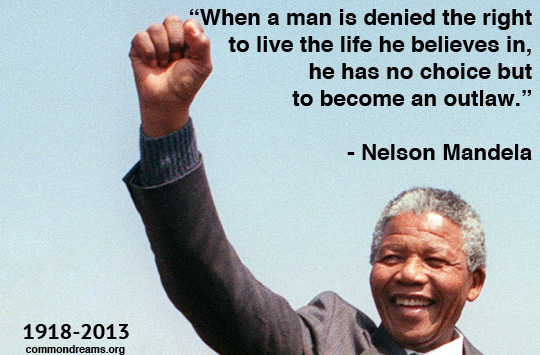
  11. “When a man is denied the right to live the life he believes in, he has no choice but to become an outlaw.”
  12. On Gandhi: “From his understanding of wealth and poverty came his understanding of labor and capital, which led him to the solution of trusteeship based on the belief that there is no private ownership of capital; it is given in trust for redistribution and equalization. Similarly, while recognizing differential aptitudes and talents, he holds that these are gifts from God to be used for the collective good.”


Posted in Quotations | Tagged , , , , | 1 Comment