
-
Recent Posts
-
Join 458 other subscribers
Categories
Archives
- March 2026
- February 2026
- January 2026
- December 2025
- November 2025
- October 2025
- September 2025
- August 2025
- July 2025
- June 2025
- May 2025
- April 2025
- March 2025
- February 2025
- January 2025
- December 2024
- November 2024
- October 2024
- September 2024
- August 2024
- July 2024
- June 2024
- May 2024
- April 2024
- March 2024
- February 2024
- January 2024
- December 2023
- November 2023
- October 2023
- September 2023
- August 2023
- July 2023
- June 2023
- May 2023
- April 2023
- March 2023
- February 2023
- January 2023
- December 2022
- November 2022
- October 2022
- September 2022
- August 2022
- July 2022
- June 2022
- May 2022
- April 2022
- March 2022
- February 2022
- January 2022
- December 2021
- November 2021
- October 2021
- September 2021
- August 2021
- August 2020
- July 2020
- June 2020
- May 2020
- April 2020
- March 2020
- February 2020
- January 2020
- December 2019
- November 2019
- October 2019
- September 2019
- August 2019
- July 2019
- June 2019
- May 2019
- April 2019
- March 2019
- February 2019
- January 2019
- December 2018
- November 2018
- October 2018
- September 2018
- August 2018
- July 2018
- June 2018
- May 2018
- April 2018
- March 2018
- February 2018
- January 2018
- December 2017
- November 2017
- October 2017
- September 2017
- August 2017
- July 2017
- June 2017
- May 2017
- April 2017
- March 2017
- February 2017
- January 2017
- December 2016
- November 2016
- October 2016
- September 2016
- August 2016
- July 2016
- June 2016
- May 2016
- April 2016
- March 2016
- February 2016
- January 2016
- December 2015
- November 2015
- October 2015
- September 2015
- August 2015
- July 2015
- May 2015
- April 2015
- March 2015
- February 2015
- January 2015
- November 2014
- October 2014
- September 2014
- August 2014
- July 2014
- June 2014
- February 2014
- January 2014
- December 2013
- November 2013
- October 2013
- September 2013
- August 2013
- March 2013
- February 2013
- January 2013
- December 2012
- November 2012
- October 2012
- September 2012
- August 2012
- July 2012
- June 2012
- May 2012
- April 2012
- March 2012
- February 2012
- January 2012
- December 2011
- November 2011
- October 2011
- September 2011
- August 2011
- July 2011
- June 2011
- May 2011
- April 2011
- March 2011
- January 2011
- December 2010
Blogroll
Meta
Trump, The Koch Brothers and Their War on Climate Science
Posted in Climate, Donald Trump, environment, global warming, government, politics, science
Tagged climate science, Danny Glover, Koch Brothers, The Real News Network
Leave a comment
Who Can Blame Them?
Nation’s Criminals Ask for F.B.I. Investigation Kavanaugh Just Got


WASHINGTON (The Borowitz Report)—In the latest controversy to envelop the Supreme Court nominee, criminals across the United States are demanding that their cases receive the kind of F.B.I. investigation that Brett Kavanaugh just got.
From coast to coast, perpetrators of crimes ranging from arson to bank robbery are arguing that, if the F.B.I. investigates them at all, such investigations should be extremely limited in scope.
Harland Dorrinson, a criminal lawyer in Cleveland, said that his clients have followed the Kavanaugh probe “with great interest” and see it as “tailor-made” for the crimes for which they stand accused.
“My clients are asking that the F.B.I. investigate them for no more than five days and only talk to the witnesses I designate,” Dorrinson said. “We think this could be a huge time saver for everybody.”
One of his clients, Denton Faldo, currently faces twenty criminal counts of cooking and selling meth, but wants the F.B.I. to investigate only an unrelated speeding violation.
“It’s important that the F.B.I. wrap up this investigation by Friday and release me from jail in time for the weekend,” Faldo said. “A man’s life is in tatters.”
Posted in government, humor, law, political humor, politics, Uncategorized
Tagged Andy Borowitz, Brett Kavanaugh, Supreme Court, the New Yorker
Leave a comment
Speaking Truth to Power
Posted in America, government, Iran, Middle East, military, war
Tagged Brian Hook, Code Pink, Hudson Institute, Iran Action Group, Medea Benjamin, The Real News
Leave a comment
The Slaves Rebel
By Chris Hedges/ Truthdig/ September 3, 2018

Cartoon by Mr. Fish
The only way to end slavery is to stop being a slave. Hundreds of men and women in prisons in some 17 states are refusing to carry out prison labor, conducting hunger strikes or boycotting for-profit commissaries in an effort to abolish the last redoubt of legalized slavery in America. The strikers are demanding to be paid the minimum wage, the right to vote, decent living conditions, educational and vocational training and an end to the death penalty and life imprisonment.
These men and women know that the courts will not help them. They know the politicians, bought by the corporations that make billions in profits from the prison system, will not help them. And they know that the mainstream press, unwilling to offend major advertisers, will ignore them.
But they also know that no prison can function without the forced labor of many among America’s 2.3 million prisoners. Prisoners do nearly all the jobs in the prisons, including laundry, maintenance, cleaning and food preparation. Some prisoners earn as little as a dollar for a full day of work; in states such as Alabama, Arkansas, Georgia, South Carolina and Texas, the figure drops to zero.
Corporations, at the same time, exploit a million prisoners who work in prison sweatshops where they staff call centers or make office furniture, shoes or clothing or who run slaughterhouses or fish farms.
If prisoners earned the minimum wage set by federal, state or local laws, the costs of the world’s largest prison system would be unsustainable. The prison population would have to be dramatically reduced. Work stoppages are the only prison reform method that has any chance of success. Demonstrations of public support, especially near prisons where strikes are underway, along with supporting the prisoners who have formed Jailhouse Lawyers Speak, which began the nationwide protest, are vital. Prison authorities seek to mute the voices of these incarcerated protesters. They seek to hide the horrific conditions inside prisons from public view. We must amplify these voices and build a popular movement to end mass incarceration.
The strike began Aug. 21, the 47th anniversary of the 1971 killing of the Black Panther prison writer and organizer George Jackson in California’s San Quentin. It will end Sept. 9, the 47th anniversary of the 1971 Attica prison uprising. It is an immensely courageous act of civil disobedience. Prison authorities have innumerable ways to exact retribution, including placing strikers in solitary confinement and severing communication with the outside world. They can take away the few privileges and freedoms, including the limited freedom of movement, yard time, phone privileges and educational programs, that prisoners have. This makes the defiance all the more heroic. These men and women cannot go elsewhere. They cannot remain anonymous. Retribution is certain. Yet they have risen up anyway.
In addition to making demands about wages, the prisoners are calling for an end to the endemic violence that plagues many prisons. During a riot in April at Lee Correctional Institution, a maximum-security prison in South Carolina, seven prisoners were killed and 17 were injured as prison guards waited four hours to intervene.
Prisons in America are a huge and lucrative business. The private prison contractors Corrections Corporation of America and The GEO Group have annual revenues of $1.6 billion and more than $2 billion, respectively. They spent a combined $8.7 million on lobbying from 2010 through 2015, according to OpenSecrets.org. Global Tel Link, which runs the privatized phone services in many prisons, is valued at $1.2 billion. The food service corporation Aramark, a $8.65 billion company, has contracts in 500 prisons across the country although it has been accused of serving contaminated and spoiled food that has led to food poisoning. The money transfer corporation JPay Inc. is a subsidiary of the telecommunications firm Securus Technologies, which is owned by the private equity firm Abry Partners. JPay made $53 million in 2014 on transfers of $525 million, through an average charge of 10 percent to those sending money to prisoners. Corizon Health has a contract to provide health care to more than 300,000 prisoners nationwide. It earns about $1.4 billion a year. And there are many other corporations with equally large revenues and profit margins within the prisons.
Private corporations exploit prison labor in at least 40 states. In some cases these workers are paid next to nothing. They have no benefits, including Social Security participation, and cannot form unions or organize. They are not paid for sick days. And if they complain or are seen as troublesome they are placed in solitary confinement, often for months.
Some of the country’s biggest corporations have moved into prisons to take advantage of this bonded labor force. They include Abbott Laboratories, AT&T, AutoZone, Bank of America, Bayer, Berkshire Hathaway, Cargill, Caterpillar, Chevron, the former Chrysler Group, Costco Wholesale, John Deere, Eddie Bauer, Eli Lilly, ExxonMobil, Fruit of the Loom, GEICO, GlaxoSmithKline, Glaxo Wellcome, Hoffmann-La Roche, International Paper, JanSport, Johnson & Johnson, Kmart, Koch Industries, Mary Kay, McDonald’s, Merck, Microsoft, Motorola, Nintendo, Pfizer, Procter & Gamble, Quaker Oats, Sarah Lee, Sears, Shell, Sprint, Starbucks, State Farm Insurance, United Airlines, UPS, Verizon, Victoria’s Secret, Walmart and Wendy’s.
Fyodor Dostoevsky wrote that “the degree of civilization in a society can be judged by entering its prisons.” Prisons expose how far a state will go to exploit and abuse its most vulnerable. Life in the American prison system is a window into the corporate tyranny that will be inflicted on all of us once we are stripped of the power to resist. The poorest families in the country are forced to pay an array of predatory fees to sustain incarcerated relatives. This is especially cruel to those children whose only contact with an incarcerated parent is through phone service that costs four or five times what it does on the outside. Prison life is one of daily humiliation and abuse. It entails beatings, torture, rape—especially for female prisoners who are preyed upon by prison staff—prolonged isolation, rancid food, inadequate heating and ventilation, substandard or nonexistent health care and being locked in a cage for days at a time, especially in supermax prisons.
Slavery within the prison system is permitted by the 13th Amendment of the U.S. Constitution, passed in 1865 at the end of the Civil War
to create a new form of slave labor. It reads: “Neither slavery nor involuntary servitude, except as punishment for crime whereof the party shall have been duly convicted, shall exist within the United States. …” Plantations in the South and industries such as Florida’s vast turpentine farm operations, which survived into the early 20th century, used the 13th Amendment to force black convicts to do the same uncompensated work that many had done as slaves.
“Imprisoned in stockades or cells, chained together at night or held under armed guards on horseback, the turpentine farms were bleak outposts miles from any chance of comfort or contact with the outside world,” Douglas A. Blackmon writes in “Slavery by Another Name,” a description of convict life for tens of thousands of African-Americans that is eerily similar to today’s prison conditions. “Workers were forced to buy their own food and clothes from a camp commissary and charged usurious interest rates on the salary advances used to pay for the goods—typically at least 100 percent.”
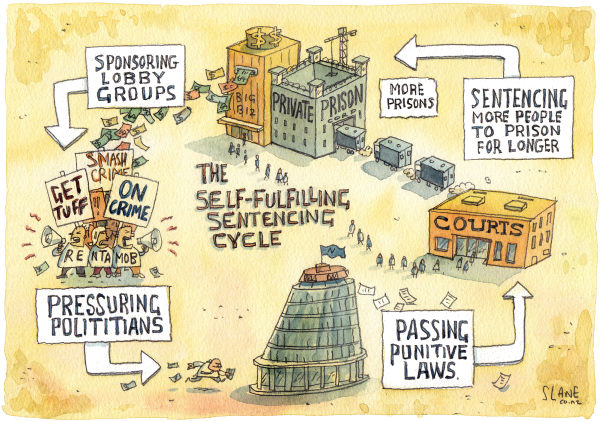
Prisons, which contain mostly poor people of color, over half of whom have never physically harmed anyone, are part of the continuum of slavery, Black Codes, Jim and Jane Crow, convict leasing, lynching and the lethal, indiscriminate force used by police on city streets. Prisons are not primarily about crime. They are about social control. They are about profiting off black and brown bodies, bodies that in blighted, deindustrialized neighborhoods do not produce money for corporations but once locked away generate some $60,000 a year per prisoner for prison contractors, police, parole agencies, corrections officers, phone companies, private prisons, money transfer companies, medical companies, food venders, commissaries and the industries that manufacture body armor, pepper spray and the gruesome array of restraints and implements—four- and five-point restraints, restraint hoods, restraint belts, restraint beds, stun grenades, stun guns, stun belts, spit hoods, body orifice security scanners (BOSS chairs), tethers, and waist and leg chains—that look like a collection amassed by the Marquis de Sade. Prisons are also where we warehouse the poor who are mentally ill. It is estimated that 25 percent of the prison population has severe mental illness. Those with crippling mental disorders are given not therapy but cocktails of powerful psychotropic drugs that turn them into zombies sleeping 20 hours a day.
Once corporations moved manufacturing overseas and denied those in poor communities the possibility of a job that could sustain them and their families, they began to extract billions in profit by putting bodies in cages. Since 1970 our prison population has grown by about 700 percent. We have invested $300 billion in prisons since 1980. The prison-industrial complex mirrors the military-industrial complex. The money is public; the profits are private. Those who enrich themselves off the incarcerated are morally no different from those who enriched themselves from the slave trade.
Prisoners, once released, often after decades, commonly suffer from severe mental and physical trauma and other health problems including diabetes (which is an epidemic in prisons because of the poor diet), hepatitis C, tuberculosis, heart disease and HIV. They do not have money or insurance to get treatment for their illnesses when they are released. They have often become alienated from their families and are homeless. Stripped of the right to public assistance, unable to vote, banned from living in public housing, without skills or education and stigmatized by employers, they become members of the vast criminal caste system. Many are burdened with debts because of monetary charges in the criminal justice structure and a predatory system of prison loans. Over 60 percent end up back in prison within five years. This is by design. The lobbyists for the prison-industrial complex make sure the laws and legislation keep the prisons full and recidivism high. This is good for profit. And it is profit, not justice, that is the primary force behind mass incarceration. This system will end only when those profits are wrested from the hands of our modern slaveholders. The only people who can do that are the slaves and the abolitionists who fight alongside them.
The full list of national demands from “the men and women in federal, immigration, and state prisons” reads:
1. Immediate improvements to the conditions of prisons and prison policies that recognize the humanity of imprisoned men and women.
2. An immediate end to prison slavery. All persons imprisoned in any place of detention under United States jurisdiction must be paid the prevailing wage in their state or territory for their labor.
3. The Prison Litigation Reform Act must be rescinded, allowing imprisoned humans a proper channel to address grievances and violations of their rights.
4. The Truth in Sentencing Act and the Sentencing Reform Act must be rescinded so that imprisoned humans have a possibility of rehabilitation and parole. No human shall be sentenced to death by incarceration or serve any sentence without the possibility of parole.
5. An immediate end to the racial overcharging, over-sentencing, and parole denials of black and brown humans. Black humans shall no longer be denied parole because the victim of the crime was white, which is a particular problem in southern states.
6. An immediate end to racist gang enhancement laws targeting black and brown humans.
7. No imprisoned human shall be denied access to rehabilitation programs at their place of detention because of their label as a violent offender.
8. State prisons must be funded specifically to offer more rehabilitation services. 9. Pell grants must be reinstated in all U.S. states and territories.
10. The voting rights of all confined citizens serving prison sentences, pretrial detainees, and so-called “ex-felons” must be counted. Representation is demanded. All voices count!
Article Link: https://www.truthdig.com/articles/the-slaves-rebel/
Posted in America, government, law, politics, prisons
Tagged Chris Hedges, Mr. Fish, prison strike, private prisons, slavery, Truthdig
Leave a comment
Marx Warned Us
Capitalism Is Beyond Saving, and America Is Living Proof
By Jacob Bacharach/ Truthdig/ August 31, 2018

Policies that fail in the same way over and over are not failing. Someone is lying about their intent. The drug war didn’t fail to stem the flow of banned narcotics and to stop epidemic abuse and addiction; it succeeded at building a vast carceral and surveillance apparatus targeted at people of color as a successor to Jim Crow.
The war in Iraq didn’t fail to bring democracy to the Middle East; it smashed an intransigent sometimes-ally in the region, and deliberately weakened and destabilized a group of countries whose control of, and access to, immense oil reserves was of strategic American interest.
The “end of welfare as we know it” didn’t fail to instill in the nation’s poor a middle-class sense of responsibility; it entrenched a draconian regime of means-testing and a Kafkaesque bureaucracy for access to even meager social benefits for a rapidly shrinking middle class.
It’s not that “Capitalism isn’t working,” as Noah Smith recently argued in Bloomberg. It’s that it’s working all too well.
Real wage growth has been nonexistent in the United States for more than 30 years. But as America enters the 10th year of the recovery—and the longest bull market in modern history—there are nervous murmurs, even among capitalism’s most reliable defenders, that some of its most basic mechanisms might be broken. The gains of the recovery have accrued absurdly, extravagantly to a tiny sliver of the world’s superrich. A small portion of that has trickled down to the professional classes—the lawyers and money managers, art buyers and decorators, consultants and “starchitects”—who work for them. For the declining middle and the growing bottom: nothing.
This is not how the economists told us it was supposed to work. Productivity is at record highs; profits are good; the unemployment rate is nearing a meager 4 percent. There are widely reported labor shortages in key industries. Recent tax cuts infused even more cash into corporate coffers. Individually and collectively, these factors are supposed to exert upward pressure on wages. It should be a workers’ market.
But wages remain flat, and companies have used their latest bounty for stock buybacks, a transparent form of market manipulation that was illegal until the Reagan-era SEC began to chip away at the edifice of New Deal market reforms. The power of labor continues to wane; the Supreme Court’s Janus v. AFSCME decision, while ostensibly limited to public sector unions, signaled in certain terms the willingness of the court’s conservative majority—five guys who have never held a real job—to effectively overturn the entire National Labor Relations Act if given the opportunity. The justices, who imagine working at Wendy’s is like getting hired as an associate at Hogan & Hartson after a couple of federal clerkships, reason that every employee can simply negotiate for the best possible deal with every employer.
To those for whom capitalism cannot fail but can only be failed, the answers lie at the margins. Neoliberal doctrine forecloses any hope of large-scale change; present circumstances always prevent future possibilities. Instead, as Smith writes, “there are some simpler, humbler changes that state governments can begin taking right away, without waiting for labor-friendly politicians to take control of the White House and Congress.”
These changes involve banning noncompete agreements, through which companies forbid employees from going to work for competitors, and more assiduously policing industry wage-fixing.
Both would be fine reforms, but neither would have much effect on the labor share of gross domestic product. They are minor symptoms of the capitalist disease. Capitalism isn’t broken; it’s working precisely as it’s supposed to: generating surpluses and giving all of them to a small ownership class. The New Deal and postwar prosperity, which barely lasted until 1980, represent historic outliers—the one significant period in which growth at the top was somewhat constrained and a relatively large share of wealth went to the middle. It was possible only through massive government intervention and redistribution, combined with a powerful labor sector backed by that same federal government. It took the collective power of entire societies to briefly restrain capitalism, which, left to its own devices, will do what it has always done: make the already very rich infinitely richer. Capitalism is “working” just fine.
What we are seeing, I suspect, is an acceleration of a broader social transformation that’s been occurring for some time. Rome, the saying goes, wasn’t built in a day, but neither did it fall in one, either. Changes to societies as large and complex as theirs or ours occur subtly and over years—if not decades. Those workers who do remain in the workforce increasingly depend on work and work alone for all their benefits. The companies for which most people work are like the Roman villas that gradually became central nodes of a manorial society as the imperial metropole retreated through a series of self-inflicted wars and crises of governance.
One moment you’re working for some kind of money wage in a fully monetized economy; the next you’re living in a company town, buying your groceries with scrip, and you can’t leave without your boss’ permission.
In America today, supposedly the most prosperous society ever to exist on earth, nearly a third of families report experiencing economic hardship. Sixty percent—60 percent!—say they could not cover an unexpected expense of $1,000, and nearly 40 percent have less than $500 in savings. People with good insurance get billed $100,000 for having a heart attack. People commute four hours a day because they can’t afford to live in the cities where they work.
The barbarians aren’t at the gates. They’re already here in the boardrooms; they’ve been here all along.
Jacob Bacharach is the author of the novels “The Doorposts of Your House and on Your Gates” and “The Bend of the World.” His most recent book is “A Cool Customer: Joan Didion’s The Year of Magical Thinking.”…
Posted in Economics, economy, government, inequality, poverty
Tagged capitalism, Jacob Bacharach, Truthdig
16 Comments
Digging a Hole
Worth a click….
Posted in America, Economics, economy, government
Tagged national debt, U.S. Debt Clock
Leave a comment
Unbalanced
published in Monterey Herald, Letters to the Editor, September 1, 2018
Is it right that Donald Trump’s bizarre tweets are considered news and reported on extensively in the corporate news media, yet are never followed by an opposing (Democratic Party) response? Chuck Schumer doesn’t have a quote? Nancy Pelosi never has an answer? Whatever happened to the concepts of balance, fairness and/or equal time? No wonder Trump’s approval numbers never dip: he controls the message (with the assistance of the news media).
–Arlen Grossman

Posted in Donald Trump, media, politics, Uncategorized
Tagged Chuck Schumer, Nancy Pelosi, Trump's tweets
Leave a comment
Follow the Money

Posted in Donald Trump, Economics, economy, government, inequality, politics
Tagged corporate profits, wages
1 Comment
Not Much of a Maverick
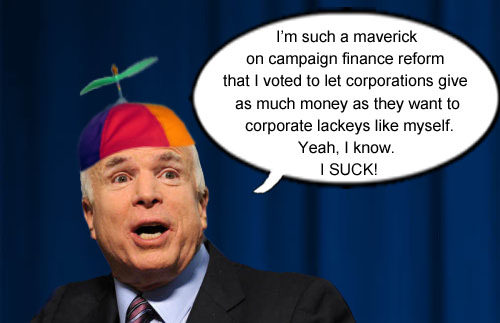
All the gushing praise of Senator John McCain is embarrassing. The man occasionally would say or vote in a courageous way. But when you come right down with it, he was still a reliable Republican, voting the party line far more than not. And a Super War Hawk, for sure. Sorry, but I won’t shed any tears for the late senator.–Arlen Grossman
https://fivethirtyeight.com/features/is-john-mccain-a-maverick/
Posted in government, John McCain, politics, Republican Party
Tagged campaign finance reform, maverick
Leave a comment
 thebigpicturereport ™