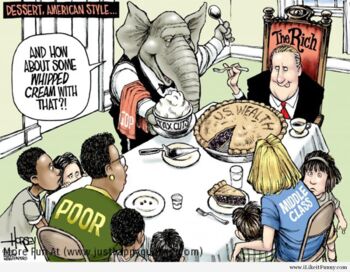
Trump’s ass-backward “affordability” agenda

By RobertReich/ robertreich@subset.com/ January 13, 2026

The latest gauge on inflation, released this morning, showed prices increasing 2.7 percent in December compared with the same period a year ago. Food prices were up 3.1 percent. (Reminder: Trump was elected on two issues: bringing prices down, especially food, and avoiding foreign entanglements.)

Today, Trump traveled to Detroit to deliver an address to the Detroit Economic Club. It was about “affordability” and he filled it with lies — such as Americans aren’t paying for his tariffs (of course they are) and inflation was “way, way, down” (it’s about the same as it was when he took office). 

And he insisted that “affordability” is a “fake word by Democrats.” Unfortunately for Trump, “affordability” has become even more politically potent than immigration or crime. And in his first year at the helm, he’s made America less affordable. 

He’s also been putting forward some ass-backward ideas for bringing down prices that will actually increase them. His biggest: Fire the current chair of the Federal Reserve Board and install a chair who’ll lower interest rates — and thereby, in Trump’s addled brain, bring down the costs of borrowing to buy homes and cars. (In his speech today, he called Fed chair Jerome Powell Powell, a “jerk.”)

Trump’s decision to open up a criminal investigation of Powell is a bizarre escalation of his pressure campaign against the central bank to cut interest rates. And it’s truly ass-backwards. Without an independent Fed committed to using interest rates to fight inflation, everyone who buys or sells or invests will have to assume the risk of runaway prices in the future. The result is a risk “premium” that makes everything more expensive instead of more affordable. 

What should be done to make America more affordable? Ten commonsense initiatives: 

1. Get rid of Trump’s tariffs

Trump’s blanket, unpredictable, on-again-off-again, gigantic and then sometimes modest tariffs have caused prices to jump on just about everything. That’s because tariffs are import taxes that are paid by the companies that do the importing and by their consumers. 

Tariffs can be a tool to create American jobs, but only if they’re used in a targeted and responsible way. Targeted and responsible are two adjectives that no one uses in describing Trump’s tariffs. 

The first step to make life more affordable for the average American is to get rid of them. 

2. Bust up monopolies

Trump’s overriding goal is to boost share prices. He doesn’t seem to understand that most Americans aren’t directly affected by share prices: Over 90 percent of the value of shares held by Americans is held by the richest 10 percent; over half by the richest 1 percent. 

In pursuit of high share prices, Trump has essentially given up on antitrust enforcement. Big corporations are now merging and buying up potential competitors at a rapid rate. But this means less competition, and less competition results in higher prices. 

It’s another ass-backward approach to affordability. Trump’s overriding goal of high share prices collides with what should be the real goal: keeping prices low. 

A real affordability agenda would bust up big corporations that dominate their industries and prohibit price gouging.

3. Fight for stronger unions

Trump hates unions and has done everything he can do to weaken the National Labor Relations Board and the Labor Department. He’s given free rein to corporate union-busting. 

Here again, Trump’s goal of high share prices and corporate profitability is at direct odds with the needs of average workers for higher wages, which are necessary if the goods and services they require are to become more affordable to them. 

Workers need more bargaining power to get higher wages. Unions do that. A real affordability agenda therefore would make it easier for workers to start or join them.

4. Raise the national minimum wage

For the same reason Trump believes unions and higher wages are bad for the economy — that is, his definition of the economy, which is the stock market — he’s been dead set against raising the national minimum wage. 

But the federal minimum wage has been stuck at a measly $7.25 since 2009. Raise the damn wage. And raise it even higher for employees of big corporations that pay their top executives hundreds of times more than their workers.

5. Pass Medicare For All

Trump has been trying to destroy the Affordable Care Act because it was passed under his predecessor, Barack Obama. His latest gambit has been to block any extension of the subsidies that Americans need to be able to afford health insurance under the ACA. (The fight over this issue resulted in the longest government shutdown in history.)

Without those subsidies, the typical American will be paying 30 to 100 percent more for health insurance this year than last — which is already driving many people out of the ACA marketplace and forcing them to live without health insurance at all. 

Extending ACA subsidies is necessary but not sufficient. A real affordability agenda would make Medicare available to all Americans. This will bring down health care costs for everyone, because Medicare is cheaper and more efficient than for-profit health insurance.

6. Make housing more affordable

Last Wednesday, Trump called for a ban on institutional investors buying single-family housing. I suppose it’s nice that he’s finally gotten around to this, but I’ll believe it when he actually signs the legislation. 

A real affordability agenda would ban Wall Street firms from buying up housing, crack down on corporate landlords that collude to jack up rent prices, get rid of zoning laws that make it harder to build homes, and increase funding to boost the construction of housing in cities that need it most.

7. Make child care and elder care more affordable

The costs of child care take a third of the incomes of parents with young children, on average. The costs of elder care can be even higher for working people with elderly parents. Both are essential for working families. 

An affordability agenda would include a universal child care program for parents and boost funding for caregivers of aging parents.

8. Give Americans paid leave

Here again, the goal of fat corporate profits and high share prices collides with what American workers need. Trump consistently opts for the former and argues that the nation “can’t afford” paid family leave. 

Baloney. We’re the richest country in the world. Every other advanced nation provides paid leave. Working Americans need it. We should provide it, too. 

9. Stop Big Finance from siphoning off people’s incomes

Trump has deregulated big banks and allowed them to charge up to 30 percent interest on credit cards. (The banks love it because credit cards provide them with four times the return of any other line of business.) Trump has gotten rid of the Consumer Financial Protection Bureau, which stopped other sleazy financial practices. And he’s allowed more consolidation of big financial institutions, which means even less competition, higher prices, and shadier deals. (His Justice Department recently approved the merger of Capital One and Discover, which will pile even more debt on low-income consumers.)

The captains of Wall Street have never had it so good. JPMorgan CEO Jamie Dimon made $770 million last year. But average working people are being shafted. 

A real affordability agenda would cap credit card interest rates at 5 percent, stop the banks from charging late fees on unsuspecting consumers (Trump’s OMB director, Russ Vought, withdrew the late fee rule in April), and bust up the biggest banks whose market power is allowing them to charge absurdly high interest rates on all borrowing. 

10. Raise taxes on the wealthiest Americans and corporations

Besides tariffs, Trump’s economic policy has cut taxes mainly on wealthy individuals and big corporations. He’s imbibed the “trickle-down” Kool-Aid that assumes tax cuts at the top make everyone better off. 

The reality, as we’ve learned since Trump’s first tax cut mostly benefiting the wealthy and big corporations (as we should have learned from Ronald Reagan’s and George W. Bush’s trickle-down tax cuts also mainly benefiting the rich and big corporations) is that nothing trickles down. Trickle-down economics is a cruel sham. 

The cumulative effects of all these tax cuts has been to make America’s rich far richer — now owning a record share of the nation’s wealth — and big corporations far more profitable (corporate profits are also near record levels), while dramatically enlarging the national debt. 

And what do we get with a bigger debt? More inflation, which makes everything less affordable. Again, Trump has it ass-backward. 

It’s time we ended the trickle-down hoax once and for all.

Besides, it’s only fair that the super rich pay more in taxes so that the rest of America can afford what Americans need: housing, health care, child care and elder care. 

And by the way, even after paying more in taxes, the rich will still be richer than they’ve ever been, and giant corporations will still be exceedingly profitable.

***

These 10 steps are crucial for making America affordable again. Don’t fall for Trump’s ass-backward agenda, which will only make the rich richer and big corporations more profitable. You and I and everyone who wants to lower the cost of living for Americans should back the real affordability agenda. 

Please share this with any Democrat or independent (hell, share it with any Republican) interested in running for office and improving Americans’ standard of living. 
Posted in Uncategorized | 5 Comments

Trump’s Attack on Venezuela Is Illegal and Unwise

By NYTimes Editorial Board/ January 3, 2026

Over the past few months, President Trump has deployed an imposing military force in the Caribbean to threaten Venezuela. Until now, the president used that force — an aircraft carrier, at least seven other warships, scores of aircraft and 15,000 U.S. troops — for illegal attacks on small boats that he claimed were ferrying drugs. On Saturday, Mr. Trump dramatically escalated his campaign by capturing President Nicolás Maduro of Venezuela as part of what he called “a large scale strike” against the country.

Few people will feel any sympathy for Mr. Maduro. He is undemocratic and repressive, and has destabilized the Western Hemisphere in recent years. The United Nations recently issued a report detailing more than a decade of killings, torture, sexual violence and arbitrary detention by henchmen against his political opponents. He stole Venezuela’s presidential election in 2024. He has fueled economic and political disruption throughout the region by instigating an exodus of nearly eight million migrants.

If there is an overriding lesson of American foreign affairs in the past century, however, it is that attempting to oust even the most deplorable regime can make matters worse. The United States spent 20 years failing to create a stable government in Afghanistan and replaced a dictatorship in Libya with a fractured state. The tragic consequences of the 2003 war in Iraq continue to beset America and the Middle East. Perhaps most relevant, the United States has sporadically destabilized Latin American countries, including Chile, Cuba, Guatemala and Nicaragua, by trying to oust a government through force.

Mr. Trump has not yet offered a coherent explanation for his actions in Venezuela. He is pushing our country toward an international crisis without valid reasons. If Mr. Trump wants to argue otherwise, the Constitution spells out what he must do: Go to Congress. Without congressional approval, his actions violate U.S. law.

The nominal rationale for the administration’s military adventurism is to destroy “narco-terrorists.” Governments throughout history have labeled the leaders of rival nations as terrorists, seeking to justify military incursions as policing operations. The claim is particularly ludicrous in this case, given that Venezuela is not a meaningful producer of fentanyl or the other drugs that have dominated the recent epidemic of overdoses in the United States, and the cocaine that it does produce flows mostly to Europe. While Mr. Trump has been attacking Venezuelan boats, he also pardoned Juan Orlando Hernández, who ran a sprawling drug operation when he was president of Honduras from 2014 to 2022.

A more plausible explanation for the attacks on Venezuela may instead be found in Mr. Trump’s recently released National Security Strategy. It claimed the right to dominate Latin America: “After years of neglect, the United States will reassert and enforce the Monroe Doctrine to restore American pre-eminence in the Western Hemisphere.” In what the document called the “Trump Corollary,” the administration vowed to redeploy forces from around the world to the region, stop traffickers on the high seas, use lethal force against migrants and drug runners and potentially base more U.S. troops around the region.

Venezuela has apparently become the first country subject to this latter-day imperialism, and it represents a dangerous and illegal approach to America’s place in the world. By proceeding without any semblance of international legitimacy, valid legal authority or domestic endorsement, Mr. Trump risks providing justification for authoritarians in China, Russia and elsewhere who want to dominate their own neighbors. More immediately, he threatens to replicate the American hubris that led to the invasion of Iraq in 2003.

As a presidential candidate, Mr. Trump seemed to recognize the problems with military overreach. In 2016, he was the rare Republican politician to call out the folly of President George W. Bush’s Iraq war. In 2024, he said: “I’m not going to start a war. I’m going to stop wars.”

He is now abandoning this principle, and he is doing so illegally. The Constitution requires Congress to approve any act of war. Yes, presidents often push the boundaries of this law. But even Mr. Bush sought and received congressional endorsement for his Iraq invasion, and presidents since Mr. Bush have justified their use of drone attacks against terrorist groups and their supporters with a 2001 law that authorized action after the Sept. 11 attacks. Mr. Trump has not even a fig leaf of legal authority for his attacks on Venezuela.

Congressional debates over military action play a crucial democratic role. They check military adventurism by forcing a president to justify his attack plans to the public and requiring members of Congress to tie their own credibility to those plans. For years after the vote on the Iraq war, Democrats who supported Mr. Bush, including Hillary Clinton and John Kerry, paid a political price, while those who criticized the war, like Bernie Sanders and Barack Obama, came to be seen as prophetic.

In the case of Venezuela, a congressional debate would expose the thinness of Mr. Trump’s rationale. His administration has justified his attacks on the small boats by claiming they pose an immediate threat to the United States. But a wide range of legal and military experts reject the claim, and common sense refutes it, too. An attempt to smuggle drugs into the United States — if, in fact, all the boats were doing so — is not an attempt to overthrow the government or defeat its military.

We suspect Mr. Trump has refused to seek congressional approval for his actions partly because he knows that even some Republicans in Congress are deeply skeptical of the direction in which he is leading this country. Already, Senators Rand Paul and Lisa Murkowski and Representatives Don Bacon and Thomas Massie — Republicans all — have backed legislation that would limit Mr. Trump’s military actions against Venezuela.

A second argument against Mr. Trump’s attacks on Venezuela is that they violate international law. By blowing up the small boats that Mr. Trump says are smuggling drugs, he has killed people based on the mere suspicion that they have committed a crime and given them no chance to defend themselves. The Geneva Conventions of 1949 and every subsequent major human rights treaty prohibit such extrajudicial killings. So does U.S. law.

The administration appears to have killed defenseless people. In one attack, the Navy fired a second strike against a hobbled boat, about 40 minutes after the first attack, killing two sailors who were clinging to the boat’s wreckage and appeared to present no threat. As our colleague David French, a former U.S. Army lawyer, has written, “The thing that separates war from murder is the law.”

The legal arguments against Mr. Trump’s actions are the more important ones, but there is also a cold-eyed realist argument. They are not in America’s national security interest. The closest thing to an encouraging analogy is President George H.W. Bush’s invasion of Panama 36 years ago last month, which drove the dictator Manuel Noriega from power and helped set Panama on a path toward democracy. Yet Venezuela is different in important ways. Panama is a much smaller country, and it was a country where American officials and troops had operated for decades because of the Panama Canal.

The potential for chaos in Venezuela seems much greater. Despite Mr. Maduro’s capture, the generals who have enabled his regime will not suddenly vanish. Nor are they likely to hand power to María Corina Machado, the opposition figure whose movement appears to have won the country’s most recent election and who accepted the Nobel Peace Prize last month.

Among the possible bad outcomes are a surge in violence by the left-wing Colombian military group the ELN, which has a foothold in Venezuela’s western area, or by the paramilitary groups known as “colectivos” that have operated on the periphery of power under the Maduro dictatorship. Further unrest in Venezuela could unsettle global energy and food markets and drive more migrants throughout the hemisphere.

So how should the United States deal with the continuing problem that Venezuela poses to the region and America’s interests? We share the hopes of desperate Venezuelans, some of whom have made a case for intervention. But there are no easy answers. By now, the world should understand the risks of regime change.

We will hold out hope that the current crisis will end less badly than we expect. We fear that the result of Mr. Trump’s adventurism is increased suffering for Venezuelans, rising regional instability and lasting damage for America’s interests around the world. We know that Mr. Trump’s warmongering violates the law.

Posted in America, Congress, Donald Trump, military, politics, Republican Party, Venezuela, war | Tagged , , , | 1 Comment

Here’s How Much Donald Trump Is Worth

By Dan Alexander and Kyle Khan-Mullins, Forbes Staff/ Forbes September 18, 2025

Everyone has an opinion, but Forbes has the answer: $7.3 billion, according to our most recent tally, updated in September. Trump added $3 billion over the last year, leveraging the presidency for profit. His cryptocurrency ventures, stalled out before the election, exploded after his victory, adding an estimated $2 billion to his fortune in 10 months. Another $500 million came in court, where Trump’s legal team succeeded in eliminating a half-billion judgement against him. His once-dormant licensing business surged by another $400 million, as foreign developers clamored to do business with an American president. With most of Trump’s second term remaining, expect billions more to head his way. 

Posted in America, Donald Trump, Economics, extremism, government, inequality, politics | Tagged , | Leave a comment

The Brazen Cruelty of the Trump Regime

Its plan to warehouse immigrants has shades of Nazi concentration camps and America’s shameful imprisonment of Japanese Americans during World War II.


By Robert Reich/ Robert Reich.substack.com/ December 24, 2025

There have been many labels describing President Trump: hateful, racist, criminal, ignorant, fascist, abuser of women, greedy, angry, narcissistic, demented, cowardly, self-serving, dictator…the list goes on forever. In this commentary, Robert Reich focuses on one of his worst, but sometimes overlooked traits, his wanton cruelty. In so many ways, the hurt and pain of people–other than perhaps his family. friends, and social and economic class–seem irrelevant and of no interest to him and those around him. Reich supplies the newest evidence.–TBPR editor.

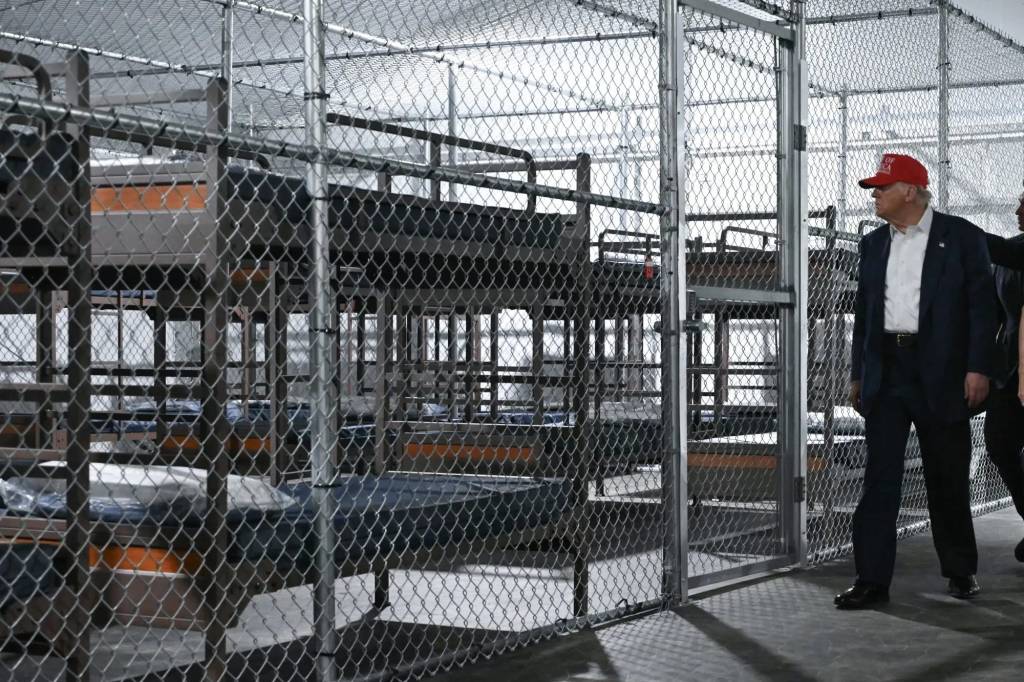
According to today’s Washington Post, the Trump regime plans to renovate industrial warehouses to hold more than 80,000 immigrant detainees at a time.

The plan is for newly arrested detainees to be funneled — let me remind you, with no due process, or independent magistrate or judge checking on whether they are in fact in the United States illegally — into one of seven large-scale warehouses holding 5,000 to 10,000 people each, where they would be “staged” for deportation.

The large warehouses would be located close to major logistics hubs in Virginia, Texas, Louisiana, Arizona, Georgia and Missouri. Sixteen smaller warehouses would hold up to 1,500 people each.

America’s immigrant detention system is already the largest in the world. 

With the $45 billion Congress appropriated for locking up immigrants, the regime has revived dormant prisons, repurposed sections of military bases, and partnered with Republican governors to build immigrant tent encampments in remote regions.

“We need to get better at treating this like a business,” ICE acting director Todd M. Lyons said at a border security conference in April, according to the Arizona Mirror. The administration’s goal, he said, was to deport immigrants as efficiently as Amazon moves packages: “Like Prime, but with human beings.”

The logistical problems of converting warehouses into detention camps are significant. Warehouses are designed for storage and shipping of things, not people. They are often poorly ventilated and without precise temperature controls, and they lack access to the plumbing and sanitation systems needed to support thousands of full-time residents.

Beyond logistics is the dehumanization. 

Ninety-three years ago, in March 1933, the Nazis established their first concentration camp in what is now Dachau, Poland. Other camps were soon established in Buchenwald and Sachsenhausen. 

Initially, the Nazi’s put into these camps Communists, Social Democrats, trade unionists, and others deemed a threat to the Nazi regime. 

After the Kristallnacht pogrom of November 9-10, 1938, approximately 30,000 Jewish men were arrested and sent to these camps in a mass, large-scale action that targeted them for being Jewish. The systematic mass murder of Jews in camps designed as extermination camps did not begin until late 1941 and early 1942, as part of the “Final Solution.”

The U.S. began forcibly moving Japanese Americans into America’s own camps in early 1942, following President Roosevelt’s signing of Executive Order 9066 of February 19, 1942, which authorized military exclusion zones. Initial roundups of Japanese Americans, deemed “enemy aliens,” started immediately after Japan’s attack on Pearl Harbor attack on December 7, 1941. 

Around 120,000 people of Japanese descent, mostly U.S. citizens from the West Coast, were incarcerated in ten camps in remote inland states and temporary Assembly Centers. Hundreds more were imprisoned in Hawaii.

Once dehumanization begins, it’s hard to end. 

As I noted, ICE is arresting, imprisoning, and deporting people it accuses of being in the United States illegally — but there is no due process, no third-party validation of ICE’s accusations. 

ICE now holds more than 68,000 people in detention facilities, according to agency data. Nearly half — 48 percent — have no criminal convictions or pending criminal charges, ICE data shows. 

ICE’s biggest current facility is a tent encampment at the Fort Bliss U.S. Army base in Texas, which now holds around 3,000 people but was expected to have a capacity of 5,000 by year’s end.

The largest proposed ICE warehouse would hold up to 10,000 detainees in Stafford, Virginia. Another with capacity for up to 9,500 is planned for Hutchins, near Dallas. A third, with space for 9,000, in Hammond, east of Baton Rouge.

There is no place in a civilized society for the warehousing of people. 

There is no justification in a society putatively organized under the rule of law to imprison people without due process. 

There is no decency in removing hardworking members of our communities from their families and neighbors and imprisoning them and then deporting them to other countries, some of which are brutal dictatorships. 

When the history of this cruel era is written, the shame should be no less than the shame we now feel about the roundups and detention of Japanese Americans in World War II. 

Hopefully, the dehumanization of the people that the Trump regime aims to warehouse will not result in the sadistic cruelties of the Nazi’s starting ninety-three years ago.

Posted in America, Democratic Party, Donald Trump, ethics, fascism, government, politics | Tagged , , , , , | Leave a comment

Our Next Racist President?

The bitter infighting over antisemitism, free speech and bigotry during Turning Point USA’s annual national conference not only exposed fissures in President Trump’s movement but also laid bare a challenge for his potential successor.

How would his likely heir apparent handle an explosive debate among Republicans over whether extremists and conspiracy theorists should be embraced or excluded from the conservative coalition?

On Sunday, Vice President JD Vance gave an answer, suggesting he was more than willing to forgo imposing any moral red lines.

“When I say that I’m going to fight alongside of you, I mean all of you — each and every one,” Mr. Vance said at Turning Point USA’s annual gathering, AmericaFest, where prominent conservative leaders called on their peers to stop promoting conspiracies and hate. “President Trump did not build the greatest coalition in politics by running his supporters through endless, self-defeating purity tests.”

The vice president’s plea for a big-tent coalition, however, belied the cracks visible in the past week in his party. The annual conservative gathering was just a year ago a platform united under Mr. Trump and elevated by its co-founder, Charlie Kirk, a young rising figure on the right. Mr. Kirk’s assassination in September galvanized Republicans and fueled conspiracy theories among them, and it prompted Mr. Vance to call on Americans to coalesce around criticizing what he called the far left.

This year, the event showcased the intense jostling over the direction of Mr. Trump’s movement and whom it would platform.

Last week, Ben Shapiro, a conservative commentator, warned that the “conservative movement was in serious danger” by those willing to amplify conspiracies, including Candace Owens, the podcaster widely accused of antisemitism. She has also spread unfounded theories about Mr. Kirk’s death. Mr. Shapiro’s warning also targeted Tucker Carlson, the former Fox News host who recently held a softball interview with Nick Fuentes, a Holocaust denier and avowed antisemite. Mr. Carlson later accused Mr. Shapiro of trying to censor him.

On Friday, Vivek Ramaswamy, an Indian American who is running for governor of Ohio as a Republican, also criticized a faction of the party. He went after those who have embraced the idea that so-called “heritage Americans” — a predominantly white group whose families have been in the country for multiple generations — have a greater claim to the nation than more recent arrivals.

Those comments appeared to put Mr. Ramaswamy at odds with Mr. Vance, who has spoken out against “importing millions and millions of low-wage serfs” and argued that mass migration was the “theft of the American dream.

Mr. Ramaswamy also took on those who have issued derogatory attacks against Mr. Vance’s wife, Usha Vance. And he said Mr. Fuentes and others promoting hateful views had “no place in the future of the conservative movement.”

JD Vance gestures with one hand while speaking behind a lectern in a darkened auditorium. Red stage lighting casts a hazy glow over the bottom of the frame.
As vice president, Mr. Vance has on multiple occasions refused to pick a side over interparty fights over bigotry.Credit…Jordan Gale for The New York Times

Mr. Vance, however, left open the possibility that they did.

“I didn’t bring a list of conservatives to denounce and deplatform,” Mr. Vance said, arguing that Mr. Kirk had welcomed debate. “We have far more important work to do than canceling each other.”

Mr. Vance’s team did not respond on Sunday to requests for comment.

Mr. Vance in the past has disavowed Mr. Fuentes, calling him in an interview with CBS News a “total loser” who had no place in Mr. Trump’s coalition during the 2024 campaign. And he played down Mr. Fuentes’s influence in a blog interview published on Sunday, while bluntly criticizing antisemitism, “ethnic hatred” and attacks on his wife.

“Antisemitism, and all forms of ethnic hatred, have no place in the conservative movement,” Mr. Vance said in the interview, which was published after his speech at Turning Point USA. “Whether you’re attacking somebody because they’re white or because they’re Black or because they’re Jewish, I think it’s disgusting.”

As vice president, Mr. Vance has on multiple occasions refused to pick a side in interparty fights over bigotry.

When the emergence of a Telegram group chat showed Republican elected leaders and young party activists routinely using racist and homophobic language, as well as invoking Hitler, Mr. Vance compared them to “anything said in a college group chat.” He also embraced false claims about Haitian Americans in the 2024 race, declining to condemn those who spread racist conspiracy theories.

And on Sunday, Mr. Vance declined to issue warnings of extremist figures like other speakers at the conference, instead arguing that the coalition was open to all as long as they “love America.”

After receiving the endorsement for president of Erika Kirk, the widow of Charlie Kirk, Mr. Vance encouraged supporters to unite around Mr. Trump’s immigration policies and the targeting of diversity initiatives. The White House has argued that they have unfairly led to the disenfranchisement of white men.

“We don’t treat anybody different because of their race or their sex, so we have relegated D.E.I. to the dustbin of history, which is exactly where it had belonged,” Mr. Vance said, using the acronym for diversity, equity and inclusion. “In the United States of America, you don’t have to apologize for being white anymore.”

He received some of the loudest applause from the crowd when he told attendees that “by the grace of God we will always be a Christian nation.”

Mr. Vance also continued to target Somali Americans after weeks of Mr. Trump’s insulting the immigrant community from the White House. Mr. Vance said Omar Fateh, a Minnesota state senator of Somali descent, had previously run for mayor of “Mogadishu.”

“I mean Minneapolis,” Mr. Vance said of the city with a large Somali American population. “Little Freudian slip there.”

Mr. Fateh said on social media after the speech that he was born in Washington, D.C., and that his father “came to America on a scholarship” in the early 1960s. He added that he was “proud to represent MPLS.”

While Mr. Vance has not announced plans to run for president, he showed signs on Sunday that he had his eyes on the future. He said Democrats were “already talking about 2028” and criticized the party’s potential leaders, including Gov. Gavin Newsom of California. He said that Representative Jasmine Crockett, a Black Democrat in Texas running for Senate, had a “street girl persona” that “is about as real as her nails.”

Ms. Crockett said in a text message that the vice president was seeking to distract. “Republicans like JD Vance attack my nails and lashes because they can’t keep up with me when it comes to debating the issues,” she said. “While JD Vance is talking about my looks, I’m talking about legislation. I’m talking about lowering the costs for groceries, utilities and health care.”

Mr. Vance’s lack of similar condemnation for fringe G.O.P. figures was met with rebukes from some in his party.

“I’ll never vote for someone who is ambiguous in their stance against antisemitism or who can’t see that Russia’s invasion of Ukraine is a threat to our long-range strategic interests,” Representative Don Bacon, Republican of Nebraska, said.

Jason Miller, a longtime Trump adviser, praised Mr. Vance’s speech, calling it a “fantastic unifying message heading into the 2026 midterms.” Mr. Miller added: “When the time comes, I think the vice president will be ready to pick up the baton from President Trump.”

Zolan Kanno-Youngs is a White House correspondent for The Times, covering President Trump and his administration.

Posted in America, extremism, politics, racism, Republican Party | Tagged , , , , , | Leave a comment

Ezra Klein: The Magic Is Dead

In January, I made a prediction: “I suspect we are at or near the peak of Trump vibes.” Now, as this long year grinds to its end, I think it can be said more declaratively: The Trump vibe shift is dead. And there are already glimmers of what will follow it./

The Trump vibe shift was American culture and institutions moving toward President Trump and Trumpism with a force unexplained by his narrow electoral victory. It was Mark Zuckerberg donning a chain and saying that the corporate world was too hostile to “masculine energy.” It was corporate executives using Trump as an excuse to wrest control of their companies back from their workers. It was the belief that Trump’s 2024 coalition — which stretched from Stephen Miller and Laura Loomer to Elon Musk and Marc Andreessen to Robert F. Kennedy Jr. and Joe Rogan and Tulsi Gabbard — was the arrival of something new rather than, as many thought in 2016, the final heave of something old.

As 2025 closes, Trump’s polling sits in the low 40s, with some surveys showing him tumbling into the 30s. Democrats routed Republicans across the year’s elections, winning governorships in New Jersey and Virginia easily and overperforming in virtually every race they contested.

Moderate Republicans broke with Speaker Mike Johnson to bring to the House floor a Democratic bill to extend Affordable Care Act subsidies. Marjorie Taylor Greene is retiring. Elon Musk said he regretted joining the administration to lead the so-called Department of Government Efficiency. Joe Rogan called Trump’s immigration policy “insane.” The right is at war with itself over the Epstein files and how much antisemitism and anti-Indian racism is too much antisemitism and anti-Indian racism.

A year ago, we kept hearing that Trump was cool now. Is anyone saying that now?

There is much to be said about where and how Trumpism ran aground. But a place to start is here: Trump’s electoral victory and his cultural momentum were in conflict. Trump won the 2024 election narrowly: 49.9 percent of the popular vote and an edge in the battleground states so slim that flipping 175,000 votes would have thrown the election to Kamala Harris. Poll after poll showed that the cost of living was what powered Trump’s victory.

But Trump’s victory provided confidence and cover to chief executives and billionaires and celebrities and institutions whose frustrations and resentments had concentrated across the Biden years. If Trump could take back power, so could they. And they did: Companies gutted diversity, equity and inclusion bureaucracies they never actually wanted; comedians felt freed from the language police; the purity tests of the left gave way to the gleeful cruelty of the right. The force of the cultural correction gave MAGA a momentum that the election results never justified. That created the conditions for overreach.

“There is little in the election results to suggest the public wants a sharp rightward lurch,” I wrote then. “But Trump and his team are jacked into the online vibes machine, and they want to meet the moment they sense. I doubt there would have been ideological modesty in any Trump administration, but I am particularly skeptical we will see it in this one.”

Now Trumpism is failing both the voters and the vibes. It is failing the voters in the most obvious of ways: Trump ran for office promising lower prices. But he also ran on policies — tariffs and deportations — that raise prices by driving up the costs of goods and labor. Nor did Trump try to persuade Americans that they should bear higher prices to subsidize domestic manufacturing or raise native-born wages or to isolate China.

Instead, Trump lied to his voters. He promised that Americans would pay nothing and gain everything. Then came Liberation Day and the markets began shuddering and the price of coffee began rising and Trump has been caught between his long-held beliefs about trade and his recognition that Americans do not want to pay the costs of his policies. He backs off the tariffs when the pain threatens markets or when China’s export restrictions threaten American manufacturers, but he has not simply abandoned the project.

The result has been a tariff regime that has raised prices, confused companies and alienated allies but has accomplished very little. The United States lost manufacturing jobs in 2025. The pivot to isolating China was short-lived — after all the tumult, the added tariff on most Chinese goods is 20 percent and Trump is now selling advanced Nvidia chips to China. The labor market is weakening. Deficits are rising. Trump may give his economic management an “A-plus-plus-plus-plus-plus,” but a recent NPR/PBS/Marist poll found that only 36 percent of Americans approve of how he is running the economy, and Democrats have muscled their way to a four-point edge on the issue.

Then there’s the vibes. I’ll admit to surprise that Trump’s ghoulish response to the killings of Rob and Michele Singer Reiner attracted so much opprobrium on the right. Trump routinely responds to personal tragedy with narcissistic cruelty. There is a sickness in his soul. But that sickness was, we were repeatedly told, what the culture hungered for. I think, here, of New York magazine’s cover story, “The Cruel Kids’ Table”:

This set’s most visible political stance is a reaction to what it sees as the left’s puritanical obsessions with policing language and talking about identity. A joke about Puerto Ricans or eugenics or sleeping with Nick Fuentes could throw a pack of smokers outside Butterworth’s into a gigglefest. Recounting her time at one of the balls, a woman tells me she jumped the velvet rope into a V.I.P. section “like a little Mexican.” Then she lets out a cackle. This is the posture that has attracted newcomers to the cause.

Offense can be refreshing when injected into conformity. But cruelty as the dominant culture repulses most people. “The immigration thing — the way it looks is horrific,” Rogan said in October. “When you’re just arresting people in front of their kids — normal, regular people who’ve been here for 20 years — everybody who has a heart can’t get along with that.” Nick Fuentes clips might carry a transgressive charge in MAGA group chats. But how many Americans will see themselves reflected in a political movement partly led by a celibate white supremacist who thinks Hitler is cool?

In Trump’s first term, there was a constant yearning for a return-to-normalcy candidate. Many Democrats believed that Joe Biden or someone like him would defeat Trump in the polls and restore a more familiar form of political competition. That was enough to win the 2020 election, but not enough to turn the page on Trumpism. Instead, it roared back with even more force in 2024. Normalcy is not enough. The Democratic Party will need to represent something new, as opposed to retrenching to something old.

A year ago, Democrats understood MSNBC and The Washington Post but seemed flummoxed by YouTube and TikTok. But younger and less terminally cautious Democrats — Zohran Mamdani in New York City, James Talarico in Texas, Gavin Newsom in California — are showing that Democrats can win the attention wars.

What’s struck me about all of them is the way they embody a vibe different from anything Trumpism offers. The defining expression of Trump’s second term — the expression he chose for his official portrait — is a scowl. Mamdani’s smile is now its omnipresent opposite, potent enough to reduce Trump to a purring chumminess in the Oval Office. Talarico’s appeal is rooted in his Christianity; the response to him reflects, in part, the yearning for an explicitly moral and spiritual politics in the face of so much callousness and nihilism. Newsom has vaulted himself into 2028 front-runner status by following two seemingly contradictory impulses: He mocks Trump on social media even as he hosts genuine conversations with right-wing figures like Steve BannonMichael Savage and Charlie Kirk. It’s resistance politics incongruously married to a searching pluralism, and it’s kept Newsom atop my social media feeds all year.

Politics, of course, is more than just vibes. In New Jersey, Mikie Sherrill ran on declaring a state of emergency to freeze utility rates. Mamdani ran on free child care and rent freezes. Talarico is taking aim at the rage economy of social media and the corruptionof big-money politics. Newsom is embracing abundance and a fight-fire-with-fire approach to redistricting.

Political backlash always seeks the opposing force to the present regime. Closed and cruel are on their way out. What comes next, I suspect, will present itself as open, friendly and assertively moral. But it will also need to credibly offer what Trump and Trumpism have failed to deliver: real solutions to the problems Americans face.

Posted in America, Congress, democracy, Democratic Party, Donald Trump, economy, foreign policy, government, racism, Republican Party, scandals | Tagged , , , , | Leave a comment

After almost a year of Trump II: What’s it REALLY all about?

The fundamental choice is democracy, the rule of law, social justice, and equal political rights VERSUS white male Christian nationalism 

By Robert Reich/ Robert Reich Substack/ December 19, 2025

Friends,

Today, after almost a year of Trump’s second regime, I want to talk about the challenge Trump and his regime pose to America’s moral purpose. The best way into the subject is, I think, to ask a few questions about what’s been happening, and then offer an answer to all of them.

Questions:

— Why does Trump’s latest National Security Strategy, released this month, make no distinction between despotism and democracy?

— Why is Trump abandoning Europe and siding with Putin over Ukraine? 

— Why is Trump also solicitous of Saudi Arabia’s Crown Prince MBS, Hungary’s Viktor Orban, and Benjamin Netanyahu? 

— Why is the Trump regime so intent on detaining or deporting undocumented people in the United States who have not committed any crimes and have been productive members of their communities for years? 

— Why is the Trump regime barring people from even entering the United States whose home countries are predominantly Muslim or whose inhabitants have mostly black or brown skin? 

— Why has the Trump regime allowed Andrew and Tristan Tate — arrested in Romania in 2023 on charges of human trafficking, rape, and forming an organized criminal group to sexually exploit women — to come to the United States?

— Why is the Trump regime admitting into the U.S. white South Africans as refugees, but not Black or brown people who are in grave danger around the world?

— Why has the Trump regime cracked down on diversity, equity, and inclusion initiatives in universities, the public sector, and the private sector? 

— Why has Trump targeted for prosecution or intimidation so many women of color who are now in, or have recently occupied, positions of power in the United States? 

Answer to all of the above:

Trump and the people around him are not interested in protecting America’s democratic ideals from the global enemies of those ideals. They reject the progress America and the rest of what used to be called the “free world” have achieved in advancing democracy, the rule of law, social justice, and human rights. 

The world they seek is one of white supremacy, male dominance, the superiority of the Judeo-Christian tradition over all other creeds, and America-first nationalism. 

White male Christian nationalism is about power. It seeks to give white Christian men power over Black and brown people, over women, over people who are not Judeo-Christians, over people born outside the United States, and over anyone who does not fit neatly into the structure and roles of a traditional family. 

White male Christian nationalism has more in common with Vladimir Putin, who condemns LGBTQ+ people and scoffs at human rights; with Saudi Arabia, which confines women to second-class status and murders critics of the regime; and with Viktor Orban, who views Muslim immigrants as direct threats to Europe’s Christian values, than it does with America’s traditional allies.

So, when Trump and his regime refer to America’s “national security,” they are not talking about security against authoritarian regimes that eschew democracy, the rule of law, and human rights. Their view of “national security” is security against forces — both inside America as well as abroad — that advocate democracy, the rule of law, and human rights (which they describe derisively as “woke” or “diversity, equity, and inclusion”) rather than white male Christian nationalism. 

White male Christian nationalism is a throwback to the world before the enlightenment of the 18th century took root in the West; before the core ideals expressed in the Declaration of Independence, the Constitution, and the Bill of Rights provided a beacon to America and the world; before Thomas Paine wrote The Rights of Man. 

America has not always lived up to these core enlightenment ideals, but it has at least striven to face its shortcomings and overcome its moral hypocrisies. It fought a horrendous civil war that ended the scourge slavery. It extended voting rights to women. It enacted the Civil Rights and the Voting Rights Acts to guarantee equal political rights to Black and brown people. It committed itself to equal marriage rights. 

Our system of rights has rested on a civic culture that demands mutual respect, adherence to the egalitarian principles enshrined in the Constitution and the Bill of Rights, rejection of bigotry and hatred, dedication to freedom and justice, and deep suspicion of centralized power whether in government or in the economy. 

***

After almost a year of Trump’s second term — even more violent and extreme than his first — the moral challenge he and his regime pose to the soul of this nation has become clear: the loss of our core ideals, the deterioration of our founding principles, and the abdication of America’s moral authority in the world.

What do you think?

Posted in America, Congress, democracy, Democratic Party, Donald Trump, economy, foreign policy, government, politics, religion, Republican Party, scandals, U.S. Constitution | Tagged , , | 1 Comment

What Distraction Should I Use?

Posted in America, Barack Obama, cartoon, Donald Trump, ethics, government, humor, media, political cartoon, politics, Venezuela, war | Leave a comment

Is the Morbidly Rich’s “Brilliance” Just a Threat to the Republic?

In 11 months, we’ll have an opportunity to retrieve our democracy from the clutches of the morbidly rich, the ideologues who deify them (and have for millennia), & their bought-&-paid-for politicians

By Thom Hartmann/ HartmannReport.com/ December 15, 2025

The idea is as old as western civilization: “The morbidly rich are born to rule the rest of us.”

And now, with a billionaire as president, 13 billionaires in his cabinet, and rightwing billionaires installing and spiffing Republican Supreme Court justices, it’s become the operational assumption of the GOP.

Older societies used religion to rationalize it, from the “divine right of kings” to Confederate plantation owners invoking Bible verses (both Old and New Testament) to justify oligarchy and slavery.

The scientific revolution era from Edison to Einstein shifted the explanation from “God wills that the rich should rule” to “rich people have superior genes and should therefore be in charge of everything.” Herbert Spenser, who coined the phrase “survival of the fittest” in the late 19th century, explicitly argued against any laws or social reforms that would help the poor, as this would interfere with the “natural” process of eliminating the “unfit.” Today’s GOP continues to embrace this worldview.

Scientist (and Darwin’s cousin) Francis Galton invented the word “eugenics,” arguing that “superior” humans should rule society while “inferior” ones shouldn’t be allowed to reproduce. His eugenics theories were embraced by both US President Woodrow Wilson and British Prime Minister Winston Churchill, the Honorary Vice President of the British Eugenics Society, and became the foundation of the Nazi-led Holocaust.

(It’s worth noting that Darwin, rather than embracing “survival of the fittest,” promoted the idea of cooperation in nature, as my old friend David Loye repeatedly pointed out in his books and lectures.)

Next came the now-discredited Libertarian experiment that animated the Reagan Revolution; it was initiated by Milton Friedman and Ayn Rand and argued that the rich should not only rule but should also be given maximal tax cuts and deregulation of their businesses, so the benefits would “trickle down” to the rest of society.

Finally, today, apologists for the rich are also trying to use philosophy and psychology to justify their holding power in America by attacking “socialism” and the human emotion of empathy that powers it. Billionaire Elon Musk has pinned to the top of his social media account:

“Either the suicidal empathy of Western civilization ends or Western civilization will end.”

The “Dark Enlightenment” that’s the current fad among tech billionaires and the GOP (particularly JD Vance) rebrands hierarchy as inevitability, inequality as virtue, and authoritarianism as efficiency, with their writings wrapped in tech-bro futurism and pseudo-scientific gibberish. Its leading philosophers are explicit:

“Democracy is a pathetic belief in the collective wisdom of individual ignorance.” “Democracy is mob rule. It is the idea that legitimacy comes from numbers rather than competence.” “The best form of government is a monarchy run like a joint-stock corporation, where the ruler owns the state.” “A stable society requires a clear distinction between those who rule and those who are ruled.” — Curtis Yarvin

“Democracy is the political expression of herd morality.” “Selection pressures do not care about fairness.” “The history of life is not the triumph of the weak, but the relentless victory of the strong.” “Compassion is a luxury belief that only stable systems can afford.” — Nick Land

Morbidly rich people aspiring to power have always, throughout history, rationalized their ownership of politics and even other human beings by arguing that their riches prove their “fitness” to rule. It’s why the DuPont brothers and other industrialists tried to kidnap and overthrow FDR back in the 1930s, is the rationalization of every dictator in today’s world, and why so many American billionaires agree with tech billionaire Peter Theil’s assertion:

“I no longer believe that freedom and democracy are compatible.”

They argue, as Yarvin said, that democracy is just another word for “mob rule,” that a nation needs a “strong leader” to overcome the impulses of the mob, and that the more democratic a nation becomes the more likely the mob is to vote themselves the wealth of the rich and use the power of the state to appropriate it through taxation.

All of this is antithetical to the core beliefs on which this country was founded, taken out of the actual period of the Enlightenment, that the larger the group making decisions the better those decisions are likely to be. This assertion of democracy as a good thing and a necessary predicate for freedom, was the foundation for our Constitution.

As I document in my book, The Hidden History of American Democracy: Recovering Humanity’s Ancient Way of Living, democracy is the default system for nearly every species of animal and the historic majority of human societies prior to the so-called Agricultural Revolution. And America’s Founders believed it.

Democracy doesn’t rule out leadership or hierarchies of wealth or power. Rather, it specifies that the power determining how those hierarchies are formed, maintained, and determined — who’s in charge, in other words — comes from, as Thomas Jefferson wrote in the Declaration of Independence, “the consent of the governed.”

And we get there through voting.

This use of voting-based democracy to establish and maintain the resilience — the survival potential — of a group, tribe, nation, or even animal species is so universal that it’s not limited to human beings.

In the Declaration of Independence’s first paragraph, for example, Jefferson wrote that “the laws of nature and of nature’s God” compelled America’s Founders to reject British oligarchy and embrace democracy.

As I discovered when researching my book, Jefferson and Ben Franklin in particular believed after decades of experience working with Native American tribes that those rules of nature are as universal to humans as they are to all other animals on earth.

But were they right? Is nature actually democratic?

Biologists Tim Roper and L. Conradt at the School of Biological Sciences, University of Sussex, England, studied this issue in animals.

We’ve always assumed that the alpha or leader animal of the herd or group makes the decisions, and the others follow, like human kings and queens of old or billionaires running their social media sites, newspapers, and TV networks. The leader knows best, they believe: he or she is prepared for that genetically by generations of Darwinian natural selection, or ordained by an omnipotent sky god.

But it turns out that there’s a system for voting among animals, from honeybees to primates, and we’ve just never noticed it because we weren’t looking for it.

“Many authors have assumed despotism without testing [for democracy],” Roper and Conradt noted in Nature, “because the feasibility of democracy, which requires the ability to vote and to count votes, is not immediately obvious in non-humans.”

Stepping into this vacuum of knowledge, the two scientists decided to create a testable model that “compares the synchronization costs of despotic and democratic groups.”

Contradicting Yarvin, Musk, and JD Vance, they and their research group discovered that when a single leader (what they call a despot) or a small group of leaders (the animal equivalent of an oligarchy) make the choices, the swings into extremes of behavior tend to be greater and more dangerous to the long-term survival of the group.

Wrong decisions, they hypothesized, would be made often enough to put the survival of the group at risk because in a despotic model the overall needs of the entire group are measured only through the lens of the leader’s needs.

With democratic decision-making, however, the overall knowledge and wisdom of the entire group, as well as the needs of the entire group, come into play. The outcome is less likely to harm anybody, and the group’s probability of survival is enhanced.

“Democratic decisions are more beneficial primarily because they tend to produce less extreme decisions,” they note in the abstract to their paper.

Britain’s leading mass-circulation science journal, New Scientist, looked at how Conradt and Roper’s model actually played out in the natural world. They examined the behavior of a herd of red deer, which are social animals with alpha “leaders.”

What they found was startling: Red deer always behave democratically. When more than half the animals were pointing their bodies at a particular water hole, for example, the entire group would then move in that direction.

“In the case of real red deer,” James Randerson noted, “the animals do indeed vote with their feet by standing up. Likewise, with groups of African buffalo, individuals decide where to go by pointing in their preferred direction. The group takes the average and heads that way.”

This explains in part the “flock,” “swarm” and “school” nature of birds, gnats, and fish.

With each wingbeat or fin motion, each member is “voting” for the direction the flock, swarm, or school should move; when the 51% threshold is hit, the entire group moves as if telepathically synchronized.

Dr. Tim Roper told me:

“Quite a lot of people have said, ‘My gorillas do that, or my animals do that.’ On an informal, anecdotal basis it [the article] seems to have triggered an, ‘Oh, yes, that’s quite true’ reaction in field workers.”

I asked him if his theory that animals — and, by inference, humans in their “natural state” — operating democratically contradicted Darwin.

He was emphatic:

“I don’t think it is [at variance with Darwin]. … So the point about this model is that democratic decision-making is best for all the individuals in the group, as opposed to following a leader, a dominant individual. So we see it as an individual selection model, and so it’s not incompatible with Darwin at all.“

Franklin and Jefferson were right. Democracy, it turns out, is the norm in nature’s god’s animal kingdom, for the simple reason that it confers the greatest likelihood the group will survive and prosper.

When democracies begin to drift away from this fundamental principle, and those who have accumulated wealth and the political power typically associated with it acquire the ability to influence or even control the rule-making process, democracy begins to fail. It becomes rigid and fragile.

When this process becomes advanced, democracies typically morph first into oligarchies (where we largely are now because five corrupt Republicans on the Supreme Court legalized political bribery in Citizens United) and then Orbán-like dictatorships (where Trump, Vance, and the other wannabee autocrats in the GOP are trying to take us).

It’s why the billionaires supporting Trump and the GOP embrace the lie of election fraud to justify gerrymandering and voter suppression, why the monarchists on the Supreme Court are supporting these apologetics for an imperial presidency and racial profiling, and why Republican politicians refuse to do anything about the plague of dark money corrupting our political system.

This wasn’t the philosophy of our Founders and Framers, none of whom considered themselves rich. They knew that we’re not a species evolved to be hoarders; we evolved to be sharers. That’s what is in our DNA: to share both wealth and power with others. To depend on others and have them depend on us, and to be reliable in that dependence.

As Jefferson, who died in bankruptcy, famously noted:

“I am not among those who fear the people. They, and not the rich, are our dependence for continued freedom.”

In eleven months, we’ll have an opportunity to retrieve our democracy from the clutches of the morbidly rich, the ideologues who deify them (and have for millennia), and their bought-and-paid-for politicians.

Get ready, double-check your voter registration, join and support organizations speaking out for democracy, and spread the good word as far and wide as you can. This may be America’s last chance.

”:

Posted in America, anti-trust, corporations, democracy, Economics, economy, Elon Musk, government, politics, Republican Party | Tagged , , , , , | 1 Comment

Sunday thought: Really, truly, the end of Trump is near

I agree with Reich. Trump is losing it faster and faster. He says more crazy, racist, hateful, and false statements every day. He has failed to live up to his impossible promises. His job approval numbers continue to plummet, and he has no rational plans to correct his failures and inadequacies.

Reich reminds us that when in trouble Trump “does the biggest and craziest things to deflect attention.” I most fear he will invade Venezuela to distract from current and future investigations, and ratchet up the chaos and failings of our government to much greater levels than we have even now.

–TBPR Editor

By Robert Reich/ RobertReich.substack.com/ December 7, 2025

Friends,

Ten and a half long months ago, America began spiraling in a terrifying direction. We knew Trump was bad; his first term had been a calamity. But few of us were prepared for the catastrophe that awaited us in the second. 

Part of it came because Republicans gained control of both chambers of Congress, and Trump was able to intimidate and browbeat them into submitting to whatever he wanted to do. 

Now, finally, the ground is shifting. 

Some congressional Republicans are turning hawkish on the budget and reject Trump’s zany notion of $2,000 “tariff dividend” checks, as well as his stated desire to extend Affordable Care Act subsidies for two years.

Russian hawks dislike Trump’s love fest with Putin on Ukraine. 

Nor did they appreciate his happy meeting with Zohran Mamdani. 

Or his refusal to release the Jeffrey Epstein files. 

Some are demanding to know more about Trump’s and Hegseth’s bombing (and re-bombing) of boats in the Caribbean. 

When Marjorie Taylor Greene decided to pick up her bigotry and leave Congress, I assumed it was because she had picked a fight with Trump and lost. But other Republican members are threatening to depart too — potentially leaving Trump and his puppet Speaker Mike Johnson without enough votes to stop the Democrats. 

Could it be — is it really possible? — that a few congressional Republicans are now feeling their backbones? 

Yes — which is enough for other congressional Republicans to realize they, too, have vertebrae. 

Why now?

Because the MAGA base that every congressional Republican is so afraid of and solicitous toward is falling apart. 

They’re finally seeing Trump for what he is: a man without principle except getting richer and more powerful and engraving his name on buildings. 

A lame-duck president who said he’d make life better for MAGA starting on “day one” but has made life worse for MAGA by month 10. 

He doesn’t even believe in lowering prices. He calls the affordability crisis a “con” job. 

Democrats swept last month’s off-year elections and performed better than usual in Tuesday’s House race in a bright-red Tennessee district. 

If you’re taking some satisfaction from the MAGA crackup, don’t let your guard down.

It’s when Trump feels he’s in trouble that he does the biggest and craziest things to deflect attention. 

So, my friends, beware.

Posted in America, Donald Trump, economy, government, Justice, politics, Republican Party | Tagged , , , , , | Leave a comment