
-
Recent Posts
-
Join 458 other subscribers
Categories
Archives
- March 2026
- February 2026
- January 2026
- December 2025
- November 2025
- October 2025
- September 2025
- August 2025
- July 2025
- June 2025
- May 2025
- April 2025
- March 2025
- February 2025
- January 2025
- December 2024
- November 2024
- October 2024
- September 2024
- August 2024
- July 2024
- June 2024
- May 2024
- April 2024
- March 2024
- February 2024
- January 2024
- December 2023
- November 2023
- October 2023
- September 2023
- August 2023
- July 2023
- June 2023
- May 2023
- April 2023
- March 2023
- February 2023
- January 2023
- December 2022
- November 2022
- October 2022
- September 2022
- August 2022
- July 2022
- June 2022
- May 2022
- April 2022
- March 2022
- February 2022
- January 2022
- December 2021
- November 2021
- October 2021
- September 2021
- August 2021
- August 2020
- July 2020
- June 2020
- May 2020
- April 2020
- March 2020
- February 2020
- January 2020
- December 2019
- November 2019
- October 2019
- September 2019
- August 2019
- July 2019
- June 2019
- May 2019
- April 2019
- March 2019
- February 2019
- January 2019
- December 2018
- November 2018
- October 2018
- September 2018
- August 2018
- July 2018
- June 2018
- May 2018
- April 2018
- March 2018
- February 2018
- January 2018
- December 2017
- November 2017
- October 2017
- September 2017
- August 2017
- July 2017
- June 2017
- May 2017
- April 2017
- March 2017
- February 2017
- January 2017
- December 2016
- November 2016
- October 2016
- September 2016
- August 2016
- July 2016
- June 2016
- May 2016
- April 2016
- March 2016
- February 2016
- January 2016
- December 2015
- November 2015
- October 2015
- September 2015
- August 2015
- July 2015
- May 2015
- April 2015
- March 2015
- February 2015
- January 2015
- November 2014
- October 2014
- September 2014
- August 2014
- July 2014
- June 2014
- February 2014
- January 2014
- December 2013
- November 2013
- October 2013
- September 2013
- August 2013
- March 2013
- February 2013
- January 2013
- December 2012
- November 2012
- October 2012
- September 2012
- August 2012
- July 2012
- June 2012
- May 2012
- April 2012
- March 2012
- February 2012
- January 2012
- December 2011
- November 2011
- October 2011
- September 2011
- August 2011
- July 2011
- June 2011
- May 2011
- April 2011
- March 2011
- January 2011
- December 2010
Blogroll
Meta
Yes, Flying Does Suck. Here’s why…….
Posted in America, anti-trust, Economics, economy, government, inequality, politics, Travel
Tagged airlines, anti-trust, consolidation, Robert Reich
Leave a comment
How to Stay Sane in Brutalizing Times
By David Brooks/ NY Times/ November 2, 2023
We’re living in a brutalizing time: Scenes of mass savagery pervade the media. Americans have become vicious toward one another amid our disagreements. Everywhere I go, people are coping with an avalanche of negative emotions: shock, pain, contempt, anger, anxiety, fear.
The first thing to say is that we in America are the lucky ones. We’re not crouching in a cellar waiting for the next bomb to drop. We’re not currently the targets of terrorists who massacre families in their homes. We should still start every day with gratitude for the blessings we enjoy.
But we’re faced with a subtler set of challenges. How do you stay mentally healthy and spiritually whole in brutalizing times? How do you prevent yourself from becoming embittered, hate-filled, calloused over, suspicious and desensitized?
Ancient wisdom has a formula to help us, which you might call skepticism of the head and audacity of the heart.
The ancient Greeks knew about violent times. They lived with frequent wars between city-states, with massacres and mass rape. In response, they adopted a tragic sensibility. This sensibility begins with the awareness that the crust of civilization is thin. Breakdowns into barbarism are the historical norm. Don’t fool yourself into believing that you’re living in some modern age, too enlightened for hatred to take over.
In these circumstances, everybody has a choice. You can try to avoid thinking about the dark realities of life and naïvely wish that bad things won’t happen. Or you can confront these realities and develop a tragic mentality to help you thrive among them. As Ralph Waldo Emerson would write centuries later, “Great men, great nations have not been boasters and buffoons, but perceivers of the terror of life, and have manned themselves to face it.” And that goes for great women, too.
This tragic sensibility prepares you for the rigors of life in concrete ways. First, it teaches a sense of humility. The tragedies that populated Greek stages sent the message that our accomplishments were tenuous. They remind us that it’s easy to become proud and conceited in moments of peace. We begin to exaggerate our ability to control our own destinies. We begin to assume that the so-called justice of our cause guarantees our success. Humility is not thinking lowly of yourself; it’s an accurate perception of yourself. It is the ability to cast aside illusions and vanities and see life as it really is.
Second, the tragic sensibility nurtures a prudent approach to life. It encourages people to focus on the downsides of their actions and work to head them off. As Hal Brands and Charles Edel write in “The Lessons of Tragedy,” Greek tragedies were part of a wide culture that forced the Greeks to confront their own “frailty and fallibility.” By “shocking, unsettling and disturbing the audience, the tragedies also forced discussions of what was needed to circumvent such a fate.” In this way, people are taught resilience and anti-fragility — to be prepared for the pain that will inevitably come.
Third, this tragic mentality encourages caution. As Thucydides would argue, in politics, the lows are lower than the highs are high. The price we pay for our errors is higher than the benefits we gain from our successes. So be careful of rushing headlong into maximalist action, convinced of your own righteousness. Be incremental and patient and steady. This is advice I wish the Israelis would heed as they wage war on Hamas. This is advice that Matt Gaetz and the burn-it-all-down caucus among the House Republicans will never understand.
Fourth, the tragic mentality teaches people to be suspicious of their own rage. “Rage” is in the first line of “The Iliad.” We immediately see Agamemnon (whom we detest) and Achilles (whom we admire) behaving stupidly because they are filled with anger. The lesson is that rage might feel luxurious because it makes you convinced of your own rightness, but ultimately, it blinds you and turns you into a hate-filled monster. This is advice I wish the hard left would heed, the people who are so consumed by their self-righteous fury that they become cruel — desensitized to the suffering of Israelis, because Israelis are the bad guys in their simple ideological fables.
Over time, I’d add, rage hardens and corrodes the mind of its bearer. It hardens into the sort of cold, amoral, nihilistic attitude that we see in Donald Trump and in many others who inhabit what the political sociologist Larry Diamond has called the “authoritarian zeitgeist.” This attitude says: The enemy is out to destroy us. The ends justify the means. Savagery is necessary. The only thing we worship is power.
Fifth, tragedies thrust the harsh realities of individual suffering in our faces, and in them we find our common humanity. I’ve always been amazed by Aeschylus’ play “The Persians.” It was performed only eight years after the major battle that would eventually secure Athenian victory over the Persians, and it was written by a man who fought in that battle. And yet it is written from the Persian vantage point and elicits sympathy for the Persians, in all their hubris and suffering. It teaches us to be empathetic to all those who suffer, not just those on our own side.
From this sort of work, we learn to have a contempt for sadism, for anything that dehumanizes, and to have compassion for the everyday people who pay the price for the designs of proud and evil men. That compassion is the noble flame that keeps humanity alive, even in times of war and barbarism. That compassion recognizes the infinite dignity of each human soul.
So far, I’ve been describing the cool, prudent and humble mentality we learn from the Athenians. Now I turn to a different mentality, a mentality that emerged among the great Abrahamic faiths, and in their sacred city, Jerusalem. This mentality celebrates an audacious act: the act of leading with love in harsh times.As much as we need bread and sleep, human beings need recognition. The essence of dehumanization is not to see someone, to render him inconsequential and invisible. For example, over the last few decades, we in the college-educated media and cultural circles have increasingly shut out working-class voices. Many people look at the national conversation and don’t see themselves represented there, and hence grow bitter and alienated. Members of the working class are far from the only people who feel invisible these days.
The core counterattack against this kind of dehumanization is to offer others the gift of being seen. What sunlight is to the vampire, recognition is to the dehumanizers. We fight back by opening our hearts and casting a just and loving attention on others, by being curious about strangers, being a little vulnerable with them in the hopes that they might be vulnerable, too. This is the kind of social repair that can happen in our daily encounters, in the way we show up for others.
I recently published a book on the concrete skills you need to do this, called “How to Know a Person.” During a recent Zoom call, someone asked me: Isn’t it dangerous to be vulnerable toward others when there is so much bitterness, betrayal and pain all around? My answer to that good question is: Yes, it is dangerous. But it is also dangerous to be hardened and calloused over by hard times. It is also dangerous, as C.S. Lewis put it, to guard your heart so thoroughly that you make it “unbreakable, impenetrable, irredeemable.”
The great Black theologian Howard Thurman faced a lot of bigotry in his life, but as he put it in his 1949 book, “Jesus and the Disinherited,” “Jesus rejected hatred because he saw that hatred meant death to the mind, death to the spirit, death to communion with his Father.”
This is not a call to naïveté. Of course there are toxic people in the world. Donald Trump is not going to change just because his opponents start feeling warm and fuzzy toward him. Genocidal fanatics like the leaders of Hamas just need to be defeated by force of arms.
But most people — maybe more than you think — are peace- and love-seeking creatures who are sometimes caught in bad situations. The most practical thing you can do, even in hard times, is to lead with curiosity, lead with respect, work hard to understand the people you might be taught to detest.
That means seeing people with generous eyes, offering trust to others before they trust you. That means adopting a certain posture toward the world. If you look at others with the eyes of fear and judgment, you will find flaws and menace; but if you look out with a respectful attitude, you’ll often find imperfect people enmeshed in uncertainty, doing the best they can.
Will casting this kind of attention change the people you are encountering? Maybe; maybe not. But this is about who you are becoming in corrosive times. Are you becoming more humane or less? Are you a person who obsesses over how unfairly you are treated, or are you a person who is primarily concerned by how you see and treat others? “Virtue is the attempt to pierce the veil of selfish consciousness and join the world as it really is,” Iris Murdoch wrote.
One of my heroes is a woman named Etty Hillesum, a young Jewish woman who lived in Amsterdam in the 1930s and ’40s. Her early diaries reveal her to be immature and self-centered. But as the Nazi occupation lasted and the horrors of the Holocaust mounted, she became more generous, kind, warm and ultimately heroic toward those who were being sent off to the death camps. She volunteered to work at a labor camp called Westerbork, where Dutch Jews were held before being transferred to the death camps in the east. There she cared for the ill, tended to those confined to the punishment barracks and became known in the camp for her sparkling compassion, her selfless love. Her biographer wrote that “it was her practice of paying deep attention which transformed her.” It was her ability to really observe others — their anxieties, their cares and their attachments — that enabled her to enter into their lives and serve them.
It did not save her. In 1943, she herself was sent to Auschwitz and was murdered. But she left a legacy: what it looks like to shine and grow and be a beacon of humanity, even in the worst imaginable circumstances.
I’m trying to describe a dual sensibility — becoming a person who learns humility and prudence from the Athenian tradition, but also audacity, emotional openness and care from the Jerusalem tradition. Can a single person possess both traits? This was the question Max Weber asked in his classic essay “Politics as a Vocation”: “How can warm passion and a cool sense of proportion be forged together in one and the same soul?”
It’s a hard challenge that most of us will fail at most of the time. But I think it’s the only practical and effective way to proceed in times like these.
Halitics: Issues in the News
Last Halitics for me until mid-December (Vermont to Monterey, CA). Hal and I discuss the current news, from the Middle East and here at home. Live 9:00am PT, Noon ET. Available any time after that.
Posted in America, Democratic Party, foreign policy, government, Middle East, military, politics
Tagged Arlen Grossman, Gaza, Hal Ginsberg, Halitics, Hamas, Israel, Joe Biden
Leave a comment
The Senate Is Getting Less Democratic by the Minute
It seems as if the Democratic Party always starts its election campaigns far behind the starting line. The Republican Party is able to benefit from all the electoral college laws and court decisions that give an advantage to smaller states. And GOP-dominated states are actively making it difficult to cast votes in their state. https://www.cnn.com/2023/02/22/politics/restrict-voting-bills-introduced-us/index.html.
In addition “The parties have reorganized themselves along urban-rural lines, and there is now a clear and pronounced partisan small-state bias in the Senate thanks to mostly rural, less populated states voting increasingly Republican. In fact, it’s reached the point that Republicans can win a majority of Senate seats while only representing a minority of Americans.”https://fivethirtyeight.com/features/the-senate-has-always-favored-smaller-states-it-just-didnt-help-republicans-until-now/–BPR Editor
Details
It seems as if the Democratic Party always starts its election campaigns far behind the starting line. The Republican Party is able to benefit from all the electoral college laws and court decisions that give an advantage to smaller states. And GOP-dominated states are actively making it difficult to cast votes in their state. https://www.cnn.com/2023/02/22/politics/restrict-voting-bills-introduced-us/index.html. In addition “The parties have reorganized themselves along urban-rural lines, and there is now a clear and pronounced partisan small-state bias in the Senate thanks to mostly rural, less populated states voting increasingly Republican. In fact, it’s reached the point that Republicans can win a majority of Senate seats while only representing a minority of Americans.”https://fivethirtyeight.com/features/the-senate-has-always-favored-smaller-states-it-just-didnt-help-republicans-until-now/–BPR Editor
By Jamelle Bouie/ New York Times/ November 21, 2023
Democrats and the independents who caucus with them will be playing defense in 23 of the 34 Senate seats on the ballot in the 2024 congressional elections. Four of the 23 are in swing states that Joe Biden won narrowly in 2020. Three are in states that Donald Trump won in both 2016 and 2020.
If Democrats were to lose all seven of those, a catastrophic defeat, they would start the next session in Congress with a weak minority of senators — its fewest since the days of President Herbert Hoover — who would nonetheless represent nearly half the population of the United States.
Depending on where you stand in relation to partisan politics in this country, you may not find this disparity all that compelling. But consider the numbers when you take political affiliation out of the picture: Roughly half of Americans, some 169 million people, live in the nine most populous states. Together, those states get 18 of the 100 seats in the United States Senate.
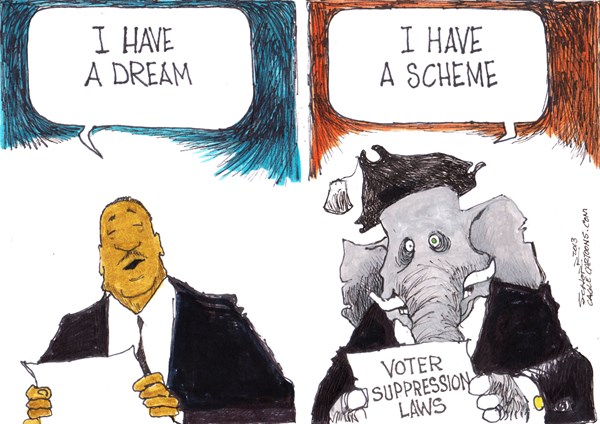
To pass anything under simple majority rules, assuming support from the sitting vice president, those 18 senators would have to attract an additional 32 votes: the equivalent, in electoral terms, of a supermajority. On the flip side, it is possible to pass an item out of the Senate with a coalition of members who represent a small fraction of the total population — around 18 percent — but hold an absolute majority of the seats. And this is before we get to the filibuster, which imposes a more explicit supermajority requirement on top of this implicit one.
Last week, The Washington Post published a detailed look at the vast disparities of power that mark the Senate, which was structured on the principle of equal state representation: Regardless of population, every state gets two members. A carry-over from the Articles of Confederation, the principle of equal state representation was so controversial that it nearly derailed the Philadelphia Convention, where James Madison and others were trying to build a national government with near total independence from the states.
It is not for nothing that in the Federalist Papers, neither Madison nor John Jay nor Alexander Hamilton attempts to defend the structure of the Senate from first principles. Instead, Madison wrote in Federalist No. 62, you should consider it a concession to the political realities of the moment:
A government founded on principles more consonant to the wishes of the larger states, is not likely to be obtained from the smaller states. The only option, then, for the former, lies between the proposed government and a government still more objectionable. Under this alternative, the advice of prudence must be to embrace the lesser evil; and, instead of indulging a fruitless anticipation of the possible mischiefs which may ensue, to contemplate rather the advantageous consequences which may qualify the sacrifice.
Today, the Senate is a distinctly undemocratic institution that has worked, over the past decade, to block policies favored by a large majority of Americans and even a solid majority of senators. And while there’s no immediate hope of changing it, a cleareyed analysis of the chamber’s structural faults can help answer one of the key questions of American democracy: Who, or what, is this system supposed to represent?
As the Post piece notes, equal state representation has never been equitable: “In 1790, Virginia, the most populous state, had roughly 13 times the population of Delaware, the least populous, with a difference of about 700,000 people.” But as the country has grown larger and more diverse, the disparities have grown greater and more perverse. The population difference between the states is so large now that a resident of the least populous state, Wyoming, as many observers have pointed out, has 68 times the representation in the Senate as does a resident of California, the largest state by population. In fact, a state gets less actual representation in the chamber the more it attracts new residents.
There is not just a disparity of representation; there is a disparity in who is represented as well. The most populous states — including not only California but also New York, Illinois, Florida and Texas — tend to be the most diverse states, with a large proportion of nonwhite residents. The smallest states by population — like Maine, Vermont and New Hampshire — tend to be the least diverse. And the structure of the Senate tends to amplify the power of residents in smaller states and weaken the power of those in larger states. When coupled with the potential for — and what is in truth the reality of — minority rule in the chamber, you have a system that gives an almost absolute veto on most federal legislation to a pretty narrow slice of white Americans.
One response to these disparities of power and influence is to say that they represent the intent of the framers. There are at least two problems with this view. The first is that the modern Senate reproduces some of the key problems — among them the possibility of a minority veto that grinds governance to a halt — that the framers were trying to overcome when they scrapped the Articles of Confederation. The second and more important problem is that the modern Senate isn’t the one the framers designed in 1787.
In 1913 the United States adopted the 17th Amendment to the Constitution, providing for the direct election of senators at the ballot box rather than their selection by state legislatures. This change disrupted the logic of the Senate. Before, each senator was a kind of ambassador from his state government. After the amendment went into effect, each senator was a direct representative of the people of that state.
If each member was a kind of ambassador, then you could justify unequal voting power by pointing to the equal sovereignty of each state under the Constitution. But if each member is a direct representative, then it becomes all the more difficult to say that some Americans deserve more representation than others on account of arbitrary state borders.
This brings us back to our question: Who, or what, is the American system supposed to represent? If it is supposed to represent the states — if the states are the primary unit of American democracy — then there’s nothing about the structure of the Senate to object to.
It’s plain as day that the states are not the primary unit of American democracy. As James Wilson of Pennsylvania observed during the Philadelphia Convention, the new national government was being formed for the sake of individuals rather than “the imaginary beings called states.” And as we’ve expanded the scope of democratic participation, we have affirmed — again and again — that it is the people who deserve representation on an equal basis, not the states.
There is no realistic way, at this moment, to make the Senate more democratic. But if we can identify the Senate as one of the key sources of an unacceptable democratic deficit, then we can look for other ways to enhance democracy in the American system.
I know that, given the scale and scope of the problem, that does not sound very inspiring. But we have to start somewhere.
When was Bribery Legalized in America?
By Thom Hartmann/ HartmannReport.com/ November 15, 2023
“When plunder becomes a way of life for a group of men in a society, over the course of time they create for themselves a legal system that authorizes it and a moral code that glorifies it.” — Frédéric Bastiat (French economist)
Virtually every crisis America is facing right now is either caused or exacerbated by the corruption of our nation’s third branch of government.
A branch of government — the Supreme Court — that this week laid out one of the most absurd charades in its history, pretending to do something about their own corruption and utter lack of ethics with a sham “Code of Conduct.”
They are responsible for our crises of gun violence, the drug epidemic, homelessness, political gridlock, our slow response to the climate emergency, a looming crisis for Social Security and Medicare, the situation on our southern border, even the lack of affordable drugs, insurance, and healthcare.
All track back to a handful of Supreme Court justices who’ve sold their votes to billionaires in exchange for extravagant vacations, luxury yachts and motorhomes, private jet travel, speaking fees, homes, tuition, and participation in exclusive clubs and billionaire networks that bar the rest of us from entry.
— America is the only country in the world that terrorizes its children with active shooter drills in schools, the only country where the leading cause of childhood deaths is bullets, and the only country where mass shootings are a near-everyday occurrence.
Why do Republicans in Congress block every effort to do something and save America’s children’s lives? Because they’re owned with big money contributions and campaign spending by the NRA and gun manufacturers.
And why is that legal? Because five corrupt Republicans on the Supreme Court — several already on the take themselves, although nobody knew it at the time — ruled in Citizens United that, “[W]e now conclude that independent expenditures, including those made by corporations, do not give rise to corruption or the appearance of corruption.”
— The Sackler family spent years making billions by addicting and ultimately killing hundreds of thousands of Americans, but to this day not a single member of that psychopathic family has seen the inside of a prison cell. Why? Because they bought off multiple politicians, including (according to reporting from The Intercept) the Republican Attorneys General Association and the Democratic Governors Association.
There was a time when these bribes — and the opioid deaths they cover up — would have been a felony; today they’re routine because corrupt Republicans on the Supreme Court legalized political bribery.
— Why isn’t America reacting more rapidly to the extreme weather events that are killing Americans from coast-to-coast (and in Hawaii and Alaska)? Why does almost every Republican in Congress refuse to acknowledge basic climate science and instead works to maintain the $600 billion annual subsidies for, and massive profits of, the fossil fuel industry?
Because they’re on the take from that very industry. Courtesy of Citizens United and its predecessors written into law by five corrupt Republicans on the Supreme Court.
— Medicare is being ripped off to the tune of over $140 billion a year, and millions of Americans who bought into the Medicare Advantage privatized insurance scam are routinely denied care, because the insurance industry was able to help write George W. Bush’s 2003 legislation “modernizing” Medicare.
Why does Congress tolerate this? Because they’re on the take from that very industry. Courtesy of Citizens United and its predecessors voted into law by corrupt Republicans on the Supreme Court.
— Cancer-causing pesticides, food additives, PFAS chemicals, and microplastics lace our environment and food supply, creating a cancer crisis unknown in Europe where these are all banned or tightly regulated. Why here? Because Congress refuses to act as long as the industries creating these problems can legally continue their campaign donations and other bribes.
— Republicans in Congress (and Nikki Haley) are pushing hard for a new “Catfood Commission” to figure out ways to cut Social Security benefits and raise the retirement age. Speaker Johnson announced yesterday afternoon that he’s creating the commission over the Thanksgiving holiday and they’ll hold their first hearings in two weeks.
Why would they defy an American public that loves the program just to avoid asking billionaires to pay the same Social Security tax rate as bus drivers?
Because they’re on the take from the billionaires who don’t want to pay their taxes, and the banks that hope the Catfood Commission will develop “Social Security Advantage” as a way of privatizing the system. Courtesy of Citizens United and its predecessors voted into law by corrupt Republicans on the Supreme Court.
— At the same time the pharmaceutical industry is enjoying the largest profits in its history, millions of Americans are cutting pills in half or even going without essential medications because they can’t afford the price-gouging that’s routine in the drug business.
Why won’t Congress act? Because they’re on the take from that very industry. Courtesy of Citizens United and its predecessors voted into law by corrupt Republicans on the Supreme Court.
— Every other developed country in the world has figured out how to give their students quality public school and free or inexpensive college educations. Here in America, private for-profit and religious schools are getting hundreds of billions from Republican-controlled Red states, decimating our public schools, while tens of millions of young people can’t start families or small businesses because they’re crushed by student debt that doesn’t exist anywhere else in the developed world.
Why does America tolerate this? Because the banking industry is making billions in profits off student loans every month and shares some of that lucre with members of Congress, a process legalized by five corrupt Republicans on the Supreme Court.
— A private for-profit prison industry intervenes in every effort to update our immigration and asylum systems as well as attempts to refocus our criminal justice system toward rehabilitation. They can do this by buying off mostly Republican politicians because corrupt Republicans on the Supreme Court legalized political bribery.
— Homelessness stalks America as rent prices skyrocket while more homes remain empty — investment properties bought by foreign and Wall Street speculators — than there are homeless people in our nation. Other countries have largely solved their homelessness crises, but here in America all systemic efforts are paralyzed by big money from the real estate and hedge fund industries.
This is legal because corrupt Republicans on the Supreme Court sold out our country to the wealthy interests that have been courting them since the Reagan era.
For over two decades, Clarence Thomas and his wife have been accepting millions in free luxury vacations, tuition for their adopted son, a home for his mother, private jet and megayacht travel, and entrance to rarified clubs.
Sam Alito is also on the gravy train, and there are questions about how Brett Kavanaugh managed to pay off his credit cards and gambling debts. John Roberts’ wife has made over $10 million from law firms with business before the court; Neil Gorsuch got a sweetheart real estate deal; Amy Coney Barrett refuses to recuse herself from cases involving her father’s oil company.
None of this is illegal because when five corrupt Republicans on the Court legalized members of Congress taking bribes they legalized that same behavior for themselves.
This week, the Supreme Court tried to put a tiny fig leaf over the bloated, corpulent, naked corpse of their own obscene corruption. They call it a “Supreme Court Code of Conduct,” but it’s a pathetic joke.
It contains no enforcement provisions, no way for anybody to file complaints or blow the whistle, no consequences for violations, no system for investigations, no mechanism for informing the public, no specifics about what “corrupt behavior” means, and no penalties whatsoever even when behavior is so clearly corrupt it’s obvious to everybody.
At best, it’s a PR stunt; at worst, it’s the latest example of how arrogant the six Republicans running the Court have become about their own “right” to stay on the take and extend that largesse to every Republican politician in the country.
They’re responding, of course, to Senator Sheldon Whitehouse’s efforts on the Senate Judiciary Committee to subpoena a few of the billionaires and political fixers who’ve been grooming Republican justices for decades. He wanted to start by questioning Harlan Crow and Leonard Leo.
Republicans on the Judiciary Committee, who are just fine with having six corrupt Republicans on the Supreme Court so long as their corruption works to the GOP’s advantage, slapped 88 proposed amendments onto Whitehouse’s subpoena request, successfully blocking his efforts for the moment.
Every one of those Republican senators has received millions in billionaire and corporate money, along with their own “right” to enjoy the private jets and mega-yachts of their morbidly rich “supporters.”
So how is it that if you bribe a store clerk or a bank teller you go to prison, but if you bribe a politician, you get a tax break? When was bribery of politicians and Supreme Court justices legalized in America?
There was a time, after all, when politicians — both Democrats and Republicans — passed laws that conformed to the desires of the majority of Americans instead of the special interests.
From the end of the Republican Great Depression right up until the Reagan Revolution — from 1933 to 1981 — the American middle class had about a half-century of uninterrupted political and economic progress.
— Democrats passed the right to unionize, which built the American middle class, the world’s first. They passed unemployment insurance, the right to unionize, and workplace safety rules to protect workers.
— Social Security largely ended poverty among the elderly, and Medicare provided them with health security.
— A top income tax rate between 74% and 91% throughout that period kept wages strong for working people and prevented the corrosive wealth inequality we see today. We didn’t get our first billionaire until after the Reagan revolution dropped those top tax rates down to 27 percent.
— We built colleges that were free or affordable, gleaming new nonprofit hospitals, the world’s finest system of public schools, and roads, bridges, rail, and airports from coast to coast.
— We cleaned up the environment with the Environmental Protection Agency, cleaned up politics with the Federal Elections Commission, cleaned up corporate backroom deals with the Securities and Exchange Commission. We outlawed banks from gambling with our deposits via the Glass-Steagall law.
But it all came to a screeching halt with the Reagan Revolution. How and why?
Instead of building the middle class, Reaganomics gutted it. Instead of educating young people, it indebted them. Instead of supporting workers, the GOP’s “right to work for less” scheme took away their dignity and their pay.
Today both our nation’s infrastructure and our workforce are in shambles because of 40 years of disinvestment and neglect.
What made that possible? Why did that happen?
It all comes back to legalized political bribery.
Our modern era of legalized political bribery began in the decade after Richard Nixon put Lewis Powell — the tobacco lawyer who wrote the infamous 1971 “Powell Memo” outlining how billionaires and corporations could take over America — on the Supreme Court in 1972.
In the 1976 Buckley v. Valeo decision, the Court ruled that political money wasn’t just cash: they claimed it’s also “free speech” protected by the First Amendment that guarantees your right to speak out on political issues.
In the 200 preceding years — all the way back to the American Revolution of 1776 — no politician or credible political scientist had ever proposed that giving money to a politician in exchange for favors or votes was anything other than simple bribery.
The “originalists” on the Supreme Court, however, claimed to be channeling the Founders of this nation, particularly those who wrote the Declaration of Independence and the Constitution, when they said that “money was the same thing as free speech.” In that claim, Republicans on the Court were lying through their teeth.
In a letter to Samuel Kerchival in 1816, President and author of the Declaration of Independence Thomas Jefferson explicitly laid it out:
“Those seeking profits, were they given total freedom, would not be the ones to trust to keep government pure and our rights secure. Indeed, it has always been those seeking wealth who were the source of corruption in government.”
In this, he was making the same argument that the Framers of Pennsylvania made when writing their constitution in 1776. As Kevin Phillips notes in his masterpiece book Wealth and Democracy: A Political History of the American Rich, a Sixteenth Article of the revolutionary-era Pennsylvania Bill of Rights declared:
“An enormous proportion of property vested in a few individuals is dangerous to the rights, and destructive of the common happiness of mankind, and, therefore, every free state hath a right by its laws to discourage the possession of such property.”
But Republicans on the Supreme Court weren’t reading the Founders. They were instead listening to the billionaires who helped get them on the court in the first place. Who had bribed them with position and power and then kept them in their thrall with luxury vacations, “friendship,”and gifts.
Two years after the 1976 Buckley decision, the Republicans on the Supreme Court struck again, this time adding that the “money is speech and can be used to buy politicians” argument applied to corporations as well as to billionaires. Lewis Powell himself wrote the majority opinion in the 1978 Boston v Bellotti decision.
Justices White, Brennan, and Marshall dissented:
“The special status of corporations has placed them in a position to control vast amounts of economic power which may, if not regulated, dominate not only our economy but the very heart of our democracy, the electoral process.”
But the dissenters lost the vote, and political corruption of everything from local elections to the Supreme Court itself was now virtually assured.
Notice that ruling came down just two years before the Reagan Revolution, when almost all forward progress in America came to a screeching halt.
It’s no coincidence.
And it’s gotten worse since then, with the Court doubling down in 2010 with Citizens United, overturning hundreds of state and federal “good government” laws dating all the way back to the late 1800s.
Thus, today America has a severe bribery problem.
It’s bizarre that the Court would keep intact anti-bribery laws across every facet of American life except politics, but that’s exactly what they did. Bribery is still illegal in business, it’s illegal in interactions with the police, but according to five corrupt Republicans on the Supreme Court it’s perfectly legal to bribe politicians.
No other developed country in the world has this problem, which is why every other developed country has a national healthcare system, free or near-free college, and strong unions that maintain a healthy middle class. It’s why they can afford pharmaceuticals, are taking active steps to stop climate change, and don’t fear being shot when they go to school, the theater, or shopping.
We’re the only major country in the world right now that is experiencing legislative gridlock on this scale. And we’ve been experiencing it for four decades.
This cannot continue. If America is to survive as a democratic republic, we must end the legal bribery of our politicians.
And that starts with the work Sheldon Whitehouse and his Democratic colleagues are doing on the Senate Judiciary Committee to reform the Supreme Court and hold its most corrupt members to account.
Posted in America, Congress, corporations, democracy, Democratic Party, elections, ethics, government, judiciary, politics, Republican Party, Supreme Court
Tagged bribery, Citizens United, Sackler family, Thom Hartmann
1 Comment
Elections, Polls, Budgets, Speaker Johnson, and More
Another Monday morning Halitics videocast, with lots of political topics for Hal and Arlen to talk about…..
Posted in America, Congress, democracy, Donald Trump, elections, government, media, politics
Tagged Arlen Grossman, Hal Ginsberg, Halitics
Leave a comment
So Much to Talk About
Posted in America, Congress, democracy, Donald Trump, government, Israel, media, protests
Tagged Arlen Grossman, Gaza, Hal Ginsberg, Halitics, polls
Leave a comment
Read the Entire Second Amendment….
Debate from “West Wing” on why we need sensible gun control laws…….
Why Didn’t Someone Think of This Before?
Amazing! Two Days Into His New job, and he already has a solution to this horrible problem in America: Prayer! Why Didn’t Anyone Else Think of This?
After mass shooting, new speaker calls for prayer that ‘senseless violence can stop’
Mike Johnson has opposed gun control measures for years, and opined about the role of faith in response to violence

By Michael Macagnone / Roll Call
Posted October 26, 2023 at 4:49pm
- New Speaker Mike Johnson offered prayer Thursday as response to a mass shooter who killed 18 and injured 13 others in Maine, while any legislation to address gun violence faces an uphill climb under his tenure.
The Louisiana Republican, in his first full day as speaker, made a statement to reporters at the Capitol that the shooting late Wednesday was a “horrific tragedy” but did not take questions.
“This is a dark time in America. We have a lot of problems, and we are hopeful and prayerful,” Johnson said. “Prayer is appropriate at a time like this, that this senseless violence can stop.”
As one of the most conservative Republicans to hold the speakership in modern times, Johnson’s opposition to gun control laws could keep any bills on the issue from reaching the House floor.
That won’t be a change. Earlier this year, under then-Speaker Kevin McCarthy, R-Calif., Democrats launched an effort through discharge petitions to force floor votes on a series of gun control bills.
None of them have received the signatures of enough members of the chamber to move forward.
White House Press Secretary Karine Jean-Pierre told reporters later Thursday that it’s great to hear calls for thoughts and prayers for the families and victims of the tragedy in Maine, but that Johnson and Republicans can put forth legislation and “help save lives.”
“Obviously, we want them to make sure they know they’re in our thoughts and prayers,” Jean-Pierre said of the families and victims. “But that’s not enough.”
Johnson has opposed gun control measures for years, including a measure passed into law last year that beefed up criminal background checks for those under age 21 for the next decade, created grants for state crisis intervention laws and provided several billion dollars in mental health and school security funding.
During floor debate on that measure, Johnson criticized the legislation as unconstitutional and reiterated many statements he made on a podcast with his wife that blamed America’s violent crime problem on a lack of faith.
“America’s problem is not guns. America’s problem is a heart problem,” Johnson said during the floor debate.
During that podcast with his wife, Kelly Johnson, he interviewed Pastor Y. J. Jimenez, who had a congregation near an elementary school in Uvalde, Texas, where a shooter killed 19 students and two teachers in May 2022.
During the podcast, Johnson emphasized the importance of turning to faith in response to the violence.
“I’m a public official and when I say, ‘We are praying for someone,’ you know, those who don’t believe criticize us for that as though it is not important, but it is important,” Johnson said.
Johnson said that young men frequently feel isolated in modern society, made worse by the years of the pandemic where “we sort of put them away for a couple of years and they sort of sat around and played violent video games and the bitterness inside of them turned to rage.”
“We’re dealing now with the inevitable results of decades of secular humanist ideology and the rise of moral relativism and the marginalization of people of faith and the erosion of the rule of law,” Johnson said.
Johnson said that has “come together in the sort of toxic soup we have in the culture” and that “these things are so tragic, but they are really not that surprising when you consider what we have been doing for the last 60 or 70 years in this country.”
During the podcast he called discussions of gun control “inevitable” following the Uvalde shooting and said his “gun-grabbing colleagues” in the Democratic Party had overstepped by proposing a wide variety of gun control measures following the shooting.
During that Democrat-led legislative push for a renewed assault weapon ban, Johnson offered an amendment that would have created an exemption for employees of crisis pregnancy centers, which he argued had been targeted following the Supreme Court ruling that overturned the constitutional right to abortion. Democrats voted down that amendment.
However, Johnson’s stint as speaker does little to shift the long-standing partisan gridlock on gun control legislation.
Numerous members on both sides of the aisle said Thursday they would try to restart bipartisan talks, but quickly acknowledged that political reality.
Rep. Brian Fitzpatrick, R-Pa., one of the Republicans who backed the 2022 law and has sponsored several bipartisan gun control measures, said the filibuster in the closely divided Senate presents a greater challenge to passing legislation.
“The House is not the problem. It’s the Senate. We have the votes in the House. They don’t have the votes in the Senate,” Fitzpatrick said, pointing to measures he has backed, such as so-called red flag laws and universal background checks, that the other chamber has not taken up.
“So I think I think realistically, this stuff is gonna have to start in the Senate and be taken up in the House because everything we’ve said to them has never been voted on,” Fitzpatrick said.
One of the Republican backers of the 2022 law, Texas Sen. John Cornyn, said Thursday that it may be too soon to look at changing the law in response to the shooting Wednesday in Lewiston, Maine. He pointed out that law has not yet been fully implemented and pointed to news reports that the alleged shooter in Lewiston had been committed to a mental institution before embarking on the shooting.
“I’m not sure what law we could pass that would address this because it looks like he was illegally in possession of a firearm in the first place. Sometimes people just don’t care what the laws are,” Cornyn said.
Sen. Christopher S. Murphy, D-Conn., one of the lead negotiators on the bipartisan package that passed last Congress told reporters that he was open to bipartisan negotiations but didn’t expect there would be much in the offing.
“I’m going to talk to [Maine Sen. Susan] Collins, you know, after she comes back from the weekend, see if there’s any potential common ground, but we’re probably gonna just have to win some more elections,” Murphy said.
Posted in America, crime, gun control, law enforcement
Tagged assault weapons, Lewiston, Maine, mass shootings, Michael Macagnone, prayer, Roll Call, Speaker Mike Johnson
Leave a comment
 thebigpicturereport ™