“It is to be regretted that the rich and powerful too often bend the acts of government to their selfish purposes….In the full enjoyment of the gifts of Heaven and the fruits of superior industry, economy, and virtue, every man is equally entitled to protection by law; but when the laws undertake to add to these natural and just advantages artificial distinctions, to grant titles, gratuities, and exclusive privileges, to make the rich richer and the potent more powerful, the humble members of society — the farmers, mechanics, and laborers — who have neither the time nor the means of securing like favors to themselves, have a right to complain of the injustice of their government.”
The president’s jobs bill doesn’t have a chance in Congress — and the Occupiers on Wall Street and elsewhere can’t become a national movement for a more equitable society – unless more Americans know the truth about the economy. Here’s a short effort to rebut the seven biggest whoppers now being told by those who want to take America backwards. The major points:
1. Tax cuts for the rich trickle down to everyone else. Baloney. Ronald Reagan and George W. Bush both sliced taxes on the rich and what happened? Most Americans’ wages (measured by the real median wage) began flattening under Reagan and have dropped since George W. Bush. Trickle-down economics is a cruel joke.
2. Higher taxes on the rich would hurt the economy and slow job growth. False. From the end of World War II until 1981, the richest Americans faced a top marginal tax rate of 70 percent or above. Under Dwight Eisenhower it was 91 percent. Even after all deductions and credits, the top taxes on the very rich were far higher than they’ve been since. Yet the economy grew faster during those years than it has since. (Don’t believe small businesses would be hurt by a higher marginal tax; fewer than 2 percent of small business owners are in the highest tax bracket.)
3. Shrinking government generates more jobs. Wrong again. It means fewer government workers – everyone from teachers, fire fighters, police officers, and social workers at the state and local levels to safety inspectors and military personnel at the federal. And fewer government contractors, who would employ fewer private-sector workers. According to Moody’s economist Mark Zandi (a campaign advisor to John McCain), the $61 billion in spending cuts proposed by the House GOP will cost the economy 700,000 jobs this year and next.
4. Cutting the budget deficit now is more important than boosting the economy. Untrue. With so many Americans out of work, budget cuts now will shrink the economy. They’ll increase unemployment and reduce tax revenues. That will worsen the ratio of the debt to the total economy. The first priority must be getting jobs and growth back by boosting the economy. Only then, when jobs and growth are returning vigorously, should we turn to cutting the deficit.
5. Medicare and Medicaid are the major drivers of budget deficits. Wrong. Medicare and Medicaid spending is rising quickly, to be sure. But that’s because the nation’s health-care costs are rising so fast. One of the best ways of slowing these costs is to use Medicare and Medicaid’s bargaining power over drug companies and hospitals to reduce costs, and to move from a fee-for-service system to a fee-for-healthy outcomes system. And since Medicare has far lower administrative costs than private health insurers, we should make Medicare available to everyone.
6. Social Security is a Ponzi scheme. Don’t believe it. Social Security is solvent for the next 26 years. It could be solvent for the next century if we raised the ceiling on income subject to the Social Security payroll tax. That ceiling is now $106,800.
7. It’s unfair that lower-income Americans don’t pay income tax. Wrong. There’s nothing unfair about it. Lower-income Americans pay out a larger share of their paychecks in payroll taxes, sales taxes, user fees, and tolls than everyone else.
Demagogues through history have known that big lies, repeated often enough, start being believed — unless they’re rebutted. These seven economic whoppers are just plain wrong. Make sure you know the truth – and spread it on.
Rep. Deutch Introduces OCCUPIED Constitutional Amendment To Ban Corporate Money In Politics
By Zaid Jilani/ Think Progress/ Nov. 18, 2011
Image: Wtfman.net
In one of the greatest signs yet that the 99 Percenters are having an impact, Rep. Ted Deutch (D-FL), a member of the House Judiciary Committee, today introduced an amendment that would ban corporate money in politics and end corporate personhood once and for all.
Deutch’s amendment, called the Outlawing Corporate Cash Undermining the Public Interest in our Elections and Democracy (OCCUPIED) Amendment, would overturn the Citizens United decision, re-establishing the right of Congress and the states to regulate campaign finance laws, and to effectively outlaw the ability of for-profit corporations to contribute to campaign spending.
“No matter how long protesters camp out across America, big banks will continue to pour money into shadow groups promoting candidates more likely to slash Medicaid for poor children than help families facing foreclosure,” said Deutch in a statement provided to ThinkProgress. “No matter how strongly Ohio families fight for basic fairness for workers, the Koch Brothers will continue to pour millions into campaigns aimed at protecting the wealthiest 1%. No matter how fed up seniors in South Florida are with an agenda that puts oil subsidies ahead of Social Security and Medicare, corporations will continue to fund massive publicity campaigns and malicious attack ads against the public interest. Americans of all stripes agree that for far too long, corporations have occupied Washington and drowned out the voices of the people. I introduced the OCCUPIED Amendment because the days of corporate control of our democracy. It is time to return the nation’s capital and our democracy to the people.”
Rep. Ted Deutch (D-FL) is tackling corporate money in politics head on.
ThinkProgress.Org (Click on link in Think Progress article to see text of the amendment.)
BPR Editor’s Comment: Wouldn’t it be wonderful if Occupy movements across the country came together and demanded that this constitutional amendment be passed? Think of all the problems that would be solved by removing corporate and other private money from our political process. Were that to happen, the needs and desires of the American people might actually matter again!
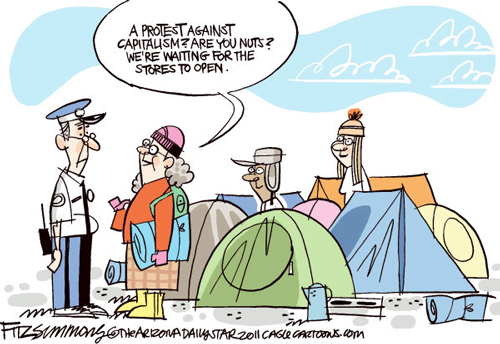
You’ve been seeing this across the country … Americans assaulted, clubbed, dragged, pepper-sprayed … Why? For exercising their right to free speech and assembly — protesting the increasing concentration of income, wealth, and political power at the top.
And what’s Washington’s response? Nothing. In fact, Congress’s so-called “supercommittee” just disbanded because Republicans refuse to raise a penny of taxes on the rich.
Meanwhile, the Supreme Court says money is speech and corporations are people. The Supreme Court’s Citizens United decision last year ended all limits on political spending. Millions of dollars are being funneled to politicians without a trace.
And a revolving door has developed between official Washington and Wall Street – with bank executives becoming public officials who make rules that benefit the banks before heading back to the Street to make money off the rules they created.
Other top officials, including an increasing proportion of former members of congress, are cashing in by joining lobbying power houses and pressuring their former colleagues to do whatever their clients want.
Millionaires and billionaires on Wall Street and in executive suites aren’t contributing all this money out of sheer love of country. Their political spending is analogous to their other investments. Mostly they want low tax rates and friendly regulations.
Why else do you suppose tax rates on the super rich are now lower than they’ve been in three decades, and why – even though the long-term budget deficit is horrendous – those rates aren’t rising? Why else do the 400 richest Americans (whose wealth is larger than the combined wealth of the bottom 150 million Americans) now pay an average tax rate of only 17 percent?
Why do you think Wall Street got bailed without a single string attached – not even being required to help homeowners to whom they sold mortgages, who are now so far under water they’re drowning? And why does the financial reform legislation have loopholes big enough for bankers to drive their Ferrari’s through?
And why else are oil companies, big agribusinesses, military contractors, and the pharmaceutical industry reaping billions of dollars of government subsidies and special tax breaks?
Experts say the 2012 presidential race is likely to be the priciest ever, costing an estimated $6 billion. “It is far worse than it has ever been,” says Republican Senator John McCain.
If there’s a single core message to the Occupier movement it’s that the increasing concentration of income and wealth at the top endangers our democracy. With money comes political power.
Yet when real people without money assemble to express their dissatisfaction with all this, they’re told the First Amendment doesn’t apply. Instead, they’re treated as public nuisances – clubbed, pepper-sprayed, thrown out of public parks and evicted from public spaces.
Across America, public officials are saying Occupiers have to go. Even in universities – where free speech is supposed to be sacrosanct – peaceful assembly is being met with clubs and pepper spray.
The First Amendment is being stood on its head. Money speaks, and an unlimited amount of it can now be spent bribing and cajoling politicians. Yet peaceful assembly is viewed as a public nuisance and removed by force.
This is especially worrisome now that so many Americans are in economic trouble. The jobs recession grinds on, seemingly without end. Homes are being foreclosed upon. Qualified students cannot afford college. Or they’re forced to take on huge debt loads they can’t repay in a jobless economy. Schools are firing teachers. Vital social services are being axed.
How are Americans to be heard about what should be done about any of this if they are not allowed to mobilize and organize? When the freedom of speech goes to the highest bidder, moneyed interests have a disproportionate say.
Now more than ever, the First Amendment needs to be put right side up. Nothing less than the future of our democracy is at stake.
Here is something we all can agree on: Federal deficits are a serious problem.
Here is something no one seriously disputes: Today’s big deficits were caused mainly by big tax cuts for the wealthy, two unpaid-for wars, a horrible recession caused by Wall Street greed, and an expensive prescription drug program rigged to favor pharmaceutical companies.
Here is something we should not agree to do: Cut Social Security, Medicare and Medicaid benefits.
There is surprisingly broad consensus among Americans (except inside the corporate-dominated D.C. beltway) on what to do about deficits. In poll after poll, strong majorities favor making the wealthiest Americans, who, in many cases, have never had it so good, share the sacrifice and pay a little more in taxes. Increasing taxes on the wealthy is overwhelmingly supported by Democrats and independents. A majority of Republicans and people in the Tea Party movement also support taxing millionaires to help bring down deficits. Even many millionaires say they should be paying higher taxes. At a time when many profitable corporations pay nothing in federal income taxes, there also is widespread support for closing corporate tax loopholes. Taking a hard look at mushrooming defense spending also enjoys widespread support.
For far too long, the Washington agenda has been set by powerful corporate interests and a right wing that do not represent the needs and aspiration of most Americans. For too long, the Democrats have gone along with Republican demands and caved in to these powerful special interests. The American people are frustrated and disgusted. They want Democrats to fight back.
As a Thanksgiving deadline nears for action by the powerful Super Committee on deficit reduction, I hope (but doubt) that Republicans will listen to the American people and support deficit reduction in a fair and responsible way. I hope (but doubt) that Democrats will not once again capitulate just for the sake of an agreement – but that’s been the pattern.
In December — when Democrats controlled the Senate, the House and the White House — Congress and President Obama not only extended Bush-era tax breaks for the wealthy but also gave new breaks to heirs of the super-rich.
In April — with a Democrat in the White House and Democrats still in the majority in the Senate — Republicans threatened to shut down the government and delay the processing of new Social Security benefits for senior citizens unless their demands were met. Democrats went along with $78 billion in cuts from the president’s budget request.
In August, in an outrageous display of unprincipled gamesmanship, Republicans put the United States on the brink of bankruptcy. Instead of invoking clear 14th Amendment powers to honor our nation’s debts, the president and most Democrats agreed to a $2.5 trillion deficit-reduction package.
That’s how we got to where we are today.
Incredibly, throughout all of these negotiations — in December, in April, in August and again today — the wealthiest Americans and the country’s major corporations have not yet been asked to contribute one penny toward deficit reduction. That is despite huge cuts in life-and-death programs for working families.
The American people have had it. The Occupy Wall Street movement is growing. A virtual popular uprising forced Bank of America to drop an unpopular $5 monthly debit card fee. On Election Day 2011, in Ohio and many other states the American people said NO to right-wing extremism and corporate greed.
The American people are very clear. They do not want Democrats to reach another ‘grand bargain’ with representatives of the rich and powerful that eviscerates the most successful and popular social programs in the history of this country. They want Democrats to stand up for the 99 percent, not the 1 percent.
If the president and Democrats on the super committee go along with cuts in Social Security, Medicare and Medicaid, the three pillars of the New Deal and the Great Society, and permanently extend the Bush tax breaks for the wealthiest 2 percent, the American people will shake their heads in disbelief. They will arrive at the reasonably valid conclusion that there are no significant differences between the two parties controlled by corporate interests.
This is a pivotal moment in American history. The rich and large corporations are doing phenomenally well while the middle class is collapsing and poverty is increasing. Now is the time to answer the question that the Woody Guthrie song poignantly asked, “Which side are you on?” The Democrats must answer boldly that they are on the side of working families and the middle class and that they will fight to protect their interests.
What if the super committee ends in stalemate? Across-the-board, automatic cuts are set to kick in. That so-called sequestration wouldn’t start, however, until 2013. That would make 2012 one of the most important election years in modern American history.
If Democrats stand with ordinary Americans and make it clear that they are prepared to take on the wealthy and the powerful, they could win both houses of Congress. They could give Obama a fresh infusion of boldness as he enters a second term in the White House.
Somehow I recall a few years ago millions of Americans chanting, “Yes, We Can.” Now is the time to hear their voices.
“The people of Egypt have rights that are universal. That includes the right to peaceful assembly and association, the right to free speech, and the ability to determine their own destiny. These are human rights. And the United States will stand up for them everywhere.”
I have long been in the Swedish camp when it comes to food (meatballs with lingonberries) women (tall blondes) and financial crises (prepackaged bankruptcy, no bailouts for banks).
While the Japanese have lots to offer (Sushi, Anime, and reliable cars), their approach to financial panics was to nationalize all of the debt, prop up insolvent corporations, and continually kick the can down the road. Ever since their 1989 RE/Bank collapse, their economy has been paying the price for bad policy decisions.
Its been two and a half years since our credit crisis, and we now have enough distance to see the results of various policy choices different nations have made. The Irish made a horrific decision to completely transfer the losses from their reckless bankers to the taxpayer, and are suffering under the weight of about €25,000 for every man woman and child in the Ireland. Similarly, the U.S. assumed much of the responsibility for irresponsible bankers and their reckless leveraged bets. Our economy has muddled along with subpar growth, weak job creation, and a nagging suspicion that another crisis is likely sometime in the future.
And then there is tiny Iceland.
Bankrupted by the global collapse, Reykjavik made the more painful, but ultimately better, Swedish choice of putting their insolvent banks through bankruptcy.
There is a hefty story in the NYT Magazine this weekend — Iceland’s Big Thaw[1] — that explains what happened during the collapse, and since, in the tiny European island:
“During the boom years, Iceland became a nation obsessed with banking. “Everyone was working for the banks — from the physicists to the philosophers,” one Icelander told me. I met two women in their mid-20s who said that when they graduated from college, virtually all of their classmates were jockeying to get into finance, and for a brief spell, they both became bankers. I asked one of the women, who trained to be an engineer, if she ever paused to consider whether she really wanted to be a banker. “It was just the coolest,” she recalled giddily. “Everybody was like, Yeah, give me a high-five!”
The success of the nation’s banks, however, was deceptive to say the least. The assets of Icelandic banks were equal to 174 percent of the nation’s gross domestic product in 2003, and rose to 744 percent in 2007, while the G.D.P. itself rose by an average of 5.5 percent per year. The economy was fueled almost entirely by foreign money. Then, as the global financial infrastructure teetered on the verge of collapse, the bonds came due, and Iceland’s banks couldn’t repay them. Depositors in other countries raced to pull their money out of Icelandic banks. The government didn’t have the resources for a bailout; the banks failed. The government did guarantee that Icelanders would not lose the money in their savings accounts, but other financial assets — including the many investment funds that the banks offered — plummeted in value, and many ordinary Icelanders lost large sums that they believed were safely invested.”
Rather than bailout the banks — Iceland could not have done so even if they wanted to — they guaranteed deposits (the way our FDIC does), and let the normal capitalistic process of failure run its course.
They are now much much better for it than the countries like the US and Ireland who did not.