The BPR Suggestion Box

The Big Picture Report has been online for one year and it’s been a totally worthwhile and enjoyable experience for me. I’m not a techie and still feel like a bit of a novice when it comes to blogging (though I’m much farther along than I used to be).

I would very much appreciate any suggestions from the readers of this blog about how it can be improved or attract more readers. Would you like to see more of something?  Less of something?  Whatever you think, I would appreciate the feedback (and don’t spare my feelings!). If you don’t want to publicly comment, my email is agross408@aol.com.

–Arlen

Posted in Announcements | 4 Comments

We’re Number…….37?

Posted in health care, music | Tagged , | Leave a comment

The Light At the End of This Economic Tunnel Is a Train

In an interview with AlterNet, economist Joseph Stiglitz points to a dismal future for this country if we continue the current path of widening economic inequality. Deregulation, government downsizing, and an unfair tax system is making things worse. The middle class has already lost 20 years of gains, and young people are coming out of school with huge student loans, few decent job prospects, and little hope of repaying their debt. — BPR Editor

Joseph Stiglitz Sees Terrifying Future for America If We Don’t Reverse Inequality

By Lynn Parramore/ AlterNet/ June 24, 2012

Nobel Prize-winning economist Joseph Stiglitz, one of America’s most prescient voices, wrote an article for Vanity Fair several months before Occupy Wall Street was born. “Of the 1%, by the 1%, for the 1%” called attention to the widening gap between rich and poor and its deadly impact on our society and its democratic institutions. In his newly released book, The Price of Inequality, Stiglitz returns to this theme of a divided society, delving into the origins and consequences of economic unfairness. I caught up with Professor Stiglitz and talked to him about how the persistent myths and beliefs associated with our capitalist system help to drive this trend, turning America from a land of opportunity to a land of broken dreams.

Lynn Parramore: An argument has been made, particularly since the end of the Cold War, that capitalism is great at producing things that can improve our lives, and so we ought to therefore tolerate some unfairness. What’s wrong with that narrative?

Joseph Stiglitz: Well, capitalism does have a lot of strengths, including producing things that are very innovative. But what drives capitalism is the profit motive. You can profit not only by making good things, but also by exploiting people, by exploiting the environment, by doing things that are not so good. The narrative that you describe ignores the extent to which a lot of the inequalities in the United States are not the result of creative activity but of exploitive activity. And if you look at the people at the top, what is so striking is that the people who’ve made the most important creative contributions are not there.

By that I mean the really foundational things like the computer, the transistor, the laser. And how many people at the top are people who made their money out of monopoly — exercising monopoly power? Like bankers who exploited through predatory lending practices and abusive credit card practices. Or CEOs who took advantage of deficiencies in corporate governance to get a larger share of the corporate revenues for themselves without any regard to the extent to which they have actually contributed to increasing the the sustainable well-being of the firm.

LP: How does our current situation compare to other eras in terms of the differences between ordinary Americans and the richest among us?

JS: Doing a precise comparison is difficult because we don’t have data sets that go back that far. But we do have data sets that go back more than 30 years and what is clear is that the share of the top 1 percent has almost tripled since 1980. So, this kind of inequality at the top has unambiguously gotten much, much, much worse. We also have data on the extent to which there’s been a hollowing out of the middle class. The data that recently came out from the Fed indicated that we’ve wiped out 20 years of increases and wealth for the middle American.

LP: So for most of us, 20 years of economic progress just went up in smoke. But the super-rich are doing very well. What happened?

JS: It’s the peculiar nature of the American economy, which is that’s it’s a very powerful machine that is working for a very few people, and has not been delivering for most Americans. If you had an economic machine that worked the way it was supposed to, everybody would be getting better. And an economy that’s normally growing, say, 3 percent, even over a 20-year period. Steady accumulation would lead to their wealth more than doubling in that period. And it clearly hasn’t happened. And adjusted for inflation, it would have even increased even before, unadjusted for inflation, would have increased it even more. And that clearly hasn’t happened.

LP: There’s a persistent myth that America is still the “land of opportunity.” Why is that myth so prevalent, even in the face of so much evidence to the contrary?

JS: Well, there are two reasons for this. One of them is that the myth is so much part of our sense of identity as Americans that it is devastating for us to give it up — for us to say we are less of a land of opportunity than old ossified Europe. It was one of the things we were most proud of, and clearly, it’s not true. When you have something that’s so inconsistent with your self image, it’s really, really hard to face the facts.

The second reason has to do with the nature of evidence. Everybody know examples of people who make it from the bottom or the middle-bottom to the top. And our press talks about them. The media calls attention to the successes. But when they call attention to successes they don’t say this is one of a million or one of a thousand. In fact, the reason they write about it is because they are so unusual. If most people did it, it wouldn’t be an unusual story. So, in a sense that’s how our media works. It encourages us to think of the exceptions as the norm.

LP: Some say that if we redistribute income in a more equitable way, people won’t want to work as hard. Is that true? What happens to our motivation to work when things are so inequitable?

JS: One of the myths that I try to destroy is the myth that if we do anything about inequality it will weaken our economy. And that’s why the title of my book is The Price of Inequality. What I argue is that if we did attack these sources of inequality, we would actually have a stronger economy. We’re paying a high price for this inequality. Now, one of the mischaracterizations of those of us who want a more equal or fairer society, is that we’re in favor of total equality, and that would mean that there would be no incentives. That’s not the issue. The question is whether we could ameliorate some of the inequality — reduce some of the inequality by, for instance, curtailing monopoly power, curtailing predatory lending, curtailing abusive credit card practices, curtailing the abuses of CEO pay. All of those kinds of things, what I generically call “rent seeking,” are things that distort and destroy our economy.

So in fact, part of the problem of low taxes at the top is that since so much of the income at the very top is a result of rent seeking, when we lower the taxes, we’re effectively lowering the taxes on rent seeking, and we’re encouraging rent-seeking activities. When we have special provisions for capital gains that allow speculations to be taxed at a lower rate than people who work for a living, we encourage speculation. So that if you look at the design bit of our tax structure, it does create incentives for doing the wrong thing.

LP: When ordinary people see this speculation and unfairness, do you think it disincentivizes them to work harder, to take risks?

JS: Oh, very much so. It has a very enervating effect on our society and our economy. I describe experimental results in in my book where peoples’ incentives to work hard are reduced when they believe they are part of an unfair system.

LP: We also hear that deregulation and downsizing government is somehow supposed to make capitalism work better for all of us. Why has that persistent belief failed us?

JS: A lot of these are questions about perception. To the extent that we can see waste, obviously we say that if we could get rid of that waste, we would be a better economy. By definition, waste is waste. The Republican rhetoric has focused on waste in the public sector. But waste, at some level, is an inherent consequence of human fallibility. We’re going to make mistakes, and that’s going to be true in the public and the private sector. No government program has ever wasted resources on the scale of America’s private financial sector in the run-up to the crisis. So the first thing you realize is there is waste everywhere including in the private sector.

Now if you ask people about things there are important to them … obviously they care a lot about the school their children go to. They worry about too-large classes. They worry about police protection. Those are all things that people value a lot. They value the Internet, which was created by government-funded research. Health care and drugs were are all based on government-funded research. So the bottom line is that government services have proved highly valuable. And this is where the big lie, the big distortion is.  By talking about the few instances of inefficiency, they try to direct the attention away from the teachers, the policeman, the fireman, the researchers, the people building the roads to make our society function. And they turn our attention away from the failures in the private sector.

(Continued Here)

Posted in Economics, economy, inequality, taxes, Wall Street | Tagged , , , | Leave a comment

The Robin Hood Tax

Professor Richard D. Wolff explains how a tiny “Robin Hood” or transaction tax on financial trades can raise enormous revenue for governments. 

Richard D. Wolff is Professor of Economics Emeritus, University of Massachusetts, Amherst where he taught economics from 1973 to 2008. He is currently a Visiting Professor in the Graduate Program in International Affairs of the New School University, New York City.

Robin Hood Tax Explained

Posted in Economics, economy, finance, government, inequality, taxes, Wall Street | Tagged , , | Leave a comment

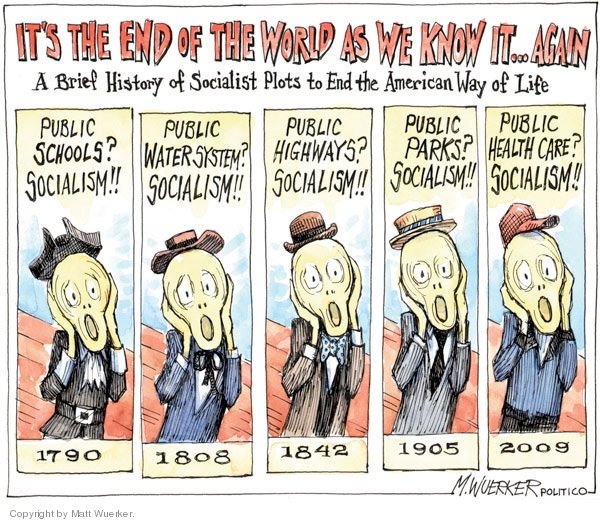
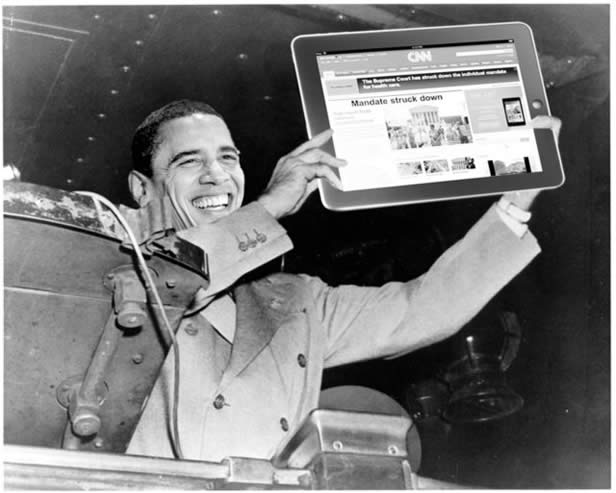
Will We Survive ObamaCare?

Posted in cartoon, health care, humor | Tagged , | 2 Comments

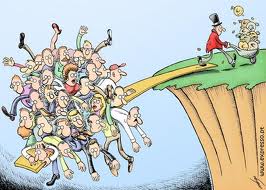
Making the World a Better Place

Posted in Economics, economy, environment, humor, inequality, poverty | Tagged , | Leave a comment

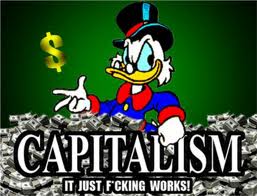
Consumer Capitalism Wins Again

Twenty years after the first substantive Earth Summit in Rio de Janeiro in 1992, representatives from more than 190 countries met again. Hopes were high, but unlike the first one, the 2012 Summit was mostly window dressing. President Obama, Prime Minister David Cameron of Britain, and Chancellor Angela Merkel of Germany and most other G20 leaders were notably absent, and little was accomplished. — BPR Editor

After Rio, we know. Governments have given up on the planet

The post-summit pledge was an admission of defeat against consumer capitalism. But we can still salvage the natural world

By George Monbiot/ The Guardian/ June 25, 2012

Wildflower meadow in Cheshire
Our children must ‘experience something of the delight in the natural world and of the peaceful, unharried lives with which we have been blessed’. Photo: Alan Novelli/Alamy

It is, perhaps, the greatest failure of collective leadership since the first world war. The Earth’s living systems are collapsing, and the leaders of some of the most powerful nations – the United States, the UK, Germany, Russia – could not even be bothered to turn up and discuss it. Those who did attend the Earth summit in Rio last week solemnly agreed to keep stoking the destructive fires: sixteen times in their text they pledged to pursue “sustained growth“, the primary cause of the biosphere’s losses.

The efforts of governments are concentrated not on defending the living Earth from destruction, but on defending the machine that is destroying it. Whenever consumer capitalism becomes snarled up by its own contradictions, governments scramble to mend the machine, to ensure – though it consumes the conditions that sustain our lives – that it runs faster than ever before.

The thought that it might be the wrong machine, pursuing the wrong task, cannot even be voiced in mainstream politics. The machine greatly enriches the economic elite, while insulating the political elite from the mass movements it might otherwise confront. We have our bread; now we are wandering, in spellbound reverie, among the circuses.

We have used our unprecedented freedoms – secured at such cost by our forebears – not to agitate for justice, for redistribution, for the defence of our common interests, but to pursue the dopamine hits triggered by the purchase of products we do not need. The world’s most inventive minds are deployed not to improve the lot of humankind but to devise ever more effective means of stimulation, to counteract the diminishing satisfactions of consumption. The mutual dependencies of consumer capitalism ensure that we all unwittingly conspire in the trashing of what may be the only living planet. The failure at Rio de Janeiro belongs to us all.

It marks, more or less, the end of the multilateral effort to protect the biosphere. The only successful global instrument – the Montreal Protocol on substances that deplete the ozone layer – was agreed and implemented years before the first Earth Summit in 1992. It was one of the last fruits of a different political era, in which intervention in the market for the sake of the greater good was not considered anathema, even by the Thatcher and Reagan governments. Everything of value discussed since then has led to weak, unenforceable agreements, or to no agreements at all.
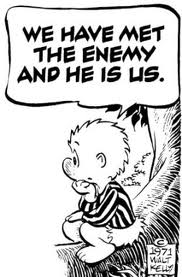
This is not to suggest that the global system and its increasingly pointless annual meetings will disappear, or even change. The governments which allowed the Earth Summit and all such meetings to fail evince no sense of responsibility for this outcome, and appear untroubled by the thought that if a system hasn’t worked for 20 years, there’s something wrong with the system. They walk away, aware that there are no political penalties; that the media is as absorbed with consumerist trivia as the rest of us; that, when future generations have to struggle with the mess they have left behind, their contribution will have been forgotten. (And then they lecture the rest of us on responsibility.)

Nor is it to suggest that multilateralism should be abandoned. Agreements on biodiversity, the oceans and the trade in endangered species may achieve some marginal mitigation of the full-spectrum assault on the biosphere that the consumption machine has unleashed. But that’s about it.

The action – if action there is – will mostly be elsewhere. Those governments which retain an interest in planet Earth will have to work alone, or in agreement with like-minded nations. There will be no means of restraining free riders, no means of persuading voters that their actions will be matched by those of other countries.

That we have missed the chance of preventing two degrees of global warming now seems obvious. That most of the other planetary boundaries will be crossed, equally so. So what do we do now?

Some people will respond by giving up, or at least withdrawing from political action. Why, they will ask, should we bother, if the inevitable destination is the loss of so much of what we hold dear: the forests, the brooks, the wetlands, the coral reefs, the sea ice, the glaciers, the birdsong and the night chorus, the soft and steady climate which has treated us kindly for so long? It seems to me that there are at least three reasons.

The first is to draw out the losses over as long a period as possible, in order to allow our children and grandchildren to experience something of the wonder and delight in the natural world and of the peaceful, unharried lives with which we have been blessed. Is that not a worthy aim, even if there were no other?

The second is to preserve what we can in the hope that conditions might change. I do not believe that the planet-eating machine, maintained by an army of mechanics, oiled by constant injections of public money, will collapse before the living systems on which it feeds. But I might be wrong. Would it not be a terrible waste to allow the tiger, the rhinoceros, the bluefin tuna, the queen’s executioner beetle and the scabious cuckoo bee, the hotlips fungus and the fountain anenome to disappear without a fight if this period of intense exploitation turns out to be a brief one?

The third is that, while we may have no influence over decisions made elsewhere, there is plenty that can be done within our own borders. Rewilding – the mass restoration of ecosystems – offers the best hope we have of creating refuges for the natural world, which is why I’ve decided to spend much of the next few years promoting it here and abroad.

Giving up on global agreements or, more accurately, on the prospect that they will substantially alter our relationship with the natural world, is almost a relief. It means walking away from decades of anger and frustration. It means turning away from a place in which we have no agency to one in which we have, at least, a chance of being heard. But it also invokes a great sadness, as it means giving up on so much else.

Was it too much to have asked of the world’s governments, which performed such miracles in developing stealth bombers and drone warfare, global markets and trillion-dollar bailouts, that they might spend a tenth of the energy and resources they devoted to these projects on defending our living planet? It seems, sadly, that it was.

George Joshua Richard Monbiot is an English writer, known for his environmental and political activism.

Boldface added by BPR Editor
Posted in Barack Obama, Economics, economy, Energy, environment, government, politics, science | Tagged , , , , , , , | 2 Comments

GMOs, What’s Not to Like?

Posted in Food, science | Tagged , , , | Leave a comment

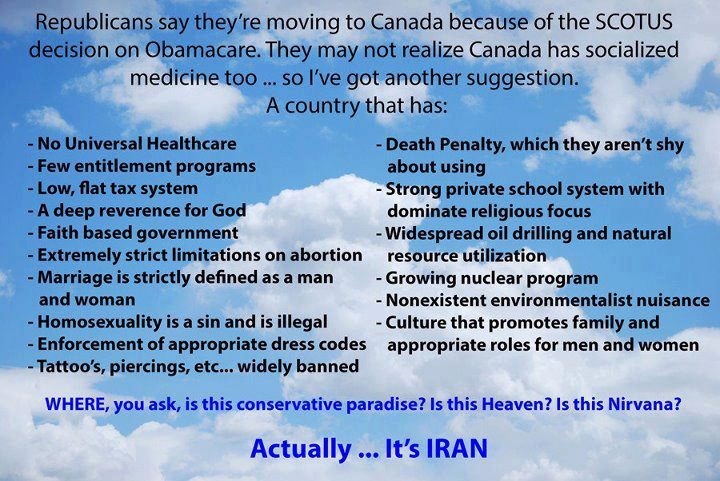
Conservative Paradise (Not Canada)

origin unknown
Posted in civil liberties, health care, humor, Iran, lifestyle, Republican Party, science, Supreme Court | Tagged | Leave a comment

The Real World Sucks, Doesn’t It?

THE FATE OF HEALTH CARE AND THE NOVEMBER ELECTION 

By Arlen Grossman

Polls show Americans like most provisions in Obama’s health care plan, but as a result of bitter and well-funded attacks by the Right, reject ObamaCare as a concept. But now that the Supreme Court has given the go-ahead for the president’s Affordable Care Act, here are two scenarios of what might happen next:

IN A FAIR WORLD (Like We Sorta Used to Have):   The mainstream news media will provide even-handed coverage of the health care plan’s pros and cons. Based on this objective information, Americans will better understand and appreciate the benefits of the new health care system. ObamaCare will rise in opinion polls and boost the campaigns of President Obama and Democrats running for Congress. In contrast, Republicans, desperately attempting to kill the health care plan, will lose support among independent voters. President Obama will be re-elected, and Democrats will hold a majority in the House and Senate, thus ensuring the continuation and possible expansion of  health care opportunities in America.

The Democratic View: webpronews.com


IN THE REAL WORLD (Where Money Rules): Right-wing billionaires will spend untold millions of dollars to rip into ObamaCare, presenting expanded health care coverage as somehow akin to Stalin’s gulags and Hitler’s death camps, while the conservative echo machine (Limbaugh, Fox News, etc.) will gleefully spread the propaganda manure. Before long, frustrated, brainwashed and confused Americans will want to scrap the whole idea. Democratic candidates will be outspent, demoralized, and using all their time to swat down GOP lies about ObamaCare. The heavily financed Republicans will retain the House, win the Senate, and President Obama will be a one-term president. American health care will revert to pre-Obama status.

The Republican View: vizfact.com

Is there any room for fairness in the real world equation this year? We’ll find out November 6.

ALSO PUBLISHED IN OPEDNEWS.COM July 2, 2012
Posted in Barack Obama, Democratic Party, elections, health care, law, media, politics, Republican Party, Supreme Court | Tagged , , , | 2 Comments