Where Have All the Protesters Gone?

What Happened to the Anti-War Movement?

By David Sirota/ Nation of Change/ September 6, 2013

0321-03

A mere 72 hours after President Obama delivered an encomium honoring the life of Dr. Martin Luther King, he announced his intention to pound yet another country with bombs. The oxymoron last week was noteworthy for how little attention it received. Yes, a president memorialized an anti-war activist who derided the U.S. government as “the greatest purveyor of violence in the world.” Then that same president quickly proposed yet more violence — this time in Syria.

Among a political press corps that rarely challenges the Washington principle of “kill foreigners first, ask questions later,” almost nobody mentioned the contradiction. Even worse, as Congress now debates whether to launch yet another military campaign in the Middle East, the anti-war movement that Dr. King represented — and that so vigorously opposed the last war — is largely silent. Sure, there have been a few perfunctory emails from liberal groups, but there seems to be little prospect for mass protest, raising questions about whether an anti-war movement even exists anymore.

So what happened to that movement? The shorter answer is: It was a victim of partisanship.

That’s the conclusion that emerges from a recent study by professors at the University of Michigan and Indiana University. Evaluating surveys of more than 5,300 anti-war protestors from 2007 to 2009, the researchers discovered that the many protestors who self-identified as Democrats “withdrew from anti-war protests when the Democratic Party achieved electoral success” in the 2008 presidential election.

Had there been legitimate reason to conclude that Obama’s presidency was synonymous with the anti-war cause, this withdrawal might have been understandable. But that’s not what happened — the withdrawal occurred even as Obama was escalating the war in Afghanistan and intensifying drone wars in places like Pakistan and Yemen. The researchers thus conclude that during the Bush years, many Democrats were not necessarily motivated to participate in the anti-war movement because they oppose militarism and war — they were instead “motivated to participate by anti-Republican sentiments.”

Not surprisingly, this hyper-partisan outlook and the lack of a more robust anti-war movement explain why political calculations rather than moral questions are at the forefront of the Washington debate over a war with Syria.

In that Beltway back and forth, the national media has focused as much on the horserace (will an attack politically weaken the president?) and political tactics (should the president have submitted to a congressional vote?) than on whether an attack would actually make things better in Syria.

Similarly, a top Democratic strategist told CNN that potential Republican opposition to a Syria attack “will coalesce Democrats around the president” in support of a military strike. Confirming that dynamic, Democratic Congresswoman Eleanor Holmes Norton said a war resolution will pass not because of the supposed merits of an attack on Syria, but simply “because of loyalty of Democrats” who “just don’t want to see (Obama) shamed and humiliated on the national stage.”

This is red-versus-blue tribalism in its most murderous form. It suggests that the party affiliation of a particular president should determine whether or not we want that president to kill other human beings. It further suggests that we should all look at war not as a life-and-death issue, but instead as a sporting event in which we blindly root for a preferred political team.

An anti-war movement is supposed to be a check on such reflexive bloodlust. It is supposed to be a voice of reason interrupting the partisan tribalism. When it, too, becomes a victim of that tribalism, we lose something more than a political battle. As the distorted debate over Syria proves, we lose the conscience that is supposed to guide us through the most vexing questions of all.


Boldface added by BPR Editor 
Posted in Barack Obama, Democratic Party, foreign policy, government, Iraq war, media, military, politics, protests, Republican Party, Syria, war | Tagged , , , , , | Leave a comment

WHAT WE KNOW NOW

Ten Things We’ve Learned About The NSA From A Summer Of Snowden Leaks

By Andy Greenberg/ Forbes/ September 9, 2013

k-bigpic

Lifehacker.com

The truth is coming, and it cannot be stopped,” Edward Snowden told readers of theGuardian in June. At the time, just a few weeks into the publication of documents that the 30-year-old former National Security Agency contractor had siphoned from his workstation in Hawaii, that prophetic statement might have seemed like grandstanding. But close to three months later, the collection of Snowden’s revelations has grown to the megaleak proportions of WikiLeaks’ Cablegate or Daniel Ellsberg’s Pentagon Papers, with no end in sight. For those who watch the watchers, Snowden may well have become the most important leaker of the 21st century.

Snowden himself has managed to take refuge in Russia and disappear from the headlines, putting the full spotlight back onto his bombshell documents. But as with all megaleaks, the sheer number of scoops he’s enabled threatens to overwhelm anyone tracking the NSA’s still-growing scandal. Here are a few highlights from what we’ve learned so far in the Summer of Snowden.

  • For more than a decade, the NSA has been working to systematically influence encryption standards or insert backdoors in the code of commercial encryption software to enable it to access Internet users’ communications, according to documents Snowden leaked to the Guardian, which were shared with the New York Times and Pro Publica. Though the published documents lack many details, the protocols the agency may have the ability to break or circumvent include Web encryption such as Secure Sockets Layer and Transport Security Layer, the Internet protocol encryption and authentication technology IPsec, common virtual private network systems used for anonymity and secure remote access, and Voice-Over-Internet-Protocol. (VoIP) The backdoor-planting projects, known as “Bullrun” in the United States and “Edgehill” within the NSA’s British equivalent the GCHQ, have made “vast amounts of encrypted Internet data…exploitable,” according to one leaked document.
  • The German newsweekly Der Spiegel wrote over the weekend that it had obtained NSA documents revealing that the agency has the ability to access a wide range of information stored on smartphones including iPhones, Blackberrys, and those running Google’s Android operating system. That information includes contacts, text message traffic, and location data–the paper alludes to the NSA’s compromise of “38 iPhone features.” Despite losing access to Blackberry’s messaging systems in 2009 after a change in how the company compressed data, the agency noted in a document that a breakthrough allowed it to regain access in 2010.
  • Snowden-leaked documents obtained and partially published by theWashington Post revealed the makeup of the so-called Black Budget, the $52.6 billion of government funding spent on classified programs. The budget showed that the NSA received $10.8 billion for the year 2013, second only to the CIA’s $14.7 billion. The budget confirmed that the NSA employs an elite hacking team it calls Tailored Access Operations, revealed the agency’s focus on hacking network routers and switches rather than servers and PCs, and exposed a program to combat “insider threats” by investigating 4,000 employees, which was (ironically) shelved to focus on reacting to WikiLeaks’ disclosures in 2010. The budget also outlined how much telecom firms are paid for their cooperation with the NSA’s surveillance.
  • Newly-revealed surveillance targets for the NSA, according to various Snowden leaks, include the presidents of U.S.-friendly countries such as Brazil and Mexicointernational organizations like the U.N. and E.U.–going so far as to bug embassies and hack the U.N.’s video conferencing systems–and Al Jazeera, the first revelation that the NSA has surveilled journalists. Earlier leaks, published by the Guardian, included a program that mapped out the frequency of NSA’s surveillance by country, showing a focus on the Middle East but also including American targets. Another document confirmed that President Obama has asked the NSA to draw up a list of potential cyberattack targets, including ones that could potentially disable enemy infrastructure.
  • Internal audit documents from the NSA, obtained by the Washington Post, show that the agency found 2,776 incidents in which its staff had broken its own rules governing surveillance in the year leading up to May 2012. In one case, a surveillance operation continued for three months before the Foreign Intelligence Surveillance Court, which is designed to oversee the agency, first heard about it and ruled it unconstitutional. In another comic example, analysts collected phone calls from the Washington area because its “202″ area code was confused with Egypt’s country code, “20.”
  • Even when the NSA follows its internal rules, it’s offered a surprising number of regulatory loopholes. A document published by the Guardian showed that the NSA makes broad exceptions to its mission of only spying on foreign targets. That includes collecting and storing information on Americans when it’s judged to contain “significant foreign intelligence” information, information about a crime that has been or may be about to be committed, is related to “the unauthorized disclosure of national security information,” or is involved in assessing “a communications security vulnerability.” In another exception, any encrypted data can also be held long enough to crack it.
  • Documents given to the Guardian revealed that the NSA helps to fund the spying operations of Britain’s GCHQ, in part to take advantage of the U.K.’s more relaxed regulations of its intelligence sector. Over three years, the NSA gave more than $150 million to British intelligence services, and 60% of GCHQ’s “refined intelligence” also reportedly came from the NSA’s analysis.
  • Other documents focusing on GCHQ and published by the Guardian showed that the British intelligence service has the ability to tap transatlantic fiberoptic cables for raw Internet data, much of which is shared with the NSA.
  • In a slideshow first published in part by the Washington Post, a program known as PRISM reportedly allowed direct access to the servers of companies including Google, Apple, Facebook, Microsoft, and others. Most of the companies implicated in PRISM denied any such access, but several, including Apple and Facebook, responded by offering details for the first time about how often they cooperate with surveillance requests from the NSA and from law enforcement.
  • The Guardian kicked off the Snowden saga in June with an order sent to Verizon on behalf of the NSA demanding the cell phone records of all of Verizon Business Network Services’ American customers for a three month period. The order, which dealt with only those users’ metadata,specifically requested Americans’ records. In the following days, Senators Saxby Chambliss and Diane Feinstein publicly stated that similar orders have been issued to telecoms for the last seven years.


Posted in civil liberties, foreign policy, government, intelligence, law, media, scandals, Terrorism | Tagged , , , , , , , , , , , , | Leave a comment

Aren’t We There Already?

BPR Quote of the Day #2

“You follow this pro-corporate trend to its logical conclusion, and sooner or later you’ll end up with a Supreme Court that functions as a wholly owned subsidiary of big business,”        

Sen. Elizabeth Warren (D-Mass)

Speaking to an AFL-CIO Convention, Sept. 8, 2013

Posted in Economics, government, Justice, law, Quotations, Supreme Court | Tagged , , | Leave a comment

Some Things Never Change

BPR Quote of the Day #1

MLK-Jr-Large

Like Quotations? Check out my QuotationQuotient.com

Posted in foreign policy, military, Quotations, war | Tagged , | Leave a comment

Neglecting the People

SYRIA AND THE REALITY AT HOME IN AMERICA

By Robert Reich/ RobertReich.org/ September 6, 2013

While all eyes are on Syria and America’s response, the real economy in which most Americans live is sputtering.

More than four years after the recession officially ended, 11.5 million Americans are unemployed, many of them for years. Nearly 4 million have given up looking for work altogether. If they were actively looking, today’s unemployment rate would be 9.5 percent instead of 7.3 percent.

The share of the population working or seeking a job is nearly its lowest in thirty years. The unemployment rate among high-school dropouts is 11 percent;  for blacks, 12.6 percent.

inflation

Chan Lowe

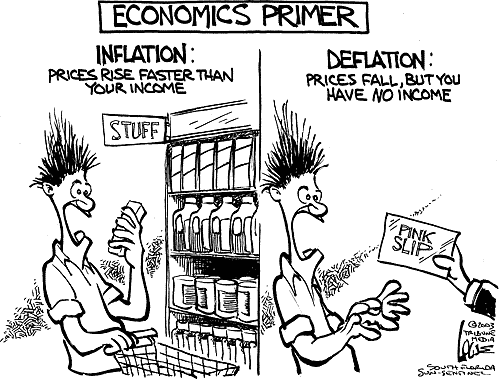
And the median wage keeps dropping, adjusted for inflation.Incomes for all but the top 1 percent are below where they were at the start of the economic recovery in 2009.

A decent society would put people to work — even if this required more government spending on roads, bridges, ports, pipelines, parks and schools.

A decent society would lift the minimum wage, expand the Earned Income Tax Credit (a wage subsidy), and provide food stamps and housing assistance so that no family with a full-time worker has to live in poverty.

We can afford this minimal level of decency.

Deficit hawks in both parties don’t want you to know this but the federal deficit as a proportion of the total economy is shrinking fast: It’s on track to be only 4 percent by the end of September, when the fiscal year ends. The non-partisan Congressional Budget Office predicts it will be only 3.4 percent in the fiscal year starting October 1.

To put this into perspective, consider that the average ratio of the deficit to the GDP over the past 30 years has been 3.3 percent. So the deficit is barely a problem at all. (We’re still projected to have large deficits starting 10 years from now because of all the aging boomers needing health care.) 

Yet while attention is focused on Syria, food stamps for the nation’s poor are being cut. House Republicans would eliminate food stamps for more than 800,000 Americans who now receive them but still do not get enough to eat or have only a barely adequate diet. 

Even if the Democrats prevent these draconian cuts, food stamp benefits will still be reduced in November, when a provision in the 2009 stimulus bill expires.

While attention is focused on Syria, funds for the nation’s poorest schools are being slashed. Teachers are still being let go. Classrooms are more crowded than ever. The sequester will drain even more funds after October 1. 

While attention is focused on Syria, low-income housing is disappearing. 

Funding for housing vouchers has already been cut by $854 million this year, with the result that half of all public housing authorities have stopped issuing new vouchers — even though the percentage of households most in need of assistance has grown by 19 percent since 2009. The cuts scheduled to begin October 1 will be even more severe.

While attention is focused on Syria, America’s rich are growing even richer. A single year’s income of one of the ten richest Americans could buy housing for every homeless person in America for an entire year. (This calculation is based on a typical day last winter, when over 633,000 people were homeless, and the typical monthly rental cost of a unit with single room occupancy of $558 per month.)

But we are not talking about any of this. We are not debating what’s happening to our nation. We are not creating jobs for the long-term unemployed. We are not raising the minimum wage, expanding the EITC, or providing enough food stamps to keep working Americans out of poverty. We are not improving the nation’s poorest schools or providing enough low-income housing to keep destitute families off the nation’s streets.

We are not reforming our tax code or fixing our schools or reforming our brutal immigration system. We are not addressing the widening gap between a few at the top who are doing better than ever and a larger number below who are sinking. We are not getting big money out of politics.

We are paralyzed at home — as we turn our attention to a potential quagmire abroad. This is the great tragedy of our time.

Boldface added by BPR Editor


Posted in Barack Obama, Economics, economy, employment, foreign policy, government, inequality, labor, political cartoon, poverty, Syria, taxes | Tagged , , , , , , | 2 Comments

Koch Brothers vs Social Security

Posted in economy, finance, government, media, Wall Street | Tagged , , , , , , , , , | Leave a comment

You’ll Have a Blast

get-attachment.aspx

Anthony Freda
Posted in cartoon, foreign policy, military, political cartoon, political humor, Syria | Tagged , | Leave a comment

We’re Good Because We Say We Are

deepwater-horizon-settlementBPR Quote of the Day

“The increase in a corporation’s P.R. ad budget goes up in direct proportion to the degree of harm done to consumers and/or the environment.”

                                       –Arlen Grossman       

  Walmart-PR-Crisis

Posted in environment, media, Quotations | Tagged , , , , | Leave a comment

Not Much to Celebrate on Labor Day

A quickie Robert Reich lecture (less than 3 minutes) on the problems of and solutions for American workers…..

Posted in Economics, economy, Education, government, health care, inequality, labor, taxes, Wall Street | Tagged , , , , , , , , | Leave a comment