

-
Recent Posts
- Trump Continues To Ruin GOP Chances And Help Dems
- The biggest problem facing the U.S. economy
- Are We On the Verge of a Progressive Revolution Like the New Deal?
- Why are progressives winning across the United States? It’s not complicated
- Republicans Rigged America’s Debt: Now We’re Paying the Billionaires Forever
-
Join 441 other subscribers
Categories
Archives
- September 2026
- August 2026
- July 2026
- June 2026
- May 2026
- April 2026
- March 2026
- February 2026
- January 2026
- December 2025
- November 2025
- October 2025
- September 2025
- August 2025
- July 2025
- June 2025
- May 2025
- April 2025
- March 2025
- February 2025
- January 2025
- December 2024
- November 2024
- October 2024
- September 2024
- August 2024
- July 2024
- June 2024
- May 2024
- April 2024
- March 2024
- February 2024
- January 2024
- December 2023
- November 2023
- October 2023
- September 2023
- August 2023
- July 2023
- June 2023
- May 2023
- April 2023
- March 2023
- February 2023
- January 2023
- December 2022
- November 2022
- October 2022
- September 2022
- August 2022
- July 2022
- June 2022
- May 2022
- April 2022
- March 2022
- February 2022
- January 2022
- December 2021
- November 2021
- October 2021
- September 2021
- August 2021
- August 2020
- July 2020
- June 2020
- May 2020
- April 2020
- March 2020
- February 2020
- January 2020
- December 2019
- November 2019
- October 2019
- September 2019
- August 2019
- July 2019
- June 2019
- May 2019
- April 2019
- March 2019
- February 2019
- January 2019
- December 2018
- November 2018
- October 2018
- September 2018
- August 2018
- July 2018
- June 2018
- May 2018
- April 2018
- March 2018
- February 2018
- January 2018
- December 2017
- November 2017
- October 2017
- September 2017
- August 2017
- July 2017
- June 2017
- May 2017
- April 2017
- March 2017
- February 2017
- January 2017
- December 2016
- November 2016
- October 2016
- September 2016
- August 2016
- July 2016
- June 2016
- May 2016
- April 2016
- March 2016
- February 2016
- January 2016
- December 2015
- November 2015
- October 2015
- September 2015
- August 2015
- July 2015
- May 2015
- April 2015
- March 2015
- February 2015
- January 2015
- November 2014
- October 2014
- September 2014
- August 2014
- July 2014
- June 2014
- February 2014
- January 2014
- December 2013
- November 2013
- October 2013
- September 2013
- August 2013
- March 2013
- February 2013
- January 2013
- December 2012
- November 2012
- October 2012
- September 2012
- August 2012
- July 2012
- June 2012
- May 2012
- April 2012
- March 2012
- February 2012
- January 2012
- December 2011
- November 2011
- October 2011
- September 2011
- August 2011
- July 2011
- June 2011
- May 2011
- April 2011
- March 2011
- January 2011
- December 2010
Blogroll
Meta
Immoral Decisions
Posted in Economics, government, inequality, politics, poverty, taxes, Uncategorized
Tagged Bernie Sanders, Estate Tax, Steve Mnuchin
Leave a comment
Losing My Religion For Equality
By Jimmy Carter/The Age/ April 27, 2017
Women and girls have been discriminated against for too long in a twisted interpretation of the word of God.
I HAVE been a practising Christian all my life and a deacon and Bible teacher for many years. My faith is a source of strength and comfort to me, as religious beliefs are to hundreds of millions of people around the world. So my decision to sever my ties with the Southern Baptist Convention, after six decades, was painful and difficult. It was, however, an unavoidable decision when the convention’s leaders, quoting a few carefully selected Bible verses and claiming that Eve was created second to Adam and was responsible for original sin, ordained that women must be “subservient” to their husbands and prohibited from serving as deacons, pastors or chaplains in the military service.
This view that women are somehow inferior to men is not restricted to one religion or belief. Women are prevented from playing a full and equal role in many faiths. Nor, tragically, does its influence stop at the walls of the church, mosque, synagogue or temple. This discrimination, unjustifiably attributed to a Higher Authority, has provided a reason or excuse for the deprivation of women’s equal rights across the world for centuries.
At its most repugnant, the belief that women must be subjugated to the wishes of men excuses slavery, violence, forced prostitution, genital mutilation and national laws that omit rape as a crime. But it also costs many millions of girls and women control over their own bodies and lives, and continues to deny them fair access to education, health, employment and influence within their own communities.
The impact of these religious beliefs touches every aspect of our lives. They help explain why in many countries boys are educated before girls; why girls are told when and whom they must marry; and why many face enormous and unacceptable risks in pregnancy and childbirth because their basic health needs are not met.

In some Islamic nations, women are restricted in their movements, punished for permitting the exposure of an arm or ankle, deprived of education, prohibited from driving a car or competing with men for a job. If a woman is raped, she is often most severely punished as the guilty party in the crime.
The same discriminatory thinking lies behind the continuing gender gap in pay and why there are still so few women in office in the West. The root of this prejudice lies deep in our histories, but its impact is felt every day. It is not women and girls alone who suffer. It damages all of us. The evidence shows that investing in women and girls delivers major benefits for society. An educated woman has healthier children. She is more likely to send them to school. She earns more and invests what she earns in her family.
It is simply self-defeating for any community to discriminate against half its population. We need to challenge these self-serving and outdated attitudes and practices – as we are seeing in Iran where women are at the forefront of the battle for democracy and freedom.
I understand, however, why many political leaders can be reluctant about stepping into this minefield. Religion, and tradition, are powerful and sensitive areas to challenge. But my fellow Elders and I, who come from many faiths and backgrounds, no longer need to worry about winning votes or avoiding controversy – and we are deeply committed to challenging injustice wherever we see it.
The Elders are an independent group of eminent global leaders, brought together by former South African president Nelson Mandela, who offer their influence and experience to support peace building, help address major causes of human suffering and promote the shared interests of humanity. We have decided to draw particular attention to the responsibility of religious and traditional leaders in ensuring equality and human rights and have recently published a statement that declares: “The justification of discrimination against women and girls on grounds of religion or tradition, as if it were prescribed by a Higher Authority, is unacceptable.”
We are calling on all leaders to challenge and change the harmful teachings and practices, no matter how ingrained, which justify discrimination against women. We ask, in particular, that leaders of all religions have the courage to acknowledge and emphasise the positive messages of dignity and equality that all the world’s major faiths share.
The carefully selected verses found in the Holy Scriptures to justify the superiority of men owe more to time and place – and the determination of male leaders to hold onto their influence – than eternal truths. Similar biblical excerpts could be found to support the approval of slavery and the timid acquiescence to oppressive rulers.
I am also familiar with vivid descriptions in the same Scriptures in which women are revered as pre-eminent leaders. During the years of the early Christian church women served as deacons, priests, bishops, apostles, teachers and prophets. It wasn’t until the fourth century that dominant Christian leaders, all men, twisted and distorted Holy Scriptures to perpetuate their ascendant positions within the religious hierarchy.
The truth is that male religious leaders have had – and still have – an option to interpret holy teachings either to exalt or subjugate women. They have, for their own selfish ends, overwhelmingly chosen the latter. Their continuing choice provides the foundation or justification for much of the pervasive persecution and abuse of women throughout the world. This is in clear violation not just of the Universal Declaration of Human Rights but also the teachings of Jesus Christ, the Apostle Paul, Moses and the prophets, Muhammad, and founders of other great religions – all of whom have called for proper and equitable treatment of all the children of God. It is time we had the courage to challenge these views.
OBSERVER
Jimmy Carter was president of the United States from 1977 to 1981.
Posted in gender, inequality, religion
Tagged Jimmy Carter, sex discrimination, Southern Baptists
8 Comments
ELECTION DO-OVER
Letter to Editor, Monterey Herald, June14
If collusion between the Trump campaign and Russia is proven, wouldn’t that mean the 2016 presidential election was essentially stolen? If so, a new election would be warranted. A fraudulent election should not stand. We need an independent commission figuring out how to implement a new presidential election if the last one is shown to be rigged. Otherwise, there will be a lot of Americans, perhaps a majority, who rightfully would not accept Donald Trump (or Mike Pence) as their legitimate president.
Arlen Grossman

Posted in elections, government, political cartoon, politics, Russia
Tagged 2016 election, collusion, Donald Trump, Mike Pence
3 Comments
Resisting Trump’s Shock Doctrine
Posted in government, politics, protests, War on Terror
Tagged Donald Trump, Naomi Klein, The Intercept, The Shock Doctrine
Leave a comment
Make Your Own Trump Tweet
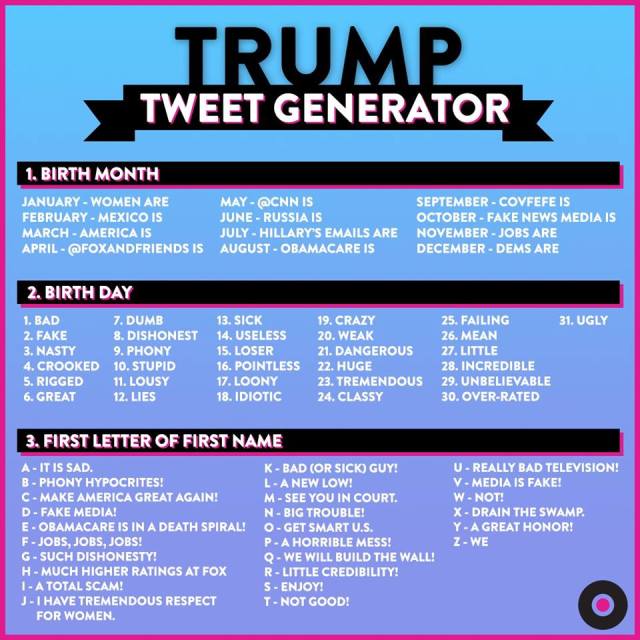
Posted in Donald Trump, humor, political humor
Tagged Trump Tweet Generator, Tweet Generator
1 Comment
Democratic Party Woes
What Do the Democrats Want? No One Knows
By Ted Rall/ Counterpunch/ May 30,2017
In the 1970s, when I was a kid, I asked my mother to explain the difference between the two major parties. “Democrats,” she explained, “are the party of the working man. Republicans represent big business.”
She was a Democrat, obviously. Still, I’m sure Republican families had their version of my mom’s binary, perhaps something along the lines of: “Republicans believe in less government and more hard work. Democrats want high taxes and welfare.”
The two-party system was easy to understand.
Now it’s a muddled mess — especially if you’re a Democrat.
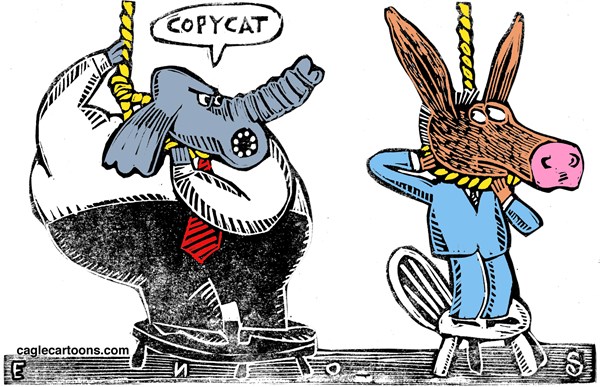
Today’s Democratic Party relies on big corporations, especially big Wall Street investment banks, for campaign donations. The old alliance between the party and labor unions is dead. Democrats support trade deals that hurt American workers. When the economy tanked at the end of the last decade, President Obama left laid-off workers and foreclosed-upon homeowners twisting in the wind; he bailed out the banks instead. Hillary Clinton, who supported the TPP trade deal before she was against it, promised bankers she’d their friend if she won. Whatever the Democrats are now, they’re not the party of working Americans.
So what is the Democratic Party now? What does it stand for and against?
I honestly don’t know. I’m obsessed with politics. So if I don’t know what Democrats want, it’s a safe bet no one else does, either.
“It’s all well and good — and really very satisfying — to harp constantly about the terribleness of Donald Trump,” observes New York Times columnist Gail Collins. “But people need to see the Democratic line on the ballot and think of something more than Not as Dreadful.”
Yes they do.
Failure to articulate an affirmative vision of what she was for, not just against, was largely to blame for Hillary Clinton’s devastating defeat. Trump Is Evil and Dangerous wasn’t enough to win in 2016. It probably won’t be enough for 2018 either. Yet party leaders still haven’t begin to say how they would address the problems voters care about.
Like healthcare. The Clintonistas, still in charge of the Democrats despite their incompetent stewardship, believe that Obamacare will survive because the Republicans’ Trumpcare alternative is unpopular even with Republicans. But they’re wrong. In one out of three counties, there is only one insurance company in the local healthcare “exchange.” Zero competition guarantees skyrocketing premiums and shrinking benefits. The collapse of Obamacare makes healthcare the #1 concern for American voters.
What would Democrats do about healthcare if they were in charge?
As far as I can tell, nada.
House Democratic Leader Nancy Pelosi’s website brags about Obamacare and its achievements. “House Democrats,” it says, “continually work to implement and improve health care reform to ensure that the best healthcare system in the world only gets better.” Newsflash to Ms. Pelosi: Actually, the U.S. has the worst healthcare system in the developed world.
When it comes to healthcare, Democrats are just like the Republicans on global warming. They won’t admit there’s a problem. So how can they offer a solution?
They don’t. Even though 58% of American voters want a European-style taxpayer-subsidized single-payer system, the Democratic Party platform does not propose significant reforms to Obamacare.
The wreckage of deindustrialization in the nation’s heartland is widely viewed as key to Trump’s surprise win. So what is the Democrats’ plan to create jobs, increase wages and help victims of the opioid epidemic?
Aside from “Trump sucks,” Democrats don’t much to say.
“We will create jobs that stay in America and restore opportunity for all Americans, starting with raising the minimum wage, expanding Pell grants and making college tuition tax deductible,” the party said in a statement a few days before Election Day 2016. Sounds great! But details are hard to come by.
Last year when it mattered, $225,000-a-speech Hillary asked workers to settle for a $12/hour minimum wage. Now, finally, Democrats are officially endorsing Bernie Sanders’ $15/hour. But it really should be at least $22/hour. And anyway, how would a minimum wage increase, or Pell grants, or tax-deductible tuition, “create jobs”? They wouldn’t. We need a big WPA-style federal hiring program. A law mandating that evil outsourcing companies like Facebook start hiring Americans wouldn’t hurt. But the Dems won’t get behind either.
When Democrats do have something to say, it’s trivial and small-bore, like making college tuition tax deductible. Why not go big? Did you know that the U.S. could make four-year college tuition free for the price of the ongoing war against Iraq?
Why are the Dems so lame? Suspect #1 is the lingering rift between the Sanders and Clinton wings of the party. “There is this grassroots movement voters’ arm of the party, and the more corporate, institutional part of the party. And the movement arm is tired of the institutional part telling us the only place for us is in the streets,” saysNebraska Democratic Party Chairwoman Jane Kleeb, a Sanders supporter. A party split by a civil war between a populist left and a corporatist right can’t articulate an inspiring platform of exciting solutions to American’s big problems. A purge, or a schism, would fix this.
Trump is already one of the most unpopular presidents in history. Going against him ought to be easy. But Democrats are about to find out — again — that people won’t vote for you unless you give them a good reason to get off their couches and drive to the polls.
Posted in Democratic Party, government, politics
Tagged Counterpunch, Daryl Cagle, Donald Trump, Hillary Clinton, Ted Rall
1 Comment
The Bad News and the Good News

Posted in cartoon, environment, political cartoon, political humor, politics
Leave a comment
Never-Ending

Posted in foreign policy, government, military, political cartoon, war
Tagged Signe Wilkinson
Leave a comment
THE BAD NEWS
Wake Up, Liberals: There Will be No 2018 ‘Blue Wave,’ No Democratic Majority and No Impeachment
By Andrew O’Hehir/ Salon/ May 27, 2017
We received a message from the future this week, directed to the outraged liberals of the so-called anti-Trump resistance. It was delivered by an unlikely intermediary, Greg Gianforte, the Republican who won a special election [3] on Thursday and will soon take his seat in Congress as Montana’s lone representative. (Here’s a trivia question to distract you from the doom and gloom: Without recourse to Google, how many other states can you name that have only one House seat?)
If you found yourself ashen-faced and dismayed on Friday morning, because you really believed the Montana election would bring a sign of hope and mark the beginning of a return to sanity in American politics, then the message encoded in Gianforte’s victory is for you. It goes something like this:
Get over Montana already—and stop trolling yourself with that stupid special election in Georgia too. They don’t mean anything, and anyway — that dude Jon Ossoff [4]? He’s about the lamest excuse for a national progressive hero in the entire history of Democratic Party milquetoast triangulation. Oh, and since we’re on the subject: Forget about the “blue wave” of 2018. Forget about the Democratic majority of 2019. Forget about the impeachment of President Donald Trump. Have you even been paying attention? Because none of that stuff is happening and it’s all a massive distraction.
A distraction from what, you ask? Well, that’s a good question without a clear answer, and the message gets pretty fuzzy after that. I would suggest that rebuilding American politics and indeed all of American public discourse, now that they’ve been Trumpified, is not about the next electoral cycle or the one after that. It’s going to take a while, and I’m not sure how much the Democratic Party will have to do with it, or what it will look like.
No doubt the exaggerated media focus on Montana was inevitable, in the age of the voracious 24/7 news cycle: This was only the second vacant congressional seat to be filled since Trump took office, and the first where the Democratic candidate appeared to have a real shot. But the Big Sky frenzy also spoke to the way American politics has almost entirely become a symbolic rather than ideological struggle — a proxy war between competing signifiers whose actual social meaning is unclear.
Despite their abundant differences, Barack Obama and Donald Trump were both semiotic candidates, who appeared to represent specific worldviews or dispositions (the espresso cosmopolitan; the shameless vulgarian) but presented themselves as a disruption to “normal” politics and were difficult to nail down in left-right ideological terms. Understanding an off-year congressional election in an idiosyncratic and thinly populated Western state, where fewer than 400,000 voters cast ballots, as a referendum on the national mood or the GOP health care bill or much of anything else is patently absurd. But it’s a miniature example of the same reduction to symbolism, in which everything is said to stand for something else and democracy becomes pure spectacle.
As for Gianforte, the inadvertent vehicle for our message, nobody outside Montana had heard of him before this week, and we’re not likely to hear much from him in Washington either, where he will disappear into the chorus of fleshy, pickled-looking, age-indeterminate white millionaires who make up the House Republican caucus. Gianforte found his one moment of fame after allegedly assaulting [5] Guardian reporter Ben Jacobs on the eve of the election, making the GOP candidate a focal point of widespread liberal wish-casting and concern-trolling. Surely the good people of Montana would see the light of reason now that the Republican candidate had been revealed — gasp! — as a thin-skinned, violent bully.
It’s almost hilarious — in the vein of that long-running “Peanuts” gag [6] about Charlie Brown, Lucy and the football — that anyone managed to convince themselves that purportedly decking a representative of the “liberal media” would damage Gianforte. It probably didn’t make much difference; about 70 percent of the votes had already been cast before the Jacobs incident. But I think it’s safe to say that likely Republican voters in Montana, and damn near everywhere else, can be divided into two groups: those who didn’t much care or were inclined to look the other way, and those who were absolutely thrilled.
Gianforte’s decisive victory over Democrat Rob Quist on Thursday has provoked a fresh round of soul-searching from the same people who made too damn much of the Montana election in the first place. We have been told that Democrats must field stronger candidates and commit more resources, that Bernie Sanders does not possess some magic elixir that attracts disgruntled white people and that Donald Trump remains popular in places where people really like him. If that’s not quite enough Captain Obvious, Washington Post columnist Greg Hohmann devoted an impressive amount of research and reporting to the Montana aftermath before arriving at the diagnosis [7] that there is “a growing tribalism that contributes to the polarization of our political system.” You don’t say!
Let me be clear that I’m indicting myself here as well: I edit political coverage at Salon, and I followed the Montana news closely. I knew perfectly well how it was likely to turn out, but one can always be wrong about that (as we discovered last November), and I shared some dim sense that it might be cathartic to experience an insignificant proxy victory in a state I have never even visited. But when I ask myself why I felt that way, even a little, the answers are not edifying.
For many people in, let’s say, the left-center quadrant of the American political spectrum — especially those who are not all that eager to confront the fractured and tormented state of the current Democratic Party — Montana and Georgia and 2018 seem(ed) to represent the opening chapters of a comeback narrative, the beginning of a happy ending. If what happened in 2016 was a nonsensical aberration, then maybe there’s a fix right around the corner, and normal, institutional politics can provide it.
First you chip away at Republican triumphalism, and the House majority, with a couple of special-election victories. Then it’s about organizing, recruiting the right candidates for the right seats, registering voters and ringing doorbells, right? Democrats picked up 31 seats in the George W. Bush midterms of 2006 — and will need 24 or so this time — so, hey, it could happen. For that matter, Republicans gained an astounding 63 seats in the Tea Party election of 2010, and many observers have speculated that Trump-revulsion might create that kind of cohesion on the left. So we sweep away Paul Ryan and his sneering goons, give Nancy Pelosi back her speaker’s gavel after eight long years, introduce the articles of impeachment and begin to set America back on the upward-trending path of political normalcy and niceness.
I suspect it’s pointless to list all the things that are wrong with that scenario, because either you agree with me that it’s a delusional fantasy built on seven different varieties of magical thinking or you don’t, and in the latter case I am not likely to convince you.
My position is that Donald Trump is a symptom of the fundamental brokenness of American politics, not the cause. Electing a Democratic House majority (which is 95 percent unlikely to happen) and impeaching Trump (which is 100 percent not going to happen) might feel good in the moment, but wouldn’t actually fix what is broken. Considered as a whole, the “blue wave” fantasy of November 2018 is a more elaborate and somewhat more realistic version of the “Hamilton elector” fantasy [8] of December 2016: Something will happen soon to make this all go away.
(Let’s throw in the caveat that there are plausible universes in which the Republicans ultimately decide to force Trump out of office for their own reasons. Entirely different scenario.)
If you don’t want to believe me now, I get it. But take a good hard look at Rep.-elect Greg Gianforte, and go through all the excuses you have made to yourself about how and why that happened, and we’ll talk.
It’s worth making two salient structural points that I think are beyond dispute, and then a larger, more contentious one. As my former boss David Daley [9] has documented extensively, both on Salon and in his book “Ratfucked,” [10] the extreme and ingenious gerrymandering of congressional districts locked in by Republican state legislators after the 2010 census virtually guarantees a GOP House majority until the next census and at least the 2022 midterms. Yes, the widely-hated health care law might put a few Republican seats in play that weren’t before. But the number of genuine “swing” districts is vanishingly small, and it would require a Democratic wave of truly historic dimensions to overcome the baked-in GOP advantage.
As for the Senate — well, Democratic campaign strategists will mumble and look away if you bring that up, because the Senate majority is completely out of reach. Of the 33 Senate seats up for election next year, 25 are currently held by Democrats — and 10 of those are in states carried by Donald Trump last year. It’s far more likely that Republicans will gain seats in the Senate, perhaps by knocking off Joe Manchin in West Virginia or Heidi Heitkamp in North Dakota, than lose any at all.
Those disadvantages could be overcome if we were looking at a major electoral shift, on the order of FDR in 1932 or the post-Watergate midterms of 1974, when Democrats won 49 seats in the House and a filibuster-proof majority in the Senate. I can only suppose that’s the sort of thing the blue-wave fantasists imagine. That brings us to the final and largest point: Exactly who is kidding themselves that the Democratic Party, in its 2017 state of disarray and dysfunction, is remotely capable of pulling off a history-shaping victory on that scale?
This is a paradoxical situation in many ways, one that reflects the larger decline of partisan politics in general. The Republican Party went through a spectacular meltdown in 2016, but wound up winning full control of the federal government, partly through luck and partly by default. Meanwhile, Democrats hold a demographic advantage that was supposed to guarantee them political hegemony into the indefinite future, and their positions on most social and economic issues are far more popular than Republican positions (except when you get to nebulous concepts like “national security”). Now they face an opposition president who is both widely despised and clownishly incompetent.
That sounds like a prescription for a major renaissance — but not for a party that is so listless, divided and ideologically adrift. Democrats have been virtually wiped out at the state and local level in non-coastal, non-metropolitan areas of the country: They had full control of 27 state legislatures in 2010, and partial control in five more; today they control 14 (with three splits). There was plenty of bad faith and unfair recrimination on both sides of the Bernie-Hillary split of 2016, which there’s no need to rehearse here. But the bitterness has lingered not just because each side blames the other for the election of Donald Trump (and they both could be right) but because it represents a profound underlying identity crisis that ultimately has little to do with Hillary Clinton or Bernie Sanders. (Again, they are the symbols or signifiers.)
I have previously argued that the Democratic Party’s civil war [11] was unavoidable and has been a long time coming. Like most people, I assumed it would play out under President Hillary Clinton, not with the party reeling in defeat and at a historic low ebb. In the face of a national emergency, maybe Democrats will find some medium-term way to bridge the gulf between pro-business liberal coalition politics and a social-democratic vision of major structural reform and economic justice. Whoever the hell they nominate for president in 2020 will have to pretend to do that, at any rate.
But right now the Democratic Party has no clear sense of mission and no coherent national message, except that it is not the party of Donald Trump. I can understand the appeal of that message, the longing for a return to normalcy, calm and order that it embodies. What we learned in Montana this week — and will likely learn in Georgia, and learn again in the 2018 midterms — is that that’s not enough. There is no “normal” state we can return to.
For the Trump resistance to have meaning, it must be more than the handmaiden or enabler of a political party that has lost its power, lost its voice and lost its way. Electoral victories will come (and go), but we should have learned by now that they are never sufficient in themselves. Rebuilding and redeeming American democracy — if that can still be accomplished — is a much bigger job, and there are no shortcuts.
Andrew O’Hehir is a senior writer for Salon.
Posted in Democratic Party, elections, government, politics
Tagged AlterNet, Andrew O'Hehir, Donald Trump, Georgia race, Greg Gianforte, Montana race, Salon
Leave a comment

