
The Russian president’s back is to the wall. That makes him more dangerous.
By David Ignatius/ Washington Post/ April 16, 2026
{Let’s not forget another war, now in its fifth year with no end in sight, between Ukraine and Russia. With high casualty numbers, economic concerns, and improved Ukrainian military capability, Putin knows Russia’s situation is not what he hoped it would be. Nobody can be sure what his next actions will be. Adding to the mystery, President Trump’s reaction is impossible to predict.-–TBPR Editor}
Russian President Vladimir Putin, always paranoid about enemies, may be feeling cornered this spring. His army is at a standstill in Ukraine, despite suffering enormous casualties. He appears powerless to help Iran, one of his few allies. And his best friend in Europe, Hungary’s Viktor Orban, just got dumped.
Worse problems are probably ahead. The Russian economy, despite a momentary windfall from the spike in oil prices, is a mess. European nations are getting stronger and angrier, with NATO forces arrayed from the White Sea in the Arctic to the Black Sea in the south. And the Ukraine war is grinding on with little chance of the decisive victory that Putin craves.
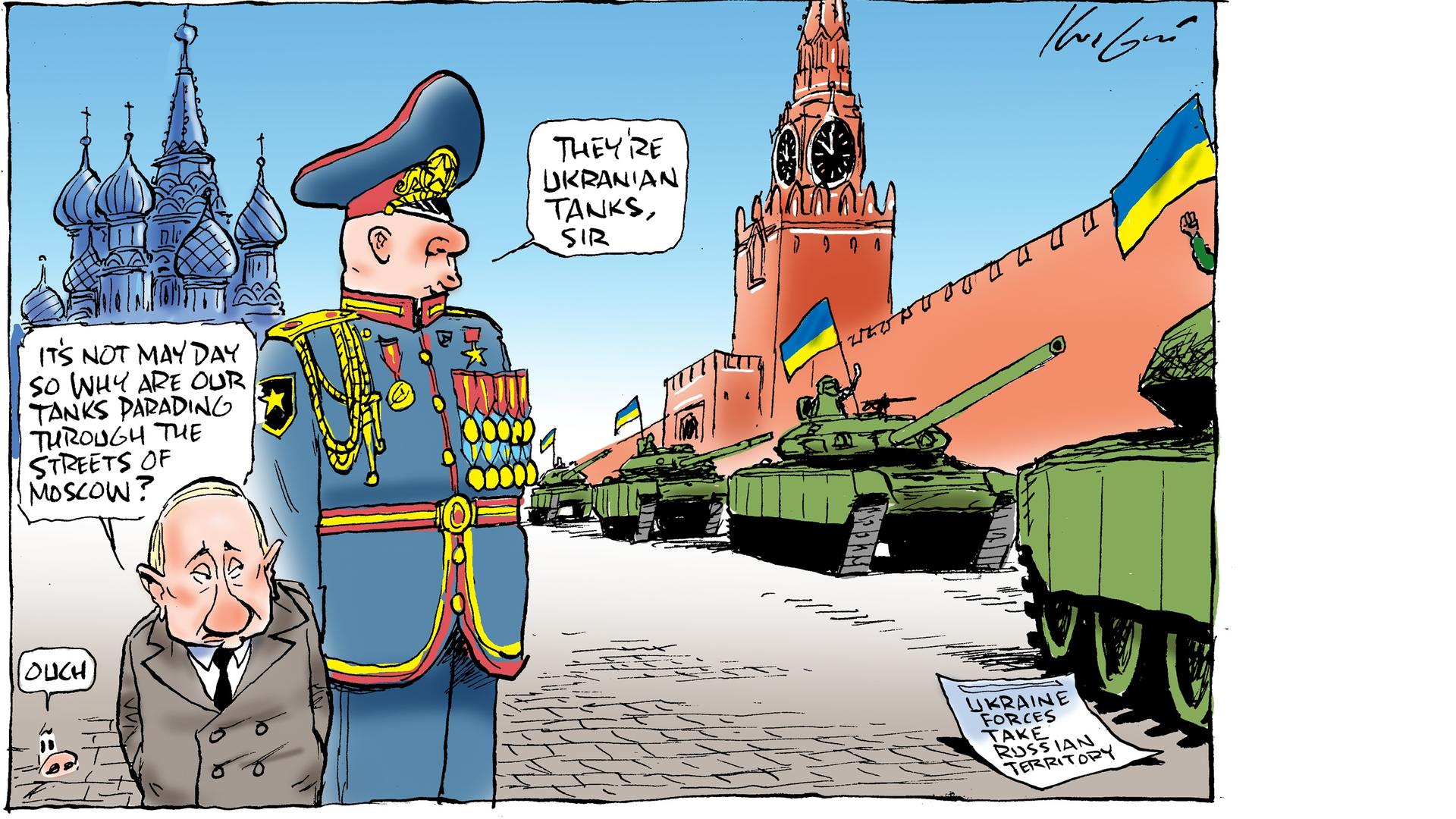
If you’re Putin, feeling so embattled, you might be starting to think about the next war — against Europe — even as you slog ahead in Ukraine. You could even be wondering if the time to strike might be soon — before European nations fully rearm, before Ukraine develops new weapons that can reach even deeper into Russia, and while your chum President Donald Trump is in the White House treating NATO like a punching bag.
The chilling prospect of future conflict between Russia and Europe is the theme of an important but little-noticed study released in March by Eugene Rumer, a former U.S. national intelligence officer for Russia and now a senior fellow at the Carnegie Endowment for International Peace. The report’s title summarized its message: “Belligerent and Beleaguered: Russia After the War with Ukraine.”
Here’s Rumer’s stark warning: “Having invaded Ukraine under the false pretext of needing to secure its western flank, Russia is poised to emerge from the war less secure, more resentful, and more threatening to Europe than before the war. Its threat perceptions will cast a long shadow over Europe.”
Rumer and his Carnegie colleagues explained in interviews this week why the abiding security challenge for the West remains the Ukraine war, despite the mayhem of the Iran conflict. “I proceed from a deep belief that Europe is the most important theater for Russia. That’s where Putin’s energies will be focused,” Rumer told me. As long as Putin is alive, he said, Ukraine will be “unfinished business.”
Michael Kofman, another Carnegie senior fellow and perhaps the most knowledgeable military analyst of the Ukraine conflict, noted that Russia failed to achieve the breakthroughs it sought last year and is off to a bad start in 2026. It suffered 30,000 to 35,000 dead and seriously wounded in March, probably losing more troops than its monthly replacement rate. This year, Kofman said, “Putin will struggle to maintain the same pace as last year.”
Ukraine threatens Putin precisely because it wants to be part of Europe. That makes it the tip of what he sees as the European spear. “From the Kremlin’s perspective, as stated repeatedly by senior Russian officials, Europe is at war with Russia,” writes Rumer. As Putin wages a “hybrid” campaign of covert sabotage against Ukraine’s allies, Europe is getting the message. Russia “could be ready to use military force against NATO within five years,” NATO Secretary General Mark Rutte warned in a speech at Chatham House in London last year.
“Let’s not kid ourselves, we are all on the Eastern flank now,” Rutte said.
Russia upped its pressure on Europe this week, as its defense ministry warned it could strike European countries that supply drones to Ukraine, a group that includes Germany, Britain, Sweden, Italy and the Netherlands. Europeans should check “addresses and locations” of companies supplying these drones, Russia growled.
Dmitry Medvedev, the former Russian president who now seems to specialize in saber rattling, posted menacingly on X that the defense ministry’s statement amounted to a list of targets: “When strikes become a reality depends on what comes next. Sleep well, European partners!”
Putin is a risk taker, as his invasion of Ukraine showed. What if he decides that his window of opportunity to challenge NATO and impose a new order is closing? In the most ominous passage of his report, Rumer writes: “If Putin is truly intent on imposing his vision of European security on the continent, he may decide that time is not on his side, as Europe is racing to rearm, and launch an attack against a Baltic neighbor to demonstrate that NATO’s Article 5 is essentially a dead letter.”
What would Trump do if Putin struck a European country? For me, that’s the scariest question. Trump spends so much time bad-mouthing NATO that Europeans already doubt the credibility of American security guarantees. His latest anti-NATO tirades have focused on its refusal to aid the United States and Israel in the Iran war. Before Rutte visited Washington this month, Trump called NATO a “paper tiger” that “Putin’s not afraid of.”
The Trump administration has even put its waffling in writing. The National Security Strategy issued in November argued for American evenhandedness in balancing the growing antagonism between Russia and Europe. “Managing European relations with Russia will require significant U.S. diplomatic engagement, both to reestablish conditions of strategic stability across the Eurasian landmass, and to mitigate the risk of conflict between Russia and European states,” the document argued. No wonder Europeans are worried.
One of the most unforgivable things that Trump could do in foreign policy would be to abandon America’s NATO allies in Europe at a moment when they face a growing, explicit threat from Moscow. As Rumer writes, “A transatlantic divorce before Europe has built up its conventional defenses and solved the problem of deterring nuclear threats from Russia without the U.S. nuclear umbrella over it would create a window of opportunity for Vladimir Putin to pursue his ambitions.”
Europe is hearing a siren in the night. Trump is so preoccupied with his list of anti-NATO grievances that he seems deaf to what could be the greatest crisis of his presidency. If one day historians ask, “Who lost Europe?” what will Trump’s supine national security advisers say in response?

