IT’S BASICALLY JUST IMMORAL TO BE RICH

 By A.Q. Smith/Current Affairs/March 30,2017

It’s Basically Just Immoral To Be Rich

A reminder that people who possess great wealth in a time of poverty are directly causing that poverty…

Here is a simple statement of principle that doesn’t get repeated enough: if you possess billions of dollars, in a world where many people struggle because they do not have much money, you are an immoral person. The same is true if you possess hundreds of millions of dollars, or even millions of dollars. Being extremely wealthy is impossible to justify in a world containing deprivation.

Even though there is a lot of public discussion about inequality, there seems to be far less talk about just how patently shameful it is to be rich. After all, there are plenty of people on this earth who die—or who watch their loved ones die—because they cannot afford to pay for medical care. There are elderly people who become homeless because they cannot afford rent. There are children living on streets and in cars, there are mothers who can’t afford diapers for their babies. All of this is beyond dispute. And all of it could be ameliorated if people who had lots of money simply gave those other people their money. It’s therefore deeply shameful to be rich. It’s not a morally defensible thing to be. 

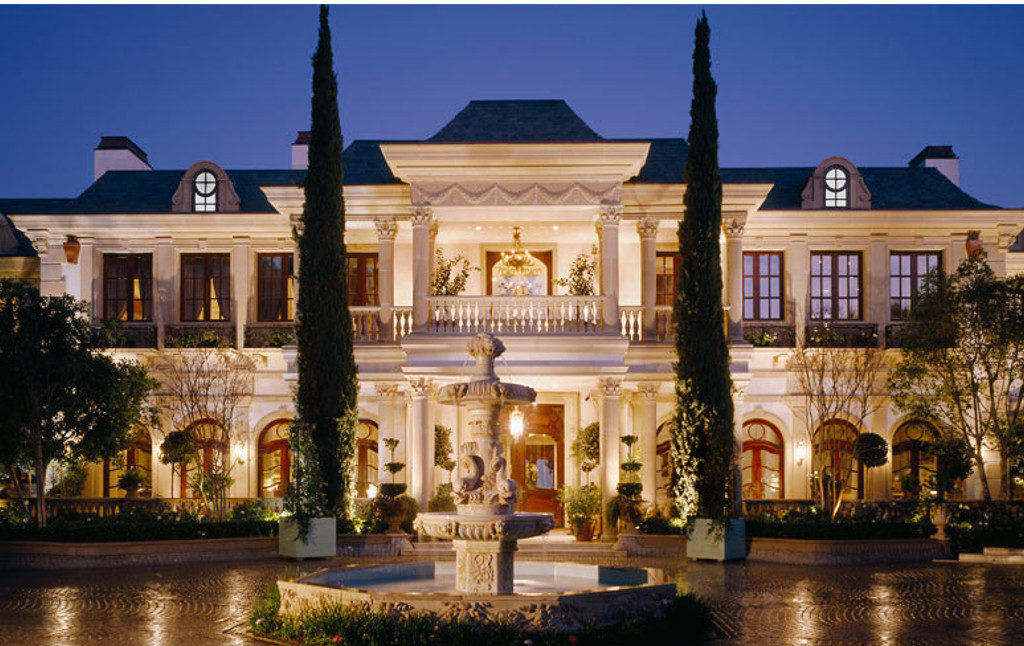
To take a U.S. example: white families in America have 16 times as much wealth on average as black families. This is indisputably because of slavery, which was very recent (there are people alive today who met people who were once slaves). Larry Ellison of Oracle could put his $55 billion in a fund that could be used to just give houses to black families, not quite as direct “reparations” but simply as a means of addressing the fact that the average white family has a house while the average black family does not. But instead of doing this, Larry Ellison bought the island of Lanai. (It’s kind of extraordinary that a single human being can just own the sixth-largest Hawaiian island, but that’s what concentrated wealth leads to.) Because every dollar you have is a dollar you’re not giving to somebody else, the decision to retain wealth is a decision to deprive others. 

Note that this is a slightly different point than the usual ones made about rich people. For example, it is sometimes claimed that CEOs get paid too much, or that the super-wealthy do not pay enough in taxes. My claim has nothing to do with either of these debates. You can hold my position and simultaneously believe that CEOs should get paid however much a company decides to pay them, and that taxes are a tyrannical form of legalized theft. What I am arguing about is not the question of how much people should be given, but the morality of their retaining it after it is given to them. 

Many times, defenses of the accumulation of great wealth depend on justifications for the initial acquisition of that wealth. The libertarian-ish philosopher Robert Nozick gave a well-known hypothetical that is used to challenge claims that wealthy people did not deserve their wealth: suppose millions of people enjoy watching Wilt Chamberlain play basketball. And suppose, Nozick wrote, that each of these people would happily give Wilt Chamberlain 25 cents for the privilege of watching him play basketball. And suppose that through the process of people paying Wilt Chamberlain, he ended up with millions of dollars, while each of his audience members had (willingly) sacrificed a quarter. Even though Wilt Chamberlain is now far richer than anyone else in the society, would anyone say that his acquisition of wealth was unjust? 

Libertarians use this example to rebut attempts to say that the rich do not deserve their wealth. After all, they say, the process by which those rich people attained their wealth is totally consensual. We’d have to be crazy Stalinists to believe that I shouldn’t have the right to pay you a quarter to watch you play basketball. Why, look at Mark Zuckerberg. Nobody has to use Facebook. He is rich because people like the product he came up with. Clearly, his wealth is the product of his own labor, and nobody should deprive him of it. People on the right often defend wealth along these lines. I earned it, therefore it’s not unfair for me to have it.

But there is a separate question that this defense ignores: regardless of whether you have earned it, to what degree are you morally permitted to retain it? The question of getting and the question of keeping are distinct. As a parallel: if I come into possession of an EpiPen, and I encounter a child experiencing a severe allergic reaction, the question of whether I am obligated to inject the child is distinguishable from the question of whether I obtained the pen legitimately. It’s important to be clear about these distinctions, because we might answer questions about systems differently than we answer questions about individual behavior. (“I don’t hate capitalism, I just hate rich people” is a perfectly legitimate and consistent perspective.) 

I therefore think there is a sort of deflection that goes on with defenses of wealth. If we find it appalling that there are so many rich people in a time of need, we are asked to consider questions of acquisition rather than questions of retention. The retention question, after all, is much harder for a wealthy person to answer. It’s one thing to argue that you got rich legitimately. It’s another to explain why you feel justified in spending your wealth upon houses and sculptures rather than helping some struggling people pay their rent or paying off a bunch of student loans or saving thousands of people from dying of malaria. There may be nothing unseemly about the process by which a basketball player earns his millions (we can debate this). But there’s certainly something unseemly about having those millions. 

One of the reasons wealthy people rarely have to defend their choices is that “shaming the rich” is not really compatible with any of the predominating political perspectives. People on the right obviously believe that having piles of wealth is fine. Centrist Democrats can’t attack rich people for being rich because they’re increasingly a party for rich people. And socialists (this is the interesting case) tend to believe that questions about the morality of having wealth are relatively unimportant, because they are far more interested in how the state divides up wealth than in what individuals choose to do with it. As G.A. Cohen points out in If You’re an Egalitarian, How Come You’re So Rich?, Marxists have been concerned with eliminating capitalism generally, which has kept them from thinking about questions of the justice of people’s personal choices. After all, if the problem of inequality is systemic, and rich people do not really make choices but pursue their class interests, then asking whether it is moral for wealthy people to retain their wealth is both irrelevant (because individual decisions don’t affect the systemic problem) and incoherent (because the idea of a moral or immoral capitalist makes no sense in the Marxist framework). In fact, there is a certain leftist argument that giving away wealth in the form of charity is actually bad, because it allows capitalism to look superficially generous without actually altering the balance of power in the society. “The worst slave owners were those who were kind to their slaves, because they prevented the core of the system from being realized by those who suffered from it,” as Oscar Wilde ludicrously put it. (In their book Blueprints for a Sparkling TomorrowNimni and Robinson parody this perspective by portraying two leftist academics who insist on being rude to servers in restaurants, on the grounds that being polite to them obscures the true brutality of class relations.)

But I think it is a mistake to avoid inquiring into the moral justifications for wealth. This is because I think individual decisions do matter, because if I am an extremely wealthy man I could be helping a lot of people who I am choosing not to help. And for those people, at least, it makes a difference when a billionaire decides to retain their wealth rather than rid themselves of it. 

Of course, when you start talking about whether it is moral to be rich, you end up heading down some difficult logical paths. If I am obligated to use my wealth to help people, am I not obligated to keep doing so until I am myself a pauper? Surely this obligation attaches to anyone who consumes luxuries they do not need, or who has some savings that they are not spending on malaria treatment for children. But the central point I want to make here is that the moral duty becomes greater the more wealth you have. If you end up with a $50,000 a year or $100,000 a year salary, we can debate what amount you should spend on helping other people. But if you earn $250,000 or 1 million, it’s quite clear that the bulk of your income should be given away. You can live very comfortably on $100,000 or so and have luxury and indulgence, so anything beyond is almost indisputably indefensible. And the super-rich, the infamous “millionaires and billionaires”, are constantly squandering resources that could be used to create wonderful and humane things. If you’re a billionaire, you could literally open a hospital and make it free. You could buy up a bunch of abandoned Baltimore rowhouses, do them up, and give them to families. You could help make sure no child ever had to go without lunch.

We can define something like a “maximum moral income” beyond which it’s obviously inexcusable not to give away all of your money. It might be 5o thousand. Call it 100, though. Per person. With an additional 50 allowed per child. This means two parents with a child can still earn $250,000! That’s so much money. And you can keep it. But everyone who earns anything beyond it is obligated to give the excess away in its entirety. The refusal to do so means intentionally allowing others to suffer, a statement which is true regardless of whether you “earned” or “deserved” the income you were originally given. (Personally, I think the maximum moral income is probably much lower, but let’s just set it here so that everyone can agree on it. I do tend to think that moral requirements should be attainable in practice, and a $30k threshold would actually require people experience some deprivation whereas a $100k threshold indisputably still leaves you with an incredibly comfortable lifestyle better than almost any other had by anyone in history.)

Of course, wealthy people do give away money, but so often in piecemeal and self-interested and foolish ways. They’ll donate to colleges with huge endowments to get needless buildings built and named after them. David Geffen will pay to open a school for the children of wealthy university faculty, and somehow be praised for it. Mark Zuckerberg will squander millions of dollars trying to fix Newark’s schools by hiring $1000-a-day-consultants. Brad Pitt will try to build homes for Katrina victims in New Orleans, but will insist that they’re architecturally cutting-edge and funky looking, instead of just trying to make as many simple houses as possible. Just as the rich can’t be trusted to spend their money well generally, they’re colossally terrible at giving it away. This is because so much is about self-aggrandizement, and “philanthropy” is far more about the donor than the donee. Furthermore, if you’re a multi-billionaire, giving away $1 billion is morally meaningless. If you’ve got $3 billion, and you give away 1, you’re still incredibly wealthy, and thus still harming many people through your retention of wealth. You have to get rid of all of it, beyond the maximum moral income. 

The central point, however, is this: it is not justifiable to retain vast wealth. This is because that wealth has the potential to help people who are suffering, and by not helping them you are letting them suffer. It does not make a difference whether you earned the vast wealth. The point is that you have it. And whether or not we should raise the tax rates, or cap CEO pay, or rearrange the economic system, we should all be able to acknowledge, before we discuss anything else, that it is immoral to be rich. That much is clear. 


Posted in Economics, inequality, philosophy | Tagged , , | 1 Comment

Two Very Different Republicans

Posted in Donald Trump, government, military, politics, Uncategorized, war | Tagged | Leave a comment

THE MOSQUE THAT DISAPPEARED

mosque_bombing

Civil defense team members and people try to rescue people who were trapped under the debris of a Mosque after an aerial attack on a mosque during prayer in the Cina village of Etarib district of Aleppo, Syria on March 16, 2017.  (Photo: İbrahim Ebu Leys/ Anadolu Agency )

By Robert C. Koehler/ Common Dreams/ March 21, 2017

We committed a quiet little war crime the other day. Forty-plus people are dead, taken out with hellfire missiles while they were praying.

Or maybe not. Maybe they were just insurgents. The women and children, if there were any, were . . . come on, you know the lingo, collateral damage. The Pentagon is going to “look into” allegations that what happened last March 16 in the village of al-Jinah in northern Syria was something more serious than a terrorist takeout operation, which, if you read the official commentary, seems like the geopolitical equivalent of rodent control.

The target was “assessed to be a meeting place for al-Qaeda, and we took the strike,” a spokesman for the U.S. Central Command explained. The strike involved two Reaper (as in Grim Reaper) drones and their payload of Hellfire missiles, plus a 500-pound bomb.

The target, at least according to human rights organizations and civilians on the ground, was a mosque during prayer hour.

“U.S. officials said the strikes . . . had killed ‘dozens’ of militants at a meeting of the terrorist group,” according to the Washington Post. “But local activists and a monitoring group reported that at least 46 people died, and more were trapped under rubble, when the attack struck a mosque during a religious gathering. . . . Photos from the area showed rescue workers pulling mangled bodies from a mound of rubble.”

One local resident told Agence France-Presse: “I saw 15 bodies and lots of body parts in the debris when I arrived. We couldn’t even recognize some of the bodies.”

“Global humanity, led by the United States of America, the planet’s primo superpower, is devolving into a state of perpetual war. It has caged itself into unending self-hatred.”

During the 30 seconds of attention the story garnered, the controversy was whether it was a mosque that was hit or a building across the street from a mosque. The Pentagon even declassified a photo of the bombing aftermath, showing that a small building near the ghastly bomb crater was still standing. However, according to The Intercept: “Activists and first responders say the building that was targeted was a part of the mosque complex — and that the charred rubble shown in the photo was where 300 people were praying when the bombs began to hit.”

Anyway, the news cycle moved on. My initial thought, as I read about the bombing, which was not described as a massacre or slaughter in the mainstream headlines, but remained an “incident,” is that the media have a default agreement on morality: Killing’s OK as long as it’s emotionless, coldly rational and strategic (even if mistakenly so). This is the American way. Coldly strategic murder can be reported in such a way that it fits into the global infrastructure of safety and the control of evil.

But killing is bad if there’s passion involved. Passion is easily linked to “extremism” and wrongthink. The man killed this month by police at Paris’ Orly Airport, for instance, had cried, “I am here to die for Allah — there will be deaths.”

This fits neatly into the moral certainty of the Western world. Compare this to military PR talk, also reported in The Intercept: “The area,” according to a U.S. Navy spokesperson, “was extensively surveilled prior to the strike in order to minimize civilian casualties.”

“The media have a default agreement on morality: Killing’s OK as long as it’s emotionless, coldly rational and strategic…”

In both cases, the perpetrators foresaw dead bodies left in the wake of their action. Nevertheless, the American military machine carefully avoided the public’s, or the media’s, moral disapproval. And geopolitics remains a game of good vs. evil: as morally complex as 10-year-old boys playing cowboys and Indians.

What I had not foreseen was how quickly the story would disappear from the news cycle. It simply couldn’t compete with the Trump cacophony of tweets and lies and whatever else passes for the news that America consumes. This adds a whole new dimension of media indifference to the actual cost of war, but I guess no nation could wage endless war if its official media made a big deal out of every mosque or hospital it (mistakenly) bombed, or put human faces on all its collateral damage.

I write this with sarcasm and irony, but what I feel is a troubled despair too deep to fathom. Global humanity, led by the United States of America, the planet’s primo superpower, is devolving into a state of perpetual war. It has caged itself into unending self-hatred.

“The way in which U.S. militarism is taken for granted,” Maya Schenwar writes at Truthout, “mirrors the ways in which other forms of mass violence are deemed inevitable — policing, deportation, the genocide and erasure of Indigenous peoples, the exploitative market-driven health care system, the vastly inequitable education system and disastrous environmental policies. The generally accepted logic tells us that these things will remain with us: The best we can hope for, according to this narrative, is modest reform amid monstrous violence.

“We have to choose,” she says, “life-giving priorities over violent ones. We have to stop granting legitimacy to all forms of state violence.”

Yes, yes, but how? The necessity of war has not been challenged at official levels of power in this country in more than four decades. The corporate media grants legitimacy to state violence more by what it doesn’t say than by what it does. Bombed mosques simply disappear from the news and, voila, they never happened. Liars had a global forum to promote the invasion of Iraq, while those who questioned it had to loose their outrage from street corners. “Collateral damage” is a linguistic blur, a magician’s cape, hiding mass murder.

And Donald Trump is under the control of the militarized far right as well as his own clueless immaturity. Of course his new budget, released, as Schenwar points out, on the anniversary of the My Lai Massacre, ups the military allotment by $54 billion and gouges social spending. As we protest and write letters to Congress and express our shock and awe at what is happening, let us keep in mind that Trump merely puts a face on America’s out-of-control militarism. He didn’t create it.

For the protests against his budget cuts to be effective, for the roiling turmoil to matter, a new country must be in formation.
 
Posted in foreign policy, government, Iraq, media, military, politics, Uncategorized | Tagged , , , , | 3 Comments

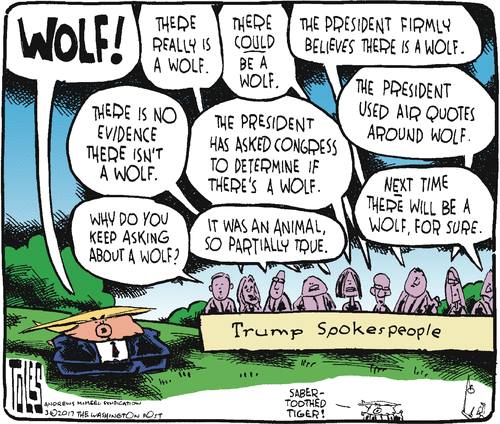
Crying Wolf

Trump

Posted in Donald Trump, government, politics, Uncategorized | Tagged , | Leave a comment

DEMOCRATIC PARTY UNPOPULAR

The Democratic Party seems to have no earthly idea why it is so damn unpopular 
By Shaun King/ NY Daily News/ March 9, 2017
Hillary Clinton is just slightly more unfavorable than her own party, according to a poll.
Shaun King

A troubling new poll was just released showing that the Democratic Party is significantly less popular than both Donald Trump and Mike Pence. My gut tells me that Democrats will ignore this poll, or blame it on bad polling, and continue down the same course they are currently on: being funded by lobbyists and the 1%, straddling the fence or outright ignoring many of most inspirational issues of the time, and blaming Bernie Sanders for why they aren’t in power right now.

As a general rule the Democratic Party doesn’t listen well and struggles to hear the truth about itself.

In case you’ve been living under a rock, Republicans now control the House, the Senate, the presidency, and the overwhelming majority of state legislatures and governorships. This new poll from Suffolk University illustrates just how that’s possible. Here are the base results of the poll with favorable/unfavorable ratings.

  • Pence: 47%/35%
  • Trump: 45%/47%
  • GOP: 37%/48%
  • Media: 37%/50%
  • Dem Party: 36%/52%
  • Hillary: 35%/55%
  • Congress: 26%/52%


Part of the reason why the Democratic Party is so reviled stems from leaked emails in which former DNC chair Debbie Wasserman-Schultz appeared to show favortism to Clinton over Bernie Sanders.

In other words, the Democratic Party has a favorability rating 11 points lower than Pence, nine points lower than Trump, and even one point lower than the GOP.


Their unfavorable rating is 17 points worse than Pence, five points worse than Trump, and four points worse than the GOP.

This is a disaster. At a time when Donald Trump is the least liked President ever measured at this point in his first term, the Democratic Party has found a way to be even less liked than him. This is how Donald Trump wins a second term. This is how congressional Republicans win the next midterm elections. This is how conservatives not only maintain their current power from coast to coast, but also expand it.

The Democratic Party is deeply unpopular – period. It’s a fact. Don’t look away. Don’t call me a Bernie Bro. It’s a problem that must be seriously addressed. Not a day goes by when I don’t have people reach out to me and ask if it would be worth it to start a credible alternative to what the Democrats are offering. Most people, I believe, would also be open to a brand new way of business for the Democratic Party, but core leaders seem hell bent on doing the same old crap.

When good people who are frustrated with the Democratic Party express their genuine concerns, I see them being told to shut up and unify. “Now is not the time for public complaints,” they are told. “We must all work together.”

But what this apparently means to the people who are calling for unity is getting behind the corporate, suit and tie, lobbyist-driven agenda of the establishment. But let me break it to you – the establishment has almost no grassroots momentum. Virtually every progressive grassroots movement in America right now is fueled by people outside of the Democratic Party establishment and this is a huge reason why the party is so outrageously unpopular.

Huge grassroots movements, made up of millions and millions of people, are fueling the fight for a $15 minimum wage, fighting back against fossil fuels and the Dakota Access Pipeline, fighting to end fracking, fighting to remove lobbyist money from politics, fighting to end senseless wars and international violence, fighting for universal healthcare, fighting for the legalization of marijuana, fighting for free college tuition, fighting against systems of mass incarceration, and so much more. But mainstream Democrats aren’t really a central part of any of those battles, and, to be clear, each of those issues have deep networks, energized volunteers, and serious donors, but corporate Democrats virtually ignore them.

In the past two months, I’ve spoken in a dozen states around the country and thousands of people show up. Wednesday night, in the freezing rain, lines were wrapped around multiple city blocks to attend an event I was hosting at a local Seattle high school. We literally formed the event a few days ago on Facebook and didn’t spend a single penny putting it together.

When I see these crowds, I don’t see them and think “Wow, I’m so popular.” I see them and think “Wow, people are hungry for change, and insight, and direction.” When I see those crowds, those polls showing how outrageously unpopular the Democratic Party is frustrate me even more. It just doesn’t have to be this way.

People show up in huge numbers for my events, or Bernie’s events, or for events put on by the organizers of the Women’s March, not just because we all want to stop Donald Trump. That’s a gross oversimplification of who we are and what we stand for. People are showing up, by the thousands, by tens and hundreds of thousands, because we have many of the very same beliefs, and passions, and preferences for how America can improve and be a better place for all of us.


JUNE 16, 2016 FILE PHOTO
The more progressive Rep. Keith Ellison (D-Minn.) narrowly lost the vote to become DNC chair, but he was crowned deputy chair by Perez.

The Democratic Party is not a fiery Barack Obama speech away from being popular. He may be beloved and mobs of screaming fans may follow him all over the country, but the party he represents simply doesn’t have that same type of support. And they won’t if they don’t do some serious soul searching about who and what they truly stand for.

Recently, I’ve asked the crowds where I am speaking two key questions about the Democratic Party. The response that I get is always the same – mass laughter or audible frustration.

The first question is, “If I asked you, in just a few sentences, to sum up what specific policies the Democratic Party stands for, what would you say?”

People have no genuine idea. They know some things the party stands against, but it’s genuinely hard to be sure of what they stand for.

The other question is, “What exactly is the strategy of the Democratic Party to take back the government from conservatives across the country?”

That one always gets the most laughs. Nobody has any idea. Not once has somebody stood up and said, “Hey, I know the strategy.” Hell, I don’t know it. I don’t think one exists. Whatever the strategy was this past election, it didn’t work either. And again, I don’t just mean in the presidential election. Democrats lost all over the place in national, state, and local elections.

Losing is hard. It sucks. I hate losing. But this much I know – if the Democratic Party does not come to grips with why it is so wildly unpopular, many more losses will be on the horizon.

Posted in Democratic Party, politics, Uncategorized | Tagged , , , , , , | 2 Comments

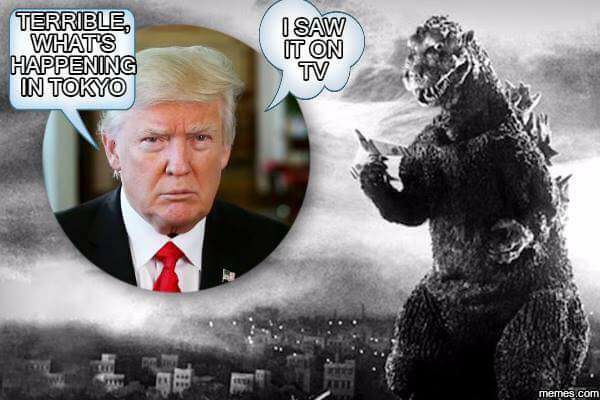
It’s Gotta Be True

godzilla

Posted in Donald Trump, media, Uncategorized | Leave a comment

For President’s Day

presidents

Posted in Donald Trump, government, history, politics | Tagged , | 2 Comments

Unless It Changes, Capitalism Will Starve Humanity By 2050

By Drew Hansen/ Forbes/ February 9, 2017

Capitalism has generated massive wealth for some, but it’s devastated the planet and has failed to improve human well-being at scale.

• Species are going extinct at a rate 1,000 times faster than that of the natural rate over the previous 65 million years (see Center for Health and the Global Environment at Harvard Medical School).

• Since 2000, 6 million hectares of primary forest have been lost each year. That’s 14,826,322 acres, or just less than the entire state of West Virginia (see the 2010 assessment by the Food and Agricultural Organization of the UN).

• Even in the U.S., 15% of the population lives below the poverty line. For children under the age of 18, that number increases to 20% (see U.S. Census).

• The world’s population is expected to reach 10 billion by 2050 (see United Nations’ projections).

How do we expect to feed that many people while we exhaust the resources that remain?

Human activities are behind the extinction crisis. Commercial agriculture, timber extraction, and infrastructure development are causing habitat loss and our reliance on fossil fuels is a major contributor to climate change.

Public corporations are responding to consumer demand and pressure from Wall Street. Professors Christopher Wright and Daniel Nyberg published Climate Change, Capitalism and Corporations last fall, arguing that businesses are locked in a cycle of exploiting the world’s resources in ever more creative ways.

“Our book shows how large corporations are able to continue engaging in increasingly environmentally exploitative behaviour by obscuring the link between endless economic growth and worsening environmental destruction,” they wrote.

Yale sociologist Justin Farrell studied 20 years of corporate funding and found that “corporations have used their wealth to amplify contrarian views [of climate change] and create an impression of greater scientific uncertainty than actually exists.”

Corporate capitalism is committed to the relentless pursuit of growth, even if it ravages the planet and threatens human health.

We need to build a new system: one that will balance economic growth with sustainability and human flourishing.

A new generation of companies are showing the way forward. They’re infusing capitalism with fresh ideas, specifically in regards to employee ownership and agile management.

The Increasing Importance Of Distributed Ownership And Governance

Fund managers at global financial institutions own the majority (70%) of the public stock exchange. These absent owners have no stake in the communities in which the companies operate. Furthermore, management-controlled equity is concentrated in the hands of a select few: the CEO and other senior executives.

On the other hand, startups have been willing to distribute equity to employees. Sometimes such equity distribution is done to make up for less than competitive salaries, but more often it’s offered as a financial incentive to motivate employees toward building a successful company.

According to The Economist, today’s startups are keen to incentivize via shared ownership: 

The central difference lies in ownership: whereas nobody is sure who owns public companies, startups go to great lengths to define who owns what. Early in a company’s life, the founders and first recruits own a majority stake—and they incentivise people with ownership stakes or performance-related rewards. That has always been true for startups, but today the rights and responsibilities are meticulously defined in contracts drawn up by lawyers. This aligns interests and creates a culture of hard work and camaraderie. Because they are private rather than public, they measure how they are doing using performance indicators (such as how many products they have produced) rather than elaborate accounting standards.

This trend hearkens back to cooperatives where employees collectively owned the enterprise and participated in management decisions through their voting rights. Mondragon is the oft-cited example of a successful, modern worker cooperative. Mondragon’s broad-based employee ownership is not the same as an Employee Stock Ownership Plan. With ownership comes a say – control – over the business. Their workers elect management, and management is responsible to the employees.

REI is a consumer cooperative that drew attention this past year when it opted out of Black Friday sales, encouraging its employees and customers to spend the day outside instead of shopping.

I suspect that the most successful companies under this emerging form of capitalism will have less concentrated, more egalitarian ownership structures. They will benefit not only financially but also communally.

Joint Ownership Will Lead To Collaborative Management

The hierarchical organization of modern corporations will give way to networks or communities that make collaboration paramount. Many options for more fluid, agile management structures could take hold.

For instance, newer companies are experimenting with alternative management models that seek to empower employees more than a traditional hierarchy typically does. Of these newer approaches, holacracy is the most widely known. It promises to bring structure and discipline to a peer-to-peer workplace.

Holacracy “is a new way of running an organization that removes power from a management hierarchy and distributes it across clear roles, which can then be executed autonomously, without a micromanaging boss.”

Companies like Zappos and Medium are in varying stages of implementing the management system.

Valve Software in Seattle goes even further, allowing employees to select which projects they want to work on. Employees then move their desks to the most conducive office area for collaborating with the project team.

These are small steps toward a system that values the employee more than what the employee can produce. By giving employees a greater say in decision-making, corporations will make choices that ensure the future of the planet and its inhabitants.


Posted in Economics, environment | Tagged , , , | 1 Comment

Will Trump Step Down?

By Arlen Grossman

trump-2

President Donald Trump will soon resign, possibly in a matter of weeks. I don’t know any more than anyone else, and maybe it’s just wishful thinking, but that’s the feeling I have.

The drip, drip, drip of troubling revelations reminds me very much of Richard Nixon and the Watergate scandal that forced the President to resign. Trump is even more unpopular than Nixon, so if it can be proven that his campaign colluded with the Russian government to sabotage the 2016 election, which seems more and more likely, the President will be in more than a heap of trouble.

Now it is true that Trump lives beyond the reality-based world, and can often position himself in a dense cloud of denial.  But we also know that he is a fanatical consumer of news media, and if developments point in the direction of a serious scandal, he may not be able to stand up to it.

We all know he does not tolerate criticism well, and a constant stream of it might just be more than he can stomach. He can’t be enjoying the media assault and the lousy poll numbers. Even Republicans in Congress can see the handwriting on the wall and may be compelled to call for an independent investigation. Trump may be asking himself, “Is this what I signed up for? Is it worth it?”

If the evidence points to a potential for impeachment, or completely destroys his credibility–what’s left of it–he may not want to continue spinning his wheels and pumping up his alternative reality. Trump can’t be having much fun, with a constant barrage of negative press and continuous damaging reports. He spent his whole life in business being fawned over, with people close to him pumping up his fragile ego. Now he’s up against a constant barrage of negative press. Can he handle this much intense pressure? He must have a breaking point, and it may come sooner than later.

It is quite possible that he will be out of office within weeks.Recent revelations combined with Trump’s narcsissistic and tenuous personality may be too much for him to deal with. I think he would rather step down and blame the press and other “enemies” than be impeached or forced to resign. 

We may be seeing a President Pence sooner than we would have thought possible.


Published in OpEd News February 17, 2016

Posted in Donald Trump, government, politics, scandals | Tagged , | 1 Comment

We Must Know the Truth

This is the worst scandal involving the White House and a foreign power since Iran-Contra. Demand the facts.

US President-elect Donald Trump (L) stands with Trump National Security Adviser Lt. General Michael Flynn (R) at Mar-a-Lago in Palm Beach, Florida, where he is holding meetings on December 21, 2016. (Jim Watson/AFP/Getty Images)

We’ve said it before and we’ll say it again: there MUST be an investigation by an independent, bipartisan commission of Russia’s ties to Donald Trump and his associates and that nation’s interference in our elections. Emphasize independent and bipartisan. That commission must have full subpoena power to call witnesses and make them testify under oath or risk prosecution. Hearings must be held out in the open, and televised live for the nation and the world to see. That’s what a democracy is all about.

The resignation of national security advisor Michael Flynn makes such an inquiry even more imperative. On Friday, winging his way to Mar-a-Lago on Air Force One, Trump told the press he knew nothing about the previous night’s Washington Post report that Flynn had secretly discussed lifting sanctions against Russia with Russia’s ambassador to the United States. But on Tuesday, press secretary Sean Spicer told reporters that Trump had known about Flynn’s phone calls – and his lies about it – weeks ago.

Why was nothing done until the media broke the story? And why did Trump lie? As the National Lampoon joked back during the Watergate era, rephrasing the crucial questions aimed at Richard Nixon: “What did the president know and when did he STOP knowing it?”

Is it possible Trump and Flynn had been talking all along and keeping it to themselves? Who authorized Flynn to speak with the Russian ambassador on Trump’s behalf in the first place? The president himself or chief strategist Steve Bannon? Or someone else? Was Flynn a lone gun? Who can tell with all the lies?

And another thing: if the White House has known what was going on for weeks, why was Flynn still attending intelligence briefings as late as Monday? That’s what White House resident spin doctor Kellyanne Conway told the Today’s show Matt Lauer on Tuesday. Otherwise,  Conway – who shortly before his resignation told the press that Flynn still had Trump’s confidence – was her usual duplicitous self.  Why the media keep turning to her for answers no one can trust is yet another indignity inflicted on the American public in this unfolding saga.

There is nothing as dangerous to democracy – with its need for checks and balances of power to protect the integrity of our system – as one-party rule. 

And where are the Republican patriots willing to come forward and place country and democracy over party and a venal lust for power? Other than John McCain, they’ve been mum or simply said ta-ta and thanked Flynn for his service. Late Tuesday, Senator Majority Leader Mitch McConnell said it’s “highly likely” the Senate intelligence committee will investigate Flynn’s discussions with the Russian ambassador, but does anyone really think a Republican-dominated inquiry, with strings pulled back stage by McConnell, will dig for the truth and let the facts fall where they will?

Jason Chaffetz, chair of the House Oversight Committee, says he won’t investigate the Flynn affair – “I think that situation has taken care of itself.” How about that for respecting the public’s need to know?  And Rep. Chris Collins of upstate New York, the man with the dubious distinction of being the first member of Congress to endorse Trump’s candidacy, told CNN’s Chris Cuomo on Tuesday morning, “I think it’s just time to move on.” When asked why so many of his GOP colleagues were silent he suggested, “Well, [it’s] Valentine’s Day, and I guess they’re having breakfasts with their wives.”

Takes your breath away, doesn’t it?

There is nothing as dangerous to democracy – with its need for checks and balances of power to protect the integrity of our system – as one-party rule.  Unless there are responsible Republicans who will break ranks and join the Democrats in calling for an independent and bipartisan joint commission to investigate these astonishing developments in a fair and impartial way – with televised hearings – one of the greatest, perhaps the greatest, assaults on democracy in our 240-year history will go unpunished except for a few culprits like Flynn.

Americans must know whether the candidate of one party worked with a foreign power to influence the election against his opponent.

We repeat: This noxious scandal requires an open, independentbipartisan investigation with public hearings. Now. No patriot can settle for anything less.


Posted in Donald Trump, government, politics, Russia, scandals | Tagged , , , , | Leave a comment