Clueless About Coronavirus

The Strongest Evidence Yet That America Is Botching Coronavirus Testing

By Robinson Meyer and Alexis C. Madrigal/ The Atlantic/ March 6, 2020

It’s one of the most urgent questions in the United States right now: How many people have actually been tested for the coronavirus?

This number would give a sense of how widespread the disease is, and how forceful a response to it the United States is mustering. But for days, the Centers for Disease Control and Prevention has refused to publish such a count, despite public anxiety and criticism from Congress. On Monday, Stephen Hahn, the commissioner of the Food and Drug Administration, estimated that “by the end of this week, close to a million tests will be able to be performed” in the United States. On Wednesday, Vice President Mike Pence promised that “roughly 1.5 million tests” would be available this week.

But the number of tests performed across the country has fallen far short of those projections, despite extraordinarily high demand, The Atlantic has found.

[Read: You’re likely to get the coronavirus]

“The CDC got this right with H1N1 and Zika, and produced huge quantities of test kits that went around the country,” Thomas Frieden, the director of the CDC from 2009 to 2017, told us. “I don’t know what went wrong this time.”

Through interviews with dozens of public-health officials and a survey of local data from across the country, The Atlantic could only verify that 1,895 people have been tested for the coronavirus in the United States, about 10 percent of whom have tested positive. And while the American capacity to test for the coronavirus has ramped up significantly over the past few days, local officials can still test only several thousand people a day, not the tens or hundreds of thousands indicated by the White House’s promises.

To arrive at our estimate, we contacted the public-health departments of all 50 states and the District of Columbia. We gathered data on websites, and we corresponded with dozens of state officials. All 50 states and D.C. have made some information available, though the quality and timeliness of the data varied widely. Some states have only committed to releasing their numbers once or three times a week. Most are focused on the number of confirmed cases; only a few have publicized the number of people they are capable of testing.

[Read: The official coronavirus numbers are wrong, and everyone knows it]

The Atlantic’s numbers reflect the best available portrait of the country’s testing capacity as of early this morning. These numbers provide an accurate baseline, but they are incomplete. Scattered on state websites, the data available are not useful to citizens or political leaders. State-based tallies lack the reliability of the CDC’s traditional—but now abandoned—method of reporting. Several states—including New Jersey, Texas, and Louisiana—have not shared the number of coronavirus tests they have conducted overall, meaning their number of positive results lacks crucial context.

The net effect of these choices is that the country’s true capacity for testing has not been made clear to its residents. This level of obfuscation is unexpected in the United States, which has long been a global leader in public-health transparency.

The figures we gathered suggest that the American response to the coronavirus and the disease it causes, COVID-19, has been shockingly sluggish, especially compared with that of other developed countries. The CDC confirmed eight days ago that the virus was in community transmission in the United States—that it was infecting Americans who had neither traveled abroad nor were in contact with others who had. In South Korea, more than 66,650 people were tested within a week of its first case of community transmission, and it quickly became able to test 10,000 people a day. The United Kingdom, which has only 115 positive cases, has so far tested 18,083 people for the virus.

Normally, the job of gathering these types of data in the U.S. would be left to epidemiologists at the CDC. The agency regularly collects and publishes positive and negative test results for several pathogens, including multiple types of the seasonal flu. But earlier this week, the agency announced that it would stop publishing negative results for the coronavirus, an extraordinary step that essentially keeps Americans from knowing how many people have been tested overall.

[Read: What you can do right now about the coronavirus]

“With more and more testing done at states, these numbers would not be representative of the testing being done nationally,” Nancy Messonnier, the chief CDC official for respiratory diseases, said at the time. “States are reporting results quickly, and in the event of a discrepancy between CDC and state case counts, the state case counts should always be considered more up to date.”

Then, last night, the CDC resumed reporting the number of tests that the agency itself has completed, but did not include testing by state public-health departments or other laboratories. Asked to respond to our own tally and reporting, the CDC directed us to Messonnier’s statement from Tuesday.

Our reporting found that disorder has followed the CDC’s decision not to publish state data. Messonnier’s statement itself implies that, as highly populous states like California increase their own testing, the number of people the CDC reports as having been tested and the actual number of people tested will become ever more divergent. The federal tally of positive cases is now also badly out of date: While the CDC is reporting 99 positive cases of the coronavirus in the United States, our data, and separate data from Johns Hopkins University, show that the true number is well above 200, including those on the Diamond Princess cruise ship.

The White House declined to comment.

The haphazard debut of the tests—and the ensuing absence of widespread data about the epidemic—has hamstrung doctors, politicians, and public-health officials as they try to act prudently during the most important week for the epidemic in the United States so far.

Our reporting found that the capacity to test for the coronavirus varies dramatically—and sometimes dangerously—from state to state.

California claims the highest testing capacity of any state, and has tested the most individuals so far. As of yesterday afternoon, it had tested 516 people, with 53 positive cases, a spokesperson for the Department of Health told us. The department now has the capacity to test 6,000 people every day, and it expects that capacity to expand to 7,400 people a day starting today, the spokesperson said.

Washington State, the site of the country’s largest outbreak thus far, can test roughly 1,000 people a day. The state health department’s laboratory can test 100 people a day; the rest of the testing is being done at the University of Washington’s Virology Lab. Officials have found 70 positive cases in Washington so far, though a genetic study has estimated that there may be hundreds of untested people who have COVID-19 in the greater Seattle area.

[Read: The problem with telling sick workers to stay home]

Oregon, situated between the California and Washington hot spots, can test only about 40 people a day. Texas has 16 positive cases, according to media reports, but the health department’s website still lists only three cases. The Texas Tribune has reported that the state can test approximately 30 people a day.

Other states can test even fewer. Hawaii can test fewer than 20 people a day, though it could double that number in an emergency, an official told us. Iowa has supplies to test about 500 patients a day. Arkansas, though not near a current known outbreak, is able to test only four or five patients a day.

On the East Coast, testing capacity varies significantly. New York State has 22 positive cases, including several cases of community transmission in Manhattan and Brooklyn. It can test 100 to 200 people a day. Neighboring New Jersey and Connecticut have not shared any information about how many tests they have run, or about their daily testing capacity.

Pennsylvania can test only about a dozen people a day, and Delaware can test about 50 people, our survey found. An official in Massachusetts, where two of 20 tests have come back positive, said that she did not know the Bay State’s daily capacity, but that its health department “currently [has] an adequate supply of test kits.”

[Read: The gig economy has never been tested by a pandemic]

These data come with an important caveat. Currently, most labs require two specimens to test one person. Single-specimen testing capability is being developed, but right now the top-line number of available tests should be cut in half. In other words, “1.5 million tests” should be able to test roughly 750,000 people. Some states, such as Colorado, told us how many specimens they could test a day (160), not how many patients (about 80). Other states shared the number of patients they could test, but not the number of specimens. In this story, we’ve standardized these numbers by dividing any specimen figure by two to give an estimate of the number of patients who can be tested.

Our reporting found that three factors determine the number of people who are tested for the coronavirus.

The first factor is the availability of tests. Until recently, very few physical tests were available, because of a mistake that the CDC made with a crucial component. The White House has pushed for and highlighted a massive increase in available tests, to perhaps 1 million in the next week. But labs have to be trained on how to set up and execute the relatively complex procedure.
corona

The second factor is that the CDC sets the parameters for state and local public-health staff regarding who should be tested. The agency’s guidelines were very strict for weeks, focusing on returning international travelers. Even as they have been loosened in the past few days, there are persistent reports that people—including a sick nurse who had cared for a coronavirus patient—have not been able to get tested.

Finally, the more people who contract the illness, the greater the demand for testing. Some weeks ago, the number of cases in the United States was probably much, much smaller than today. The upshot is that there is likely to be an explosion of Americans tested for the coronavirus in the next week, led by California and Washington, each of which has a substantial number of cases and has shown signs that the virus is spreading.

[Read: The coronavirus is a truly modern epidemic]

Even in an emergency, laboratories cannot be spun up immediately. The University of Washington, which appears to have the country’s largest testing capacity outside of California—it can test up to 1,000 people a day—has been working on its own coronavirus test for several weeks.

A week ago, the FDA eased some regulations on the types of coronavirus tests that can be used. This means that testing capacity will increase, but not overnight.

It has not always been so challenging to get estimates of the number of Americans tested. Throughout February, the CDC published a regular tally of Americans who had been tested for the pathogen. Last Saturday, several days after the country’s first case of community transmission was confirmed, that figure was 472.

Then the agency stopped updating the tally. It did not publish new numbers of how many Americans had been tested for the virus on Sunday or Monday, as public criticism of the sluggish response to the disease began to mount. On Tuesday, it announced that it would stop publishing the figure altogether.

Our reporting has found that the CDC has not made good on Messonnier’s assurance that state numbers would be available and up to date. Many states are not reporting their results quickly: In our survey, we found that in some states, the most recently available numbers were days old.

Since the CDC’s pullback, it has become extremely difficult to track the nation’s growing capacity to test for the coronavirus.

There are material reasons for this. At first, the CDC did all the testing, so its results were easy to report. But as the outbreak grew, state public-health laboratories were brought into action. Each of them can do only so many tests, however, so university research laboratories have now joined the effort. Soon private laboratories such as LabCorp and Quest Diagnostics will begin testing people too. Both companies announced yesterday that doctors can now order tests. Still, no one is quite sure precisely when this new testing capability will start delivering results at scale.*

The more entities involved, the more complex the data-gathering effort grows. State public-health departments should be tracking tests from university labs and eventually private labs, but in this time of crisis, they may not have the capacity to gather those data. For example, a Washington public-health official told us that the state could test up to 100 people, but as noted, the University of Washington has far higher throughput. That suggests a positive implication of our reporting: more capacity nationwide than our, or any, data reflect.

[Read: Here’s who should be avoiding crowds right now]

As more laboratories join in the effort, quality control will become more difficult. While each lab must have the FDA’s permission to operate, under an Emergency Use Authorization, a new FDA policy allows labs to immediately begin testing people, and requires that they submit their paperwork to the agency within the next 15 days.

These types of measures are necessary because the United States’ response to the coronavirus is far behind the spread of the disease within its borders. Testing is the first and most important tool in understanding the epidemiology of a disease outbreak. In the United States, a series of failures has combined with the decentralized nature of our health-care system to handicap the nation’s ability to see the severity of the outbreak in hard numbers.

Today, more than a week after the country’s first case of community transmission, the most significant finding about the coronavirus’s spread in the United States has come from an independent genetic study, not from field data collected by the government. And no state or city has banned large gatherings or implemented the type of aggressive “social distancing” policies employed to battle the virus in Italy, Hong Kong, and other affluent places.

If the true extent of the outbreak were known through testing, the American situation would look worse. But health-care officials and providers would be better positioned to combat the virus. Hard decisions require data. For now, state and local governments don’t have the information they need.

* This story has been updated with new information about testing capabilities at LabCorp and Quest Diagnostics.
Posted in America, Donald Trump, government, health | Tagged , , , , , , | 3 Comments

What Democracy?

Moving on from the expectation that we have a democracy

By Josh Mitteldorf/ OpEd News/ March 3, 2020

They’re not going to let Bernie anywhere near the White House, and the sooner we stop fretting about it, the sooner we can begin to refocus on the kinds of education and organizing that need to be done. These are not about Sanders, and they’re not about any candidate. They’re about the structure of the system that has been captured by Capitalist thugs.

From 1961 to 1963, there was an epic struggle behind the scenes in Washington, whether the elected government or the Deep State was the final authority. In 1961, with the Bay of Pigs fiasco and Kennedy’s dismissal of CIA Director Allen Dulles, it looked as though the elected government had won. 2-1/2 years later in Dallas, there was a different outcome, and the victors have been solidifying their control ever since.

Yes, the Deep State was able to get rid of JFK because he wouldn’t tolerate the regime change wars that had become the main occupation of our CIA and DoD, because he wanted to curb the Fed’s power to profit from control over our sovereign currency, and because his brother was cracking down on the Mafia. Three powerful enemies combined to murder him.

But the assassination was extremely costly and very risky. It very nearly failed. Two thousand people were murdered in the wake of JFKjust to keep the lid on, and 50 years later, the vast majority of Americans still don’t buy the flimsy story about Oswald and Ruby.

Why was JFK able to ascend to the presidency, from which they were compelled to assassinate him? (1) In 1963, the Democratic party was a three-ring circus, a decentralized free-for-all, out of control. (2) The voting system was by hand-counted paper ballot in almost a million different locations around the country. (3) And the press, too, was decentralized, with competing newspapers serving every major metropolis, and networks of TV and radio independent of one another and of the print media.

In the intervening years, the Deep State has worked it out so they don’t have to kill presidents any more.

(1) The Republican party has been pushed from the realm of Eisenhower and Rockefeller and Ed Brooke into never-neverland. The Democratic party has been re-positioned where the Republican party used to be. Yes, Democratic is the new Republican. “Mainstream” Democrats today are positioned to the right of where Nixon was in 1970. And the (former majority) FDR Democrats have been deprived of a home.

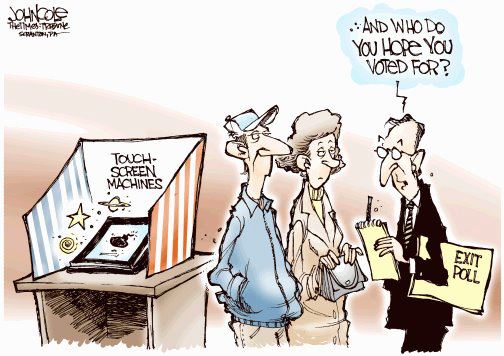
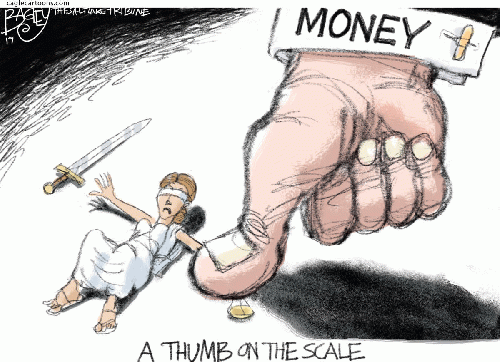
(2) The voting system has been centralized with electronic machines, so the count can be manipulated by a few insiders with rudimentary programming skills, like Mike Connell.

(3) The press has been consolidated and taken over from the outside by corporate advertisers, from the inside by CIA plants in all the news organs that we used to think of as “liberal”. (Douglas Valentine is another good source.)


(Image by Pat Bagley)   


The only thing they don’t control is the Internet. They’re well aware of this, and doing everything they can to promote Internet censorship, using “fake news” as a pretext. They’re working both through FCC regulation and also through the private monopolies of Facebook, Google, Amazon and Apple.

So, where does this leave us? It leaves us fighting for our lives to save net neutrality and to cast off censorship. It leaves us face-to-face organizing and educating, getting people out into the streets to feel our strength in numbers and make an impression that doesn’t depend on those who control spigots of the newsfeed.

We are not without resource. We are not without hope. But the first step is to shed our faith that anything like “democracy” is operational in America.

Rise, like lions after slumber
In unvanquishable number!
Shake your chains to earth, like dew
Which in sleep had fallen on you:
Ye are many-they are few!

Percy Bysshe Shelley wrote these words 200 years ago. We’ve been slumbering a long while.

Josh Mitteldorf, a senior editor at OpEdNews, blogs on aging at http://JoshMitteldorf.ScienceBlog.com. Read how to stay young at http://AgingAdvice.org.

Posted in America, democracy, Democratic Party, government, politics | Tagged , , , | Leave a comment

Change is Coming

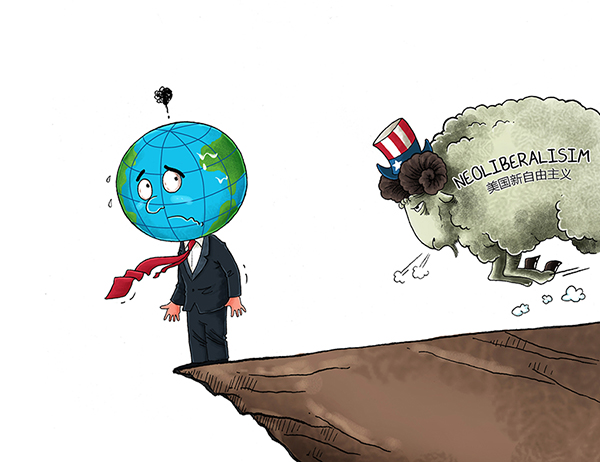
Neoliberalism Has Radicalized a Whole Generation

By Conor Lynch/ Truthdig/ February 26, 2020

When the conversation veered toward “capitalism” and “socialism” at last week’s Democratic presidential debate in Las Vegas, the preeminent capitalist on the stage, Michael Bloomberg, could hardly believe what he was hearing. “I can’t think of a way that would make it easier for Donald Trump to get reelected than listening to this conversation,” lamented billionaire Bloomberg, who pronounced the discussion ridiculous. “We’re not going to throw out capitalism,” he said. “We tried that. Other countries tried that. It was called communism, and it just didn’t work.”

Ten, or even five, years ago, Bloomberg’s concern would have probably seemed justified. In the recent past, having a serious discussion about the benefits of socialism versus capitalism on American national television — and at a major presidential debate, no less — appeared almost inconceivable. For as long as many Americans have been alive, capitalism has been widely considered the natural order of things. Questioning its existence seemed not only wrong but woefully naive and dangerous.

Since the Cold War began in the mid-20th century, the United States has been viewed as the center of the capitalist world. After the collapse of the Soviet Union, capitalism seemed to have triumphed once and for all, ending the historical struggle between the competing ideologies that characterized modernity (hence the notion of the “end of history”). There was no more questioning capitalism, which had proved to be the economic system that corresponded most with human nature. (At least that’s what orthodox economists, who subscribed to the homo economicus, or “economic man,” model of human nature, told us.)

In his 2009 book, “Capitalist Realism,” the late author Mark Fisher described a certain pessimistic attitude on the left, captured by the popular saying: “It is easier to imagine the end of the world than to imagine the end of capitalism.” Capitalist realism, Fisher wrote, was the “widespread sense that not only is capitalism the only viable political and economic system, but also that it is now impossible even to imagine a coherent alternative to it.”

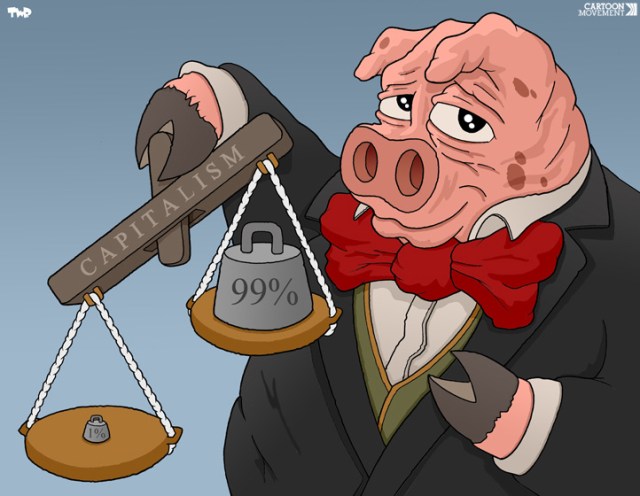
capitalism


In the decade-plus since Fisher wrote these words, a great deal has changed. Though it is still hard to imagine the end of capitalism, it is no longer universally accepted that capitalism is simply part of the “natural” order, or that there is “no alternative” (as the United Kingdom’s former prime minister, Margaret Thatcher, famously proclaimed). The armor of neoliberalism was first pierced by the global financial crisis, and the rise of populist movements on both the left and right in the years since have further eroded the political and intellectual hegemony of the all-encompassing worldview.

Neoliberalism wasn’t even acknowledged as an actual ideology until fairly recently. In fact, many neoliberals continue to deny its very existence. As scholar Adam Kotsko notes in his book, “Neoliberalism’s Demons,” neoliberalism “loves to hide” and its “very invisibility is a measure of its power.” Neoliberalism, according to Kotsko, is more than just a set of economic policies that have been implemented throughout the world in the last half-century. Rather, it “aspires to be a complete way of life and a holistic worldview, in a way that previous models of capitalism did not.” For this reason, Kotsko describes neoliberalism not just as an ideology but as a form of “political theology.”

In neoliberalism, Kotsko remarks,

an account of human nature where economic competition is the highest value leads to a political theology where the prime duty of the state is to enable, and indeed mandate, such competition, and the result is a world wherein individuals, firms, and states are all continually constrained to express themselves via economic competition. This means that neoliberalism tends to create a world in which neoliberalism is ‘true.’

The very fact that we are now discussing neoliberalism, Kotsko writes, is a “sign that its planetary sway is growing less secure.” As the “planetary sway” of neoliberalism has weakened over the past decade, more and more people — especially young people who were born and raised in the neoliberal era — have started to question a system that has left their generation drowning in debt, burned out and mentally exhausted, and stuck in an endless loop of precarious uncertainty.

Neoliberal ideas, political scientist Lester Spence writes, “radically change what it means to be human, as the perfect human being now becomes an entrepreneur of his own human capital, responsible for his personal development.” Young people entering the workforce today are expected to cheerfully embrace their own alienation and the commodification of their whole existence. Under neoliberalism, citizens become producers/consumers who are “free” to participate in the market economy but not necessarily free to engage in political protest or to form unions.

Neoliberalism is the opposite of solidarity. It encourages an extreme form of selfish individualism that ends up depoliticizing the populace and eroding the collective spirit of democracy. It also leaves the individual isolated and alone. “In a brutal, competitive, and atomized society, psychic well-being is so difficult that success on this front can feel like a significant accomplishment,” observes political theorist Jodi Dean. “Trying to do it themselves, people are immiserated and proletarianized and confront this immiseration and proletarianization alone.”

Considering the hellish reality that it has created for so many people, the backlash against neoliberalism was as predictable as it was inevitable. In a real sense, neoliberalism has radicalized an entire generation, pushing many young people to revolt against the existing order as a whole. The fact that the Democratic Party’s likely presidential nominee (especially after his landslide victory in Nevada) is self-professed democratic socialist Bernie Sanders tells us that the secular religion of neoliberalism has quickly lost all credibility and authority.

During the Cold War, under the threat of communism, America and other capitalist countries in the West embraced social democratic reforms that played an essential role in curbing the more extreme contradictions of capitalism. This led to a less brutal and unequal system, and therefore a more stable one. When communism fell in the late 20th century, the neoliberal age was already in full swing, with both parties uniting to reverse many of the progressive reforms that had been enacted after the Great Depression. Now, after 40 years of neoliberalism, the worst contradictions have returned, and unsurprisingly, mass movements opposing the current system also have returned.

When Bloomberg’s tenure as mayor of New York City came to an end in 2013, a few years after the Great Recession, it was already clear the neoliberal era was on its last legs. Bloomberg used the New York Police Department (the world’s “seventh largest army,” he once boasted) to crush Occupy Wall Street in 2011, but the spirit of the movement could not be crushed. On the debate stage almost a decade later, Bloomberg’s neoliberal talking points no longer sounded like Thatcherist truisms.

Sanders began his “political revolution” in 2016, and he is clearly still leading it in 2020. For most people in the halls of power, his electoral success has come as an utter shock. “Something is happening in America right now that actually does not fit our mental models,” remarked journalist Anand Giridharadas on MSNBC after Sanders’ big win in Nevada. The donor class, the media elites and those in the political establishment, Giridharadas said, are behaving like “out-of-touch aristocrats in a dying aristocracy.” While 18th and 19th century aristocrats in Europe were coming to terms with the collapse of monarchism after it was undermined by the radical critiques of enlightenment thinkers like Rousseau, today’s elites are dealing with the collapse of neoliberalism, the ruling ideology for the past half-century.

There’s little doubt that elites will do whatever they can to stop Sanders from winning the Democratic nomination and perhaps the general election. Although they are less likely to succeed after Nevada, it is unwise to underestimate the reactionary impulses of a dying aristocracy (the Bloomberg campaign is already plotting its brokered convention strategy). Regardless of what happens in the next few weeks, one thing is absolutely clear: The neoliberal worldview that has dominated the discourse for decades is being consigned to the dustbin of history.

neoliberalism
Conor Lynch is a freelance writer and journalist living in New York. His work has appeared in The Week, Salon, The New Republic, and other publications. You can follow him on Twitter…
Posted in America, democracy, Economics, government, inequality, politics, revolution | Tagged , , , , , | 1 Comment

F**k in the Road

path

Posted in Donald Trump, government, politics | 1 Comment

Choosing Death Over Life

jet

Posted in economy, government, Middle East, military, politics, taxes | Tagged , , | Leave a comment

Who Should the Democrats Nominate?

By Arlen Grossman

As of this moment*, and after seeing the latest debate in New Hampshire:

The candidate who I’d most like to be president: Bernie Sanders.

The candidate with the best chance to beat Donald Trump: Amy Klobuchar

(*subject to how I feel any particular day)

election

Posted in America, debates, Democratic Party, Donald Trump, elections, politics | Tagged , | Leave a comment

Unprecedented Election Cheating

The Billion-Dollar Disinformation Campaign to Reelect the President

How new technologies and techniques pioneered by dictators will shape the 2020 election

By MacKay Coppins/ The Atlantic/ February 10, 2020


One day last fall, I sat down to create a new Facebook account. I picked a forgettable name, snapped a profile pic with my face obscured, and clicked “Like” on the official pages of Donald Trump and his reelection campaign. Facebook’s algorithm prodded me to follow Ann Coulter, Fox Business, and a variety of fan pages with names like “In Trump We Trust.” I complied. I also gave my cellphone number to the Trump campaign, and joined a handful of private Facebook groups for MAGA diehards, one of which required an application that seemed designed to screen out interlopers.

The president’s reelection campaign was then in the midst of a multimillion-dollar ad blitz aimed at shaping Americans’ understanding of the recently launched impeachment proceedings. Thousands of micro-targeted ads had flooded the internet, portraying Trump as a heroic reformer cracking down on foreign corruption while Democrats plotted a coup. That this narrative bore little resemblance to reality seemed only to accelerate its spread. Right-wing websites amplified every claim. Pro-Trump forums teemed with conspiracy theories. An alternate information ecosystem was taking shape around the biggest news story in the country, and I wanted to see it from the inside.

The story that unfurled in my Facebook feed over the next several weeks was, at times, disorienting. There were days when I would watch, live on TV, an impeachment hearing filled with damning testimony about the president’s conduct, only to look at my phone later and find a slickly edited video—served up by the Trump campaign—that used out-of-context clips to recast the same testimony as an exoneration. Wait, I caught myself wondering more than once, is that what happened today?As I swiped at my phone, a stream of pro-Trump propaganda filled the screen: “That’s right, the whistleblower’s own lawyer said, ‘The coup has started …’ ” Swipe. “Democrats are doing Putin’s bidding …” Swipe. “The only message these radical socialists and extremists will understand is a crushing …” Swipe. “Only one man can stop this chaos …” Swipe, swipe, swipe.I was surprised by the effect it had on me. I’d assumed that my skepticism and media literacy would inoculate me against such distortions. But I soon found myself reflexively questioning every headline. It wasn’t that I believed Trump and his boosters were telling the truth. It was that, in this state of heightened suspicion, truth itself—about Ukraine, impeachment, or anything else—felt more and more difficult to locate. With each swipe, the notion of observable reality drifted further out of reach.

What I was seeing was a strategy that has been deployed by illiberal political leaders around the world. Rather than shutting down dissenting voices, these leaders have learned to harness the democratizing power of social media for their own purposes—jamming the signals, sowing confusion. They no longer need to silence the dissident shouting in the streets; they can use a megaphone to drown him out. Scholars have a name for this: censorship through noise.

After the 2016 election, much was made of the threats posed to American democracy by foreign disinformation. Stories of Russian troll farms and Macedonian fake-news mills loomed in the national imagination. But while these shadowy outside forces preoccupied politicians and journalists, Trump and his domestic allies were beginning to adopt the same tactics of information warfare that have kept the world’s demagogues and strongmen in power.

Every presidential campaign sees its share of spin and misdirection, but this year’s contest promises to be different. In conversations with political strategists and other experts, a dystopian picture of the general election comes into view—one shaped by coordinated bot attacks, Potemkin local-news sites, micro-targeted fearmongering, and anonymous mass texting. Both parties will have these tools at their disposal. But in the hands of a president who lies constantly, who traffics in conspiracy theories, and who readily manipulates the levers of government for his own gain, their potential to wreak havoc is enormous.

The Trump campaign is planning to spend more than $1 billion, and it will be aided by a vast coalition of partisan media, outside political groups, and enterprising freelance operatives. These pro-Trump forces are poised to wage what could be the most extensive disinformation campaign in U.S. history. Whether or not it succeeds in reelecting the president, the wreckage it leaves behind could be irreparable.

THE DEATH STAR

The campaign is run from the 14th floor of a gleaming, modern office tower in Rosslyn, Virginia, just outside Washington, D.C. Glass-walled conference rooms look out on the Potomac River. Rows of sleek monitors line the main office space. Unlike the bootstrap operation that first got Trump elected—with its motley band of B-teamers toiling in an unfinished space in Trump Tower—his 2020 enterprise is heavily funded, technologically sophisticated, and staffed with dozens of experienced operatives. One Republican strategist referred to it, admiringly, as “the Death Star.”

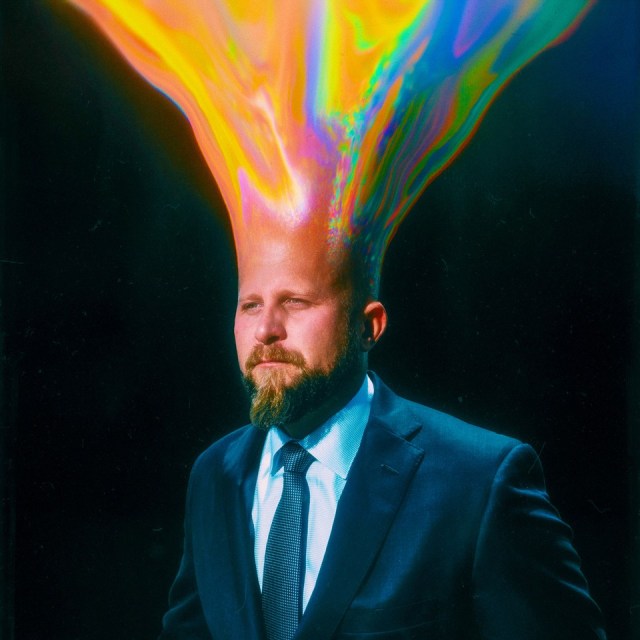
Presiding over this effort is Brad Parscale, a 6-foot-8 Viking of a man with a shaved head and a triangular beard. As the digital director of Trump’s 2016 campaign, Parscale didn’t become a household name like Steve Bannon and Kellyanne Conway. But he played a crucial role in delivering Trump to the Oval Office—and his efforts will shape this year’s election.In speeches and interviews, Parscale likes to tell his life story as a tidy rags-to-riches tale, embroidered with Trumpian embellishments. He grew up a simple “farm boy from Kansas” (read: son of an affluent lawyer from suburban Topeka) who managed to graduate from an “Ivy League” school (Trinity University, in San Antonio). After college, he went to work for a software company in California, only to watch the business collapse in the economic aftermath of 9/11 (not to mention allegations in a lawsuit that he and his parents, who owned the business, had illegally transferred company funds—claims that they disputed). Broke and desperate, Parscale took his “last $500” (not counting the value of three rental properties he owned) and used it to start a one-man web-design business in Texas.Parscale Media was, by most accounts, a scrappy endeavor at the outset. Hustling to drum up clients, Parscale cold-pitched shoppers in the tech aisle of a Borders bookstore. Over time, he built enough websites for plumbers and gun shops that bigger clients took notice—including the Trump Organization. In 2011, Parscale was invited to bid on designing a website for Trump International Realty. An ardent fan of The Apprentice, he offered to do the job for $10,000, a fraction of the actual cost. “I just made up a price,” he later told The Washington Post. “I recognized that I was a nobody in San Antonio, but working for the Trumps would be everything.” The contract was his, and a lucrative relationship was born.

Over the next four years, he was hired to design websites for a range of Trump ventures—a winery, a skin-care line, and then a presidential campaign. By late 2015, Parscale—a man with no discernible politics, let alone campaign experience—was running the Republican front-runner’s digital operation from his personal laptop.Parscale slid comfortably into Trump’s orbit. Not only was he cheap and unpretentious—with no hint of the savvier-than-thou smugness that characterized other political operatives—but he seemed to carry a chip on his shoulder that matched the candidate’s. “Brad was one of those people who wanted to prove the establishment wrong and show the world what he was made of,” says a former colleague from the campaign.Perhaps most important, he seemed to have no reservations about the kind of campaign Trump wanted to run. The race-baiting, the immigrant-bashing, the truth-bending—none of it seemed to bother Parscale. While some Republicans wrung their hands over Trump’s inflammatory messages, Parscale came up with ideas to more effectively disseminate them.

The campaign had little interest at first in cutting-edge ad technology, and for a while, Parscale’s most valued contribution was the merchandise page he built to sell MAGA hats. But that changed in the general election. Outgunned on the airwaves and lagging badly in fundraising, campaign officials turned to Google and Facebook, where ads were inexpensive and shock value was rewarded. As the campaign poured tens of millions into online advertising—amplifying themes such as Hillary Clinton’s criminality and the threat of radical Islamic terrorism—Parscale’s team, which was christened Project Alamo, grew to 100.

Brad
As Trump’s 2016 digital director, Brad Parscale flooded the internet with the campaign’s messages. (Illustration: Mishko; Jabin Botsford / The Washington Post / Getty)
Parscale was generally well liked by his colleagues, who recall him as competent and intensely focused. “He was a get-shit-done type of person,” says A. J. Delgado, who worked with him. Perhaps just as important, he had a talent for ingratiating himself with the Trump family. “He was probably better at managing up,” Kurt Luidhardt, a consultant for the campaign, told me. He made sure to share credit for his work with the candidate’s son-in-law, Jared Kushner, and he excelled at using Trump’s digital ignorance to flatter him. “Parscale would come in and tell Trump he didn’t need to listen to the polls, because he’d crunched his data and they were going to win by six points,” one former campaign staffer told me. “I was like, ‘Come on, man, don’t bullshit a bullshitter.’ ” But Trump seemed to buy it. (Parscale declined to be interviewed for this story.)

James Barnes, a Facebook employee who was dispatched to work closely with the campaign, told me Parscale’s political inexperience made him open to experimenting with the platform’s new tools. “Whereas some grizzled campaign strategist who’d been around the block a few times might say, ‘Oh, that will never work,’ Brad’s predisposition was to say, ‘Yeah, let’s try it.’ ” From June to November, Trump’s campaign ran 5.9 million ads on Facebook, while Clinton’s ran just 66,000. A Facebook executive would later write in a leaked memo that Trump “got elected because he ran the single best digital ad campaign I’ve ever seen from any advertiser.”

Though some strategists questioned how much these ads actually mattered, Parscale was hailed for Trump’s surprise victory. Stories appeared in the press calling him a “genius” and the campaign’s “secret weapon,” and in 2018 he was tapped to lead the entire reelection effort. The promotion was widely viewed as a sign that the president’s 2020 strategy would hinge on the digital tactics that Parscale had mastered.

Through it all, the strategist has continued to show a preference for narrative over truth. Last May, Parscale regaled a crowd of donors and activists in Miami with the story of his ascent. When a ProPublica reporter confronted him about the many misleading details in his account, he shrugged off the fact-check. “When I give a speech, I tell it like a story,” he said. “My story is my story.”

DISINFORMATION ARCHITECTURE

In his book This Is Not Propaganda, Peter Pomerantsev, a researcher at the London School of Economics, writes about a young Filipino political consultant he calls “P.” In college, P had studied the “Little Albert experiment,” in which scientists conditioned a young child to fear furry animals by exposing him to loud noises every time he encountered a white lab rat. The experiment gave P an idea. He created a series of Facebook groups for Filipinos to discuss what was going on in their communities. Once the groups got big enough—about 100,000 members—he began posting local crime stories, and instructed his employees to leave comments falsely tying the grisly headlines to drug cartels. The pages lit up with frightened chatter. Rumors swirled; conspiracy theories metastasized. To many, all crimes became drug crimes.

Unbeknownst to their members, the Facebook groups were designed to boost Rodrigo Duterte, then a long-shot presidential candidate running on a pledge to brutally crack down on drug criminals. (Duterte once boasted that, as mayor of Davao City, he rode through the streets on his motorcycle and personally executed drug dealers.) P’s experiment was one plank in a larger “disinformation architecture”—which also included social-media influencers paid to mock opposing candidates, and mercenary trolls working out of former call centers—that experts say aided Duterte’s rise to power. Since assuming office in 2016, Duterte has reportedly ramped up these efforts while presiding over thousands of extrajudicial killings.The campaign in the Philippines was emblematic of an emerging propaganda playbook, one that uses new tools for the age-old ends of autocracy. The Kremlin has long been an innovator in this area. (A 2011 manual for Russian civil servants favorably compared their methods of disinformation to “an invisible radiation” that takes effect while “the population doesn’t even feel it is being acted upon.”) But with the technological advances of the past decade, and the global proliferation of smartphones, governments around the world have found success deploying Kremlin-honed techniques against their own people.

In the United States, we tend to view such tools of oppression as the faraway problems of more fragile democracies. But the people working to reelect Trump understand the power of these tactics. They may use gentler terminology—muddy the waters; alternative facts—but they’re building a machine designed to exploit their own sprawling disinformation architecture.

TO READ ENTIRE ARTICLE CLICK HERE


elections 2

Posted in America, democracy, Donald Trump, elections, government, politics, Republican Party, technology | Tagged , , , | Leave a comment

Is the Stork the Bird of War?


Posted in environment, overpopulation, Uncategorized | Tagged , | Leave a comment

Global Capitalism Is Theft

Government Debts as Class Swindles

By Richard Wolff/ Common Dreams/ January 31, 2020

free stuff

In modern capitalism, governments routinely borrow money. They do this to finance budget deficits that occur when governments raise less in taxes than they spend. Governments also borrow to invest in long-term projects of economic development. The swindling occurs when the lenders and borrowers—usually private financiers and career politicians—negotiate loans that serve their own particular interests at the expense of the taxpayers who eventually cover the costs of repaying the government’s loans plus interest on them.

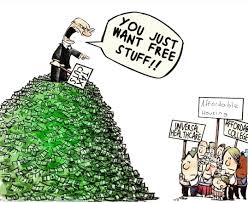
If governments raised enough taxes to cover their desired levels of spending, they would not need to borrow. Taxes imposed on the wealthiest corporations and individuals would be the most equitable strategy. The corporate wealthy protest, of course, threatening that if taxed, they might reduce their contributions to the economy (investing less, etc.). Most government politicians sympathize with those protests. Many come from the ranks of the wealthiest corporations and individuals (or aspire to join them). They share similar ideologies and depend on campaign donations from them. Compliant politicians typically exaggerate the negative aspects of taxing corporations and the rich. They rarely compare them to the negative effects of the alternatives: taxing middle and lower income people more or cutting government spending.

Government borrowing to cover budget deficits has its own negative effects on the economy. Many variables influence the impacts of taxes and deficit borrowing. Because those variables’ effects cannot be known or measured for years into the future, no one can know which is better or worse for the economy in the long run. When the corporate rich and their political allies stress the negative effects of taxes on the rich they usually carefully neglect the other side of the story as when advertisers mention only the positive side of whatever they are paid to promote. Their goals are simply more profits and less taxes.

Posted in Economics, economy, finance, government | Tagged , , , , , , , | Leave a comment

How the Fix Was In

Amazing interview by Rachel Maddow (and Claire McCaskill) of Senator Sheldon Whitehouse (D-R.I.} on how the fix was in on the Impeachment trial and future legislation. This explains how big money controls Washington….

This is a must-see. …..Needs to be shared!

Posted in America, democracy, Donald Trump, government, Impeachment, politics | Tagged , , , , | Leave a comment