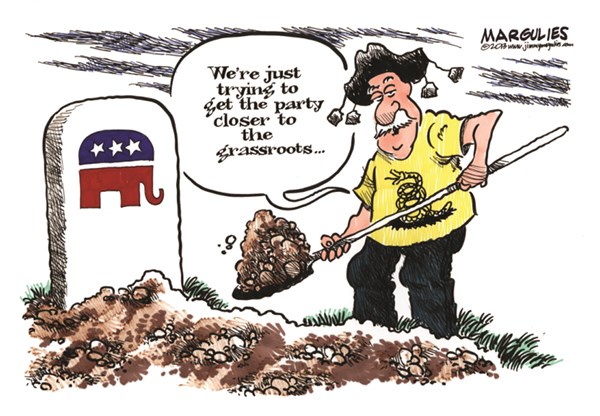
Without the Infrastructure of Democracy, America Will Slide First Into Oligarchy and Then Racism

Voters who believe in democracy, a free press & a public education committed to honest inquiry & intellectual integrity must also step up and let their reps how important these things are to them…

By Thom Hartmann/ HartmannReport.com/ October 23, 2023

For far too many years, Americans have made the mistake of assuming that our republican democracy will be safe as long as we elect competent and well-intentioned politicians as leaders. 

Sadly, that’s like thinking your surgeon, who is very good at what she does, will do a wonderful job even though the hospital can no longer provide her with sterile instruments or running water. 

The reality is that democracies depend on a particular type of infrastructure to function properly. Without that infrastructure, they rapidly slide first into oligarchy and then into fascism. The two most recent examples are Russia and Hungary, although America is well down the road herself.

Recognizing the need for these core infrastructure elements to sustain democracy, neofascists within the GOP and the Supreme Court have been busily deconstructing them for the past 40 years, leading us directly to today’s crisis.

The three core pillars that hold up democratic republics are a vibrant and free press, trustworthy electoral systems, and academic independence. Which is why Republicans have been trying to destroy all three.

In Russia, for example, the word is “dzherimendering.” In the months before elections are held in that country, the government re-draws the maps for political districts to make sure Putin and his party maintain majority control of the parliament (Duma). It’s a trick they brag they learned from Americans.

It’s pretty much the same in Hungary, as Project Syndicate notes:

“After Fidesz won its first supermajority in 2010, it changed the electoral law unilaterally to boost its own future results (through gerrymandering and new rules awarding extra seats for big wins in individual districts). With these changes in place, Fidesz retained its supermajority in 2014, even though it received 8% less of the vote than it had in 2010.

“Changing the rules has since become the party’s modus operandi. Its amendments to the electoral law now number in the hundreds; the latest were adopted just months ago. Owing to the electoral system’s skewed rules, Fidesz has secured 68% of parliamentary seats with 53% of the vote.”

And Viktor Orbán’s Fidesz party was only able to get 53% of the vote by similarly rigging the media. His government has taken over their public broadcasting equivalents of NPR and PBS, so they sing Orbán’s praises 24/7.

And, like in Russia, the commercial media has been almost entirely taken over by Hungarian oligarchs made rich by sweetheart government deals: almost every radio and TV station in Hungary today is broadcasting the Hungarian equivalent of Fox “News,” all deifying Orbán and his billionaire buddies who run the country.

Education is similarly under the control of the Russian and Hungarian governments. Any professor in Russia who dares discuss politics, race, or queer issues will find himself shipped off to a prison camp. In Budapest, the progressive Christian Central European University fled Hungary in the face of growing threats of violence against progressive religious organizations, a ban on classes, and the tight embrace of rightwing churches by the government.  Its rector, Michael Ignatieff, said:

“There’s just no doubt but that this is organized as a way of saying that ‘Christianity’ means ‘white conservative Europe’. It’s a trope. Say the world ‘Christian’ and it says everything else that you want to say.”

Thus, it surprised nobody when wannabee fascist strongman Ron DeSantis seized control of Florida’s flagship liberal arts school, the New College, and replaced a third of its staff, rewrote its classes to eliminate references to African-American history or white race-based crimes, and packed the incoming student body with people on athletic scholarships.

These are also examples of ways Republicans are trying to destroy the infrastructure of democracy here.

Which is why just keeping an insurrection-supporting traitor like Jim Jordan out of the House speakership isn’t going to save American democracy. 

While it’s important to keep toxic politicians out of office or positions of power, without elections that are not gerrymandered and thus truly reflect the will of the voters; politically independent media; and a vibrant university system to educate the next generation of American leaders, we’re inexorably heading down the path that Russia and Hungary have trod.

And it’s not like Republicans and their wealthy colleagues are trying to hide it.

When Orbán hosted the CPAC Republican fascist-fest this May in Budapest, the Hungarian “soft fascism” strongman president told the audience, to a standing ovation:

“Hungary is actually an incubator where experiments are done on the future of conservative policies. Hungary is the place where we didn’t just talk about defeating the progressives and liberals and causing a conservative Christian political turn, but we actually did it.”

The key, Orbán told his American fascist fanboys, was for the government and the party’s billionaires to take control of the media using the same strategy he and Putin used to hand most industrial and media operations to their favored oligarchs.

Orbán has handed government contracts to his favored few, elevating an entire group of pro-Orbán businessmen (it appears all are men) who have now seized almost complete control of that nation’s economy. Those who opposed him have lost their businesses, been forced to sell their companies, and often fled the country.

This is why virtually all of Hungary’s press is now in the hands of oligarchs and corporations loyal to Orbán, with hard-right talk radio and television across the country singing his praises daily. Progressive media is functionally banned. Billboards and social media proclaim Orbán’s patriotism everywhere. 

He told the American CPAC conference in Budapest last year they should do the same in America when Republicans next seize control of the US government:

“Have your own media,” he said. “It’s the only way to point out the insanity of the progressive left. The problem is that the western media is adjusted to the leftist viewpoint. Those who taught reporters in universities already had progressive leftist principles.”

He added:

“Of course, the GOP has its media allies but they can’t compete with the mainstream liberal media. My friend Tucker Carlson is the only one who puts himself out there. His show is the most popular. What does it mean? It means programs like his should be broadcasted day and night. Or, as you say, 24/7.”

After his 2022 speech was publicized in the US, many American media outlets were banned from attending CPAC 2023 in Budapest. As Vice News reported:

“Besides VICE News, journalists from Rolling Stone, Vox Media, and the New Yorker were turned away from the conference on Thursday, despite repeated assurances from the American Conservative Union that access would be provided. Journalists from other non-Hungarian media outlets, including the Guardian and Associated Press, tweeted that they had also been denied accreditation, despite months of requests.”

His media allies are now reaching out to purchase media across the rest of Europe and inviting American rightwing groups to Hungary to help spread his racist, “soft fascist” message. Tucker Carlson took him up on his invitation last year, broadcasting his poison directly into American homes from his presidential palace.

In his opening comments before Orbán took the stage, CPAC chairman (and accused sexual harasser) Matt Schlapp echoed Orbán’s strategy, as the Associated Press noted:

“In opening comments, CPAC chairman Matt Schlapp said that CPAC in the U.S. had decided to ‘go Hungarian’ in their approach to the media, deciding for themselves ‘who is a journalist and who is not a journalist’ when determining which outlets to allow into their events.”

But journalism isn’t the only institution fascists want to tear down.

Orbán recently began dismantling the Hungarian Science Academy, replacing or simply firing scientists and professors who acknowledge climate change, which he has called “left-wing trickery made up by Barack Obama.”

Here in the US, rightwingers started building their political empires with American oligarchs and their giant corporations that wanted to become even more massive. They were willing to pay politicians nearly anything to get the job done, and, since five corrupt Republicans on the Supreme Court had legalized political bribery in 1978, that meant billions.

Following massive campaign contributions from wannabe monopolies, in 1983 President Reagan ordered the DOJ, SEC, and FTC to essentially stop enforcing America’s anti-trust laws. At that time, every mall and downtown in America was filled with locally-owned businesses and there were over 10,000 independent media operations in America. Most radio and television stations had a single, local owner, as did most newspapers.

In 1987 he ended enforcement of the FCC’s Fairness Doctrine and in 1996 Bill Clinton signed the Telecommunications Act of 1996 that both gave immunity to social media from the content they carry (making Mark Zuckerberg a billionaire) and largely ended restrictions on the number of radio stations, TV stations, and newspapers a single company could own.

Rush Limbaugh started the year after Reagan killed the fairness doctrine; Air America died when the giant radio monopoly Clear Channel, recently acquired by Mitt Romney’s Bain Capital, began flipping their stations to sports. Pretty much the only independent voices today are found on a handful of commercial progressive radio stations, Pacifica, and Free Speech TV.

As a result, America’s media landscape is looking more and more like Orbán’s: unwilling or unable to call our rightwing leadership out for their real agenda of American fascism.

Ninety percent of our media is now owned by six corporations; two rightwing billionaires own our largest social media operations; and Republicans are treated as if a party that’s all-in on sedition is still legitimate.

This past weekend on the Sunday news/politics shows, for example, it was two Republicans for every Democrat as SocialDemocrat61 pointed out on Democratic Underground:

“ABC This Week: Secretary of Defense Lloyd Austin, GOP Rep. Michael McCaul, GOP Senator Tim Scott (2 republicans and 1 democrat, although cabinet Secretaries are non-partisan we’ll count him as a Dem)

“CBS Face the Nation: Secretary of State Antony Blinken, GOP Senator Mitch McConnell, Liz Cheney (again 2 Republicans and 1 Democrat)

“FOX News Sunday: GOP Senator Mitch McConnell, Dem Rep. Adam Smith, Newt Gingrich (once again 2 republicans and 1 democrat)

“NBC Meet the Press: Secretary of State Antony Blinken, GOP Rep. Kevin McCarthy, Mike Pence. (Yet again 2 republicans and 1 democrat)”

This is nothing new. During the Bush administration the networks told us they needed more Republicans than Democrats on the Sunday shows because Republicans were in power and so we needed to hear from those who could actually make and change legislation.

During the Obama administration the pattern of more Republicans than Democrats continued, but through those 8 years we were told they needed more Republicans because the GOP was the party out of power and so we needed to hear from “the opposition.”

In the middle of the Trump administration, 2018, Media Matters for America again looked at three months worth of Sunday shows and noted that the media had maintained their same ratio:

“Over the past three months, right-leaning guest panels on the five major Sunday political news shows have outnumbered left-leaning panels 33 to six. Nearly half of all guest panels titled right, meaning they had more right-leaning than left-leaning guests; by comparison, less than 10 percent of the panels tilted left.”

This is not how you keep a democracy intact. In the third year of George Washington’s presidency, 1791, our Constitution was amended with the Bill of Rights, including the First Amendment that prevents the government from legislating or dictating the news.

Four years later, according to 19th century historian Thomas Carlyle, British conservative Edmund Burke defined the press as “the fourth estate of the realm.” He meant it as a slur; Burke was no egalitarian and in his opinion the press of his day, enthralled by the American revolutionaries’ example, too often tended in that direction.

In the roughly three centuries since the rise of American democracy and the British royal family’s largely surrendering sovereignty to Parliament and the people who elect them at a local level, a free and independent press has played a vital role in maintaining and preserving the robust and adversarial political system necessary for a functioning republic.

The author of the Declaration of Independence and the first draft of that Bill of Rights (in correspondence with James Madison), Thomas Jefferson wrote:

“The basis of our government being the opinion of the people, the very first object should be to keep that right; and were it left to me to decide, whether we should have a government without newspapers, or newspapers without a government, I should not hesitate a moment to prefer the latter.”

Make no mistake: the MAGA faction of the GOP, which has largely taken over that party nationwide, is irreversibly committed to gerrymanders that defy the will of voters, supporting oligarch-owned for-profit media that caters to them, and ending the independence of public schools, colleges, and universities.

Consider how gerrymanders fly in the face of democracy itself. In multiple states, more citizens voted for Democrats than Republicans, which is why each of those states now have a Democratic governor (a statewide election).

But Wisconsin, for example, gives us a quick view of how the GOP has gone around democracy to hang onto power against the will of the state’s people. Fully 53% of the state voted Democratic, but their delegation to the US House is made up of 6 Republicans and 2 Democrats. In the State House, Republicans hold 64 out of 99 seats; it’s the same story in the State Senate with Republicans keeping 22 out of 33 seats.

Increasingly, Democratic politicians are starting to emphasize these structural impediments to functional democracy in America. It’s becoming all too clear how they’re being rigged by the GOP in Red state after Red state to hold onto power, even in the face of rising opposition from voters.

Voters who believe in democracy, a free press, and a public education system committed to honest inquiry and intellectual integrity must now step up and let their representatives know how important these things are to them. I’ll continue to point this out here on HartmannReport.com.

Because, as Russia and Hungary show us, once a country has lost the institutions that maintain its democracy, it’s damn hard to get them back. 
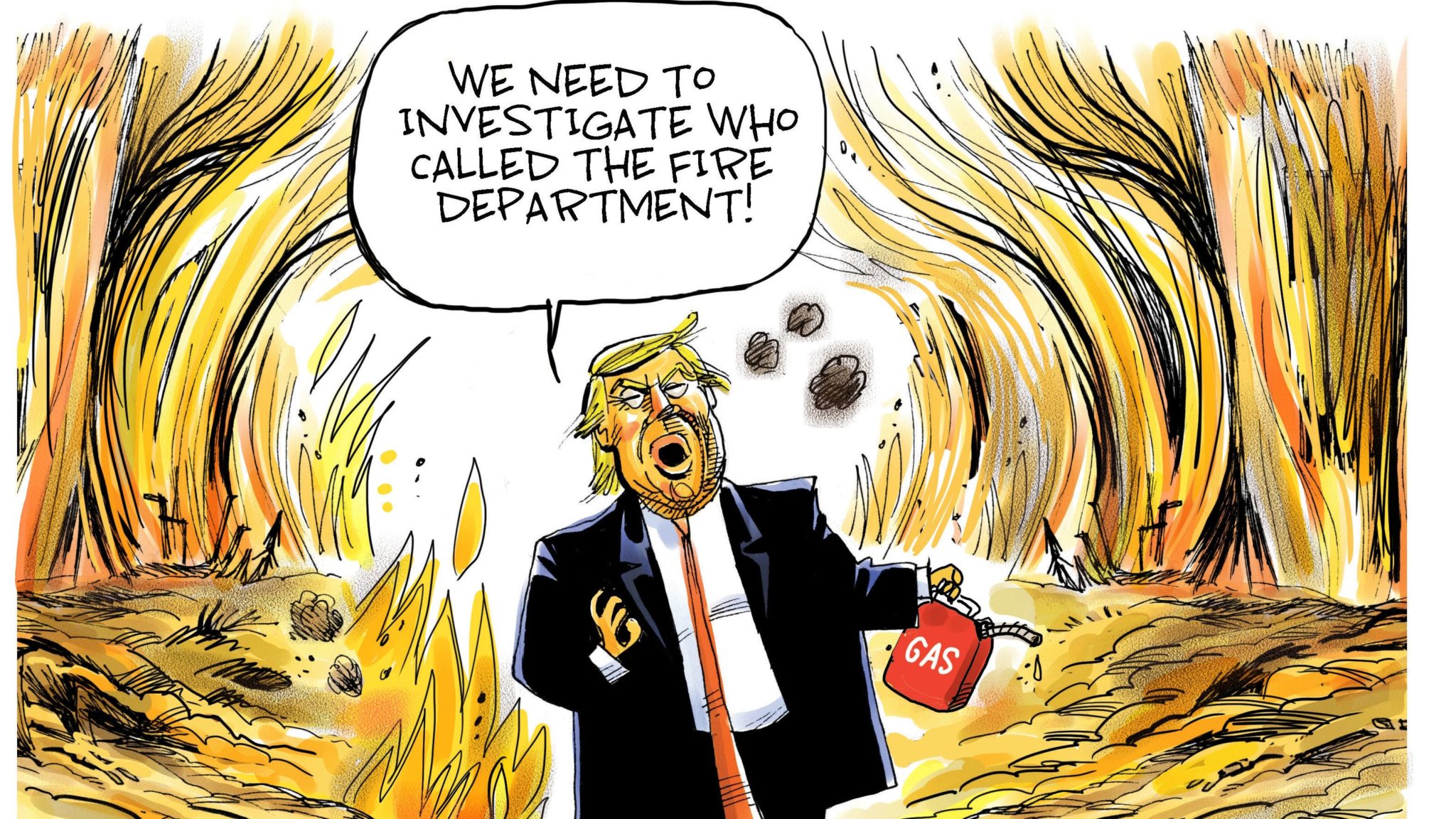
Posted in America, democracy, elections, extremism, fascism, media, Republican Party | Tagged , , , | Leave a comment

War in the Middle East

Hal and I spend the hour talking about the Israeli-Palestine War and what comes next.

Posted in extremism, foreign policy, Israel, Middle East, military, Terrorism, war | Tagged , , , , , , | Leave a comment

TRUMP WILL NOT BE PRESIDENT AGAIN—IT WILL BE HIS CHOICE

By Arlen Grossman/ DailyKos.com/ September 27, 2023

Also: OpEdNews/ October 2, 2023

None of us knows what will happen election night, 2024. But if I were in Las Vegas and could make a bet on the outcome, I would bet Donald Trump would not be on the ballot. 

Many observers look at his lead in the polls and are certain he will be the Republican nominee for president. I am not one of those people.

Auto workers union to announce plans on Friday to expand strike in contract dispute with companies

As 2023 progresses and 2024 right behind it, Donald Trump will spend a lot of time in the courtroom. He will be in front of judges and grand juries multiple times in the coming months. He has 91 felony charges against him and we can expect many more. 

The evidence against him is overwhelming. Trump has lied and cheated in every business or political venture he has ever undertaken. His lawyers are unable to mount a credible defense. He could mount a defense of his own in court, but doesn’t have the ability to do so. If he spoke during his trial, his lawyers would have a fit. They know he would dig himself a deeper hole.

As popular as he is with his base, as the election draws nearer, Republicans would have to wonder about the value of a potential or real criminal representing their party. I suspect the ex-president’s polls will gradually decline, especially if one of his GOP opponents looks electable.

Besides that, he has begun saying more bizarre and crazy things as the pressure mounts on him. He has already begun to repeat more

absurb, unhinged complaints and irrational attacks on his prosecutors. Potential voters will start noticing his rapid mental breakdown. 

But we know Trump does not give up easily or at all. However, as it appears all his legal troubles are mounting and the possibility of going to jail becomes more likely, he has displayed obvious signs of fear.

Under those circumstances, the Justice Department might welcome a way out of their own difficult position. Most likely, Attorney General Merrick Garland recoils at the idea of sending a former President of the United States to prison. As much as Trump deserves that fate, there is no knowing how his millions of his MAGA cult-like followers might react.  The potential for violence from his angriest supporters would have to be considered.

That is when Merrick Garland could play his trump card, so to speak.  He might be willing to present the ex-president an opportunity to avoid prison time. Being behind bars is no doubt terrifying to Trump. But if he accepts a plea deal from the government that would guarantee that he avoids prison time, that would be the best realistic outcome for Trump, his lawyers, his family, and his supporters.

Of course, there will be a cost that will be hard for Trump to stomach.

To avoid spending time in prison, he would have to agree to no longer run for public office, including for president.

The Justice Department would have to get Trump’s prosecutors in other jurisdictions to back that plea deal and not sentence Trump for his many other crimes. For the good of the country–and assuming the legalities would be worked out–it is likely they will agree, knowing the dangerous consequences of Trump potentially becoming president again. They would see that accepting the plea bargain would be the smart and patriotic thing to do and spare the country from certain upheaval if the former president were sent to prison.

I expect Trump would agree to the plea bargain. Spending time in prison  would be frightening  to him and would be further proof of his crimes. It would be the last thing he would want for himself. Trump will see the benefits of agreeing to the plea deal. Remember, this is the guy who claims to have written “The Art of the Deal.”

The country would benefit from precluding the possibility of him becoming the leader of the country. He would still be allowed to spout out the garbage he posts on his social media site and would still have access to the media. 

Naturally I can’t guarantee such a plea deal will come about, but that would be where my money would go in Las Vegas. I think the plea deal should and will happen. It would save the United States the prolonged nightmare of a vicious and divisive election, and the possibility of re-electing this anti-democratic, authoritarian, ego-driven man. Both pro- and anti-Trump camps will be disappointed they won’t get what they want, but it would be best for the future of our divided and insecure nation.

Plea Deal?
Posted in America, democracy, Donald Trump, elections, government, Republican Party | Tagged , , | Leave a comment

Cancer and Monopoly

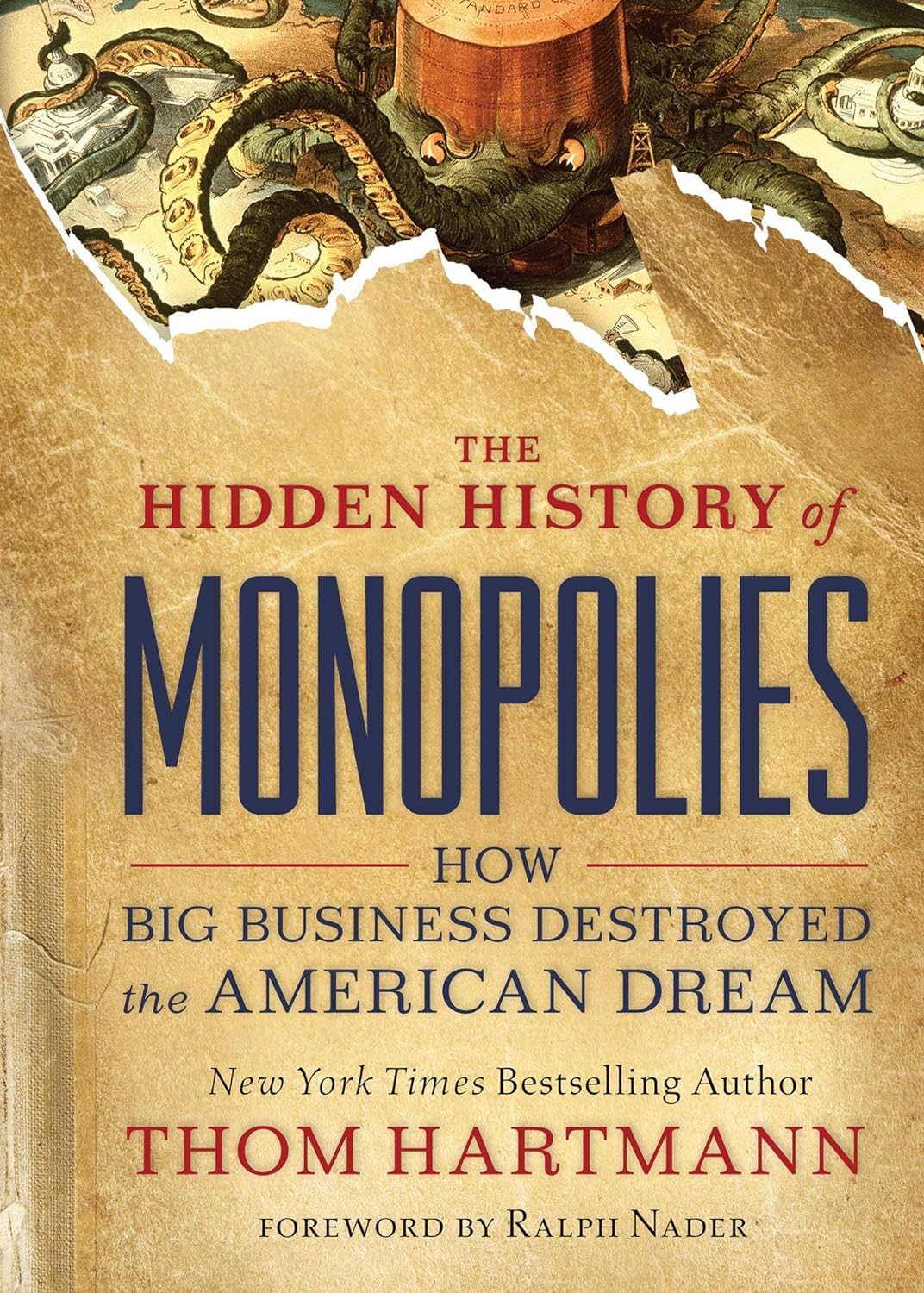
The Hidden History of Monopolies

By Thom Hartmann/ TheHartmannReport.com/ September 24, 2023

This is the Introduction to Hartmann’s newest book Cancer and Monopoly. Available only to subscribers.

Cell phone service that costs $15 a month in France or $12 a  month in Australia bills out at an average of $61.85 per month  in the United States. High-speed broadband that’s a bit over  $31 a month in France or $36 in Germany (for higher speeds  and bett er reliability than almost anywhere in the United  States) averages nearly $70 per month in the US. Similar met rics are found with pharmaceuticals, airfares, and medical  costs, among dozens of other product and service categories. Why is this? Monopoly. 

The average American family pays an annual “monopoly  tax”—in additional costs for pretty much everything—of  around $5,000, according to economist Thomas Philippon.  And things are steadily getting worse as monopolistic concentrations continue to tighten their grip on every American  industry from banking to telecom to food.2 

Monopoly isn’t the arcane, legalistic thing that most Americans think of (if they’re not mistaking it for the board game,  which was invented by Elizabeth Magie in 1904 as a cautionary tale3). In multiple very real ways, monopoly touches the  lives of all of us.  

monopoly is broadly defined as a single part of a larger sys tem that takes over or dominates, controls, and consumes all  the energy and functions of the entire system. In the process, the system is warped and twisted away from its normal func tion and, like a body reacting to a cancer, begins to redirect all  its resources to feed the single monopolistic entity.  

Cancer in the body works pretty much the same way that  monopoly works across an entire spectrum of things, from  monopolies in business to monopolies in religion, language,  agriculture, power systems, and, ultimately, the biological systems of the planet over which we humans have seized monopoly control.  

This book is about what happens when the cancer of  monopoly infects the economic, political, religious, atmospheric, biospheric, or cultural body. In virtually every regard,  the explosion of humanity across our planet, along with our  monopolization of the food, water, soil, and cultural resources  of the planet, is cancer-like. Big business has done the same in  our economic and political realms. Th e result—if we don’t get  this under control soon—will be disaster. 

Which raises a fundamental question, asked from the days  of Plato to Adam Smith to Bernie Sanders: Is the economy  here to serve the majority of the people, or are the majority of  the people here to serve the economy and those few who own  the largest parts of it?  

Until the 1980s, the consensus answer was the former, and  the primary regulator of the economy, the government, largely  worked to protect working people. Since the “Reagan Revolution,” however, the issue has rarely been raised, as media,  the courts, and the majority of politicians of both parties have  chosen the latter answer. 

And the principal vehicle used by those who control most  of the economy to regulate it to their favor and against average  working people has been monopoly. 

Monopoly (using the term in its broadest sense, to include  everything from a single company controlling a market to a  half dozen companies working in a cartel-like fashion) is why  working people’s pay hasn’t gone up since 1982, when President Ronald Reagan’s Federal Trade Commission and Department of Justice stopped enforcing the anti-monopoly laws.4 The rich have gotten fabulously richer since then. Consum ers, when harmed or ripped off, have largely been stripped of  their legal powers to hold businesses accountable. America  now lags behind other countries in innovation, which is why  (as one small example) we have the highest pharmaceutical  and health care costs in the world.  

Our streets are filled with guns, our schools have been  stripped of books and school supplies, and our food is so deficient in nutrients (vegetables today have about half the nutrients  they did in 19505) that we are experiencing a malnutrition induced obesity epidemic. 

Monopoly is why it’s so hard to start a new business (particularly a small, local business) and so difficult for existing local  and regional companies to survive. It’s why pension funds  have been “legally” stolen, and the vast majority of workers  have lost or been denied the right to representation in the  workplace.  

Monopoly is why so many of our politicians seem to work  in lockstep against the interests of average people and in favor of big business and the very rich. More and more democra cies around the world are sliding into autocracy and oligarchy.  Our courts have repealed laws passed in the fi rst decade of the  1900s—both federally and in the states—that made it a crime  for corporations to contribute “any thing of value” to political  campaigns, even though voters overwhelmingly support limits on campaign contributions.  

Because of monopolies, billionaires pay lower tax rates than  you do, and the nation’s largest companies not only usually  pay no taxes at all but also get billions every year in subsidies  funded with your tax dollars. So many families have fallen out  of the middle class that this country is experiencing epidem ics of suicide, opioid addiction, and divorce. Our defense budget is bloated, while our returning soldiers find it harder and  harder to get jobs or services. 

Although it’s almost never discussed in our highly monop olized media, monopoly is why right-wing radio and TV are  found in every nook and cranny, every town small and large  across America, while progressive media is marginalized. It’s  why our politics are broken and foreign governments have  been able to manipulate our elections and seize control of so  many of our politicians.  

The simple fact is that everything—literally everything— exists in some sort of a balanced relationship with every thing else and does so because everything obeys simple rules  to maintain that balance. Break the rules—as both business  monopolies and cancer do—and the balance collapses.  

Most of these rules are the rules of nature; our bodies, for  example, have a complex and delicately balanced immune system that detects when a cell has mutated in a way that it’s  breaking the rules, and the immune system takes that cell  apart, recycling its internal materials. But lacking the proper  nutrients to maintain its normal functions, our immune  systems—the rule-keepers—become less and less able to do  their jobs. Th e result is disease and, in the worst cases, cancer.  

Similarly, when the rule-keepers in political and economic  systems are compromised, monopolies emerge just like cancer does in bodies. Those monopolies suck all the resources  out of the system and eventually either change it so much that  it’s no longer functional or push it so far that it collapses.  

During the first few months of a tumor’s growth, if it were  self-aware, it’d be quite proud of its ability to reroute blood  and nutrients away from other cells and into itself. Similarly,  rule-breakers oft en are quite successful, at least for a while.  Consider the organized-crime “mob” and its dominance of  the construction and real estate industries in New York up  until the past few decades.  

For some time, mob- and oligarch-connected real estate  developers like Donald Trump were able to build themselves  empires based on unfairly winning against competitors who  played by the rules and didn’t lie about their properties or  hook up with overseas criminal billionaires looking to stash  ill-gotten gains or hire illegal undocumented laborers from  Poland.  

In the United States, in large part because of massive  changes in the rules of business starting during the Reagan  Revolution, we’re now in the cancer stage of capitalism. Similarly, our environment is badly out of balance and could be 

described as cancerous. So far, most of the victims have been  those who can’t fight back: workers who’ve seen their pay and  rights crash, and people whose homes and lives have been rav aged by out-of-control weather systems they can’t control or  defend against.  

But, like an immune system desperately trying to fight back  against a fast-growing tumor, workers are wising up and starting to demand that the rules return to the kind of balance that  kept wages high and inequality low before Reagan; similarly,  nations around the world are reacting to the climate crisis by  cutting their carbon outputs and moving rapidly to renewable  energy sources. Th e question now is whether the cancer of  monopoly has gone so far that it’s like an end-stage metastasis;  will Western democracy survive its assault? 

Monopoly doesn’t threaten just the business world. It  spreads its cancerous tentacles into politics as well, destroying  the ability of government to make policy that allows free people to make their own decisions about their own lives. 

As President Teddy Roosevelt, the great trust buster, said,  “Th ere can be no eff ective control of corporations while their  political activity remains. To put an end to it will be neither a  short nor an easy task.”6 

Adam Smith wrote, in Wealth of Nations, “[T]he monopoly  which our manufacturers have obtained against us. . . . [L]ike  an overgrown standing army, they have become formidable  to the government, and upon many occasions intimidate the  legislature.”7 

If the economic engine of the United States is to be turned  back to benefi ting the majority of the people rather than today’s small minority, breaking up monopolies will be one of  the most powerful tools to bring about that change.

Next week: Chapter 1 — Monopoly Kills:  Competition, Creativity, and Americans

Posted in Uncategorized | Leave a comment

Too Old to Run: Biden, Trump, Both, Neither?

Monday’s Halitics YouTube videocast with Hal Ginsberg and Arlen Grossman.

Posted in America, Congress, democracy, Democratic Party, Donald Trump, elections, Joe Biden, politics, poll, Republican Party | Tagged , , | Leave a comment

America Can’t Let the 9/11 War Lies Go Down the Memory Hole

By Thom Hartmann/ HartmannReport.com/ September 11, 2023

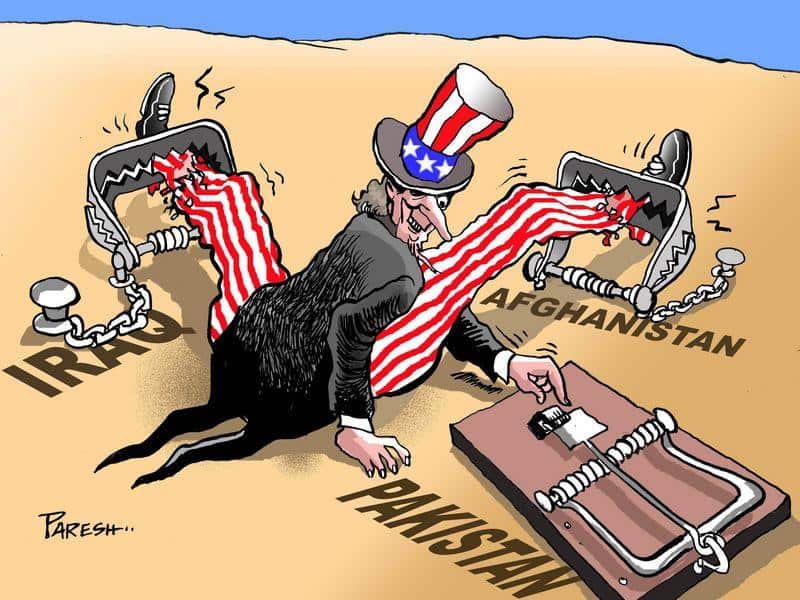
Today is 9/11, the event that first brought America together and then was cynically exploited by George W. Bush and Dick Cheney to have a war against Iraq, following their illegal invasion of Afghanistan just a bit more than a year earlier.

Yet the media today (so far, anyway) is curiously silent about Bush and Cheney’s lies. 

Given the costs of both these wars — and the current possibility of our being drawn deeper into conflict in both Ukraine and Taiwan — it’s an important moment to discuss our history of wars, both illegal and unnecessary, and those that are arguably essential to the survival of democracy in the world.

To be clear, I support US involvement — and even an expanded US involvement — in the defense of the Ukrainian democracy against Putin’s Hitler-grabs-Poland-like attack and mass slaughter of Ukrainian civilians. Had the world mobilized to stop Hitler when he invaded the Sudetenland in Czechoslovakia in 1938 there almost certainly wouldn’t have been either the Holocaust or WWII, which is why Europe is so united in this effort.

If Putin succeeds in taking Ukraine, his administration has already suggested that both Poland and Moldova are next, with the Baltic states (Latvia, Lithuania, Estonia) also on the menu. That would almost certainly lead to war in Europe.

And China is watching: a Putin victory in Ukraine will encourage Xi to try to take Taiwan. Between the two — war in both Europe and the Pacific — we could find ourselves in the middle of World War III if Putin isn’t stopped now.

That said, essentially defensive military involvement like with Ukraine or in World War II have been the exception rather than the rule in American history. We’ve been far more likely to have presidents lie us into wars for their own personal and political gain than to defend ourselves or other democracies.

For example, after 9/11 in 2001 the Taliban that then ran Afghanistan offered to arrest Bin Laden, but Bush turned them down because he wanted to be a “wartime president” to have a “successful presidency.” 

The Washington Post headline weeks after 9/11 put it succinctly: “Bush Rejects Taliban Offer On Bin Laden.” With that decision not to arrest and try Bin Laden for his crime but instead to go to war, George W. Bush set the US and Afghanistan on a direct path to disaster (but simultaneously set himself up for re-election in 2004 as a “wartime president”).

To further complicate things for Bush and Cheney, the 9/11 attacks were not planned, hatched, developed, practiced, expanded, worked out, or otherwise devised in Afghanistan or by even one single citizen of Afghanistan. 

That country and its leadership in 2001, in fact, had nothing whatsoever to do with 9/11, as I detailed in depth here on August 15th of last year. The actual planning and management of the operation was done out of Pakistan and Germany, mostly by Khalid Sheik Mohammed.

The Taliban were bad guys, trashing the rights of women and running a tinpot dictatorship, but they represented no threat whatsoever to America or our allies.

Almost two decades later, though, then-President Trump and Mike Pompeo gave the Taliban everything they wanted — power, legitimacy, shutting down 9 of the 10 US air bases in that country to screw incoming President Joe Biden, and the release of 5000 of Afghanistan’s worst Taliban war criminals — all over the strong objections of the democratically elected Afghan government in 2019.

Trump did this so could falsely claim, heading into the 2020 election, that he’d “negotiated peace” in Afghanistan, when in fact he’d set up the debacle that happened around President Biden’s withdrawal from that country.

”The relationship I have with the Mullah is very good,” Trump proclaimed — after ordering the mullah who then named himself President of Afghanistan — freed from prison over the furious objection of Afghan’s government, which Trump had cut out of the negotiations.

Following that betrayal of both Afghanistan and America, Trump and the GOP scrubbed the record of their embrace of the Taliban from their websites, as noted here and here. 

And the conservative Boris Johnson administration in the UK came right out and said that Trump’s “rushed” deal with the Taliban — without involvement of the Afghan government or the international community — set up the difficulties Biden faced.

“The die was cast,” Defense Minister Ben Wallace told the BBC, “when the deal was done by Donald Trump, if you want my observation.”

So, Republican George W. Bush lied us into both the Afghanistan and Iraq wars, and then Donald Trump tried to lie us out of at least one of them.  

But this was far from the first time a president has lied us into a war.

—  Vietnam wasn’t the first time an American president and his buddies in the media lied us into a war when Defense Secretary Robert McNamara falsely claimed that an American warship had come under attack in the Gulf of Tonkin and LBJ went along with the lie.  

—  Neither was President William McKinley lying us into the Spanish-American war in 1898 by falsely claiming that the USS Maine had been blown up in Havana harbor (it caught fire all by itself). 

—  The first time we were lied into a major war by a president was probably the Mexican-American war of 1846 when President James Polk lied that we’d been invaded by Mexico. Even Abraham Lincoln, then a congressman from Illinois, called him out on that lie

—  You could also argue that when President Andrew Jackson signed the Indian Removal Act in 1830 leading to the Trail of Tears slaughter and forced relocation of the Cherokee under President Buchanan (among other atrocities) it was all based on a series of lies.

Bush’s lies that took us into Afghanistan and, a bit over a year later into Iraq, are particularly egregious, however, given his and Cheney’s reasons for those lies. 

In 1999, when George W. Bush decided he was going to run for president in the 2000 election, his family hired Mickey Herskowitz to write the first draft of Bush’s autobiography, A Charge To Keep.  

Although Bush had gone AWOL for about a year during the Vietnam war and was thus apparently no fan of combat, he’d concluded (from watching his father’s “little 3- day war” with Iraq) that being a “wartime president” was the most consistently surefire way to get reelected (if you did it right) and have a two-term presidency.  

“I’ll tell you, he was thinking about invading Iraq in 1999,” Herskowitz told reporter Russ Baker in 2004. 

“One of the things [Bush] said to me,” Herskowitz said, “is: ‘One of the keys to being seen as a great leader is to be seen as a commander-in-chief. My father had all this political capital built up when he drove the Iraqis out of (Kuwait) and he wasted it.

“[Bush] said, ‘If I have a chance to invade Iraq, if I had that much capital, I’m not going to waste it. I’m going to get everything passed I want to get passed and I’m going to have a successful presidency.’”

The attack on 9/11 gave Bush his first chance to “be seen as a commander-in-chief” when our guy Osama Bin Laden, who the Reagan/Bush administration had spent $3 billion building up in Afghanistan, engineered an attack on New York and DC.

The crime was planned in Germany and Florida and on 9/11 Bin Laden was, according to CBS News, not even in Afghanistan

“CBS Evening News has been told that the night before the Sept. 11 terrorists attack, Osama bin Laden was in Pakistan. He was getting medical treatment with the support of the very military that days later pledged its backing for the U.S. war on terror in Afghanistan.”  

When the Obama administration finally caught and killed Bin Laden, he was back in Pakistan, the home base for the Taliban.

But attacking our ally Pakistan in 2001 would have been impossible for Bush, and, besides, nearby Afghanistan was an easier target, being at that time the second-poorest country in the world with an average annual per-capita income of $700 a year. Bin Laden had run terrorist training camps there — unrelated to 9/11 — but they made a fine excuse for Bush’s first chance to “be seen as a commander-in-chief” and get some leadership cred.

Cheney, meanwhile, was in a world of trouble because of a huge bet he’d made as CEO of Halliburton in 1998. Dresser Industries was big into asbestos and about to fall into bankruptcy because of asbestos lawsuits that the company was fighting through the court system.

Cheney bet Dresser would ultimately win the suits and had Halliburton buy the company on the cheap, but a year later, in 1999, Dresser got turned down by the courts and Haliburton’s stock went into freefall, crashing 68 percent in a matter of months. 

Bush had asked Cheney — who’d worked in his father’s White House as Secretary of Defense — to help him find a suitable candidate for VP.  

Cheney, as his company was collapsing, recommended himself for the job.  In July of 2000, Cheney walked away with $30 million from the troubled company and the year after that, as VP, Halliburton subsidiary KBR received one of the first no-bid no-ceiling (no accountability and no limit on how much they could receive) multi-billion-dollar military contracts.

Bush and Cheney both had good reason to want to invade Afghanistan in October 2001. Bush was seen as an illegitimate president at the time because his father’s corrupt appointee on the Supreme Court, Clarence Thomas, had cast the deciding vote in the Bush v Gore lawsuit that made him president; a war that gave him legitimacy and the aura of leadership.  

Cheney’s company was in a crisis, and Afghanistan War no-bid contracts helped turn around Halliburton from the edge of bankruptcy into one of the world’s largest defense contractors today.

Even Trump had to get into the “let’s lie about Afghanistan” game, in his case to have bragging rights that he’d “ended the war in Afghanistan.” 

In 2019, Trump went around the Afghan government (to their outrage: he even invitedthe Taliban to Camp David in a move that disgusted the world) to cut a so-called “peace deal” that sent thousands of newly-empowered Taliban fighters back into the field, and then drew down our troops to the point where today’s chaos in that country was absolutely predictable. 

Trump’s deal was the signal to the 300,000+ Afghan army recruits we’d put together and paid that America no longer had their back and if the Taliban showed up they should just run away. Which, of course, is what happened on Trump’s watch. As Susannah George of The Washington Post noted:

“The Taliban capitalized on the uncertainty caused by the [Trump] February 2020 agreement reached in Doha, Qatar, between the militant group and the United States calling for a full American withdrawal from Afghanistan. Some Afghan forces realized they would soon no longer be able to count on American air power and other crucial battlefield support and grew receptive to the Taliban’s approaches.”

Jon Perr’s article at Daily Kos did a great summary, with the title: “Trump put 5,000 Taliban fighters back in battle and tied Biden’s hands in Afghanistan.” 

Trump schemed and lied to help his own reelection efforts, and the people who worked with our military and the US-backed Afghan government paid a terrible price for it.

As President Biden told America: 

“When I came to office, I inherited a deal cut by my predecessor—which he invited the Taliban to discuss at Camp David on the eve of 9/11 of 2019—that left the Taliban in the strongest position militarily since 2001 and imposed a May 1, 2021 deadline on U.S. Forces. Shortly before he left office, he also drew U.S. Forces down to a bare minimum of 2,500.

“Therefore, when I became President, I faced a choice—follow through on the deal, with a brief extension to get our Forces and our allies’ Forces out safely, or ramp up our presence and send more American troops to fight once again in another country’s civil conflict. I was the fourth President to preside over an American troop presence in Afghanistan—two Republicans, two Democrats. I would not, and will not, pass this war onto a fifth.”

America has been lied into too many wars.  It’s cost us too much in money, credibility, and blood.  We must remember the lies, and tell our children about them so that memory isn’t lost.

When President Ford withdrew US forces from Vietnam (I remember it well), there was barely a mention of McNamara’s and LBJ’s lies that got us into that war.  

Similarly, today’s reporting on the chaos in Afghanistan and the war to seize the Iraqi oil fields almost never mention Bush’s and Cheney’s lies and ulterior motives in getting us into those wars in the first place.

George Santayana famously noted, “Those who cannot remember the past are condemned to repeat it.”

We can’t afford to let these lies go down the memory hole, like we have the other wars we were lied into that I mentioned earlier. Sadly, it’s clear now that neither Bush nor Cheney will be held accountable for their lies or for the American, Afghan, and Iraqi blood and treasure they cost.

But both should be subject to a clear and public airing of the crimes they committed in office and required — at the very least — to apologize to the thousands of American families destroyed by the loss of their soldier children, parents, and spouses, as well as to the people of both Afghanistan and Iraq. 

If the media refuses to mention the Bush/Cheney lies on this anniversary of 9/11, it’s all the more important that the rest of us use this opportunity to do so. Pass it on.

Posted in America, military, politics, Terrorism, war | Tagged , , , , , | Leave a comment

Current Political Issues–Halitics

Today’s Halitics YouTube videocast. Hal and my takes on the California senate race, Biden’s low numbers in recent polls, and the immigration problem at the borders.
Posted in elections, immigration, media, politics | Tagged , , | 2 Comments

WHY AMERICAN ELECTIONS ARE A SHAM

By Arlen Grossman / DailyKos.com/ September 1, 2023

Also published at OpEdNews.com September 3


We are a democracy, and we prove it with periodic elections, including presidential elections every four years. At least, that’s what we’re told. But every fourth year, most voters grumble at the mediocre (at best) choice of presidential candidates we are stuck with. Next year the probability is that an octogenarian incumbent will face off against a mentally unstable 77-year old challenger. Nobody seems to be happy about that.

How does this happen? We have to start with our 234-year-old Constitution, the universally accepted law of our land. While many see our Constitution as somewhat sacred, like the Bible, the truth is that this once vital and still generally respected document is antiquated and not always practical in the 21st Century, especially when it comes to election laws. 

Think about it: how can we say we have free elections when the candidate with the least number of votes can be elected president? We’ve seen that more than once, and as recently as 2016. Instead, we choose the winner based on the election results of a mysterious electoral college, which is not the kind of college that most of us are familiar with. How many Americans know the name of any of these electors? It’s unfair, too. The electoral college is advantageous to smaller states but disregards the national popular vote. 

More than that, the electoral college system renders the votes of many states irrelevant, instead focusing attention and money on the few states that are still in play, commonly referred to as “swing states.”  When the voter in California marks his ballot, it matters little whom he or she chooses, since we know that all the state’s electoral votes will go to the Democrats, as it has done for the last several decades. The West Virginia voter who votes for Democrats is wasting a vote, too, as Republicans reliably win the state, and get all its delegates. Surely this is not how a democratic and free election should work. 

Another complicating factor is whether the federal government or the state legislatures decide voting rules. The Constitution specifies:

 “The Times, Places and Manner of holding Elections for Senators and Representatives, shall be prescribed in each State by the Legislature thereof; but the Congress may at any time by Law make or alter such Regulations, except as to the Places of chusing Senators.”

In practice, states make most of the rules for their elections, even federal elections. This has become an issue because states controlled by one party have been able to enact laws that make voting more difficult for the other party. In recent years, Republican-controlled states especially have used gerrymandering to give themselves an advantage in redrawing districts and have enacted laws that make it more difficult to cast ballots for minorities, students and other groups that typically vote Democratic.

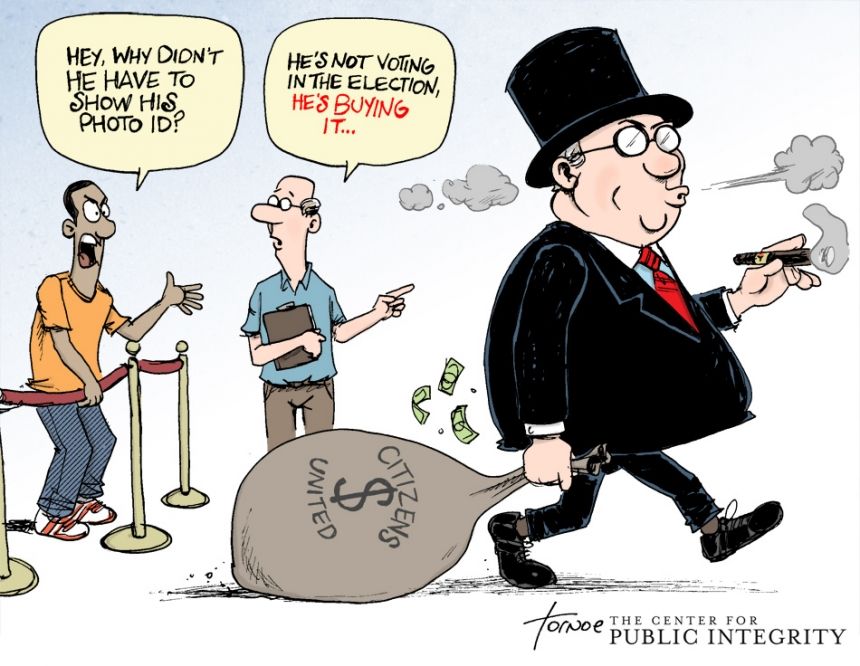
Finally, and perhaps worst of all, our ultra-conservative Supreme Court has declared that rich people can spend as much money as they like to get laws passed that favor them. In a 2010 ruling in Citizens United vs the FEC, along with other decisions before and after, the Supreme Court determined that freedom of the press as spelled out in the Bill of Rights means that money is equivalent to speech and therefore there should be virtually no limits on spending for elections.

That has led to the messed-up system we have now, in which those with money can freely donate to candidates of their choice. Those favored lawmakers are pleased to take campaign donations from their rich constituents and see how they can be of service. 

For example, let’s say you are a retired couple on a fixed income and want to donate $10 to your local representative “A.” The CEO of a big corporation has a similar right. He can donate $10 million to a large Political Action Committee (PAC), often in secret, who will in turn donate the $10 million to representative “B.” Not all that fair, is it?

In other words, politics today is essentially legalized bribery, with compliant politicians writing up laws to keep their wealthy donors happy. The average voter, lacking the big bucks, can only stand on the sidelines and watch the game being played.

Free and fair elections are a noble goal, one in which a nation can point to as evidence of a thriving democracy. Our country is not there yet.  Nonetheless it is something we should put in a lot of effort to achieve. But to say and pretend we have it now is just plain wrong.

Posted in America, Congress, democracy, elections, government, politics, Supreme Court | Tagged , , , , , , , | 6 Comments

The Shocking GOP Plan to Dismantle the American Government Revealed

By Thom Hartmann/ Hartmannreport.com/ August 31, 2023

As we learned from last week’s Republican debates, the leading candidates for the GOP nomination all appear to agree on a broad plan to gut American government and replace it with a strongman president and corporate rule.

The modern administrative state, sometimes called the “welfare state” by Republicans, was largely created by President Franklin D. Roosevelt in response to the Republican Great Depression of the early 1930s. And every day since FDR was sworn into office on March 4, 1933, the GOP has worked feverishly to dismantle his legacy.

Outside of Russia, China, and Hungary, this isn’t true at all for the rest of the developed world.

Nations across the rest of Europe, South America, and Asia imitated FDR’s and LBJ’s America, most going beyond our simple development of Social Security, Medicare, Medicaid, and the legalization of unions to further expand opportunity and social mobility for their citizens.

For example, Taiwan has the most efficient and comprehensive single-payer healthcare system in the world; Germany requires half of the members of every large corporation’s board of directors to come from the ranks of organized labor; Luxembourg has the highest national minimum wage in the world at roughly $19.50 an hour (they calculate it monthly).

All of Europe is pledged to reduce greenhouse gasses to get climate change under control, and they require chemical companies to prove their new compounds are safe before introducing them into food or the environment (the “precautionary principle”).

Prisons across the rest of the developed world are committed to rehabilitation and only in America are run for profit; every other developed country carefully regulatesthe possession of guns; pharmaceuticals are inexpensive — at least half, and sometimes a tenth of their cost here in the US — in every other developed country in the world.

Republicans and the billionaires who fund them reject all of that.

They want to abandon modern ideas like prohibitions on child labor and the age of consent; worker and workplace protections and unions; free, quality public schools and colleges; civil rights and the power of women to make their own healthcare decisions. 

They’re dedicated to taking America back to the era before the New Deal and, as Steve Bannon said, “deconstructing the administrative state.”

Over the years, the GOP has used a series of plans to reach their goal of a billionaire- and-corporate-owned-and-run America with working people turned into serfs and children in factories instead of school.

In 1971, it was the Powell Memo, written by Virginia tobacco lawyer Lewis Powell and delivered to the US Chamber of Commerce. It called for a rightwing takeover of America’s schools and colleges; building out a corporate-friendly media infrastructure; packing the courts with pro-corporate, anti-labor conservatives; and the wholesale purchase of Republican politicians at both the state and federal level.

The following year Richard Nixon put Powell on the Supreme Court and over the next quarter-century he used that position to put many of his own suggestions into law. In addition to decisions gutting the powers of unions and deregulating industry, Powell’s major achievement was authoring the 1978 Boston v Bellotti decision that struck down hundreds of state and federal anti-corruption laws, explicitly allowing corporations and their senior officers to bribe politicians for the first time in American history.

No other developed country in the world tolerates this; outside of the United States, you only find it in developing countries that have been taken over by corrupt autocrats.

Two years later, when Ronald Reagan cut a treasonous deal with the Ayatollah to hold the American hostages in Iran long enough to destroy Jimmy Carter’s chances in the 1980 election, the Heritage Foundation stepped up with a plan to further gut the rights and powers of working-class people and elevate corporate and billionaire power. 

They called it the Mandate for Leadership and, at the time, The Washington Post said it was “an action plan for turning the government toward the right as fast as possible.”

Reagan adopted over half of Heritage’s suggestions and in some cases went even farther, cutting enforcement of our anti-trust laws; ending the Fairness Doctrine; slashing the top income tax rate on the morbidly rich from 74 percent down to 27 percent; declaring all-out war on unions; gutting the EPA, Education, and Labor Departments; and selling off federal lands for pennies on the dollar to mining and drilling operations.

Now the partly-billionaire-funded Heritage Foundation has laid out a second-stage plan for the next Republican administration, whether it’s Trump or somebody else, whether it’s next year or in future presidential election cycles. 

They call it Project 2025. With it, they intend to finally and fully seize control of and transform America. With it, they will rule.

Ideologues on the right correctly see the Trump administration as having been a bumbling mess. Nobody expected him to win the election, not even Trump himself (he and Roger Stone had already registered the URLs and put together a “Stop the Steal” campaign claiming “election fraud” to distract and kneecap incoming President Hillary Clinton).

Nobody realized how effective Putin’s interventions — his 29 million Facebook ads and message posts targeting a million or so people in six swing states who’d been identified as persuadable by the GOP and passed along to Russian Intelligence via Paul Manafort — would be. 

When Trump was declared the winner he didn’t even have a victory speech ready, was totally unprepared to govern, and it took the better part of three years for Trump and his corrupt clown car to get their act together. Most of the time he and his son-in-law were too busy making money out of their connection to the White House. They’ve corruptly taken home billions in the years since 2016.

So this time the rightwing billionaires and their GOP lackeys aren’t taking any chances.

First up, they want to deconstruct the Civil Service, taking much of the federal workforce back to 1882. There’s an amazing backstory here.

Way back in 1881, a man named Charles Guiteau thought he’d properly bribed President James Garfield by giving the president, during an in-person visit in the White House, a speech he’d written for Garfield to use. Garfield was polite but didn’t offer Guiteau a federal job, which provoked a murderous rage: shortly thereafter, Guiteau met Garfield’s train and shot him twice, killing him.

The explicit and institutionalized practice of exchanging gifts and personal loyalty for federal jobs dates back to the presidency of Andrew Jackson (1829-1837), arguably the second-most depraved president in American history behind Trump (which is probably why Trump hung his picture in the Oval Office). His favorite nickname for himself — given him by the Cherokee he slaughtered with the Trail of Tears — was “The Indian Killer.”

Jackson had elevated the practice of bribing the president to get federal jobs into an art-form: it was called the “spoils” or patronage system and was insanely corrupt. It was also, by 1883, routine.

After Guiteau failed to gain his “spoil” or “patronage” from Garfield and killed him, President Chester Arthur oversaw the writing and passage of the Pendleton Civil Service Reform Act of 1883. It separated all those government jobs from the administration in power, turning federal workers from patrons of the president into permanent bureaucrats whose first loyalty was to the nation instead of the guy who happened to be in the White House at any particular time.

It also outlawed bribing the president for a job. The goal, which it accomplished and has held for 140 years, was to end corruption in the bureaucratic branches of the federal government.

Donald Trump wanted to functionally end the Civil Service and replace the top levels of the nation’s 2.7 million federal workers with people loyal exclusively to himself. He did this through an October 21, 2020 executive order, Schedule F, (which Biden reversed on his first day in office) that reclassified those workers out of their Civil Service jobs and into political appointee positions doing the exact same work.

The next Republican administration will almost certainly put Schedule F back into force, reestablishing the 1829 spoils system for the federal government. As Paul Dans, director of Project 2025’s “Presidential Transition Project” and a former Trump administration official, told the Associated Press:

“We need to flood the zone with conservatives.”

Next up, Project 2025 proposes to kill off federal efforts that may inhibit the profits of the fossil fuel industry and the billionaires it’s created who are helping fund both the GOP and Heritage.

As Scott Waldman wrote for Politico:

“Called Project 2025, it would block the expansion of the electrical grid for wind and solar energy; slash funding for the Environmental Protection Agency’s environmental justice office; shutter the Energy Department’s renewable energy offices; prevent states from adopting California’s car pollution standards; and delegate more regulation of polluting industries to Republican state officials.

“If enacted, it could decimate the federal government’s climate work, stymie the transition to clean energy, and shift agencies toward nurturing the fossil fuel industry rather than regulating it. It’s designed to be implemented on the first day of a Republican presidency.”

After ensuring fossil fuel industry profits and the further wilding of our weather, Project 2025 would effectively dismantle the Environmental Protection Agency, presumably on behalf of the petrochemical and other polluting industries that are also big GOP donors.

It would either end or downsize the Office of Environmental Justice and External Civil Rights, the Office of Enforcement and Compliance Assistance, and the Office of Public Engagement and Environmental Education. Like the process Trump began, it would shatter the EPA into pieces, moving regional offices and cutting its workforce by “terminating the newest hires in low-value programs.”

It would also block states from advancing any agenda that may prevent the further expansion of carbon pollutants that are driving global warming by “ensur[ing] that other states can adopt California’s standards only for traditional/criteria pollutants, not greenhouse gasses.”

One of the most disturbing aspects of Project 2025 and other plans for future Republican presidencies is their consolidation of power in the hands of the president, reflecting the way government is run in Hungary, China, and Russia rather than the checks-and-balances envisioned by our nation’s Founders.

They would outright end the operational independence of the of the Department of Justice and the FBI, turning both into tools (or weapons) the president alone could wield.

The Federal Reserve, with its ability to turn on the monetary spigot to ensure “the good times roll” or turn off the spigot to induce a recession would also become the president’s political plaything.

Ditto for the Federal Communications Commission, which has the power to not only regulate but even shut down over-the-air radio and TV broadcasts that displease it, as well as wielding a largely today-unused power of censorship over cable TV and the internet.

And the Federal Trade Commission, which has the power to grant billion-dollar favors or inflict severe punishments on companies, would lose their independence because they could be used to reward or destroy companies that have earned the favor or ire of the president.

As Russell Vought, president of one of the 65 far-right organizations on the Project 2025 advisory board, told  The New York Times:

“What we’re trying to do is identify the pockets of independence and seize them.” 

This is all a reflection of what, for several decades, has been called the Unitary Executive Theory. It argues — erroneously — that a strongman president like Putin, Xi, or Orbán is what the Founders and Framers had in mind. 

As professors Karl Manheim and Allan Ides of Loyola Law School in Los Angeles famously wrote in 2006:

“In fact, the theory of the unitary executive is anything but an innocuous or unremarkable description of the presidency. In its stronger versions, it embraces and promotes a notion of consolidated presidential power that essentially isolates the Executive Branch from any type of congressional or judicial oversight.

“And it is much more than an academic theory. Rather it is an operative way of thinking about and applying Executive Branch power that has had and will continue to have real-world consequences for our republic and for the international community. In attempting to understand and appreciate the significance of unitary executive theory, it is worthwhile to keep in mind that it is a product of the late 20th century and not a legacy bequeathed from the founding generation.

“The theory, which in fact is more about power that it is about law, grew out of a somewhat perverse reaction to abuses of presidential power that had come to light during the late sixties and early seventies. Such events as President Johnson’s fabricated Gulf of Tonkin incident and President Nixon’s secret war in Cambodia, among many other similar abuses of presidential power, led to efforts to curb what was perceived as an increasingly imperious Executive Branch. …

“The almost immediate response to this reform movement was a redoubling of efforts to consolidate and amplify presidential power. The theory of the unitary executive grew out of this reactionary response.”

Project 2025 and other efforts by the GOP to consolidate power in the Executive branch, as well as their recent successes at packing the courts and buying off Republican members of Congress, should be a clanging five-alarm fire bell for our republic.

This neofascist ideology of “rule by the rich” has been explicitly embraced by both Trump and DeSantis (who, this June, sent a senior advisor, David Dewhirst, to work on Project 2025), and the themes and contents of the plan are also regularly invoked on the campaign trail by Vivek Ramaswamy and Nikki Haley.

The merger of billionaire wealth with partisan Republican governance — and their combined efforts to reshape our government in their own corrupt image, the public be damned — threaten the integrity and future of the American experiment.

But it can only come about if we fail to awaken people, mobilize them, and vote. 

Step one, then, is to wake people up to what the GOP and its billionaire patrons are planning. Pass it along.

Posted in Congress, democracy, elections, government, politics, Republican Party | Tagged , , | Leave a comment

Frank Zappa on Fascist Theocracy

Posted in fascism, government, politics, religion | Tagged , , , | Leave a comment