

The website http://www.theeconomiccrisiswasaninsidejob.com explains and criticizes the Federal Reserve banking system.
The website http://www.theeconomiccrisiswasaninsidejob.com explains and criticizes the Federal Reserve banking system.
Not exactly impartial, but basically accurate……
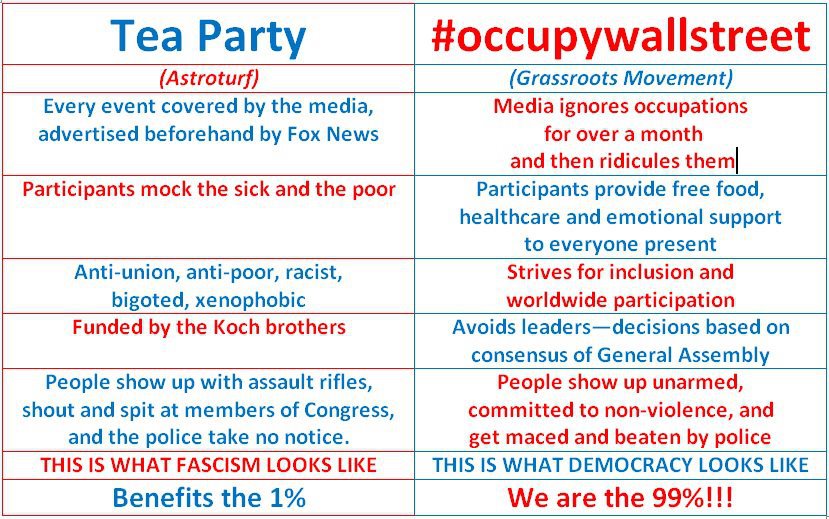
Over-the-top rhetoric or realistic scenario?
Excerpts from
in OpEdNews, 10/21/2011:
“Except for Washington’s favored mega-rich, the one percent that has captured all of the income gains of recent years, the rest of America has been assigned to the trash can. Nothing whatsoever has been done for them since the financial crisis hit in December 2007. Bush and Obama, Republican and Democrat, have focused on saving the 1 percent while giving the finger to the 99 percent.
Finally, some Americans, though not enough, have caught on to the flag-waving rah-rah “patriotism” that has consigned them to the trash bin of history. They are not going down without a fight and are in the streets. Occupy Wall Street has spread. What will be the fate of this movement?
Will the snow and ice of cold weather end the protests, or send them into public buildings? How long will the local authorities, subservient to Washington as they are, tolerate the obvious signal that the population lacks any confidence whatsoever in the government?
If the protests last, especially if they grow and don’t decline, the authorities will infiltrate the protesters with police provocateurs who will fire on the police. This will be the excuse to shoot down the protesters and to arrest the survivors as “terrorists” or “domestic extremists” and to send them to the $385 million dollar camps built under US government contract by Cheney’s Halliburton.
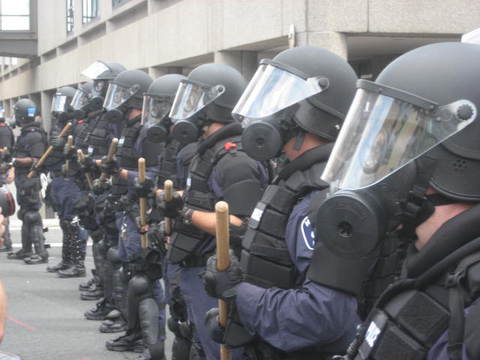
The Amerikan Police State will have taken its next step into the Amerikan Concentration Camp State.”
Read the entire article, including Roberts’ take on the future of Libya, by clicking here The End of History

by Jonathan Schell | The Nation/ October 19, 2011
Nothing is more striking about the Occupy Wall Street movement, which in a political instant has swept through not only the United States but the world, than its origin. It seemed to come out of nowhere, like a virgin birth. There were, of course, organizations that played a critical initiating role, which is gradually being acknowledged and rightly honored (see, for example, Nathan Schneider, “From Occupy Wall Street to Occupy Everywhere [1],” October 31). But it would be wrong to assign paternity in any ordinary sense to them, and they indeed disavow such a claim. On the contrary, the core activists in Liberty Plaza founded on the spot a decentralized, nonviolent pattern of “leaderless” self-organization that made every participant, old or new to the process, a “founding father” (or mother). The movement, you could say, was father and mother to itself. To join it was, immediately, to become it.
This feature was underscored when, in response to a police ban on megaphones, the occupiers deployed their now famous human microphone, in which an individual speaker’s words are repeated by all within hearing, inventing a new animal, a speaking crowd, who thus become the voice of their joint action.
This indefinite open-endedness of origins was carried forward in another conspicuous novelty of the movement: its lack of a list of demands. According to some reports, early efforts to frame such lists went nowhere. If so, the failure became a virtue. It was not a new set of policy ideas that was being born—the world was already overloaded with these, unacted upon—but a new spirit: a spirit of action, without which all the demands in the world are a dead letter.
What we might call the demand for demands, so prominent in early media reactions, was based on a fundamental error. It confused demands and content. A movement—like a book or an article—can have content without demands. Demands are a later stage that comes once the content is developed and, above all, once the movement is strong. This movement was born rich in unmistakable content. As everyone who cares to look knows by now, its members are crying out “Enough!” to a corrupt political, economic and media establishment that is hijacking the world’s wealth for itself, immiserating ordinary people, sabotaging the rule of law, waging interminable savage and futile wars, plundering the world’s finite resources, lying about all this to the public and threatening Earth’s life forms into the bargain. As for the development of leaders and demands, Anonymous, one of the precursor groups, offered a prescription in keeping with the spirit of the movement: “If you are looking to contact one of our leaders, go to the nearest mirror and peer deeply into it. It may take some time, but, eventually, one of our leaders will appear with answers to all of your questions.”
An understanding of Occupy Wall Street’s beginnings and continuing structure perhaps offers a clue to an issue that promptly began to roil the movement: what its relationship to established groups, especially the Democratic Party, should be. Almost immediately, top Democrats, including President Obama and House minority leader Nancy Pelosi, weighed in with friendly and supportive comments. (Obama said, “The protesters are giving voice to a more broad-based frustration about how our financial system works.” Pelosi said, “The message of the protesters is a message for the establishment in every place.”) Newspapers of moderate bent eventually jumped on board. The New York Times sang the praises of the occupation in an editorial. Older leftish movements like MoveOn threw their support behind it. Even the counterattack was surprisingly feeble and off-balance. No sooner had House majority leader Eric Cantor called the occupation a “mob” than he turned around and admitted the nation knows that “folks at the top end of the income scale…make too much and too many don’t make enough.”
The usual metaphor for a movement is an explosion. But Occupy Wall Street acted more like an implosion. The established actors appeared not so much to yield in the face of pressure exerted by the movement as to fall inward into the potent new space the demonstrators had created. Only a few hundred strong at first, the movement set up a blackboard on which established powers turned out to be unexpectedly eager to write their messages. As it turned out, the powers had demands to spare, as if they had been saving them up.
Yet shortly after these friendly faces appeared, petitioning the petitioners, the worries about co-optation arose in the movement. While welcoming support, a “working group” of the occupation voiced fear of “divide and conquer attempts being made to co-opt the movement,” and warned that some “are trying to label us as the Democrats’ version of the Tea Party”—a development that would undermine “the very essence of this movement with your obsolete divide and conquer groupthink propaganda.” And certainly it is true that a party affiliation would be even more stultifying than a premature list of demands.
But it may be that such worries are unnecessary. The power of the movement does not lie in the mite that it can add to or withdraw from some existing grouping through such traditional means as alliances and endorsements. Rather, its power lies in its direct appeal to the hearts and minds of the population at large—to the 99 percent that the movement so audaciously and promisingly claims to represent. By this process, the mite becomes mighty. It was surely such a felt tremor in the hidden recesses of hearts and minds—in short, in public opinion and, even more, in public will—that alone can explain the established expressions of support as well as the wildfire spread of the protest.
When such sea changes in opinion and will are under way, entrenched institutions start to tremble and shake, and political miracles become possible. If the scale of the national and international response to Occupy Wall Street is any measure, they have begun.
The exceptional creativity in the movement has been evident in countless handwritten signs. For example: I Lost My Job but Found an Occupation. And, Love Is the New Fear. But perhaps the loveliest, appearing in the demonstration’s early days and cited in these pages, was The Beginning Is Near. To this we can now gratefully add, The Beginning Is Here.
Occupy Wall Street: The Beginning Is Here (The Nation)
During the Republican Presidential Debate Monday, Mitt Romney explains what happened when he found out illegal aliens were working on his property:
“We hired a lawn company to mow our lawn and they had illegal immigrants that were working there. When that was pointed out to us, we let them go […] So we went to the company and we said, ‘Look, you can’t have any illegals working on our property! I’m running for office, for Pete’s sake, we can’t have illegals!’”

In 1978, to the laughter of many and the derision of a few, I wrote a book called, “The Downfall of Capitalism and Communism,” which predicted that Soviet communism would vanish around the end of the century, whereas crony or monopoly capitalism would create the worst-ever concentration of wealth in its history, so much so that a social revolution would start its demise around 2010. My forecasts derived from the law of social cycles, which was pioneered by my late teacher and mentor, P. R. Sarkar. Lo and behold, Soviet communism disappeared right before your eyes during the 1990s, and now, just a year after 2010, middle-class America, spearheaded by a movement increasingly known as “Occupy Wall Street (OWS),” is beginning to revolt against Wall Street greed and crony capitalism. Will the revolt succeed? It surely will, because the pre-conditions for its success are all there.
The first question is this: Why does rising wealth disparity create poverty? My answer is that it causes overproduction and hence unemployment and destitution. It is all a matter of supply and demand. Inequality goes up when official economic policy does not allow wages to catch up with the ever-growing labor productivity, so that profits soar and rising productivity increasingly raises the incomes and bonuses of business executives. I have detailed this process in an earlier article [3]. Then money sits idly in the vaults of bankers and big-business CEOs and restrains consumer demand, leading to overproduction and hence layoffs. The toxic combination of mounting layoffs and absent job creation raises poverty, which, according to official figures, is now the highest in 50 years.
The next question is: how has the government either restrained wages relative to productivity or made the rich richer and the poor poorer? It is easy to see that almost all official economic measures adopted since 1981 and contained in the following list have devastated the middle class. The list includes:
1. The Reagan income tax cut of 1981 that benefited the rich, but made it necessary to sharply raise all other federal taxes, paid mostly by the poor and the middle class, to finance that tax cut.
2. Unenforced antitrust laws, leading to mergers among large and profitable firms, but killing high-paying jobs in numerous industries.
3. Permitting the oil industry mergers in the 1990s that are now preventing oil prices from falling in the middle of the worst slump since the 1930s.
4. Permitting relentless mergers among pharmaceuticals and health insurance companies, so that America, far more than any other nation, now spends almost 15 percent of its gross domestic product (GDP) on health care that is mediocre by European and Japanese standards.
5. Unchecked use of outsourcing that kills high-paying jobs in manufacturing and services.
6. Ignoring the growth of the trade deficit that has destroyed our manufacturing base.
7. The 1999 repeal of the Glass-Steagall Act under President Clinton that led to reckless lending by banks and an unprecedented housing bubble, which collapsed in 2007 to trigger the ongoing slump.
8. The Bush tax cuts and bailouts that further benefited the rich while nearly doubling the government debt.
9. And finally, the decimation of the real minimum wage by President Reagan and other Republicans. (In 1981 the hourly minimum wage bought $8 worth of goods compared to $6 by the end of Reagan’ presidency in 1988, and to mere $5.15 in 2006 under Bush.)

Looking at this nine-point list, is there any government program that a big business CEO would hate? Stated another way, is there any measure that has helped the middle class? I can’t think of any. Thus, over the past three decades whatever the government did, ostensibly to help the people, actually ended up hurting them. Mergers, outsourcing and free trade raise productivity, but also lower wages, whereas the other provisions of the above list directly enrich the wealthy. The nine-point list is really a list of exploitation.
Read the entire article at Ravi Batra in Truthout

They increasingly dot the planet. There’s a facility outside Las Vegas where “pilots” work in climate-controlledtrailers, another at a dusty camp in Africa formerly used by the French Foreign Legion, a third at a big air base in Afghanistan where Air Force personnel sit in front of multiple computer screens, and a fourth that almost no one talks about at an air base in the United Arab Emirates.
And that leaves at least 56 more such facilities to mention in an expanding American empire of unmanned drone bases being set up worldwide. Despite frequent news reports on the drone assassination campaign launched in support of America’s ever-widening undeclared wars and a spate of stories on drone bases in Africa and the Middle East, most of these facilities have remained unnoted, uncounted, and remarkably anonymous — until now.
Run by the military, the Central Intelligence Agency, and their proxies, these bases — some little more than desolate airstrips, others sophisticated command and control centers filled with computer screens and high-tech electronic equipment — are the backbone of a new American robotic way of war. They are also the latest development in a long-evolving saga of American power projection abroad — in this case, remote-controlled strikes anywhere on the planet with a minimal foreign “footprint” and little accountability.
Using military documents, press accounts and other open source information, an in-depth analysis by AlterNet has identified at least 60 bases integral to U.S. military and CIA drone operations. There may, however, be more, since a cloak of secrecy about drone warfare leaves the full size and scope of these bases distinctly in the shadows.
For the complete report read: AlterNet and TomDispatch Drone Investigation


