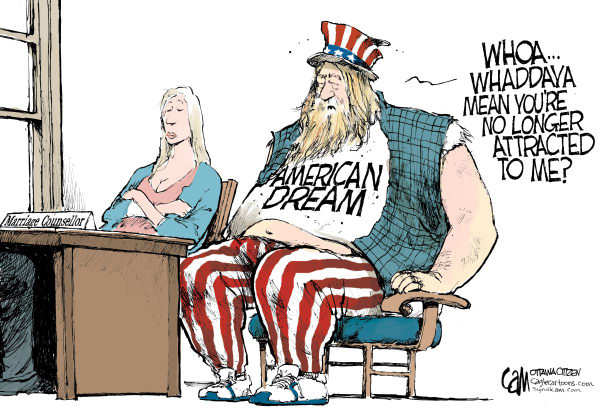
Just For the Kids

Posted in civil liberties, Terrorism | Tagged , | Leave a comment

McCarthyism – 2012 Version

“I believe there’s about 78 to 81 members of the Democratic Party that are members of the Communist Party.”

Rep. Allen West (R-FL)

Read the story in Politico Here

Posted in Democratic Party, politics, Quotations | Tagged , , , , | Leave a comment

The War on Whistleblowers Continues

For more information on this case, read reports from Politico and Mother Jones

Posted in Barack Obama, civil liberties, foreign policy, government, Justice, law, Terrorism | Tagged , , , , , , | Leave a comment

With a Cherry on Top?

Posted in economy, inequality, politics, poverty, taxes | Tagged , , , , | Leave a comment

When Top Tax Rates Rise, So Does The Economy

by Arlen Grossman/ The Big Picture Report/ April 9, 2012

Looking at the first chart below, you can see the top marginal income tax rates dropped from 73% in 1921 all the way down to 24% by 1929. After that, as we know from history, the stock market crashed and we plunged into the Great Depression.

Image: Susan Missal Lenner, CPA

When the top marginal rate jumped as high as 94% in 1945 (and 92% during the Eisenhower era) and never below 70% until President Reagan was in office, the American economy hummed along very nicely.

{Note: The marginal tax rate is the rate on the last dollar of income earned, which is different and less than the average tax rate, which is the total tax paid as a percentage of total income earned.}

But from Reagan’s presidency to now, the top rate dropped to its current level of 35%, and for all but the wealthy, the economy has been sluggish at best. It shouldn’t take an Ivy League mathematician to figure out from the numbers in the charts that the economy does best for most Americans when the rich are paying their fair share, something they haven’t done for a very long time.

Of course, the Republican Party is horrified at the thought of letting the Bush tax cuts of 2001 and 2003 expire (as they were scheduled to in 2010) and allowing the top marginal rate to move from the current 35% to its previous 2000 level of 39.6%.  Even with massive federal deficits, the thought of a 4.6% hike on the marginal rate of millionaires and billionaires is totally unacceptable to the GOP tax-cut idealogues.

The facts contained in the charts below should be convincing to any objective observer that the top tax rates need to rise, though not if he or she has a Republican or Tea Party bent, because to those people, facts and evidence are trumped by discredited ideology.

Chart above is from the Tax Policy Center (Urban Institute and Brookings Institution)

Chart from The American Thinker

PUBLISHED IN OPEDNEWS.COM 04/11/2012
Posted in Economics, economy, government, inequality, Republican Party, taxes | Tagged , , , , , , | 53 Comments

BPR Quote of the Day: Understanding the Bible

“Most people are bothered by those passages of Scripture they do not understand, but the passages that bother me are those I do understand.”

Mark Twain

Posted in Quotations, religion | Tagged , , | Leave a comment

The Security State Noose Tightens

Someone You Love: Coming to a Gulag Near You

by Chris Hedges/ Truthdig/ April 2, 2012

The security and surveillance state does not deal in nuance or ambiguity. Its millions of agents, intelligence gatherers, spies, clandestine operatives, analysts and armed paramilitary units live in a binary world of opposites, of good and evil, black and white, opponent and ally. There is nothing between. You are for us or against us. You are a patriot or an enemy of freedom. You either embrace the crusade to physically eradicate evildoers from the face of the Earth or you are an Islamic terrorist, a collaborator or an unwitting tool of terrorists. And now that we have created this monster it will be difficult, perhaps impossible, to free ourselves from it. Our 16 national intelligence agencies and army of private contractors feed on paranoia, rumor, rampant careerism, demonization of critical free speech and often invented narratives. They justify their existence, and their consuming of vast governmental resources, by turning even the banal and the mundane into a potential threat. And by the time they finish, the nation will be a gulag.

This is why the National Defense Authorization Act(NDAA), which was contested by me and three other plaintiffs before Judge Katherine B. Forrest in the U.S. District Court for the Southern District of New York on Thursday, is so dangerous. This act, signed into law by President Barack Obama last Dec. 31, puts into the hands of people with no discernible understanding of legitimate dissent the power to use the military to deny due process to all deemed to be terrorists, or terrorist sympathizers, and hold them indefinitely in military detention. The deliberate obtuseness of the NDAA’s language, which defines “covered persons” as those who “substantially supported” al-Qaida, the Taliban or “associated forces,” makes all Americans, in the eyes of our expanding homeland security apparatus, potential terrorists. It does not differentiate. And the testimony of my fellow plaintiffs, who understand that the NDAA is not about them but about us, repeatedly illustrated this.

Alexa O’Brien, a content strategist and information architect who co-founded the U.S. Day of Rage, an organization created to reform the election process and wrest it back from corporate hands, was the first plaintiff to address the court. She testified that when WikiLeaks released 5 million emails from Stratfor, a private security firm that does work for the U.S. Department of Homeland Security, the Marine Corps and the Defense Intelligence Agency, she discovered that the company was attempting to link her and her organization to Islamic radicals and websites as well as jihadist ideology.

Last August there was an email exchange between Fred Burton, Stratfor’s vice president for counterterrorism and corporate security and a former deputy director of the counterterrorism division of the State Department’s Diplomatic Security Service, and Thomas Kopecky, director of operations at Investigative Research Consultants Inc. and Fortis Protective Services LLC. In that exchange, leaked Feb. 27 by WikiLeaks, Kopecky wrote: “I was looking into that U.S. Day of Rage movement and specifically asked to connect it to any Saudi or other fundamentalist Islamic movements. Thus far, I have only hear[d] rumors but not gotten any substantial connection. Do you guys know much about this other than its US Domestic fiscal ideals?”?

Burton replied: “No, we’re not aware of any concrete connections between fundamentalist Islamist movements and the Day of Rage, or the October 2011 movement at this point.”

But that changed quickly. Stratfor, through others working in conjunction with the FBI, soon linked U.S. Day of Rage to al-Qaida and other terrorist groups.

In early September, U.S. Day of Rage, which supported the Sept. 17 call to occupy Wall Street, received Twitter messages that falsely accused it of being affiliated with terrorist groups. The messages came from a privately owned security and intelligence contractor, Provide Security, managed by Thomas Ryan, who works for U.S. military and government agencies, and Dr. Kevin Schatzle, a former FBI, Secret Service and New York City Police Department counterterrorism agent who is on the advisory board of a private intelligence firm that sells technology to profile and interrogate terrorism suspects. On Sept. 1 U.S. Day of Rage received three private, direct Twitter messages that read:

“Now you are really in over your head with this. Muslims from an Afghanistan Jihad site have jumped in. …”

“You seem peaceful, but #Anonymous will tarnish that reputation and FAST! They plan to hack NYPD and Banks for #OccupyWallStreet with #RefRef.”

“Just a heads up. I watched your training videos, but do you realize the #Anonymous relationship/infiltration will cause you MANY problems.”  (Continued Here)

Boldface added by BPR Editor
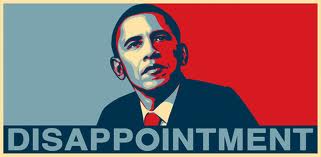
Posted in civil liberties, crime, Justice, law, Occupy, protest, protests, Terrorism | Tagged , , , , , , , , | Leave a comment

Morris Berman: “A Postmortem For a Dying Nation”

Why the American Empire Was Destined to Collapse

Interview with author and social critic Morris Berman  who says the fact that we’re a nation of hustlers lies at the root of our decline.

by Nomi Prins/ AlterNet/ March 7, 2012

Several years after the Wall Street-ignited crisis began, the nation’s top bank CEOs (who far out-accumulated their European and other international counterparts) continue to hobnob with the president at campaign dinners where each plate costs more than one out of four US households make in a year. Financial bigwigs lead their affluent lives, unaffected, unremorseful, and unindicted for wreaking havoc on the nation. Why? Because they won. They hustled better. They are living the American Dream.

This is not the American Dream that says if you work hard you can be more comfortable than your parents; but rather, if you connive well, game the rules, and rule the game, your take from others is unlimited. In this paradigm, human empathy, caring, compassion, and connection have been devalued from the get-go. This is the flaw in the entire premise of the American Dream: if we can have it all, it must by definition be at someone else’s expense.

In Why America Failed, noted historian and cultural critic Morris Berman’s brilliant, raw and unflinchingly accurate postmortem of America, he concludes that this hustling model, literally woven into the American DNA, doomed the country from the start, and led us inevitably to this dysfunctional point. It is not just the American Dream that has failed, but America itself, because the dream was a mistake in the first place. We are at our core a nation of hustlers; not recently, not sometimes, but always. Conventional wisdom has it that America was predicated on the republican desire to break free from monarchical tyranny, and that was certainly a factor in the War of Independence; but in practical terms, it came down to a drive for “more” — for individual accumulation of wealth.

So where does that leave us as a country? I caught up with Berman to find out.

Nomi Prins: Why America Failed is the third book in a trilogy you wrote on the decline of the American Empire. How did this trilogy evolve?

Morris Berman: The first book in the series, The Twilight of American Culture (2000), is a structural analysis, or internal comparison, of the contemporary US and the late Roman Empire. In it, I identified factors that were central to the fall of Rome and showed that they were present in the US today. I said that if we didn’t address these, we were doomed. I didn’t believe for a moment we would, of course, and now the results are obvious.

After 9/11, I realized that my comparison with Rome lacked one crucial component: like Rome, we were attacked from the outside. Dark Ages America (2006), the sequel to Twilight, is an analysis of US foreign policy and its relationship to domestic policy, once again arguing that there had to be a serious reevaluation of both if we were to arrest the disintegration of the nation. Of course, no such reevaluation took place, and we are now in huge economic trouble with no hope of recovery, and stuck in two wars in the Middle East that we cannot seem to win.

By the time I sat down to write the third volume, Why America Failed, I was past the point of issuing warnings. The book is basically a postmortem for a dying nation. The argument is that we failed for reasons that go back more than 400 years. As a result, the historical momentum to not undertake a reassessment, and just continue on with business as usual, is very powerful. At this point we can no more reverse our downward trajectory than we can turn around an aircraft carrier in a bathtub.

NP: So you’ve been analyzing America’s decline for over a decade. Was there a particular, specific inspiration for Why America Failed?

MB: I was originally inspired by the historian Walter McDougall (Freedom Just Around the Corner) and his argument about America being a nation of hustlers. The original working title was Capitalism and Its Discontents, the point being that those who dissented from the dominant ideology never had a chance. The crux of the problem remains the American Dream: even “progressives” see it as the solution — including, I have the impression, the Wall Street protesters — when it’s actually the problem.

In my essay collection, A Question of Values, I talk about how we are driven by a number of unconscious assumptions, including the notions of our being the “chosen people” and the availability of an endless frontier (once geographical, now economic and technological). For a while I had The Roots of American Failure as the title, but more to the point would be The Failure of American Roots — for even our success was a failure, because it was purely material. This is really what the American Dream is about, in its essence, as Douglas Dowd argued years ago in The Twisted Dream.

There is a story, probably apocryphal, of a Native American scouting expedition that came across the starving members of the Donner Party in 1847, who were snowbound in the Sierra Nevadas and resorted to cannibalism in order to survive. The expedition, which had never seen white people before, observed the Donner Party from a distance, then returned to base camp to report what they had seen. The report consisted of four words: “They eat each other.” Frankly, if I could summarize the argument of Why America Failed in a single phrase, this would be it. Unless Occupy Wall Street (or some other sociopolitical movement) manages to turn things around in a fundamental way, “They ate each other” will be our epitaph.

I should add that Why America Failed is actually part of a lineage, following the path initially staked out by Richard Hofstadter, C. Vann Woodward and Louis Hartz. Between 1948 and 1955 they all argued something similar; I just updated the argument.

NP: What do you say to people who don’t believe America has failed; who may just see the country as going through a bad patch, so to speak? What evidence have you compiled for the argument that the United States has failed?

MB: The major evidence is, of course, economic, and there is by now a slew of books showing that this time around recovery is not really possible and that we are going to be eclipsed by China or even Europe. These are books by very respected economists, I might add; and even a US Intelligence report of two yrs ago, “Global Trends 2025,” says pretty much the same thing, although it adds cultural and political decline into the mix. The statistics here are massive, but just consider a single one: in terms of collective wealth, the top 1 percent of the nation owns more than the bottom 90 percent. If we have a future, it’s that of a banana republic. And there will be no New Deal this time around to save us; just the opposite, in fact, as we are busy shredding any social safety net we once had.

NP: How does this relate to the rise of the Tea Party, or the Occupy Wall Street movement?

MB: Americans may be very vocal in claiming we’ll eventually recover, or that the US is still number-one, but I believe that on some level they know that this is whistling in the dark. They suspect their lives will get worse as time goes on, and that the lives of their children will be even worse than that. They feel the American Dream betrayed them, and this has left them bitter and resentful. The Wall Street protests are, as during the Depression, a demand for restoring the American Dream; for letting more people into it. The Tea Party seeks a solution in returning to original American principles of hustling, i.e. of a laissez-faire economy and society, in which the government plays an extremely small role. Thus they see Obama as a socialist, which is absurd; even FDR doesn’t fit that description. There are great differences between the two movements, of course, but both are grounded in a deep malaise, a fear that someone or something has absconded with America.

NP: Most political analysts place the blame for our current situation on major institutions, whether it is Wall Street, Congress, the Bush or Obama administrations, and so on. You agree with them to a great extent, but you also seem to place a lot of emphasis on the American people themselves—on individual values and behavior. Why is that? How do you see that as a factor?

MB: The dominant thinking on the left, I suppose, is some variety of a “false consciousness” argument, that the elite have pulled the wool over the eyes of the vast majority of the population, and once the latter realizes that they’ve been had, they’ll rebel, they’ll move the country in a populist or democratic socialist direction. The problem I have with this is the evident fact that most Americans want the American Dream, not a different way of life—a Mercedes-Benz, as Janis Joplin once put it. Endless material wealth based on individual striving is the American ideal, and the desire to change that paradigm is practically nonexistent. Even the poor buy into this, which is why John Steinbeck once remarked that they regard themselves as “temporarily embarrassed millionaires.” Hence I would argue that nations get the governments they deserve; that the wool is the eyes.

In addition, all of the data over the last 20 years show that Americans are not very bright, and not even the bright ones are very bright—it’s not merely a question of IQ. A Marist poll released on July 4, 2011 showed that 42 percent of American adults are unaware that the U.S. declared its independence in 1776, and this figure increases to 69 percent for the under-30 age group. Twenty-five percent of Americans don’t know from which country the United States seceded. A poll taken in the Oklahoma public school system turned up the fact that 77 percent of the students didn’t know who George Washington was, and the Texas Board of Education recently voted to include a unit on Estee Lauder in the history curriculum, when they don’t have one on the first president. Nearly 30 percent of the American population thinks the sun revolves around the earth or is unsure of which revolves around which. Etc. etc. How can such a population grasp a structural analysis of American history or politics? They simply aren’t capable of it. (Continued)

Nomi Prins is a journalist and senior fellow at Demos. She is the author of Other People’s Money: The Corporate Mugging of America and Jacked: How “Conservatives” are Picking Your Pocket (Whether You Voted For Them or Not).

Read entire article Here

Boldface added by BPR Editor
Posted in Economics, economy, finance, inequality, media, politics, poverty, Uncategorized | Tagged , , , | 3 Comments

BPR Quote of the Day: America, A Love Story

“I know of no other country where love of money has such a grip on men’s hearts or where stronger scorn is expressed for the theory of permanent equality of property.”

Alexis de Tocqueville from Democracy in America, (1835)

Posted in Quotations | Tagged , , , | Leave a comment

Is It Still Torture If We Do It?

New Bush-Era Torture Memo Released, Raises Questions About What Has Changed And What Hasn’t

by Dan Foomkin/ Huffington Post/ April 6, 2012

WASHINGTON — A six-year-old memo from within the George W. Bush administration that came to light this week acknowledges that White House-approved interrogation techniques amounted to “war crimes.” The memo’s release has called attention to what has changed since President Barack Obama took office, but it also raises questions about what hasn’t.

The Bush White House tried to destroy every copy of the memo, written by then-State Department counselor Philip Zelikow. Zelikow examined tactics like waterboarding — which simulates drowning — and concluded that there was no way they were legal, domestically or internationally.

“We are unaware of any precedent in World War II, the Korean War, the Vietnam War, or any subsequent conflict for authorized, systematic interrogation practices similar to those in question here,” Zelikow wrote. The memo has been obtained by George Washington University’s National Security Archive and Wired’s Spencer Ackerman.

On his second full day in office, President Barack Obama formally disavowed torture, banning the types of techniques Zelikow had objected to so strongly in his memo.

But while Democrats are using the memo as evidence of a new post-torture era under Obama, human rights activists, civil libertarians and opponents of excessive secrecy say they see many ways in which the country’s moral compass is still askew — and in some ways even more so than before.

“If your baseline is the Bush years, it’s night and day,” said Tom Blanton, director of the National Security Archive. “If your baselines are a set of first principles, as the ACLU calls for, or as us openness advocates call for, then your situation is: Is the glass half full or the glass half empty?”

Obama has refused to pursue legal action against those who may have engaged in law-breaking under his predecessor’s watch — saying he prefers to “look forward instead of looking backward.” To some, this indicates there is little assurance that the U.S. won’t torture again in the future.

“The administration has clearly disavowed torture, and that is an important and welcome thing,” said Jameel Jaffer, a national security expert at the American Civil Liberties Union.

“But they’re steadily building a framework for impunity.”

When it comes to issues like warrantless surveillance, “continuity is the rule and not the exception and in fact in some very important areas this administration has gone even farther than the Bush Administration did,” Jaffer said.

Most alarming, says Jafeer, is the issue of the targeted killing of American citizens who are terrorism suspects.

Jaffer said the idea that the government can mark an American for death without any judicial oversight is something the framers of the Constitution “would have found totally foreign to the project they were engaged in.”

“I think there are many Democrats out there who are quiet because they trust President Obama,” Jaffer said. But, he added, “there’s no doubt that the power we’re giving President Obama will be available to a future president.”  (Continued)

Read complete article Here

Boldface added by BPR Editor
Posted in Afghanistan, Barack Obama, foreign policy, Iraq war, Justice, law, military, Terrorism, war | Tagged , , , , , , , | Leave a comment