By Arlen Grossman/ The Big Picture Report
1st Great Thing About America: We Are a Democracy (Or Used To Be)
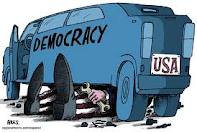
Image: Ares/caglecartoons.com
Once a shining beacon of democracy, the United States of America has lost its way. To be sure, this country didn’t start out as a democracy. If you were white, over 21 and owned property, you could vote. If not, you were out of luck–and rights. When George Washington became our first president, only 6% of the population could vote. The voting base expanded considerably since then, and this country thrived as a democracy (or a republic, if you want to be technical) through the middle years of the 20th Century.
Unfortunately, the influence of the average voter has steadily eroded in recent decades, culminating in the 2010 Citizens United decision by a conservative Supreme Court, allowing wealthy Americans and big corporations to spend unlimited amounts of money to influence elections. That is when the last vestiges of American Democracy went up in smoke, when the traditional “one man, one vote” concept of democracy ended, that vacuum filled by the powerful influence of unlimited special interest money. Politics in the U.S. today runs by legalized bribery, in which wealthy special interests promote and help elect candidates, who for their self-preservation, willingly do the bidding of their benefactors.
There is no way average voters can compete with millions of dollars of campaign spending by millionaires, billionaires and multi-national corporations. Call it oligarchy and/or plutocracy, but don’t pretend it’s democracy. If it were, our troops would leave Afghanistan, the rich would pay higher taxes, and we would enjoy universal health care, positions supported by large majorities of the American people.
2nd Great Thing: We Are a Peace-Loving Nation (Or Used to Be)
In his farewell speech from the White House, President Dwight Eisenhower warned us: “In the councils of government, we must guard against the acquisition of unwarranted influence, whether sought or unsought, by the military-industrial complex. The potential for the disastrous rise of misplaced power exists and will persist.” Our leaders didn’t listen and the problem has gotten considerably worse in the more than half-century since Eisenhower’s ominous premonition.
The United States military has at least 700 and perhaps more than 1000 overseas bases and is deployed in probably over 150 countries around the world. Our military budget nearly dwarfs the rest of the world combined. We are the only military superpower, in addition to being the biggest arms dealer in the world. We desire to shape the world to our economic and strategic benefit and no other nation is capable of stopping us.
Where once the U.S. military’s mission was to defend this country, we have decided we have the right to invade any sovereign country, wage pre-emptive wars, and disregard international law. We are increasingly sending unmanned drones to kill anybody we want anywhere in the world. We are making enemies and future terrorists faster than we can kill them. Not incidentally, the military-industrial-national security complex is accumulating enormous wealth from these ventures.
3rd Great Thing: We Enjoy Freedom of the Press (Or Used To)
Thomas Jefferson said “…were it left to me to decide whether we should have a government without newspapers or newspapers without a government, I should not hesitate a moment to prefer the latter.” Jefferson understood that without an informed citizenry democratic government would not function in the best interests of the people.
While in theory we have freedom of the press in this country, the vast majority of Americans receive their information from the major media outlets. In 1983, 90% of American media was owned by over 50 companies. That number has shrunk now to six huge corporations. Their primary interest is maximizing profit, not working for the public interest (and one of the Big Six, Rupert Murdoch’s News Corp, is widely known as a propaganda arm of the Republican Party). Information detrimental to the interests of multinational corporations is seldom reported in the major news media.
Independent, critical journalism is de-emphasized in favor of popular, titillating, high-ratings pablum: celebrity and crime news, superficial political controversies, and interviews with establishment business, political, government and military figures. Controversial social issues, frightening stories and other forms of sensationalism are covered for ratings boosts. Rarely is our economic system or our never-ending military conflicts ever seriously questioned. This narrow news programming is antithetical to the free flow of important information critical for a functioning democracy.
4th Great Thing: The Constitution Protects Our Rights (Or Used To)
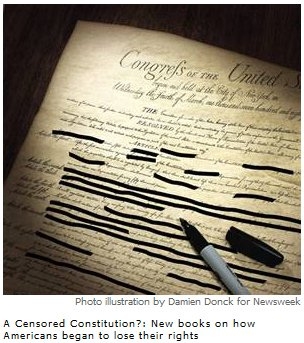
All it took was one elaborate terrorist attack to transform the Constitution and the Bill of Rights from the law of the land to a loose and weakened anachronism. Following 9/11, the fear of terrorism allowed the quick passage of the Patriot Act, and other laws and policies that greatly undercut our long history of freedom and civil liberties.
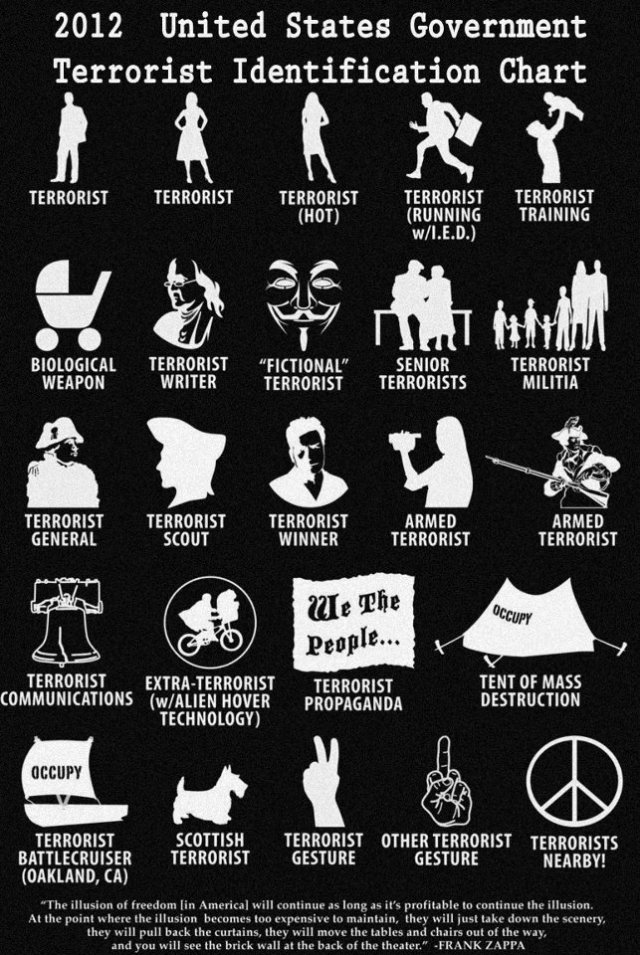
Some examples of our lost liberties and protections: search and seizure of homes and businesses without the owner’s consent or court order, warrantless wiretapping of U.S. citizens, indefinite detention of citizens and even assassination of citizens by the government without a court order, torture and/or rendition to countries who will torture for us, greater restrictions on peaceful protest and assembly. The government can legally obtain your library and other records, and prosecute librarians and record keepers if they let you know. The list goes on and on. All it takes is the mention of the word “terrorism,” and more of our established hard-fought Constitutional rights and protections crumble into dust.
5th Great Thing: Anybody Can Succeed in America (Or Once Could)
Remember the American Dream: Anybody can succeed in this country. Work hard, live right, and at the very least you will be rewarded with a secure middle class life, with a home and cars, and a college education for your children. That dream is turning into a fantasy. Recent studies have found that upward economic mobility in the U.S. is less likely here than in Canada and most European countries.
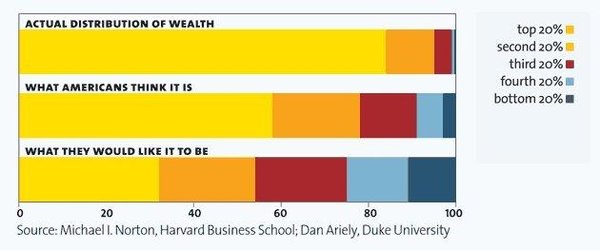
The widening gap in economic inequality is a big factor in our fall from grace. America is heading down a path toward third-world status, ranking close to the bottom of income disparity among all nations. As Occupy Wall Street has pointed out, the top one percent earn about 24% of the nation’s income, and 40% of the nation’s wealth. The wealthiest 400 Americans are worth more than the entire bottom half of the country. And the inequality gap continues to widen as the wealthy accumulate more money while paying less taxes.
Conclusion
American Exceptionalism was a case convincingly made through much of the 20th Century, but a much harder sell today. The forward-looking, compassionate America I grew up in during the 1950s, 60s and 70s has disappeared, replaced by a greedier, meaner nation, afflicted with fear, distrust and callousness.
Our political and economic systems are seriously broken. Our freedoms and constitutional rights, once taken for granted, are disappearing; our military empire is expanding, and the middle class is shrinking away, its wealth shifting upward into the bloated, low-taxed portfolios of the One Percent.
I would like to think the exceptional America I knew as a youngster is still salvageable, that it still holds the great promise its founders envisioned: an optimistic nation that cares about people more than profits, and treats everyone, here and abroad, including the most disadvantaged, with dignity and respect. If that now-dormant spirit can be revived and re-energized, then that America is worth fighting for.
A massive restructuring of American society is necessary if there is to be any hope of recapturing the greatness that previously existed. It will require the active commitment and effort of massive numbers of angry and frustrated citizens taking to the streets and demanding it, because the traditional political system has broken down. Whether the boots on the ground come from Occupy or elsewhere, American culture and society requires significant reforming and revitalizing, which won’t happen until millions of Americans march in the streets and demand it. The American people may not be ready yet, but as conditions worsen, eventually they will be.
ALSO PUBLISHED IN OPEDNEWS.COM June 21, 2012


 gonzoville.deviantart.com