
SECRETS AND LIES OF THE BAILOUT
The federal rescue of Wall Street didn’t fix the economy – it created a permanent bailout state based on a Ponzi-like confidence scheme. And the worst may be yet to come
By Matt Taibbi/ Rolling Stone/ January 4, 2013

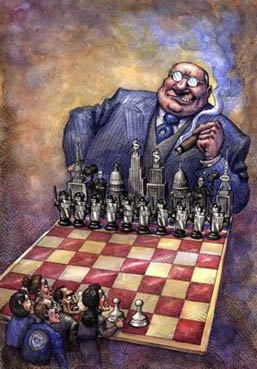
Illustration by Victor Juhasz
It has been four long winters since the federal government, in the hulking, shaven-skulled, Alien Nation-esque form of then-Treasury Secretary Hank Paulson, committed $700 billion in taxpayer money to rescue Wall Street from its own chicanery and greed. To listen to the bankers and their allies in Washington tell it, you’d think the bailout was the best thing to hit the American economy since the invention of the assembly line. Not only did it prevent another Great Depression, we’ve been told, but the money has all been paid back, and the government even made a profit. No harm, no foul – right?
Wrong.
It was all a lie – one of the biggest and most elaborate falsehoods ever sold to the American people. We were told that the taxpayer was stepping in – only temporarily, mind you – to prop up the economy and save the world from financial catastrophe. What we actually ended up doing was the exact opposite: committing American taxpayers to permanent, blind support of an ungovernable, unregulatable, hyperconcentrated new financial system that exacerbates the greed and inequality that caused the crash, and forces Wall Street banks like Goldman Sachs and Citigroup to increase risk rather than reduce it. The result is one of those deals where one wrong decision early on blossoms into a lush nightmare of unintended consequences. We thought we were just letting a friend crash at the house for a few days; we ended up with a family of hillbillies who moved in forever, sleeping nine to a bed and building a meth lab on the front lawn.
How Wall Street Killed Financial Reform
But the most appalling part is the lying. The public has been lied to so shamelessly and so often in the course of the past four years that the failure to tell the truth to the general populace has become a kind of baked-in, official feature of the financial rescue. Money wasn’t the only thing the government gave Wall Street – it also conferred the right to hide the truth from the rest of us. And it was all done in the name of helping regular people and creating jobs. “It is,” says former bailout Inspector General Neil Barofsky, “the ultimate bait-and-switch.”
The bailout deceptions came early, late and in between. There were lies told in the first moments of their inception, and others still being told four years later. The lies, in fact, were the most important mechanisms of the bailout. The only reason investors haven’t run screaming from an obviously corrupt financial marketplace is because the government has gone to such extraordinary lengths to sell the narrative that the problems of 2008 have been fixed. Investors may not actually believe the lie, but they are impressed by how totally committed the government has been, from the very beginning, to selling it.
THEY LIED TO PASS THE BAILOUT
Today what few remember about the bailouts is that we had to approve them. It wasn’t like Paulson could just go out and unilaterally commit trillions of public dollars to rescue Goldman Sachs and Citigroup from their own stupidity and bad management (although the government ended up doing just that, later on). Much as with a declaration of war, a similarly extreme and expensive commitment of public resources, Paulson needed at least a film of congressional approval. And much like the Iraq War resolution, which was only secured after George W. Bush ludicrously warned that Saddam was planning to send drones to spray poison over New York City, the bailouts were pushed through Congress with a series of threats and promises that ranged from the merely ridiculous to the outright deceptive. At one meeting to discuss the original bailout bill – at 11 a.m. on September 18th, 2008 – Paulson actually told members of Congress that $5.5 trillion in wealth would disappear by 2 p.m. that day unless the government took immediate action, and that the world economy would collapse “within 24 hours.”
To be fair, Paulson started out by trying to tell the truth in his own ham-headed, narcissistic way. His first TARP proposal was a three-page absurdity pulled straight from a Beavis and Butt-Head episode – it was basically Paulson saying, “Can you, like, give me some money?” Sen. Sherrod Brown, a Democrat from Ohio, remembers a call with Paulson and Federal Reserve chairman Ben Bernanke. “We need $700 billion,” they told Brown, “and we need it in three days.” What’s more, the plan stipulated, Paulson could spend the money however he pleased, without review “by any court of law or any administrative agency.”
The White House and leaders of both parties actually agreed to this preposterous document, but it died in the House when 95 Democrats lined up against it. For an all-too-rare moment during the Bush administration, something resembling sanity prevailed in Washington.
So Paulson came up with a more convincing lie. On paper, the Emergency Economic Stabilization Act of 2008 was simple: Treasury would buy $700 billion of troubled mortgages from the banks and then modify them to help struggling homeowners. Section 109 of the act, in fact, specifically empowered the Treasury secretary to “facilitate loan modifications to prevent avoidable foreclosures.” With that promise on the table, wary Democrats finally approved the bailout on October 3rd, 2008. “That provision,” says Barofsky, “is what got the bill passed.”
But within days of passage, the Fed and the Treasury unilaterally decided to abandon the planned purchase of toxic assets in favor of direct injections of billions in cash into companies like Goldman and Citigroup. Overnight, Section 109 was unceremoniously ditched, and what was pitched as a bailout of both banks and homeowners instantly became a bank-only operation – marking the first in a long series of moves in which bailout officials either casually ignored or openly defied their own promises with regard to TARP.
Congress was furious. “We’ve been lied to,” fumed Rep. David Scott, a Democrat from Georgia. Rep. Elijah Cummings, a Democrat from Maryland, raged at transparently douchey TARP administrator (and Goldman banker) Neel Kashkari, calling him a “chump” for the banks. And the anger was bipartisan: Republican senators David Vitter of Louisiana and James Inhofe of Oklahoma were so mad about the unilateral changes and lack of oversight that they sponsored a bill in January 2009 to cancel the remaining $350 billion of TARP.
So what did bailout officials do? They put together a proposal full of even bigger deceptions to get it past Congress a second time. That process began almost exactly four years ago – on January 12th and 15th, 2009 – when Larry Summers, the senior economic adviser to President-elect Barack Obama, sent a pair of letters to Congress. The pudgy, stubbyfingered former World Bank economist, who had been forced out as Harvard president for suggesting that women lack a natural aptitude for math and science, begged legislators to reject Vitter’s bill and leave TARP alone.
In the letters, Summers laid out a five-point plan in which the bailout was pitched as a kind of giant populist program to help ordinary Americans. Obama, Summers vowed, would use the money to stimulate bank lending to put people back to work. He even went so far as to say that banks would be denied funding unless they agreed to “increase lending above baseline levels.” He promised that “tough and transparent conditions” would be imposed on bailout recipients, who would not be allowed to use bailout funds toward “enriching shareholders or executives.” As in the original TARP bill, he pledged that bailout money would be used to aid homeowners in foreclosure. And lastly, he promised that the bailouts would be temporary – with a “plan for exit of government intervention” implemented “as quickly as possible.”
The reassurances worked. Once again, TARP survived in Congress – and once again, the bailouts were greenlighted with the aid of Democrats who fell for the old “it’ll help ordinary people” sales pitch. “I feel like they’ve given me a lot of commitment on the housing front,” explained Sen. Mark Begich, a Democrat from Alaska.
But in the end, almost nothing Summers promised actually materialized. A small slice of TARP was earmarked for foreclosure relief, but the resultant aid programs for homeowners turned out to be riddled with problems, for the perfectly logical reason that none of the bailout’s architects gave a shit about them. They were drawn up practically overnight and rushed out the door for purely political reasons – to trick Congress into handing over tons of instant cash for Wall Street, with no strings attached. “Without those assurances, the level of opposition would have remained the same,” says Rep. Raúl Grijalva, a leading progressive who voted against TARP. The promise of housing aid, in particular, turned out to be a “paper tiger.”
HAMP, the signature program to aid poor homeowners, was announced by President Obama on February 18th, 2009. The move inspired CNBC commentator Rick Santelli to go berserk the next day – the infamous viral rant that essentially birthed the Tea Party. Reacting to the news that Obama was planning to use bailout funds to help poor and (presumably) minority homeowners facing foreclosure, Santelli fumed that the president wanted to “subsidize the losers’ mortgages” when he should “reward people that could carry the water, instead of drink the water.” The tirade against “water drinkers” led to the sort of spontaneous nationwide protests one might have expected months before, when we essentially gave a taxpayer-funded blank check to Gamblers Anonymous addicts, the millionaire and billionaire class.
In fact, the amount of money that eventually got spent on homeowner aid now stands as a kind of grotesque joke compared to the Himalayan mountain range of cash that got moved onto the balance sheets of the big banks more or less instantly in the first months of the bailouts. At the start, $50 billion of TARP funds were earmarked for HAMP. In 2010, the size of the program was cut to $30 billion. As of November of last year, a mere $4 billion total has been spent for loan modifications and other homeowner aid.
In short, the bailout program designed to help those lazy, job-averse, “water-drinking” minority homeowners – the one that gave birth to the Tea Party – turns out to have comprised about one percent of total TARP spending. “It’s amazing,” says Paul Kiel, who monitors bailout spending for ProPublica. “It’s probably one of the biggest failures of the Obama administration.”
The failure of HAMP underscores another damning truth – that the Bush-Obama bailout was as purely bipartisan a program as we’ve had. Imagine Obama retaining Don Rumsfeld as defense secretary and still digging for WMDs in the Iraqi desert four years after his election: That’s what it was like when he left Tim Geithner, one of the chief architects of Bush’s bailout, in command of the no-stringsattached rescue four years after Bush left office.
Yet Obama’s HAMP program, as lame as it turned out to be, still stands out as one of the few pre-bailout promises that was even partially fulfilled. Virtually every other promise Summers made in his letters turned out to be total bullshit. And that includes maybe the most important promise of all – the pledge to use the bailout money to put people back to work.
(CONTINUED-Read Entire Article HERE)







 thebigpicturereport ™
Freedom Isn’t Free
BPR Quote of the Day:
Share this: