
BPR Quote of the Day
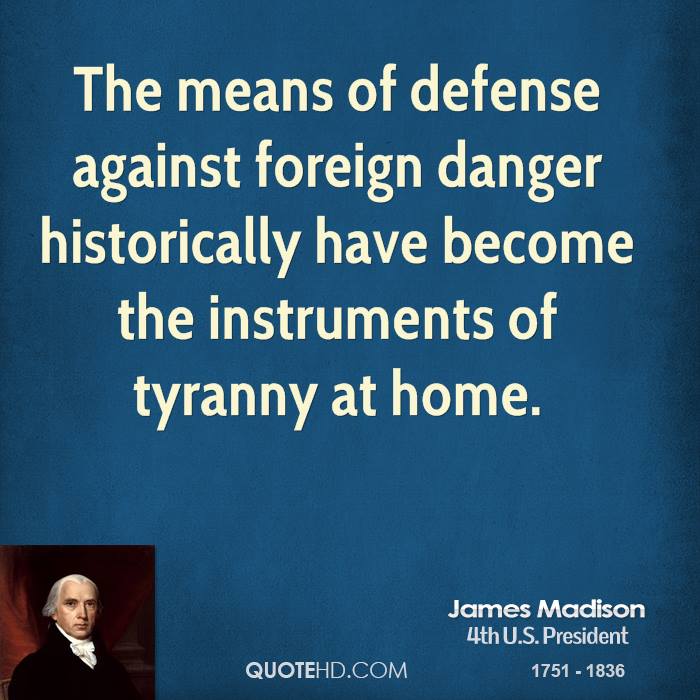
BPR Quote of the Day
BPR Quote of the Day
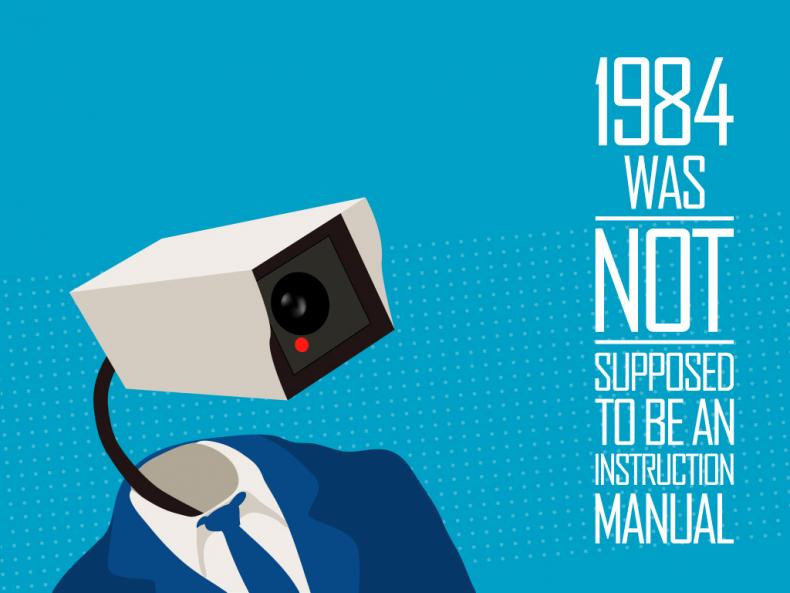
“The technotronic era involves the gradual appearance of a more controlled society. Such a society would be dominated by an elite, unrestrained by traditional values. Soon it will be possible to assert almost continuous surveillance over every citizen and maintain up-to-date complete files containing even the most personal information about the citizen. These files will be subject to instantaneous retrieval by the authorities. ”
Zbigniew Brzezinski (1970)
from Between Two Ages: America’s Role in the Technetronic Era
By Chris Hedges/ Truthdig/ September 16, 2013
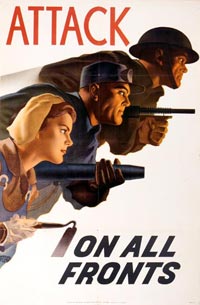
The intoxication of war, fueled by the euphoric nationalism that swept through the country like a plague following the attacks of 9/11, is a spent force in the United States. The high-blown rhetoric of patriotism and national destiny, of the sacred duty to reshape the world through violence, to liberate the enslaved and implant democracy in the Middle East, has finally been exposed as empty and meaningless. The war machine has tried all the old tricks. It trotted out the requisite footage of atrocities. It issued the histrionic warnings that the evil dictator will turn his weapons of mass destruction against us if we do not bomb and “degrade” his military. It appealed to the nation’s noble sacrifice in World War II, with the Secretary of State John Kerry calling the present situation a “Munich moment.”But none of it worked. It was only anoffhand remarkby Kerry that opened the door to a Russian initiative, providing the Obama administration a swift exit from its mindless bellicosity and what would have been a humiliating domestic defeat. Twelve long years of fruitless war in Afghanistan and another 10 in Iraq have left the public wary of the lies of politicians, sick of the endless violence of empire and unwilling to continue to pump trillions of dollars into a war machine that has made a small cabal of defense contractors and arms manufacturers such as Raytheon and Halliburton huge profits while we are economically and politically hollowed out from the inside. The party is over.
The myth of war, as each generation discovers over the corpses of its young and the looting of its national treasury by war profiteers, is a lie. War is no longer able to divert Americans from the economic and political decay that is rapidly turning the nation into a corporate oligarchy, a nation where “the consent of the governed” is a cruel joke. War cannot hide what we have become. War has made us a nation that openly tortures and holds people indefinitely in our archipelago of offshore penal colonies. War has unleashed death squads—known as special operations forces—to assassinate our enemies around the globe, even American citizens. War has seen us terrorize whole populations, including populations with which we are not officially at war, with armed drones that circle night and day above mud-walled villages in Pakistan, Yemen and Somalia as well as Iraq and Afghanistan. War has shredded, in the name of national security, our most basic civil liberties. War has turned us into the most spied-upon, monitored, eavesdropped and photographed population in human history. War has seen our most courageous dissidents and whistle-blowers—those who warned us of the crimes of war and empire, from Chelsea (formerly Bradley) Manning to Edward Snowden—become persecuted political prisoners or the hunted. War has made a few very rich, as it always does, as our schools, libraries and firehouses are closed in the name of fiscal austerity, basic social service programs for children and the elderly are shut down, cities such as Detroit declare bankruptcy, and chronic underemployment and unemployment hover at 15 percent, perhaps 20. No one knows the truth anymore about America. The vast Potemkin village we have become, the monstrous lie that is America, includes the willful manipulation of financial and official statistics from Wall Street and Washington.
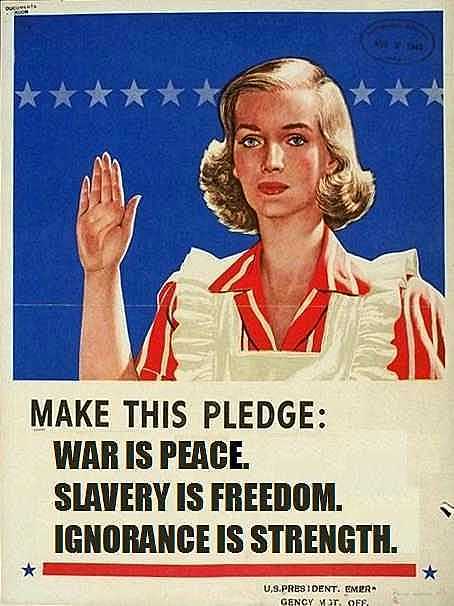
We are slowly awakening, after years on a drunken bender, to the awful pain of sobriety and the unpleasant glare of daylight. We are being forced to face grim truths about ourselves and the war machine. We have understood that we cannot impart our “virtues” through violence, that all talk of human rights, once you employ the industrial weapons of the modern battlefield, is absurd. We see through the Orwellian assertions made by Barack Obama and John Kerry, who have assured the world that the United States is considering only an “unbelievably small, limited” strikeon Syria that is not a war. We know that the Pentagon’s plan to obliterate the command bunkers, airfields or the artillery batteries and rocket launchers used to fire chemical projectiles is indeed what the politicians insist it is not—a war. We know that the launching of several hundred Tomahawk missiles from destroyers and submarines in the Mediterranean Sea on Syrian military and command installations would be perceived by the Syrians—as we would should such missiles be launched against us—as an act of war. A Tomahawk carries a 1,000-pound bomb or 166 cluster bombs. One Tomahawk has appalling destructive power. Hundreds mean indiscriminate death from the sky. We have heard the careful parsing that does not preclude, should the Pandora’s box of war be opened and chaos envelope Syria, the possible deployment of troops on the ground. We have listened to Gen. Martin Dempsey, chairman of the Joint Chiefs of Staff, concede that “there is a probability for collateral damage.” We know this means civilians will be killed to prevent the regime of Bashar Assad from killing civilians. Only the circular logic of war makes such a proposition rational. And this circular logic, no longer obscured by the waving of flags, the bombast of “glory and honor,” the cant of politicians, the self-exaltation that comes with the disease of nationalism, means that Barack Obama and the war machine he serves are going to face a wave of popular revulsion if he starts another war.
BPR Quote of the Day
One of the most deceptive ideas continuously sounded by the Right (and its fathomless think tanks and media outlets) is that the “free market” is natural and inevitable, existing outside and beyond government. So whatever inequality or insecurity it generates is beyond our control. And whatever ways we might seek to reduce inequality or insecurity — to make the economy work for us — are unwarranted constraints on the market’s freedom, and will inevitably go wrong.
By this view, if some people aren’t paid enough to live on, the market has determined they aren’t worth enough. If others rake in billions, they must be worth it. If millions of Americans remain unemployed or their paychecks are shrinking or they work two or three part-time jobs with no idea what they’ll earn next month or next week, that’s too bad; it’s just the outcome of the market.
According to this logic, government shouldn’t intrude through minimum wages, high taxes on top earners, public spending to get people back to work, regulations on business, or anything else, because the “free market” knows best.
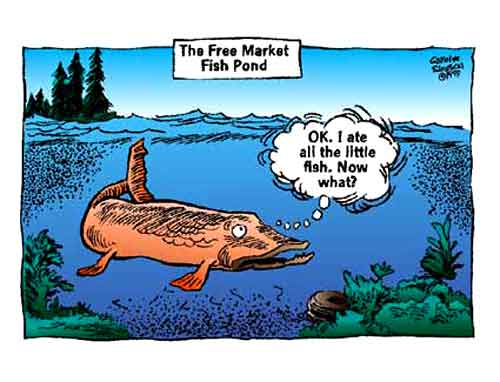 In reality, the “free market” is a bunch of rules about (1) what can be owned and traded (the genome? slaves? nuclear materials? babies? votes?); (2) on what terms (equal access to the internet? the right to organize unions? corporate monopolies? the length of patent protections? ); (3) under what conditions (poisonous drugs? unsafe foods? deceptive Ponzi schemes? uninsured derivatives? dangerous workplaces?) (4) what’s private and what’s public (police? roads? clean air and clean water? healthcare? good schools? parks and playgrounds?); (5) how to pay for what (taxes, user fees, individual pricing?). And so on.
These rules don’t exist in nature; they are human creations. Governments don’t “intrude” on free markets; governments organize and maintain them. Markets aren’t “free” of rules; the rules define them.
The interesting question is what the rules should seek to achieve. They can be designed to maximize efficiency (given the current distribution of resources), or growth (depending on what we’re willing to sacrifice to obtain that growth), or fairness (depending on our ideas about a decent society). Or some combination of all three — which aren’t necessarily in competition with one another. Evidence suggests, for example, that if prosperity were more widely shared, we’d have faster growth.
The rules can even be designed to entrench and enhance the wealth of a few at the top, and keep almost everyone else comparatively poor and economically insecure.
Which brings us to the central political question: Who should decide on the rules, and their major purpose? If our democracy was working as it should, presumably our elected representatives, agency heads, and courts would be making the rules roughly according to what most of us want the rules to be. The economy would be working for us; we wouldn’t be working for the economy.
Instead, the rules are being made mainly by those with the power and resources to buy the politicians, regulatory heads, and even the courts (and the lawyers who appear before them). As income and wealth have concentrated at the top, so has political clout. And the most important clout is determining the rules of the game.
Not incidentally, these are the same people who want you and most others to believe in the fiction of an immutable “free market.”
If we want to reduce the savage inequalities and insecurities that are now undermining our economy and democracy, we shouldn’t be deterred by the myth of the “free market.” We can make the economy work for us, rather than the other way around. But in order to change the rules, we must exert the power that is supposed to be ours.
BPR Quote of the Day
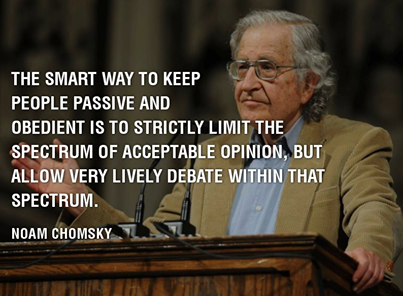
“Group think” is alive and well in Official Washington, with virtually all the important pundits marching in lock-step with the Obama administration’s accusations against the Syrian government and everyone fuming over an Op-Ed by Russian President Vladimir Putin.
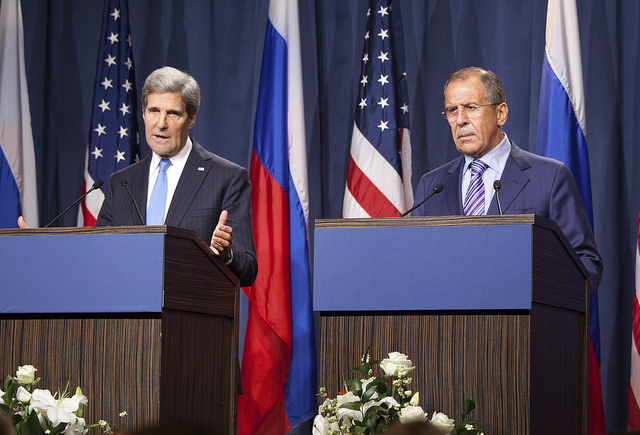 U.S. Secretary of State John Kerry at a joint press conference regarding the Syrian crisis with Russian Foreign Minister Sergey Lavrov. (State Department photo)There is something troubling — even a bit scary — to watch the mainstream U.S. media in a full stampede as we’re now seeing over the issue of the Syrian civil war and against Russian attempts to find a diplomatic way to steer the American pack from rushing over the cliff into another U.S. military intervention. Nearly every U.S. pundit and politician — from neocon to liberal — is charging off in the same direction, accepting undocumented U.S. government claims about Syria’s alleged chemical attack on Aug. 21 as undeniably true and deriding Russian President Vladimir Putin for a New York Times Op-Ed that had the audacity to defend the Nuremberg principles against aggressive war. “Under current international law, force is permitted only in self-defense or by the decision of the Security Council,” Putin wrote, making an obvious and incontrovertible point. “Anything else is unacceptable under the United Nations Charter and would constitute an act of aggression.” Putin then added: “It is alarming that military intervention in internal conflicts in foreign countries has become commonplace for the United States. Is it in America’s long-term interest? I doubt it. Millions around the world increasingly see America not as a model of democracy but as relying solely on brute force, cobbling coalitions together under the slogan ‘you’re either with us or against us.'” Again, what Putin is saying here is clearly true, really not even debatable. U.S. presidents and pundits love to talk about America as the “indispensable nation,” a reference to its recurring role as a military interventionist around the world, supposedly to protect the interests of the “Free World” and “Civilization.” But Putin really got under the skin of the U.S. establishment when he disagreed with President Barack Obama’s defense of “American exceptionalism.” Putin wrote, “It is extremely dangerous to encourage people to see themselves as exceptional, whatever the motivation. There are big countries and small countries, rich and poor, those with long democratic traditions and those still finding their way to democracy. Their policies differ, too. We are all different, but when we ask for the Lord’s blessings, we must not forget that God created us equal.” Yet, for making these rather banal points, Putin was inundated with insults across Official Washington. Politicians said they were sickened by his affront, one even to the point of vomiting. Liberal Washington Post columnist Eugene Robinson, usually a thoughtful writer, mocked the Russian president in highly personal terms. “As I read Vladimir Putin’s sanctimonious op-ed about U.S. policy in Syria, I imagined the Russian president sitting at the keyboard in a lovely pink negligee,” Robinson wrote in a column entitled “Exceptional? You bet.” Buying the Official Story Beyond reflecting the conventional wisdom’s contempt for Putin, Robinson, like nearly every major U.S. opinion-leader, has accepted the U.S. government’s version of events regarding the alleged chemical attack on a Damascus suburb on Aug. 21. Though the Obama administration has not released a single piece of verifiable evidence to support its “Government Assessment” fingering the regime of Bashar al-Assad, Robinson and his colleagues now report those assertions as flat fact, including the strange calculation that precisely “1,429” people died from poison gas. Other estimates have cited several hundred deaths, and the U.S. government has not explained the provenance of its number. Yet, the U.S. tally of the dead and other claims are good enough for the American pundit class, evidence not required. “When we see more than 1,400 men, women and children killed with poison gas, it is not our nature to look the other way,” Robinson wrote. “The moral case for a strike against the Assad regime is predicated on the fact that if the United States doesn’t do something, nobody will.” But Robinson was far from alone in his contempt for Putin and acceptance of the U.S. rendition of the murky events of Aug. 21 half a world away. Up and down the opinion pages of American newspapers, there was mouth-open-wide credulity. Beyond the opinion pages and TV chat shows, I’ve heard the same conformity of opinion from usually thoughtful think-tank “experts.” It’s clear that any skepticism now, even just calling for public release of the U.S. evidence, is a threat to one’s career. You might have hoped that one thing the U.S. mainstream press and pundits would have learned from the Iraq War — not to mention other misguided “group think” going back to the Tonkin Gulf resolution and beyond — is that the U.S. government is not always right in its assessments. Skepticism should not be equated with conspiracism. Yet, over the last couple of weeks, I’ve been hearing a derisive and condescending tone slip into the words of the “respectable” opinion shapers toward any suggestion that the Obama administration should release recordings of intercepts, satellite photos of troop movements and other supposed proof to back up its accusations. (CONTINUED-READ ENTIRE ARTICLE HERE) |
By Arlen Grossman/ The Big Picture Report
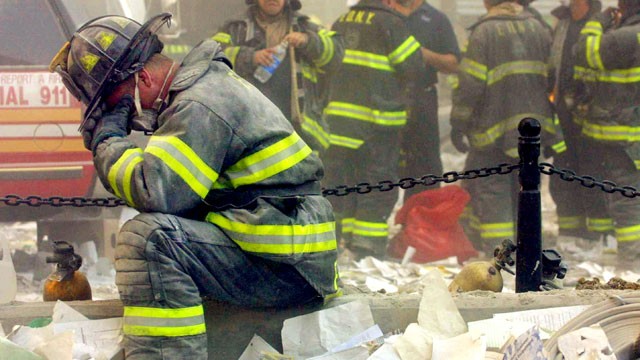
No, we mustn’t forget 9/11 and the thousands of unfortunate victims of that fateful day. I just wish we didn’t dwell on it. The aftermath of that horrendous attack changed our country in major ways–and all of them bad.
What is the point of dwelling on a horrible attack from which no good lessons were learned and for which we reacted in the worst possible ways? Why dwell on an event that pushed us into the easily frightened and bellicose people we are today?
Because of our heightened fear, we re-elected an incompetent, shallow-minded president, and illegally invaded and occupied countries that weren’t even responsible for 9/11. Because of that fear, we were able to justify crimes rationalized as “enhanced interrogation” (torture), “extraordinary rendition” (torture by proxy), and “collateral damage” (killing innocent civilians).
Why should we dwell on a tragic event that helped spur us into a more militaristic nation waging perpetual war–which allowed us to justify extravagant spending on the military/industrial complex while siphoning money from where it was desperately needed: schools, infrastructure, jobs, and social services.
Why dwell on an event that allowed us to meekly and willingly surrender so many of our constitutionally guaranteed civil liberties and privacy, while becoming history’s most efficient surveillance state.
No, the victims of 9/11 shouldn’t be forgotten. But neither should we overly dwell on that horrific day that changed us into a nation our founders would be shocked to observe. A nation that in twelve years has changed from the land of the free into a fearful and divided military/security state ruled by leaders who no longer care about privacy, compassion, nor peace.
Next anniversary, we should remember 9/11, but please, let’s not dwell on it. Our leaders failed to learn and we continue to pay a stiff price for the belligerent and frightened way we responded. At some point we need to learn from those mistakes.
When we do, that would be reason to dwell.
BPR Quote of the Day
 thebigpicturereport ™