
-
Recent Posts
-
Join 441 other subscribers
Categories
Archives
- October 2026
- September 2026
- August 2026
- July 2026
- June 2026
- May 2026
- April 2026
- March 2026
- February 2026
- January 2026
- December 2025
- November 2025
- October 2025
- September 2025
- August 2025
- July 2025
- June 2025
- May 2025
- April 2025
- March 2025
- February 2025
- January 2025
- December 2024
- November 2024
- October 2024
- September 2024
- August 2024
- July 2024
- June 2024
- May 2024
- April 2024
- March 2024
- February 2024
- January 2024
- December 2023
- November 2023
- October 2023
- September 2023
- August 2023
- July 2023
- June 2023
- May 2023
- April 2023
- March 2023
- February 2023
- January 2023
- December 2022
- November 2022
- October 2022
- September 2022
- August 2022
- July 2022
- June 2022
- May 2022
- April 2022
- March 2022
- February 2022
- January 2022
- December 2021
- November 2021
- October 2021
- September 2021
- August 2021
- August 2020
- July 2020
- June 2020
- May 2020
- April 2020
- March 2020
- February 2020
- January 2020
- December 2019
- November 2019
- October 2019
- September 2019
- August 2019
- July 2019
- June 2019
- May 2019
- April 2019
- March 2019
- February 2019
- January 2019
- December 2018
- November 2018
- October 2018
- September 2018
- August 2018
- July 2018
- June 2018
- May 2018
- April 2018
- March 2018
- February 2018
- January 2018
- December 2017
- November 2017
- October 2017
- September 2017
- August 2017
- July 2017
- June 2017
- May 2017
- April 2017
- March 2017
- February 2017
- January 2017
- December 2016
- November 2016
- October 2016
- September 2016
- August 2016
- July 2016
- June 2016
- May 2016
- April 2016
- March 2016
- February 2016
- January 2016
- December 2015
- November 2015
- October 2015
- September 2015
- August 2015
- July 2015
- May 2015
- April 2015
- March 2015
- February 2015
- January 2015
- November 2014
- October 2014
- September 2014
- August 2014
- July 2014
- June 2014
- February 2014
- January 2014
- December 2013
- November 2013
- October 2013
- September 2013
- August 2013
- March 2013
- February 2013
- January 2013
- December 2012
- November 2012
- October 2012
- September 2012
- August 2012
- July 2012
- June 2012
- May 2012
- April 2012
- March 2012
- February 2012
- January 2012
- December 2011
- November 2011
- October 2011
- September 2011
- August 2011
- July 2011
- June 2011
- May 2011
- April 2011
- March 2011
- January 2011
- December 2010
Blogroll
Meta
It’s Monday Again On Halitics…..
Posted in America, climate change, debates, Democratic Party, Donald Trump, global warming, Joe Biden, media, politics, Republican Party
Tagged Arlen Grossman, Cornel West, Hal Ginsberg, Halitics
Leave a comment
Donald Trump, David Brooks, Cornel West and More….
This is my appearance on Halitics, Hal Ginsberg’s daily YouTube Videocast about political issues. Hal and I go back a long ways. He started a progressive talk radio station in Monterey, CA in 2005. I participated when I could and had a great time. Hal sold KRXA in 2012 and he and his family moved back to their hometown in Maryland. Now that I am spending a few months in Vermont and we share the same time zone, Hal invited me to appear on his show. Our first show together was today and it went well enough that we agreed I would come on every Monday. Watch it and let me know what you think.
Posted in debates, democracy, Donald Trump, extremism, media, politics, Republican Party
Tagged Arlen Grossman, Cornel West, David Brooks, Democratic Party, Hal Ginsberg, Halitics, Robert Reich, videocast, youtube
Leave a comment
What if We’re the Bad Guys Here?
By David Brooks/ NewYork Times/ August 2, 2023
Donald Trump seems to get indicted on a weekly basis. Yet he is utterly dominating his Republican rivals in the polls, and he is tiedwith Joe Biden in the general election surveys. Trump’s poll numbers are stronger against Biden now than at any time in 2020.
What’s going on here? Why is this guy still politically viable, after all he’s done?
We anti-Trumpers often tell a story to explain that. It was encapsulated in a quote the University of North Carolina political scientist Marc Hetherington gave to my colleague Thomas B. Edsall recently: “Republicans see a world changing around them uncomfortably fast, and they want it to slow down, maybe even take a step backward. But if you are a person of color, a woman who values gender equality or an L.G.B.T. person, would you want to go back to 1963? I doubt it.”
In this story, we anti-Trumpers are the good guys, the forces of progress and enlightenment. The Trumpers are reactionary bigots and authoritarians. Many Republicans support Trump no matter what, according to this story, because at the end of the day, he’s still the bigot in chief, the embodiment of their resentments and that’s what matters to them most.
I partly agree with this story, but it’s also a monument to elite self-satisfaction.
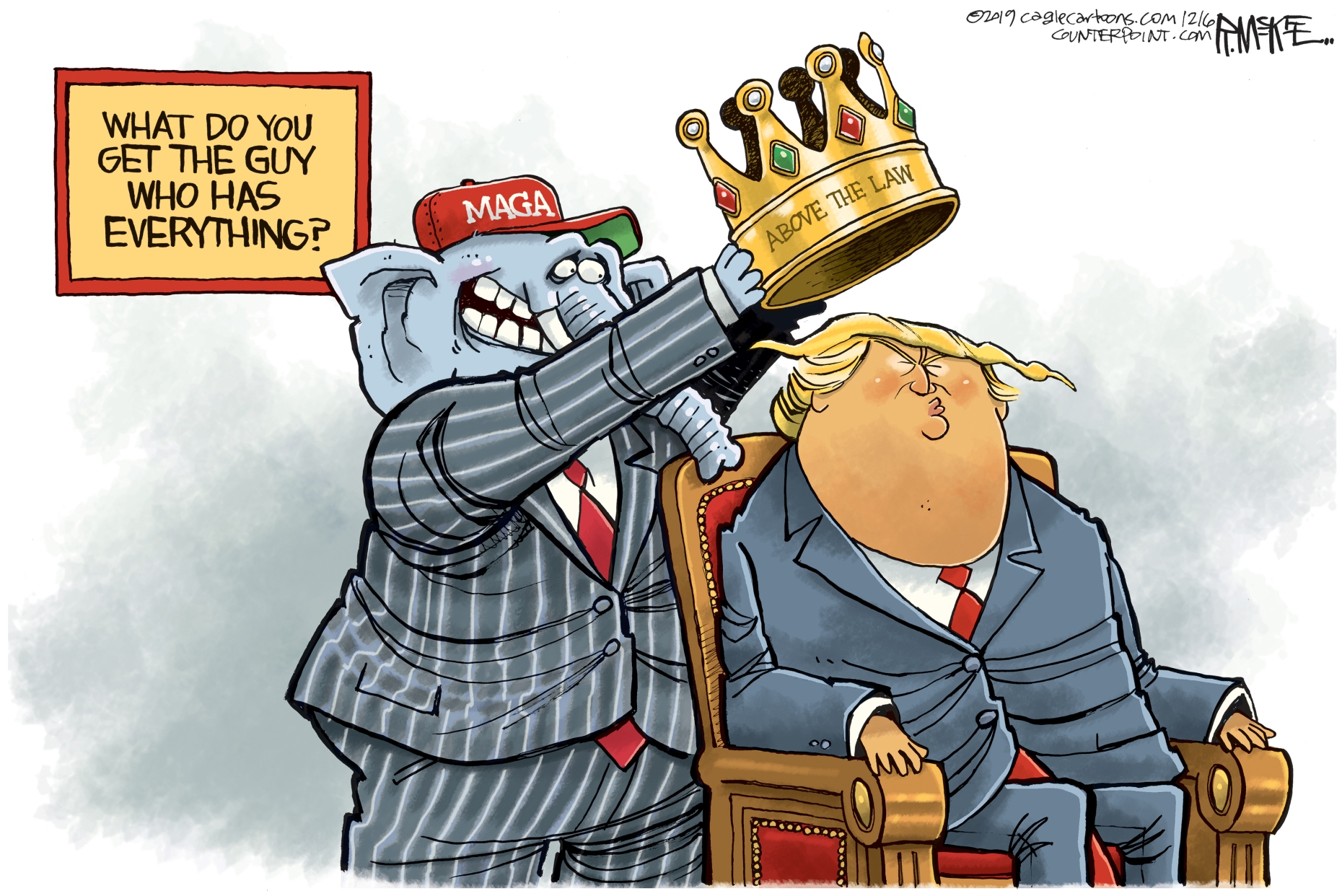
So let me try another story on you. I ask you to try on a vantage point in which we anti-Trumpers are not the eternal good guys. In fact, we’re the bad guys.
This story begins in the 1960s, when high school grads had to go off to fight in Vietnam but the children of the educated class got college deferments. It continues in the 1970s, when the authorities imposed busing on working-class areas in Boston but not on the upscale communities like Wellesley where they themselves lived.
The ideal that we’re all in this together was replaced with the reality that the educated class lives in a world up here and everybody else is forced into a world down there. Members of our class are always publicly speaking out for the marginalized, but somehow we always end up building systems that serve ourselves.
The most important of those systems is the modern meritocracy. We built an entire social order that sorts and excludes people on the basis of the quality that we possess most: academic achievement. Highly educated parents go to elite schools, marry each other, work at high-paying professional jobs and pour enormous resources into our children, who get into the same elite schools, marry each other and pass their exclusive class privileges down from generation to generation.
Daniel Markovits summarized years of research in his book “The Meritocracy Trap”: “Today, middle-class children lose out to the rich children at school, and middle-class adults lose out to elite graduates at work. Meritocracy blocks the middle class from opportunity. Then it blames those who lose a competition for income and status that, even when everyone plays by the rules, only the rich can win.”
The meritocracy isn’t only a system of exclusion; it’s an ethos. During his presidency, Barack Obama used the word “smart” in the context of his policies over 900 times. The implication was that anybody who disagreed with his policies (and perhaps didn’t go to Harvard Law) must be stupid.
Over the last decades, we’ve taken over whole professions and locked everybody else out. When I began my journalism career in Chicago in the 1980s, there were still some old crusty working-class guys around the newsroom. Now we’re not only a college-dominated profession; we’re an elite-college-dominated profession. Only 0.8 percent of college students graduate from the super-elite 12 schools (the Ivy League colleges, plus Stanford, M.I.T., Duke and the University of Chicago). A 2018 study found that more than 50 percent of the staff writers at the beloved New York Times and The Wall Street Journal attended one of the 29 most elite universities in the nation.
Writing in Compact magazine, Michael Lind observes that the upper-middle-class job market looks like a candelabrum: “Those who manage to squeeze through the stem of a few prestigious colleges and universities in their youth can then branch out to fill leadership positions in almost every vocation.”
Or, as Markovits puts it, “elite graduates monopolize the best jobs and at the same time invent new technologies that privilege superskilled workers, making the best jobs better and all other jobs worse.”
Members of our class also segregate ourselves into a few booming metro areas: San Francisco, D.C., Austin and so on. In 2020, Biden won only 500 or so counties, but together they are responsible for 71 percent of the American economy. Trump won over 2,500 counties, responsible for only 29 percent. Once we find our cliques, we don’t get out much. In the book “Social Class in the 21st Century,” the sociologist Mike Savage and his co-researchers found that the members of the highly educated class tend to be the most insular, measured by how often we have contact with those who have jobs unlike our own.

Armed with all kinds of economic, cultural and political power, we support policies that help ourselves. Free trade makes the products we buy cheaper, and our jobs are unlikely to be moved to China. Open immigration makes our service staff cheaper, but new, less-educated immigrants aren’t likely to put downward pressure on our wages.
Like all elites, we use language and mores as tools to recognize one another and exclude others. Using words like “problematic,” “cisgender,” “Latinx” and “intersectional” is a sure sign that you’ve got cultural capital coming out of your ears. Meanwhile, members of the less-educated classes have to walk on eggshells because they never know when we’ve changed the usage rules so that something that was sayable five years ago now gets you fired.
We also change the moral norms in ways that suit ourselves, never mind the cost to others. For example, there used to be a norm that discouraged people from having children outside marriage, but that got washed away during our period of cultural dominance, as we eroded norms that seemed judgmental or that might inhibit individual freedom.
After this social norm was eroded, a funny thing happened. Members of our class still overwhelmingly married and had children within wedlock. People without our resources, unsupported by social norms, were less able to do that. As Adrian Wooldridge points out in his magisterial 2021 book, “The Aristocracy of Talent,” “Sixty percent of births to women with only a high school certificate occur out of wedlock, compared with only 10 percent to women with a university degree.” That matters, he continues, because “the rate of single parenting is the most significant predictor of social immobility in the country.”
Does this mean that I think the people in my class are vicious and evil? No. Most of us are earnest, kind and public-spirited. But we take for granted and benefit from systems that have become oppressive. Elite institutions have become so politically progressive in part because the people in them want to feel good about themselves as they take part in systems that exclude and reject.
It’s easy to understand why people in less-educated classes would conclude that they are under economic, political, cultural and moral assault — and why they’ve rallied around Trump as their best warrior against the educated class. He understood that it’s not the entrepreneurs who seem most threatening to workers; it’s the professional class. Trump understood that there was great demand for a leader who would stick his thumb in our eyes on a daily basis and reject the whole epistemic regime that we rode in on.
If distrustful populism is your basic worldview, the Trump indictments seem like just another skirmish in the class war between the professionals and the workers, another assault by a bunch of coastal lawyers who want to take down the man who most aggressively stands up to them. Of course, the indictments don’t cause Trump supporters to abandon him. They cause them to become more fiercely loyal. That’s the polling story of the last six months.
Are Trump supporters right that the indictments are just a political witch hunt? Of course not. As a card-carrying member of my class, I still basically trust the legal system and the neutral arbiters of justice. Trump is a monster in the way we’ve all been saying for years and deserves to go to prison.
But there’s a larger context here. As the sociologist E. Digby Baltzell wrote decades ago, “History is a graveyard of classes which have preferred caste privileges to leadership.” That is the destiny our class is now flirting with. We can condemn the Trumpian populists until the cows come home, but the real question is: When will we stop behaving in ways that make Trumpism inevitable?
Posted in America, democracy, Donald Trump, Economics, government, inequality, politics, Republican Party
Tagged Daniel Markovits, David Brooks, New York Daily News
2 Comments
Greatest Political Ad EVER!!!!!
Posted in Abortion, elections, government, media, politics, Republican Party
Leave a comment
How to Ignore 4.5 Million Deaths
A review of Norman Solomon’s War Made Invisible
By Bryce Greene/ Fair.org/ August 1, 2023
Brown University’s Costs of War project released a study this year estimating that US-led wars since 9/11 have contributed directly and indirectly to 4.5 million deaths in the targeted countries. Those countries—Afghanistan, Iraq, Yemen, Pakistan, Libya, Somalia and Syria—have also seen an estimated 40–60 million peopledisplaced from their homes. This refugee crisis is as destructive as any war, and marks the largest number of refugees since the end of World War II. By all accounts, the US-led Global War on Terror has been a disaster for tens of millions of people.
When the study was released in May, there was only one report (Washington Post, 5/15/23) in all of America’s top newspapersthat brought attention to the staggering figure. The Hill (5/16/23) and a few smaller outlets (NY1, 5/17/23; UPI, 5/16/23) published pieces on the topic, but the bulk of corporate media did not deem it worthy of any coverage at all.
No solemn reflections about the war machine, no policy pieces about how we might avoid such devastation in the future, and certainly no op-eds calling for the wars’ architects to stand trial for their crimes.
How does our media environment so easily dismiss carnage of this scale? Norman Solomon’s new book, War Made Invisible: How America Hides the Human Toll of Its War Machine (New Press), offers a deep look at the media system that enables a monstrous war machine to extract such a heavy toll on the world with impunity.
Solomon’s book attempts to show how our institutions came to be so casual about burying the costs of US wars. He challenges the traditional myth of the American “free press” as a check on power, and instead shows how the media act as “a fourth branch of government.” This book serves as a survey of media malfeasance in recent history, but also as a meditation on the role of our media system in manufacturing consent for a brutal foreign policy for the entire world.
Useful victims
Solomon takes aim at the common, unchallenged assumptions that often shape how media portray conflicts. Persistent tropes, like the constant appeal for America to “lead the world,” and dangerously common euphemisms like “defense spending” contribute to a culture that worships a mythical version of America, while the empire’s true nature remains hidden.

FAIR.org (3/18/22): In the Ukraine War, US corporate media discovered a “newfound ability to cover the impact on civilians—when those civilians are white and under attack by an official US enemy, rather than by the US itself.”
One key aspect of that myth-building is the selective way US media cover civilian victims. Some are covered extensively, eliciting calls for revenge, while others are ignored entirely—depending on who the aggressor is. Solomon recalls a critical moment just a few weeks into the US invasion of Afghanistan—at a time when, as the Washington Post (10/31/01) reported, “more errant US bombs have landed in residential areas, causing damage to such places as a Red Cross warehouse and senior citizens’ center.” Images of these atrocities had sparked “criticism of the American war effort.”
At CNN, chair Walter Isaacson declared in a memo to staff that it “seems perverse to focus too much on the casualties or hardship in Afghanistan.” When the network did cover the toll on civilians, Isaacson told the Washington Post (10/31/01), “You want to make sure people understand…it’s in the context of a terrorist attack that caused enormous suffering in the United States.” John Moody, the vice president of Fox News at the time, called the directive “not at all a bad thing,” because “Americans need to remember what started this.” The coverage was designed to reinforce the US government line of a noble cause, to shield viewers from the toll on civilians, and justify them if they were shown.
The media’s expedient treatment of civilian suffering has continued to this day. In the Russian invasion of Ukraine, where civilian casualties supported rather than hindered the message the media wanted to send, the coverage was reversed (FAIR.org, 3/18/22). “By any consistent standard,” Solomon writes, “the horrors that the US military had brought to so many civilians since the autumn of 2001 were no less terrible for the victims than what Russia was doing in Ukraine.” Despite that, the media coverage of Ukraine was “vastly more immediate, graphic, extensive and outraged about Russia’s slaughter than America’s slaughter.”
During April 2022, the New York Times published 14 front-page stories on civilian casualties from Russia’s military offensive. During a comparable period after the US invasion of Iraq, there was only one front-page story about civilian victims of the US attack (FAIR.org, 6/9/22).
Media boundaries
Looming over any current discussion of news media is their abysmal reporting of the Global War on Terror. Solomon uses the case of Iraq to demonstrate the boundaries of our media system, both top-down and self-imposed.
Through social filtering, the journalists who end up covering wars for elite institutions often have internalized the assumptions that justify the empire. Journalist Reese Erlich (Target Iraq, Solomon and Erlich) recounted that he “didn’t meet a single foreign reporter in Iraq who disagreed with the notion that the US and Britain have the right to overthrow the Iraqi government by force.” This selection bias was clearly reflected in the West’s acquiescent coverage of the war.

Ashleigh Banfield (4/24/03): “There is a grand difference between journalism and coverage, and getting access does not mean you’re getting the story.”
Other times, boundaries can be rigidly and publicly reinforced, as in the case of the young journalist Ashleigh Banfield. Banfield was a journalist who ascended the heights of cable news. A rising star, Banfield’s career at NBC hit a wall after she made a speech in April 2003 deeply critical of how the media obscured the harsh realities of the Iraq War. She told an audience at Kansas State University:
What didn’t you see? You didn’t see where those bullets landed. You didn’t see what happened when the mortar landed… There are horrors that were completely left out of this war.
Television coverage of the war, Banfield said, was “a glorious wonderful picture that had a lot of people watching and a lot of advertisers excited.”
NBC announced that it was “deeply disappointed and troubled by her remarks.” Her punishment was swift and harsh:
I was officeless for ten months. No phone, no computer…. Eventually after ten months of this, I was given an office that was a tape closet…. The message was crystal clear.
The message wasn’t just for Banfield. Journalists could not help but pay close attention to this destruction of one of their own. If they stray outside the unspoken bounds set by corporate media’s owners, they could share Banfield’s fate or worse.
Accepting forever wars

Even war critics give the US military credit for being “more humane” (New York Times, 9/3/21).
As of 2021, the last soldiers exited Afghanistan, solidifying a new era of US warfare dubbed “over the horizon.” This is a reference to the constant high-tech, “lower intensity” slaughter emanating from the hundreds of military bases the US still has across the world.
US drone warfare has been a persistent source of horror for millions. But, as Solomon notes, “the systems of remote killing get major help from reporters, producers and editors who detour around the carnage at the other end of US weaponry.” One clear way they help is by endorsing and repeating the idea that America’s campaign of air assassinations is a new form of “humane war.”
Even some of the more thoughtful critics of this kind of war fall into linguistic traps that minimize its true toll. In a New York Timesop-ed (9/3/21) that described the trend as “disturbing,” Yale historian Samuel Moyn wrote that “America’s bequest to the world…over the last 20 years” was an “endless and humane” form of “counterterrorist belligerency,” one in which “Human Rights Watch examined for violations of the law of war and…military lawyers helped pick targets.” Moyn is concerned that “more humane war became a companion to an increasingly interventionist foreign policy”—but seems to miss the irony of calling a strategy “humane” that kills innocents by the millions.
Moyn seems partially aware that the “humane” war is more rebranding than restraint, but insists that the “improved humanity of our wars” is both “ostensible and real.” References to “humane” war should ring just as hollow as Lyndon Johnson’s proclamation in 1966 about soldiers on the way to Vietnam: “No American army in all of our long history has been so compassionate.”
The risk of truth-telling

Jacobin (8/21) notes that “the Espionage Act makes no distinction between spies who steal information for hostile foreign governments and government employees who share information of public interest with the press, journalists, or even members of the public.”
As a sharp contrast to the media who shield the empire from any reckoning, Solomon highlights the people who take a risk to bring the world the truth about this detached, mechanized warfare. He talks to Cian Westmoreland, who “spoke sadly of the commendations he received for helping to kill more than 200 people with drone strikes.” Brandon Bryant lamented that the entire system was designed “so that no one has taken responsibility for what happens.” There was Heather Linebaugh, who recounted how she and her colleagues “always wonder if we killed the right people.”
One of these heroes was Daniel Hale, who remains in prison today for leaking information that showed that over a five-month period in 2012, 90% of the people killed in Afghanistan drone strikes were not the intended target. Solomon quotes Hale’s touching letter explaining that he leaked the information so that “I might someday humbly ask forgiveness.”
Other whistleblowers have suffered immensely for their acts of bravery. In 2010, army intelligence analyst Chelsea Manning leaked the infamous “Collateral Murder” video, showing US forces using an Apache helicopter to gun down a dozen civilians in Iraq. The dead included two Reuters employees. For leaking the video and other documents, Manning spent seven years in prison, much of that in solitary confinement. In 2019, Manning spent another year in prison for refusing to testify against the publisher of her documents, Julian Assange—who is himself incarcerated in Britain, facing extradition to the United States to face charges related to exposing US war crimes.
These whistleblowers and truth-tellers only exist on the margins in public discourse. When the 20-year US occupation of Afghanistan was bookended by yet another “unintentional” drone strike on ten civilians, the words of these whistleblowers had long left the public mind. Media shrugged when the Pentagon cleared itself of any wrongdoing, as they have done countless times before. In this so-called free press, Solomon writes, “outliers can’t compete with drumbeats.”
It really is no surprise that US media had so little to say when Brown University’s Cost of War Project released its estimates for the death toll of the US’s post-9/11 wars. They ensured America’s 4.5 million victims barely registered in the public consciousness, as they diverted audiences’ attention to another noble US cause in Ukraine. War Made Invisible lays bare the very heart of the system that allows the US war machine to grind onward, with minimal resistance from a confused and misled public.
Posted in America, foreign policy, government, media, military, politics, war
Tagged Afghanistan, Bryce Greene, civilians, Daniel Hale, fair.org, Julie Hollar, Norman Solomon
Leave a comment
The Biggest Issue for 2024: Can Humanity Survive Trump & the GOP?
By Thom Hartmann/ ThomHartmann.com/ August 2, 2023
So, yeah, let’s take seriously the existential threat a GOP president represents to our nation, the nations of the world, and all life on Earth. The stakes have literally never been higher…
Every day that goes by, even with yesterday’s newest indictment, looks more and more like Donald Trump will be the GOP’s standard bearer in 2024. After all, his popularity stood at 44 percent when NY DA Alvin Bragg indicted him; it then rose to 49 percent when he was indicted in the documents crime; following his conviction for raping E. Jean Caroll it rose to 54 percent among Republicans.
But even if he’s not the candidate, Republican primary voters will demand a candidate with the same affection for Putin and other dictators; the same disdain for racial, religious, and gender minorities; the same abusive attitude toward women and girls; the same faux embrace of Confederate and hillbilly values and hatred of city-dwellers and college graduates; the same cavalier attitude toward guns and fossil fuels.
There’s also the growing possibility that Trump or another MAGA Republican could win the White House. Yesterday, both the New York Times and CNN reported on polls showing that Trump and Biden are right now at a dead heat.

And even if Trump collapses in the polls as the result of the indictments, which is unlikely (Netanyahu is under indictment for bribery and some pretty terrible stuff and he just got re-elected), there are numerous other Republicans who would love to take his place.
And no matter who it is, if they are MAGA inclined, Trump has shown them where there are levers of power and corruption that are consequential in ways that they never dreamed of before him.
Joe Biden, at 81, faces multiple possible personal scenarios that could pull him out of the race. No Labels and the Green Party’s candidates (presumably Joe Manchin and Cornell West) could pull enough votes from Biden to hand the election to Trump as Jill Stein did in three swing states in 2016 (she pulled more votes in each of those states than Trump’s margin of victory).
The prosecution of Trump (which almost certainly won’t be resolved before the election — and it’s not even remotely possible that appeals would be resolved by then — because of Garland’s dithering for two years) could backfire politically and make him into a popular martyr even with Republicans who disliked him before.
And don’t discount the impact Putin throwing millions of rubles into social media can have: his previous fleet of trolls overwhelming social media helped get Trump elected in 2016 and drove Brits to make the crazy decision to separate from the European Union.
So, it’s important to examine what a second Trump or 2025 MAGA presidency would look like, what effect it would have on America and the world, and how it will impact average Americans.
Forewarned, after all, is forearmed, and all these predictions are based on past behavior and public statements:
Women make up 51 percent of the American populace but they won’t be spared by a MAGA presidency.
MAGA voters celebrate Trump’s “proof of manhood” through his multiple sexual assaults, from his alleged rape of 13-year-old Katie Johnson (with Jeffrey Epstein) to the adult E. Jean Carroll and more than 20 others. He publicly bragged that he just “grabs them by the…” whenever he wants, and Republicans — including more than halfof all white women voters — ran to the polls to mark his name on their ballots.
The MAGA base supports bans on abortion: the white nationalist part of that base is fervent about having more white babies (and middle class white women are the most likely to get abortions when they’re legal, according to these people).
Catholics and evangelicals even support bans on birth control, an issue that’s already been floated by Clarence Thomas on the Supreme Court and in several state legislatures. Fully 195 Republican members of the House of Representatives voted against protecting birth control from state bans. And all of the Republicans on the Court are conservative Catholics (Gorsuch attends his wife’s church, but was raised Catholic).
Additionally, MAGA Republicans support ending no-fault divorce and limiting alimony, putting women back under husband’s thumbs; lowering the marriage age for girls to as low as 12, as Republicans have already attempted in Idaho, Wyoming, Tennessee, Missouri, and Louisiana; and seizing and monitoring the health and doctor’s records of all childbearing-age women to catch early pregnancies so those women can be detained or surveilled “for their own good” (yes, it’s already happened).
The LGBTQ+ community will come under assault in ways not seen for decades.
Like in Germany in 1933, the trans community will be the first to come under assault, a process that’s already begun as Red state after Red state enacts laws banning gender-affirming healthcare. Drag queens are already criminalized in multiple states.
Gays and lesbians won’t be far behind; Republicans are already trying to outlaw gay marriage and adoption. Three-quarters of all House Republicans voted against a Democratic bill protecting gay marriage; all but one Republican on the House Appropriations Committee voted for a Republican bill that would allow states to ban gay and lesbian parents from adopting.
Stochastic terrorism against the LGBTQ+ community will explode, and, in a throwback to the 1980s (when Reagan refused to say the word “AIDS” for 8 long years as tens of thousands, including close friends of mine, died) and before, rural law enforcement will often yawn when queer people are assaulted or even murdered.
Terror against racial and religious minorities will become routine.
The last time Trump was president and sanctioned a “very fine people on both sides” climate of hate and bigotry, incidents of lone-wolf terrorism exploded. Jews executedat Pittsburgh’s Tree of Life synagogue; Blacks gunned down in a supermarket in Buffalo and executed at Mother Emmanuel church in Charleston; Hispanics slaughtered in El Paso. All of the killers cited or wrote what were essentially MAGA or MAGA-aligned propaganda instruments as part of their motivation.
When minority communities rise up in indignation and step out into the streets to demand protection from roving bands of street Nazis, armed vigilantes will threaten and even kill them with impunity. As I noted yesterday, Kyle Rittenhouse is now lionized by Republicans and three states have passed into law provisions that hold people who kill protestors with their cars free from prosecution.
American support for democracy around the world will end and Putin will destroy Ukraine.
During his first four years, Trump did everything he could to ridicule and minimize our democratic allies and suck up to strongman dictators around the world.
He tried to blackmail Ukraine’s president and then withheld defensive weapons from that country when Zelenskyy refused to go along.
He told the world that he trusts Putin more than America’s intelligence services. After meeting privately with Putin, he demanded a list of all of America’s spies and their stations around the world; within months, the CIA reported that their assets were being murdered with an unprecedented speed and efficiency.
He or his son-in-law conveyed top-secret documents to the brutal murderer MBS in Saudi Arabia that enabled him to stage a coup and seize control of that nation, a gift for which the Trump family has already received at least $2.5 billion with more coming every day.
Trump has now said that he will end the Ukraine war “in 24 hours.” His strategy? As Mike Pence (who would know) said, “The only way you’d solve this war in a day is if you gave Vladimir Putin what he wanted.”
Putin’s allies, in fact, have told the press that his main strategy for seizing all of Ukraine is to wait for Trump to re-take the White House (and, of course, he’ll do everything he can to make that happen). And just last week, in Erie, Pennsylvania, Trump came right out and said that he’d end all arms support to Ukraine on day one.
Seeing that America will no longer defend democracies, China will take Taiwan and North Korea may well attack South Korea. It could trigger a nuclear World War III, although instead of America being the “bulwark of freedom” as we were in the 1940s, that burden will fall to Europe, Japan, and Australia.
Reagan’s Republican War on Workers will resume and even pick up steam.
The Heritage Foundation already has a 900+ page plan to change the American government, stripping the DOJ, FBI, FCC and the Fed of their independence while ending most union rights and effectively outlawing strikes.
Billionaires will receive more tax cuts, Social Security and Medicare will be fully privatized, and public schools will be replaced with vouchers for private, segregated, religious academies as has already happened under Republican administrations in Arizona and Florida.
The EPA and other regulatory agencies that protect workers, consumers, and the environment will be gutted to the point of impotence in the face of corporate and billionaire assaults.
Efforts to mitigate the climate emergency will be rolled back and fossil fuel extraction and use will explode.
The world just lived through the hottest month in human history; ocean waters off Florida are at the temperature Jacuzzi recommends for their hot tubs; the world’s oceans are dying and winter sea ice isn’t forming in Antarctica.
Right now we humans are adding heat to the atmosphere (because of higher levels of greenhouse gasses) at a rate identical to 345,600 Hiroshima bombs going off in our atmosphere every day: four nuclear bombs per second, every second, minute, and hour of every day.
In response, our planet is screaming at us.
Fossil fuel billionaires and their shills, however, are unconcerned as they continue to fund climate denial nonprofits and Republican politicians who claim it’s all a hoax. They apparently believe their vast wealth will insulate them from the most dire effects.
And they’re probably right: a third of poverty-stricken Bangladesh was underwater this year, as drought, floods, wildfires, heat domes, bomb cyclones, tornadoes, derechos, and typhoons ravaged America with unprecedented ferocity. Increasingly, those without the financial means to withstand weather disasters are killed or wiped out, losing their family homes and often their livelihoods.
Scientists tell us we may have as few as five years, and certainly not more than 20, to end our use of fossil fuels and fully transition to clean renewables. Even within the five-year window it’s technically feasible, but if Trump or another MAGA Republican is elected, civilization-ending weather and the death of much of humanity is virtually assured.
We must wake up America.
So, yeah, let’s take seriously the existential threat a MAGA president represents to our nation, the nations of the world, and all life on Earth. The stakes have literally never been higher.

Posted in America, democracy, Democratic Party, Donald Trump, extremism, government, politics, Republican Party
Tagged Abortion, Climate, LGBTQ+, MAGA Republican, Putin, racism, Thom Hartmann
Leave a comment
A Plea Bargain Is Almost as Good As Seeing Orange Behind Bars
By Arlen Grossman
I expect there will be a plea deal soon. The only way Donald Trump can avoid prison is to promise not to run for office again. As much as I wish to see him behind bars, this is probably the next best alternative. Jack Smith will understand what could happen and probably offer the Orange Moron a plea deal. This country can’t take a chance Trump will somehow win office and pardon himself and all his friends. Oh, and while he’s at it, would repeal democracy in America. Even if Trump were not the nominee, another MAGA Republican could win and would likely use pardon powers to excuse Trump of his crimes and make his base happy.
It is almost inconceivable to me that Trump could win election as president, but our electoral system is so broken, bizarre, and outdated the possibility is there. Many nations around the world are turning to the right, and we can’t take a chance that America will be one of those. American fascism would be very ugly and hateful, and would destroy all future hope and progress in this nation. A dark cloud would descend on America and the world, and a better life would only be possible by billionaires and heads of large corporations. And those whose last name is Trump.

Posted in America, Donald Trump, government, Justice, politics, scandals
Tagged Arlen Grossman, Jack Smith, plea bargain
Leave a comment
Republican Overreach
Letter to the Editor/ Monterey Herald/ July 25, 2023
In case you were wondering what our government would be like under Republican control, consider this: last month 19 GOP state attorneys general signed on to a joint letter to the U.S. Department of Health and Human Services, seeking the power to access private medical records of its citizens who seek reproductive procedures (translation: they might choose to get an abortion in a state that allows it). Yes, these attorney generals want the power to take the medical records of their state’s citizens, for possible investigations of crimes, even from a different state! Does anybody remember when Republicans called themselves the party of small government?
— Arlen Grossman

Posted in Abortion, democracy, extremism, government, politics, Republican Party
Tagged Arlen Grossman, medical records, Monterey Herald, pricacy
Leave a comment
Marjorie Taylor Greene Endorses Biden!
She just doesn’t realize it!
Oh yeah, by the way, she also displayed dickpics of Hunter Biden while testifying in Congress. Thanks Marjorie, we all needed that…..or maybe not.
Posted in elections, Joe Biden, labor, media, politics
Tagged FDR, Hunter Biden, Joe Biden, Marjorie Taylor Greene
Leave a comment
Trump and Allies Forge Plans to Increase Presidential Power in 2025
The former president and his backers aim to strengthen the power of the White House and limit the independence of federal agencies.
By Jonathan Swan, Charlie Savage and Maggie Haberman/ New York Times/ July 17, 2023
Donald J. Trump and his allies are planning a sweeping expansion of presidential power over the machinery of government if voters return him to the White House in 2025, reshaping the structure of the executive branch to concentrate far greater authority directly in his hands.
Their plans to centralize more power in the Oval Office stretch far beyond the former president’s recent remarks that he would order a criminal investigation into his political rival, President Biden, signaling his intent to end the post-Watergate norm of Justice Department independence from White House political control.
Mr. Trump and his associates have a broader goal: to alter the balance of power by increasing the president’s authority over every part of the federal government that now operates, by either law or tradition, with any measure of independence from political interference by the White House, according to a review of his campaign policy proposals and interviews with people close to him.
Mr. Trump intends to bring independent agencies — like the Federal Communications Commission, which makes and enforces rules for television and internet companies, and the Federal Trade Commission, which enforces various antitrust and other consumer protection rules against businesses — under direct presidential control.
He wants to revive the practice of “impounding” funds, refusing to spend money Congress has appropriated for programs a president doesn’t like — a tactic that lawmakers banned under President Richard Nixon.
He intends to strip employment protections from tens of thousands of career civil servants, making it easier to replace them if they are deemed obstacles to his agenda. And he plans to scour the intelligence agencies, the State Department and the defense bureaucracies to remove officials he has vilified as “the sick political class that hates our country.”

“The president’s plan should be to fundamentally reorient the federal government in a way that hasn’t been done since F.D.R.’s New Deal,” said John McEntee, a former White House personnel chief who began Mr. Trump’s systematic attempt to sweep out officials deemed to be disloyal in 2020 and who is now involved in mapping out the new approach.
“Our current executive branch,” Mr. McEntee added, “was conceived of by liberals for the purpose of promulgating liberal policies. There is no way to make the existing structure function in a conservative manner. It’s not enough to get the personnel right. What’s necessary is a complete system overhaul.”
Mr. Trump and his advisers are making no secret of their intentions — proclaiming them in rallies and on his campaign website, describing them in white papers and openly discussing them.
“What we’re trying to do is identify the pockets of independence and seize them,” said Russell T. Vought, who ran the Office of Management and Budget in the Trump White House and now runs a policy organization, the Center for Renewing America.
A Divided Congress
- Defense Bill: Republicans rammed through the House a deeply partisan defense bill that would limit abortion access, transgender care and diversity training for military personnel, setting up a showdown in the Senate that could imperil the crucial annual legislation.
- Equal Rights Amendment: Democrats in Congress are making a fresh push for the nearly century-old amendment to be enshrined in the Constitution.
- U.F.O. Records: Senator Chuck Schumer, the majority leader, is pushing legislation to create a commission with broad authority to declassify government documents about U.F.O.s and extraterrestrial matters.
- Assailing the F.B.I.: House Republicans bombarded Christopher Wray, the F.B.I. director, with criticisms during a contentious hearing. Stoked by Donald Trump, Republicans have been trying to undermine the bureau’s legitimacy with the public.
The strategy in talking openly about such “paradigm-shifting ideas” before the election, Mr. Vought said, is to “plant a flag” — both to shift the debate and to later be able to claim a mandate. He said he was delighted to see few of Mr. Trump’s Republican primary rivals defend the norm of Justice Department independence after the former president openly attacked it.
Steven Cheung, a spokesman for Mr. Trump’s campaign, said in a statement that the former president has “laid out a bold and transparent agenda for his second term, something no other candidate has done.” He added, “Voters will know exactly how President Trump will supercharge the economy, bring down inflation, secure the border, protect communities and eradicate the deep state that works against Americans once and for all.”

The two driving forces of this effort to reshape the executive branch are Mr. Trump’s own campaign policy shop and a well-funded network of conservative groups, many of which are populated by former senior Trump administration officials who would most likely play key roles in any second term.
Mr. Vought and Mr. McEntee are involved in Project 2025, a $22 million presidential transition operation that is preparing policies, personnel lists and transition plans to recommend to any Republican who may win the 2024 election. The transition project, the scale of which is unprecedented in conservative politics, is led by the Heritage Foundation, a think tank that has shaped the personnel and policies of Republican administrations since the Reagan presidency.
That work at Heritage dovetails with plans on the Trump campaign website to expand presidential power that were drafted primarily by two of Mr. Trump’s advisers, Vincent Haley and Ross Worthington, with input from other advisers, including Stephen Miller, the architect of the former president’s hard-line immigration agenda.
Some elements of the plans had been floated when Mr. Trump was in office but were impeded by internal concerns that they would be unworkable and could lead to setbacks. And for some veterans of Mr. Trump’s turbulent White House who came to question his fitness for leadership, the prospect of removing guardrails and centralizing even greater power over government directly in his hands sounded like a recipe for mayhem.
“It would be chaotic,” said John F. Kelly, Mr. Trump’s second White House chief of staff. “It just simply would be chaotic, because he’d continually be trying to exceed his authority but the sycophants would go along with it. It would be a nonstop gunfight with the Congress and the courts.”
The agenda being pursued has deep roots in the decades-long effort by conservative legal thinkers to undercut what has become known as the administrative state — agencies that enact regulations aimed at keeping the air and water clean and food, drugs and consumer products safe, but that cut into business profits.
Its legal underpinning is a maximalist version of the so-called unitary executive theory.
The legal theory rejects the idea that the government is composed of three separate branches with overlapping powers to check and balance each other. Instead, the theory’s adherents argue that Article 2 of the Constitution gives the president complete control of the executive branch, so Congress cannot empower agency heads to make decisions or restrict the president’s ability to fire them. Reagan administration lawyers developed the theory as they sought to advance a deregulatory agenda.

“The notion of independent federal agencies or federal employees who don’t answer to the president violates the very foundation of our democratic republic,” said Kevin D. Roberts, the president of the Heritage Foundation, adding that the contributors to Project 2025 are committed to “dismantling this rogue administrative state.”
Personal power has always been a driving force for Mr. Trump. He often gestures toward it in a more simplistic manner, such as in 2019, when he declared to a cheering crowd, “I have an Article 2, where I have the right to do whatever I want as president.”
Mr. Trump made the remark in reference to his claimed ability to directly fire Robert S. Mueller III, the special counsel in the Russia inquiry, which primed his hostility toward law enforcement and intelligence agencies. He also tried to get a subordinate to have Mr. Mueller ousted, but was defied.
Early in Mr. Trump’s presidency, his chief strategist, Stephen K. Bannon, promised a “deconstruction of the administrative state.” But Mr. Trump installed people in other key roles who ended up telling him that more radical ideas were unworkable or illegal. In the final year of his presidency, he told aides he was fed up with being constrained by subordinates.
Now, Mr. Trump is laying out a far more expansive vision of power in any second term. And, in contrast with his disorganized transition after his surprise 2016 victory, he now benefits from a well-funded policymaking infrastructure, led by former officials who did not break with him after his attempts to overturn the 2020 election and the Jan. 6, 2021, attack on the Capitol.
One idea the people around Mr. Trump have developed centers on bringing independent agencies under his thumb.
Congress created these specialized technocratic agencies inside the executive branch and delegated to them some of its power to make rules for society. But it did so on the condition that it was not simply handing off that power to presidents to wield like kings — putting commissioners atop them whom presidents appoint but generally cannot fire before their terms end, while using its control of their budgets to keep them partly accountable to lawmakers as well. (Agency actions are also subject to court review.)
Presidents of both parties have chafed at the agencies’ independence. President Franklin D. Roosevelt, whose New Deal created many of them, endorsed a proposal in 1937 to fold them all into cabinet departments under his control, but Congress did not enact it.
Later presidents sought to impose greater control over nonindependent agencies Congress created, like the Environmental Protection Agency, which is run by an administrator whom a president can remove at will. For example, President Ronald Reagan issued executive orders requiring nonindependent agencies to submit proposed regulations to the White House for review. But overall, presidents have largely left the independent agencies alone.
Mr. Trump’s allies are preparing to change that, drafting an executive order requiring independent agencies to submit actions to the White House for review. Mr. Trump endorsed the idea on his campaign website, vowing to bring them “under presidential authority.”
Such an order was drafted in Mr. Trump’s first term — and blessed by the Justice Department — but never issued amid internal concerns. Some of the concerns were over how to carry out reviews for agencies that are headed by multiple commissioners and subject to administrative procedures and open-meetings laws, as well as over how the market would react if the order chipped away at the Federal Reserve’s independence, people familiar with the matter said.

The Federal Reserve was ultimately exempted in the draft executive order, but Mr. Trump did not sign it before his presidency ended. If Mr. Trump and his allies get another shot at power, the independence of the Federal Reserve — an institution Mr. Trump publicly railed at as president — could be up for debate. Notably, the Trump campaign website’s discussion of bringing independent agencies under presidential control is silent on whether that includes the Fed.
Asked whether presidents should be able to order interest rates lowered before elections, even if experts think that would hurt the long-term health of the economy, Mr. Vought said that would have to be worked out with Congress. But “at the bare minimum,” he said, the Federal Reserve’s regulatory functions should be subject to White House review.
“It’s very hard to square the Fed’s independence with the Constitution,” Mr. Vought said.
Other former Trump administration officials involved in the planning said there would also probably be a legal challenge to the limits on a president’s power to fire heads of independent agencies. Mr. Trump could remove an agency head, teeing up the question for the Supreme Court.
The Supreme Court in 1935 and 1988 upheld the power of Congress to shield some executive branch officials from being fired without cause. But after justices appointed by Republicans since Reagan took control, it has started to erode those precedents.
Peter L. Strauss, professor emeritus of law at Columbia University and a critic of the strong version of the unitary executive theory, argued that it is constitutional and desirable for Congress, in creating and empowering an agency to perform some task, to also include some checks on the president’s control over officials “because we don’t want autocracy” and to prevent abuses.
“The regrettable fact is that the judiciary at the moment seems inclined to recognize that the president does have this kind of authority,” he said. “They are clawing away agency independence in ways that I find quite unfortunate and disrespectful of congressional choice.”
Mr. Trump has also vowed to impound funds, or refuse to spend money appropriated by Congress. After Nixon used the practice to aggressively block agency spending he was opposed to, on water pollution control, housing construction and other issues, Congress banned the tactic.
On his campaign website, Mr. Trump declared that presidents have a constitutional right to impound funds and said he would restore the practice — though he acknowledged it could result in a legal battle.
Mr. Trump and his allies also want to transform the civil service — government employees who are supposed to be nonpartisan professionals and experts with protections against being fired for political reasons.
The former president views the civil service as a den of “deep staters” who were trying to thwart him at every turn, including by raising legal or pragmatic objections to his immigration policies, among many other examples. Toward the end of his term, his aides drafted an executive order, “Creating Schedule F in the Excepted Service,” that removed employment protections from career officials whose jobs were deemed linked to policymaking.
Mr. Trump signed the order, which became known as Schedule F, near the end of his presidency, but President Biden rescinded it. Mr. Trump has vowed to immediately reinstitute it in a second term.
Critics say he could use it for a partisan purge. But James Sherk, a former Trump administration official who came up with the idea and now works at the America First Policy Institute — a think tank stocked heavily with former Trump officials — argued it would only be used against poor performers and people who actively impeded the elected president’s agenda.
“Schedule F expressly forbids hiring or firing based on political loyalty,” Mr. Sherk said. “Schedule F employees would keep their jobs if they served effectively and impartially.”
Mr. Trump himself has characterized his intentions rather differently — promising on his campaign website to “find and remove the radicals who have infiltrated the federal Department of Education” and listing a litany of targets at a rally last month.
“We will demolish the deep state,” Mr. Trump said at the rally in Michigan. “We will expel the warmongers from our government. We will drive out the globalists. We will cast out the communists, Marxists and fascists. And we will throw off the sick political class that hates our country.”

