Donald Trump unleashed new invective at superstar Taylor Swift after she endorsed VP Kamala Harris for president.
“I HATE TAYLOR SWIFT!” Trump posted Sunday morning on Truth Social in his trademark all-caps style, without context or elaboration.
Responding to Trump in a post on X (formerly Twitter), Liz Cheney — the Republican former congressional representative who is backing Harris — quoted his comment and wrote, “Says the smallest man who ever lived,” referencing a track from Swift’s most recent album, “The Tortured Poets Department.”
“I’m voting for @kamalaharris because she fights for the rights and causes I believe need a warrior to champion them,” Swift wrote in the IG post in part. “I think she is a steady-handed, gifted leader and I believe we can accomplish so much more in this country if we are led by calm and not chaos.”
Following Swift’s public backing of Harris, Trump claimed, “I was not a Taylor Swift fan” and said “she’ll probably pay a price for it in the marketplace.” During a call in to Fox News’ “Fox & Friends” show, the ex-president instead praised Brittany Mahomes, who is married to Kansas City Chiefs quarterback Patrick Mahomes. Patrick is friends and teammates with Swift’s boyfriend, Travis Kelce, and Swift and Brittany Mahomes were photographed hugging each other at the U.S. Open tennis tournament earlier this month in New York.
“Well I actually like Mrs. Mahomes much better. If you want to know the truth. She’s a big Trump fan. I was not a Taylor Swift fan,” Trump said, when asked about Swift’s endorsement for Harris. “It was only a matter of time. You couldn’t possibly endorse Biden. But she’s a very liberal person. She seems to always endorse a Democrat and she’ll probably pay a price for it in the marketplace. But I like Brittany. Brittany is great. She’s the one I like much better than Taylor Swift. Wife of the great quarterback. I think she’s terrific.”
One day before their one debate Hal Ginsberg and I talk about our choices in the coming presidential election. Hal, dissatisfied with the choices, is sticking with Green Party outsider Jill Stein. I like Kamala, considering if it isn’t her, Trump will be president again, and that would be a disaster. But I want the vice-president to be stronger, and distinguish herself from Joe Biden, especially by holding the Israeli government more accountable for civilian deaths in Gaza and make it more difficult for Netanyahu to continue his failed policies.
Back in February, the music historian Ted Gioia wrote an essay on the state of American culture. He argued that many creative people want to create art (work that puts demands on people), but all the commercial pressures push them to create entertainment (which gives audiences what they want). As a result, for the past many years, entertainment (superhero movies) has been swallowing up art (literary novels and serious dramas).
But now, Gioia observed, even the entertainment business is in crisis. Hollywood studios are laying off employees. The number of new scripted TV series is down. That’s because entertainment is being swallowed up by distraction (TikTok, Instagram). People stay on their phones because it’s easier. Each object of distraction lasts only a few seconds and doesn’t require any cognitive work; the audience just keeps scrolling.
Our dopamine-driven brains drive us to choose cheap distraction over entertainment and art. A 15-second video causes a dopamine release in the brain, which creates a desire for more stimulus, which leads to the habit of more scrolling on your phone, which leads to an addiction to more stimulus. If distraction is swallowing entertainment in our culture, addiction is also swallowing distraction.
Gioia wrote: “The tech platforms aren’t like the Medici in Florence, or those other rich patrons of the arts. They don’t want to find the next Michelangelo or Mozart. They want to create a world of junkies — because they will be the dealers.”
The phenomenon Gioia describes isn’t happening just to culture; it recurs across American life. We have access to wonderful things. But they require effort, so we settle for the junky things that provide the quick dopamine hits. We could all be eating a Mediterranean diet, but instead it’s potato chips and cherry Coke. We could enjoy the richness of full awareness, but booze, weed and other drugs provide that quick reward. Think of all the things in American life that seem to offer that burst of stimulation but threaten to be addictive — gambling, porn, video games, checking email.
Even journalism has found ways to trigger dopamine for profit. We journalists go into this business to inform and provoke, but many outlets have found they can generate clicks by telling partisan viewers how right they are about everything. Minute after minute they’re rubbing their audience’s pleasure centers, which feels like a somewhat older profession.
The result is we’re now in a culture in which we want worse things — the cheap hit over the long flourishing. You reach for immediate gratification, but it fails to satisfy. It just puts you on a hamster wheel of looking for the next mild stimulus and pretty soon you’re in the land of addiction and junk food, you just keep scrolling, you just keep snacking. As the psychiatrist Anna Lembke writes in her book “Dopamine Nation,” “The paradox is that hedonism, the pursuit of pleasure for its own sake, leads to anhedonia, which is the inability to enjoy.”
Big companies don’t care. They have become sensational at arousing and manipulating our cravings. Their goal is to keep us consuming. By offering constant temptation, they appeal straight to our dopamine circuits and threaten to circumvent our capacity for self-control. In their book “The Molecule of More,” Daniel Z. Lieberman and Michael E. Long write, “The sensation of wanting is not a choice you make. It is a reaction to the things you encounter.” The cookie, cat video or margarita is right there in front of you, whispering, “Consume me!” You can’t resist.
Modern life makes us vulnerable to these seducers. People live overwhelmed lives, exhausted, anxious. Willpower is drained. Big Gulps and trashy TV at least provide a break. But afterward, there come the recriminations: Why did I do that? So millions turn to therapists, dietitians, trainers, 12-step programs, lifestyle experts and authors of books on habit formation in order to regain control over their desires.
The great volume of advice that flows from these people seems to fall into three buckets. First, there is the self-binding bucket. Create rules so you don’t have easy access to the things that tempt you: No phones in school. No carbs in your diet. No alcohol in the house. A woman I once knew got dumped by her boyfriend; of course she came home with a big tub of ice cream. Halfway through the tub she grew disgusted with herself and threw it in the trash. Ten minutes later she was digging through the trash so she could eat some more. Finally, she poured dishwashing soap on the ice cream to help her resist temptation. Effective self-binding.
Then there is the here and now bucket. Don’t go searching for the next dopamine hit; enjoy the life that you already have around you. The neuroscientist Kent Berridge has shown that the wanting circuits in the brain are different from the liking circuits. So try to stimulate the liking circuits by amping up your enjoyment of the life you already have.
For example, Lembke, the psychiatrist, had a patient who suffered from depression and anxiety and spent her life plugged into Instagram, YouTube and all the rest. Lembke suggested that the patient walk through her days without any devices and let her own thoughts surface.
The patient was dumbstruck at the suggestion. “Why would I do that?” she asked. Lembke said it’s a way of becoming familiar with yourself and not being consumed by distractions. “But it’s so boring,” the patient countered. Boredom can be good, an opportunity for reflection, Lembke argued. Finally, the patient agreed to put down her phone during walks. Later, she reported back to Lembke: “It was hard at first. But then I got used to it and even kind of liked it. I started noticing the trees.”
The third bucket is the higher desires bucket. That’s based on the premise that you usually can’t control a desire through sheer willpower. But you can replace a low desire with a higher desire. Pregnant women give up alcohol because the appeal of a drink is dwarfed by their love for their coming child.
Dopamine can sometimes sound like the bad guy in this conversation, but all in all, it’s an awesome neurotransmitter. It’s what drives us to create, to learn, to build, to improve. Dopamine pushes us to boldly go where no person has gone before. America was practically built on dopamine. As William Casey King argues in his book “Ambition, a History,” throughout most of European history, ambition was regarded as a terrible sin. But when the New World was discovered, people decided that ambition is mostly a virtue, driving us to explore.
The problem with our culture today is not too much desire but the miniaturization of desire, settling for these small, short-term hits. Our culture used to be full of institutions that sought to arouse people’s higher desires — the love of God, the love of country, the love of learning, the love of being excellent at a craft. Sermons, teachers, mentors and the whole apparatus of moral formation were there to elongate people’s time horizons and arouse the highest desires.
The culture of consumerism, of secularism, of hedonism has undermined those institutions and that important work. The culture has changed. As Philip Rieff noticed all the way back in his 1966 book, “The Triumph of the Therapeutic,” “Religious man was born to be saved; psychological man is born to be pleased.”
We have schools to train our minds and gyms to train our bodies. We get less help training, elevating and regulating our desires. History suggests you can elevate people’s desires by giving them access to what is truly worth wanting. I imagine the cultural decline that Gioia described in his essay can be turned around if people can experience, at school or somewhere else, the emotional impact of a great film, a great novel, a great concert. It’s more desirable than a TikTok. Once you’ve tasted the fine wine, it’s harder to settle for Kool-Aid.
On our regular Monday YouTube videocast, Halitics, Hal and I discuss if getting Trump out of the picture will fix our broken political system. I say it is essential that he be beaten and gone, while Hal sees that Kamala would not change the country’s problems and direction, especially our failed policies regarding Israeli war crimes against the Gaza people. I’m hoping Kamala follows up on her expressed desires to stop the civilian deaths in Gaza, preferably by pressuring Netanyahu to stop the killing, and move to a two-state solution in Gaza.
This article in The NY Times is about as scary a story as I’ve seen in a long time. I only hope it is a necessary warning more than a frightening prediction. –Arlen
The damage inflicted on the nation during Donald Trump’s first term in office pales in comparison with what he will do if he is elected to a second term. How can we know this? The best evidence is Trump himself. He has repeatedly demonstrated his willingness to tear the country apart.
“Donald Trump and his MAGA supporters,” Sean Wilentz, a historian at Princeton, writes in a forthcoming article in Liberties,
have made it clear that they will not accept defeat in November any more than they did when Trump lost four years ago. They believe that Trump is the one true legitimate president, that those who refuse to accept this fundamental fact are the true deniers, and that any result other than Trump’s restoration would be a thwarting of history’s purpose and a diabolical act of treason.
The authoritarian imperative has moved beyond Trumpian narcissism and the cultish MAGA fringe to become an article of faith from top to bottom inside the utterly transformed Republican Party, which Trump totally commands.
Like Wilentz, Laurence Tribe, a law professor at Harvard, does not mince words, writing by email:
All the dangers foreign and domestic posed by Trump’s cruelly vindictive, self-aggrandizing, morally unconstrained, reality-defying character — as evidenced in his first presidential term and in his unprecedented refusal to accept his 2020 electoral loss — would be magnified many times over in any subsequent term by three factors.
First, he has systematically eroded the norms and the institutional guardrails that initially set boundaries on the damage he and his now more carefully chosen loyalist enablers are poised to do in carrying out the dangerous project to which they are jointly committed.
Second, their failures to insulate themselves from electoral and legal constraints during the dry run of 2017-21 have led them to formulate far more sophisticated and less vulnerable plans for their second attempt at consolidating permanent control of the apparatus of our fragile republic.
And third, their capture of the Supreme Court and indeed much of the federal judiciary has put in place devastating precedents like the immunity ruling of July 1 that will license a virtually limitless autocratic power — if, but only if, they are not stopped during the epic struggle that will reach one climax this Nov. 5 and another next Jan. 6.
The most important reason a second Trump term would be far more dangerous than his first is that if he does win this year, Trump will have triumphed with the electorate’s full knowledge that he has been criminally charged with 88 felonies and convicted of 34 of them (so far); that he has promised to “appoint a real special prosecutor to go after the most corrupt president in the history of the United States of America, Joe Biden, and the entire Biden crime family”; and that he intends to “totally obliterate the deep state” by gutting civil service protections for the 50,000 most important jobs in the federal work force, a central tenet of what he calls his “retribution” agenda.
Julie Wronski, a political scientist at the University of Mississippi, contended in an email:
The question is how much the Supreme Court presidential immunity decision will undermine institutional guardrails against Trump’s anti-democratic behavior. If there are no repercussions for his role in the Jan. 6 Capitol insurrection, intimidation of election officers, and casual handling of classified materials, then Trump will be emboldened to partake in such activities again.
Trump has made clear that norms of governance — e.g., civility, accepting electoral defeat, and treating members of the political opposition as legitimate holders of power — do not apply to him.
While Kamala Harris has pulled even with, if not ahead of, Trump in recent polling, Republican attacks on her have yet to reach full intensity, and the outcome remains very much up for grabs.
Bruce Cain, a Stanford political scientist, voiced concerns similar to Wronski’s by email:
Trump is more erratic, impulsive, and self-interested than your average candidate and is much bolder than most in testing the boundaries of what he can get away with. In political insider lingo, he is a guy who likes to put his toes right up to the chalk line between legal and illegal activity.
There is some evidence that his bad traits are getting worse with old age, but the more serious problem is the lowering of institutional and political guardrails that constrained him in the past. The decision in Trump v. the U.S. entitling a former president to “absolute immunity from criminal prosecution for actions within his conclusive and preclusive constitutional authority” and “presumptive immunity from prosecution for all his official acts” seems to me particularly problematic. The court left open the question of how to distinguish between official and unofficial acts. Trump’s personality is such that he will without doubt test the limits of this distinction.
Timothy Snyder, a historian at Yale and an expert on the regimes of Stalin and Hitler, wrote by email in reply to my inquiry: “It would be closer to the truth to think about a second Trump administration beginning from the images of Jan. 6, 2021. That is where Trump left us and that is where he would begin.”
Unlike oligarchy and tyranny, Snyder argued,
Democracy depends upon example, and Trump sets the worst possible one. He has openly admired dictators his entire life. He would encourage Xi and Putin. The Russians make completely clear that a Trump presidency is their hope for victory in Ukraine. Allowing Russia to win that war, which I think is Trump’s likely orientation, destabilizes Europe, encourages China toward aggression in the Pacific, and undermines the rule of law everywhere.
Charles Stewart, a political scientist at M.I.T., warned in an email:
A second Trump administration would escalate the threat of authoritarian governance, most notably, by sanctioning politically motivated prosecutions. Even if the courts resisted the baldest of efforts, doing so will be costly to political opponents and also continue to silence dissent among conservatives who wish to have political careers.
In 2016 and for much of his first term, major elements of the Republican Party viewed Trump with deep suspicion, repeatedly blocking or weakening his more delusional initiatives. That’s no longer the case.
“The Republican Party is fully and totally behind Trump — the epicenter of election disruption — even after two impeachments, an insurrection and a criminal conviction,” Julian Zelizer, a historian at Princeton, pointed out in an email, adding:
The support that Trump received after Jan. 6, and the entire effort to overturn the election, demonstrates that much of the G.O.P. is fine with doing this. Now that the party knows what insurrection looks like and has given its stamp of approval by nominating Trump, we know that this is officially part of the Republican playbook.
One thing is clear: Trump would assume control of the White House in 2025 with far more power and far fewer restraints than when he took office in January 2017.
Jacob Hacker, a political scientist at Yale, argued that Trump’s near-dictatorial rule over the Republican Party and the absence of intraparty dissent will play a crucial role if he returns to the White House in 2025:
Democratic backsliding rests heavily on the absence of contrary messages within the party undermining democracy, because (a) this further radicalizes sympathetic voters (who take their cues from in-party politicians) and (b) makes the battle into an “us” vs. “them” partisan fight that is easily used by demagogues to justify further democratic backsliding.
Both Hacker and Frances Lee, a Princeton political scientist, pointed out that even with solid support from fellow House and Senate Republicans, Trump’s power and freedom to act will depend on partisan control of the House and the Senate.
As Hacker put it:
The scale of the threat posed by a Trump presidency will rest far more than commonly recognized on the exact balance of partisan power in D.C. If Trump has both houses of Congress — along with, of course, a highly sympathetic Supreme Court — the pace and extent of democratic backsliding will be much greater than if Republicans “merely” hold the White House.
Given its role in appointments and its greater prominence, the Senate is the critical fulcrum. We saw in 2019-20 that Democrats holding the House helped keep the spotlight on Trump’s misdeeds and blocked some of Trump’s most egregious potential legislative moves. But House control is worth much less than Senate control, and a Democratic House may not be enough to prevent serious democratic backsliding.
If Democrats win a House majority, Lee wrote by email, “their control of the House would foreclose any opportunity for one-party legislating, such as the Tax Cuts and Jobs Act of 2017.”
In addition, Lee argued, “Trump’s proposals and priorities still do divide the Republican Party internally. Even though Trump has improved his position with the congressional wing of the Republican Party relative to 2017, he still faces pockets of intraparty resistance, especially but not exclusively on foreign policy.”
As a result, Lee wrote, “the remaining Trump-skeptic Republicans in Congress will have pivotal status in a narrow Republican majority. So the bottom line is that we don’t know much about the influence Trump can wield until we see the outcome of the congressional elections.”
Even accounting for Lee’s caution, however, Trump’s base of support has grown over the past eight years to encompass not only the MAGA electorate and the network of elected officials who have learned dissent is politically suicidal, but also the individuals and interests that make up the party’s infrastructure, especially the donors and lobbyists.
Just three and a half years ago, in the wake of the Jan. 6 assault on the Capitol, this wing of the party threatened to become a major roadblock to a second Trump term. Leaders of Wall Street and big business voiced seemingly deep concern over the threat to democracy posed by Trump and his followers, with many of these leaders vowing that they would never contribute to a Trump campaign.
“Many of the nation’s richest people said after the Jan. 6, 2021, attack on the U.S. Capitol that they would never again back former President Trump,” David Lauter of The Los Angeles Times reported. Those concerns have dissipated.
In March, The Washington Post reported: “Elite donors who once balked at Trump’s fueling of the Capitol insurrection, worried about his legal problems and decried what they saw as his chaotic presidency are rediscovering their affinity for the former president — even as he praises and vows to free Jan. 6 defendants, promises mass deportations and faces 88 felony charges.”
It would be hard to overestimate the importance of Trump’s increasingly strong ties to his party’s financial establishment. His ability to shape the flow of campaign money is second only to the power of his endorsements, making obeisance to his authority even more crucial to political survival.
Trump’s shifting relationship with the Republican establishment’s major-donor community can best be seen in the changing composition of his financial backing from 2016 to 2024.
In 2016, many of Trump’s top backers, according to OpenSecrets, could best be described as marginal figures in the world of campaign finance:
McMahon Ventures, a consulting firm founded by the owners of World Wrestling Entertainment, $6 million; Mountainaire, a chicken producer, $2.01 million.
In terms of money, Trump today is a very different candidate. The corporate qualms that surfaced in the wake of the Jan. 6 insurrection have been subordinated to the prospect of billions in tax breaks for business and the rich if Trump returns to office.
According to OpenSecrets, of the $472.8 million Trump and allied PACs have raised through the middle of this year, a quarter, $115.4 million, has come from the securities and investment industry, the financial core of the Republican establishment. In 2016, this industry effectively shunned Trump, giving him a paltry $20.8 million.
“The leaders of major industries’ decision to back Trump suggests that the economic benefits of staying on the team will outweigh principled concerns about democratic norms should push come to shove in a second Trump term,” Eric Schickler, a political scientist at the University of California, Berkeley, wrote by email in response to my query.
There are several other factors raising the level of danger posed by a second Trump term in the White House.
When he took office in 2017, Trump had no clear agenda, just a collection of grievances, impulses and prejudices; no carefully prepared list of prospective loyalists to appoint to key posts; and in essence no understanding of the workings of the federal government.
These deficiencies kept many, but not all, of his destructive impulses in check as top aides and key party leaders repeatedly steered him away from the cliff.
If he wins this year, those checks on Trump will be gone.
Trump’s advisers and allies have put together a detailed agenda along with lists of men and women who are ready to do his bidding — developments that have been detailed in this column and elsewhere.
In his email, Schickler emphasized the crucial role played by Trump’s successful efforts to drive Republican opponents out of elective office. Now, Schickler wrote:
“Each Republican member’s own political survival depends on being loyal to the team.” He continued, “Republicans will stand by Trump in any potential impeachment battle — as result, there will be no chance for a conviction, essentially making any attempt to enforce accountability into just another partisan showdown.”
During his first term, Schickler noted, Trump “raised the possibility of taking a threatening action — such as sending in troops to arrest or even shoot protesters,” but he was held back by his own appointees and senior government employees.
“The big difference in 2025,” Schickler cautioned,
is that there is a much more built-out political operation supporting Trump. Appointees will be carefully vetted for their loyalty. When it comes time to implement an order that, for example, removes civil service protections from most federal workers, the top layers of executive agencies will be filled with people eager to follow through and weed out those with “bad” views.
Not only will Trump be more robustly protected if he returns to the White House in 2025; a key institution — the Supreme Court — is more likely to back his initiatives now that it is dominated by a 6-3 conservative majority, half of which is made up of Trump appointees.
That conservative bloc has already signaled its willingness to unleash Trump in its July 1 immunity decision, Trump v. United States.
The ruling gave Trump new grounds to challenge the criminal charges and convictions he faces and suggests broad approval for future Trump policies and initiatives. The president, Chief Justice John Roberts wrote in the 6-3 majority opinion, “may not be prosecuted for exercising his core constitutional powers, and he is entitled, at a minimum, to a presumptive immunity from prosecution for all his official acts.”
Robert Y. Shapiro, a political scientist at Columbia, wrote by email:
Trump says he wants to replace the bureaucracy — part of the “deep state” — with political appointees. He wants to go after his political enemies, lock up refugees in camps, and implicit in all this he will appoint cabinet members and high-level officials who support what he wants to do instead of the “grown-ups” who constrained him at every turn during his presidency.
In this context, Shapiro continued:
The above threat to democracy has to be seen, on the face of it, as real, given that the Supreme Court has opened the possibility of immunity on any presidential actions, however criminal they might be. What Trump has said he will do, and what the Supreme Court has opened the door to — what he can do in terms of what would be criminal and not just impeachable offenses — pose an enormous threat to the nation and American democracy.
Gary Jacobson, a political scientist at the University of California, San Diego, summarized the risks raised by the Supreme Court’s immunity ruling in an email:
The court’s decisions have made it harder for the judiciary, Congress or other institutions to hold Trump in check. The immunity decision certainly enables an authoritarian presidency far beyond that envisioned by the people who wrote the Constitution.
The biggest difference if Trump is re-elected, Jacobson argued,
will be the absence of officials in the administration with the stature, experience, and integrity to resist Trump’s worst instincts in such matters. A White House staffed with sycophantic loyalists or white nationalist zealots who share Trump’s ignorance and contempt for norms and institutions will give him freer rein than in the first term.
As Sean Wilentz warns:
Trump, who does not speak in metaphors, has made it plain: “If I don’t get elected, it’s going to be a blood bath.” This is a time for imagining the worst. Not a single loyal Republican official has objected to that statement or to similar MAGA warnings about an impending civil war.
Yet, Wilentz writes, “many of even the most influential news sources hold to the fiction Trump and his party are waging a presidential campaign instead of a continuing coup, a staggering failure to recognize Trump’s stated agenda.”
I am going to give the last word to Timothy Snyder, the Yale historian:
Trump is in the classic dictatorial position: He needs to die in bed holding all executive power to stay out of prison. This means that he will do whatever he can to gain power, and once in power will do all that he can to never let it go. This is a basic incentive structure which underlies everything else. It is entirely inconsistent with democracy.
As the Democratic Party Convention begins in Chicago, Kamala’s poll numbers are moving up. But will she be any different than President Biden? We hope to find out soon. On Halitics today, Hal Ginsberg and I discuss where the Democrats go from here….
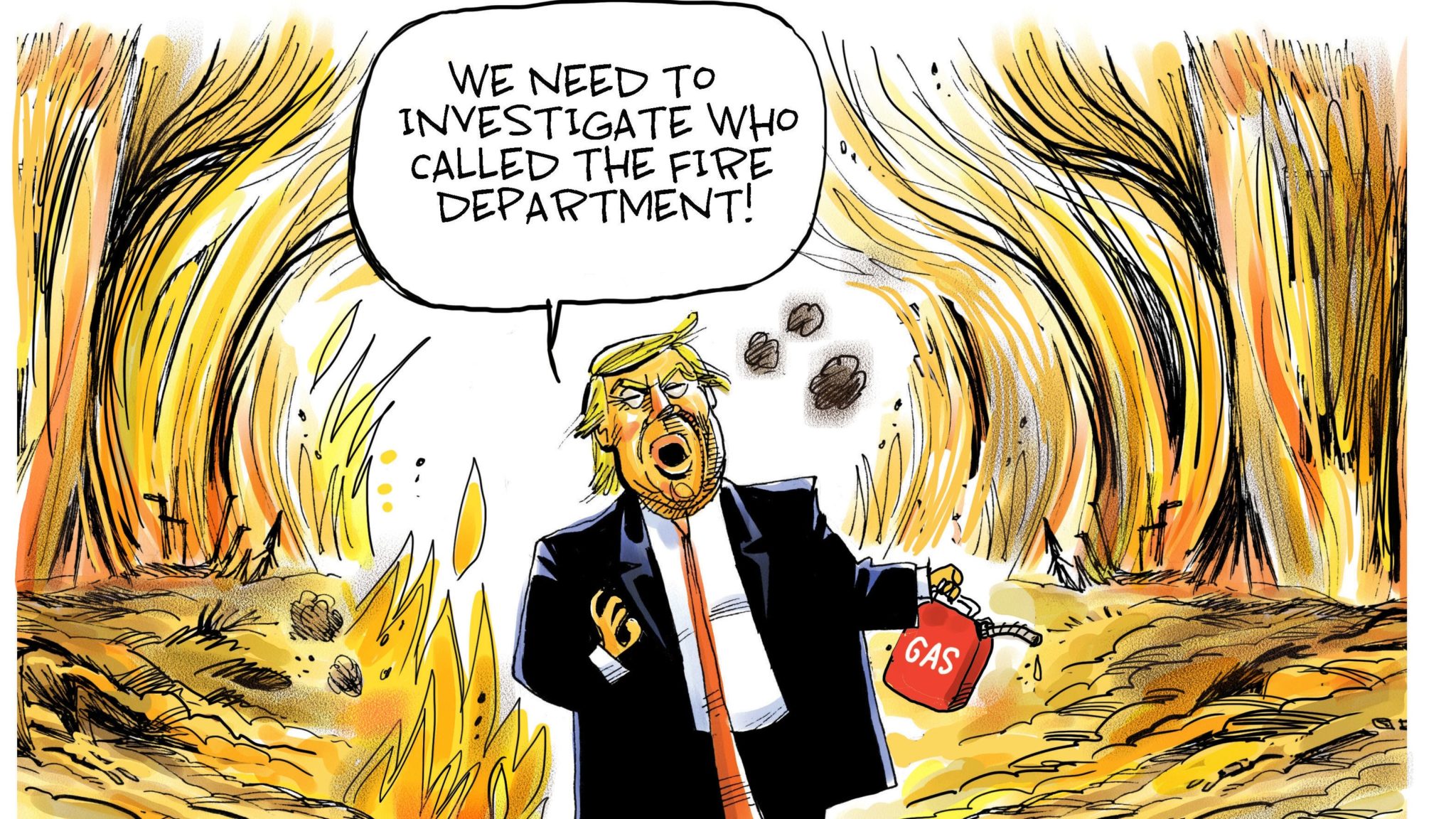
The former president’s desperation could drive his actions even after the final votes are cast.
“Trump, enraged and rattled, is reverting to his feral ways,” Peter Wehner wrote in The Atlantic today. Among those is Trump’s insistence on refusing reality: This weekend, the former president pushed a bizarre conspiracy theory that the massive crowds at recent rallies for Kamala Harris were faked by AI.
Apparently suffering from a severe case of crowd envy, Trump seized on right-wing social-media speculation and claimed that “NOBODY” had really shown up at Harris’s rallies. Despite extensive photographic evidence that thousands of supporters had turned out at an airport in Detroit, Trump insisted that the crowds “DIDN’T EXIST.” In fact, he declared, “there was nobody there,” and cited as evidence “the reflection of the mirror like finish on the Vice Presidential Plane,” which did not reflect images of the crowd that was otherwise in plain sight.
Trump’s claims were pathetically easy to debunk. His rally-crowd lie is yet another of his denials of the truth in front of him. But it was also a warning of a different sort: The former president is openly laying the groundwork for challenging the legitimacy of the November election.
After claiming that Harris had “CHEATED at the airport,” Trump telegraphed his other message: “This is the way the Democrats win Elections, by CHEATING – And they’re even worse at the Ballot Box.” Trump has been workshopping his claims that Harris’s candidacy is illegitimate; he has already suggested that the replacement of Joe Biden with Harris was somehow “unconstitutional.” (It wasn’t, because the Constitution is silent on party nominations.) In his weekend rant, Trump suggested that Harris “should be disqualified because the creation of a fake image is ELECTION INTERFERENCE. Anyone who does that will cheat at ANYTHING!”
In the 2020 race, Trump used the lie that the election had been stolen to incite a violent attack on the nation’s Capitol; now he and his allies have the added advantage of an infrastructure for sowing chaos the next time around. One of Trump’s campaign managers, Chris LaCivita, has already made it clear that Trump may fight the outcome of the election long after November 5. “It’s not over until he puts his hand on the Bible and takes the oath,” LaCivita said in a recent interview with Politico at the Republican National Convention. “It’s not over on Election Day, it’s over on Inauguration Day.” An investigation by Rolling Stone last month found that nearly 70 pro-Trump election deniers serve as election officials in key battleground counties.
In Georgia, Trump supporters on the state election board have adopted rules requiring “reasonable inquiry” before election results are certified, a move that could give GOP county-election-board members the ability to reject the 2024 election’s outcome. And as The Guardianreports, the lawyer and Trump ally Cleta Mitchell “has spent the last few years building up a network of activists focused on local boards of elections.” At the national level, the Republican National Committee says that it hopes to mobilize 100,000 volunteers, including thousands of poll watchers, to focus on “Democrat attempts to circumvent the rules.” Meanwhile, one RNC senior counsel for election integrity, Christina Bobb, was criminally indicted earlier this year for her role in trying to overturn the 2020 election (she pleaded not guilty).
Then there is the mood of the MAGA base. Trump’s lies about the 2020 election have become a litmus test in the GOP, and a recent Pew Research Center poll found that although 77 percent of Democratic voters believe that the election will be conducted “fairly and accurately,” less than half of Republican voters have faith in the system. Despite Harris’s recent surge, the majority of Trump supporters are confident that he will be victorious. (A recent YouGov poll found that nearly eight in 10 Trump supporters think he would win if pitted against Harris.) Trump fully intends to stoke his supporters’ disbelief and anger at the possibility that he could lose. As Wehner warned recently: “If you have friends who are Trump worshippers, a word of counsel: They’re heading to a very dark place psychologically … They felt this race was won; now it’s slipping away. Expect even greater self-delusion and more toxic rants.”
A defeated Trump could be even more dangerous this year than he was in 2020, because the personal stakes for him are higher than ever: Trump is already a convicted felon, but if he wins, he can make many of the remaining criminal cases against him go away. If he loses, he faces not only personal humiliation but also a potential legal nightmare. This makes Trump a desperate man—and that desperation could drive his actions even after the final votes are cast.
On the YouTube Videocast Halitics today, Hal and I discuss the state of the presidential race and agree that Governor Walz was a wise choice for VP. Harris and Walz together are far better than the weird team of Trump and Vance.
Today’s Halitics Youtube videocast with Hal Ginsberg. After three weeks off, we have much to discuss: Kamala, J.D. Vance, Trump, etc. Gaza and Israel, too.
I appear every Monday on Halitics. Live at noon ET, 9:00am PT, but always available on YouTube




 thebigpicturereport ™