Want to Buy a Judge?

Here is just one more example of why private money needs to be eliminated from the political process, and  public financing established for all elections. If the Occupy Movement had to have just one demand, that should be it. –Arlen

adam_cohen

Judges Are for Sale — and Special Interests Are Buying

By Adam Cohen

Time Ideas  Oct. 31, 2011

A new report details how big business and corporate lobbyists are packing courts with judges who put special interests ahead of the public interest

Getty Images

GETTY IMAGES

Cohen is the author ofNothing to Fear: FDR’s Inner Circle and the Hundred Days that Created Modern America. He teaches at Yale Law School.

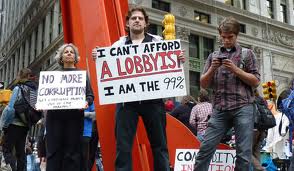
The Occupy Wall Street movement is shining a spotlight on how much influence big-money interests have with the White House and Congress. But people are not talking about how big money is also increasingly getting its way with the courts, which is too bad. It’s a scandal that needs more attention. A blistering new report details how big business and corporate lobbyists are pouring money into state judicial elections across the country and packing the courts with judges who put special interests ahead of the public interest.

A case in point: West Virginia. In 2007, the West Virginia Supreme Court, on a 3-2 vote, threw out a $50 million damage award against the owner of a coal company. Funny thing: the man who would have had to pay the $50 million had spent $3 million to help elect the justice who cast the deciding vote. The West Virginia ruling was so outrageous that in 2009 the United States Supreme Court overturned it. But that was unusual. In most cases, judges are free to decide cases involving individuals and groups that have paid big money to get them elected.

So who is paying? The new study – by New York University Law School’s Brennan Center for Justice, the National Institute on Money in State Politics, and the Justice at Stake Campaign, a non-partisan reform group – found that a small group of super spenders plays the biggest role, using their money to buy the kind of judges they want hearing their cases. These super spenders are the usual suspects: mainly big business, corporate lobbyists, and trial lawyers. Also high on the list: a disturbing category called “unknown.” In many states, disclosure laws are so weak that special interests can buy judicial elections without the public even finding out.

There is also a lot of one-issue money sloshing around. In 2010, three Iowa Supreme Court justices who ruled in favor of gay marriage were voted out of office – after a bitterly fought campaign dominated by money from out-of-state groups like the National Organization for Marriage and the American Family Association. Much of the special interest money is used for attack ads, which leverage hot-button issues to demonize judicial candidates. Has a sitting judge ever reversed a criminal conviction because the law was not followed? Then they must be soft on crime – and not care about victims.

Why does all this matter? Because as money floods into judicial elections, we are getting courts that are filled with judges whose first loyalty is not to justice – or to the general public – but to insurance companies, big business and other special interests. It’s not hard to guess what insurance companies want their judges to do. They want them to rule against people who have been injured – even when they deserve compensation, and they want damage awards to be slashed. Big business wants weak enforcement of laws against discrimination and pollution. On the other side of the political spectrum, trial lawyers want verdicts for plaintiffs – and large damage awards.

The report’s authors have some suggestions for minimizing the impact of payola. They want to see more public financing of judicial campaigns, although it is unclear how much the current United States Supreme Court will allow. (The conservative majority has been recklessly striking down campaign finance rules in recent years.) Many reformers think that the answer lies in ending the direct election of judges, and switching to a system (which some states already have) of appointing judges. That takes away the problem of elections, but special interests can shift their strategy to lobbying governors to appoint sympathetic judges.

Clearly, this is not a problem with easy solutions. But there need to be solutions. The American ideal of justice requires neutral judges, whose only commitment is to the law. Judicial elections that are dominated by special interest money make a mockery of that ideal.
 from Time.com

Boldface added by BPR Editor
Posted in elections, Justice, law, Occupy Wall Street, politics | Tagged , , , , , , , | Leave a comment

BPR Quote of the Day: What Is OWS About?

The question I’m most often asked about the Occupy Wall Street movement, or OWS, is: “What’s it all about?” And, every time, I’m reminded of the famous New Yorker cartoon of the man who walks into a showroom for luxury yachts. “If you have to ask the price,” the salesman solemnly informs him, “you can’t afford it.”

Similarly, if you have to ask what OWS followers are protesting, you’ll never understand….Quite simply, the protests are directed against every manifestation of a system today that is dramatically tilted in favor of the wealthiest 1 percent of Americans at the expense of the other 99 percent. If there’s one statement that sums up the entire movement, it’s the banner “We Are the 99 Percent.”

Bill Press  “Occupy Wall Street Becomes Occupy America.”                       Oct. 21, 2011

Posted in Occupy Wall Street, protests, Quotations | Tagged , | Leave a comment

A History Lesson You Won’t Learn From the Corporate Media

Published on Friday, November 4, 2011 by The Nation

How Wall Street Occupied America

By Bill Moyers

This article is adapted from a speech Bill Moyers gave in October at Public Citizen’s 40th Anniversary Gala.   

.

During the prairie revolt that swept the Great Plains in 1890, populist orator Mary Elizabeth Lease exclaimed, “Wall Street owns the country…. Money rules…. Our laws are the output of a system which clothes rascals in robes and honesty in rags. The [political] parties lie to us and the political speakers mislead us.”

She should see us now. John Boehner calls on the bankers, holds out his cup and offers them total obeisance from the House majority if only they fill it. Barack Obama criticizes bankers as “fat cats,” then invites them to dine at a pricey New York restaurant where the tasting menu runs to $195 a person.

That’s now the norm, and they get away with it. The president has raised more money from employees of banks, hedge funds and private equity managers than any Republican candidate, including Mitt Romney. Inch by inch he has conceded ground to them while espousing populist rhetoric that his very actions betray.

Let’s name this for what it is: hypocrisy made worse, the further perversion of democracy. Our politicians are little more than money launderers in the trafficking of power and policy—fewer than six degrees of separation from the spirit and tactics of Tony Soprano.

Why New York’s Zuccotti Park is filled with people is no mystery. Reporters keep scratching their heads and asking, “Why are you here?” But it’s clear they are occupying Wall Street because Wall Street has occupied the country. And that’s why in public places across the nation workaday Americans are standing up in solidarity. Did you see the sign a woman was carrying at a fraternal march in Iowa the other day? It read, I Can’t Afford to Buy a Politician So I Bought This Sign. Americans have learned the hard way that when rich organizations and wealthy individuals shower Washington with millions in campaign contributions, they get what they want.

In his Pulitzer Prize–winning book The Radicalism of the American Revolution, historian Gordon Wood says that our nation discovered its greatness “by creating a prosperous free society belonging to obscure people with their workaday concerns and pecuniary pursuits of happiness.” This democracy, he said, changed the lives of “hitherto neglected and despised masses of common laboring people.”

Those words moved me when I read them. They moved me because Henry and Ruby Moyers were “common laboring people.” My father dropped out of the fourth grade and never returned to school because his family needed him to pick cotton to help make ends meet. Mother managed to finish the eighth grade before she followed him into the fields. They were tenant farmers when the Great Depression knocked them down and almost out. The year I was born my father was making $2 a day working on the highway to Oklahoma City. He never took home more than $100 a week in his working life, and he made that only when he joined the union in the last job he held. I was one of the poorest white kids in town, but in many respects I was the equal of my friend who was the daughter of the richest man in town. I went to good public schools, had the use of a good public library, played sandlot baseball in a good public park and traveled far on good public roads with good public facilities to a good public university. Because these public goods were there for us, I never thought of myself as poor. When I began to piece the story together years later, I came to realize that people like the Moyerses had been included in the American deal. “We, the People” included us.

* * *

It’s heartbreaking to see what has become of that bargain. Nowadays it’s every man for himself. How did this happen? The rise of the money power in our time goes back forty years. We can pinpoint the date. On August 23, 1971, a corporate lawyer named Lewis Powell—a board member of the death-dealing tobacco giant Philip Morris and a future justice of the Supreme Court—released a confidential memorandum for his friends at the US Chamber of Commerce. We look back on now as a call to arms for class war waged from the top down.

Read the entire article at The Nation

Boldface added by BPR editor
Posted in economy, Occupy Wall Street, politics, protests | Tagged , , , , | Leave a comment

Oligarchy, American Style

By Paul Krugman


The New York Times   November 3, 2011

Inequality is back in the news, largely thanks to Occupy Wall Street, but with an assist from the Congressional Budget Office. And you know what that means: It’s time to roll out the obfuscators!

Anyone who has tracked this issue over time knows what I mean. Whenever growing income disparities threaten to come into focus, a reliable set of defenders tries to bring back the blur. Think tanks put out reports claiming that inequality isn’t really rising, or that it doesn’t matter. Pundits try to put a more benign face on the phenomenon, claiming that it’s not really the wealthy few versus the rest, it’s the educated versus the less educated.

So what you need to know is that all of these claims are basically attempts to obscure the stark reality: We have a society in which money is increasingly concentrated in the hands of a few people, and in which that concentration of income and wealth threatens to make us a democracy in name only.

brokeassstuart.com

The budget office laid out some of that stark reality in a recent report, which documented a sharp decline in the share of total income going to lower- and middle-income Americans. We still like to think of ourselves as a middle-class country. But with the bottom 80 percent of households now receiving less than half of total income, that’s a vision increasingly at odds with reality.

In response, the usual suspects have rolled out some familiar arguments: the data are flawed (they aren’t); the rich are an ever-changing group (not so); and so on. The most popular argument right now seems, however, to be the claim that we may not be a middle-class society, but we’re still an upper-middle-class society, in which a broad class of highly educated workers, who have the skills to compete in the modern world, is doing very well.

It’s a nice story, and a lot less disturbing than the picture of a nation in which a much smaller group of rich people is becoming increasingly dominant. But it’s not true.

Workers with college degrees have indeed, on average, done better than workers without, and the gap has generally widened over time. But highly educated Americans have by no means been immune to income stagnation and growing economic insecurity. Wage gains for most college-educated workers have been unimpressive (and nonexistent since 2000), while even the well-educated can no longer count on getting jobs with good benefits. In particular, these days workers with a college degree but no further degrees are less likely to get workplace health coverage than workers with only a high school degree were in 1979.

So who is getting the big gains? A very small, wealthy minority.

The budget office report tells us that essentially all of the upward redistribution of income away from the bottom 80 percent has gone to the highest-income 1 percent of Americans. That is, the protesters who portray themselves as representing the interests of the 99 percent have it basically right, and the pundits solemnly assuring them that it’s really about education, not the gains of a small elite, have it completely wrong.

If anything, the protesters are setting the cutoff too low. The recent budget office report doesn’t look inside the top 1 percent, but an earlier report, which only went up to 2005, found that almost two-thirds of the rising share of the top percentile in income actually went to the top 0.1 percent — the richest thousandth of Americans, who saw their real incomes rise more than 400 percent over the period from 1979 to 2005.

Who’s in that top 0.1 percent? Are they heroic entrepreneurs creating jobs? No, for the most part, they’re corporate executives. Recent research shows that around 60 percent of the top 0.1 percent either are executives in nonfinancial companies or make their money in finance, i.e., Wall Street broadly defined. Add in lawyers and people in real estate, and we’re talking about more than 70 percent of the lucky one-thousandth.

But why does this growing concentration of income and wealth in a few hands matter? Part of the answer is that rising inequality has meant a nation in which most families don’t share fully in economic growth. Another part of the answer is that once you realize just how much richer the rich have become, the argument that higher taxes on high incomes should be part of any long-run budget deal becomes a lot more compelling.

The larger answer, however, is that extreme concentration of income is incompatible with real democracy. Can anyone seriously deny that our political system is being warped by the influence of big money, and that the warping is getting worse as the wealth of a few grows ever larger?

Some pundits are still trying to dismiss concerns about rising inequality as somehow foolish. But the truth is that the whole nature of our society is at stake.

 Krugman’s Column

Boldface font by BPR Editor
Posted in economy, Occupy Wall Street, politics, protests | Tagged , , , | Leave a comment

BPR Quote of the Day: Are We Worm Food?

“Is God God? Or is man God? In God do we trust, or in man do we trust?….If man is God than an atheist state is as brutal as the thesis that it rests upon and there is no longer any reason for us to gather here in this place. We should just let anarchy prevail because, after all, we are just worm food. So indeed we have the time to reaffirm that God is God and in God do we trust.”

                                          Rep. Trent Franks (R-AZ)                                                                    Nov. 1, 2011 during debate on “In God We Trust” motto.

Posted in government, politics, religion | Tagged , , , , | 4 Comments

Beginnings of the Revolution?

Occupy Oakland General Strike, November 2, 2011

photo: Boots Riley (Facebook Wall)
Posted in protests | Tagged , , | Leave a comment

Greedy Lying Bastards


greedylyingbastards.com

Posted in environment | Tagged , , | Leave a comment

Robert F. Kennedy: What Our Gross National Product Really Means

Speech by Robert F. Kennedy, March 18, 1968, University of Kansas (Excerpts)”

“We will find neither national purpose nor personal satisfaction in a mere continuation of economic progress, in an endless amassing of worldly goods.We cannot measure national spirit by the Dow Jones Average, nor national achievement by the gross national product. For the gross national product includes air pollution and advertising for cigarettes, and ambulances to clear our highway carnage. It counts special locks for our doors, and jails for the people who break them. The gross national product includes the destruction of the redwoods, and the death of Lake Superior. It grows with the production of napalm and missiles and nuclear warheads . . . It includes Whitman’s rifle and Speck’s knife, and the broadcasting of television programs which glorify violence to sell goods to our country.”

“And if the gross national product includes all this, there is much that it does not comprehend. It does not allow for the health of our families, the quality of their education or the joy of their play. It is indifferent to the decency of our factories and the safety of our streets alike. It does not include the beauty of our poetry or the strength of our marriages, the intelligence of our public debate or the integrity of public officials . . . the gross national product measures neither our wit nor our courage, neither our wisdom nor our learning, neither our compassion nor our devotion to our country. It measures everything, in short, except that which makes life worthwhile; and it can tell us everything about America — except whether we are proud to be Americans.”

from the Glaser Progress Foundation

Boldface Font by BPR Editor
Posted in economy | Tagged , , | Leave a comment

Greece’s Choice — and Ours: Democracy or Finance?

By Robert Reich

TUESDAY, NOVEMBER 1, 2011

Which do you trust more: democracy or financial markets?

Greek Prime Minister George Papandreou decided in favor of democracy yesterday when he announced a national referendum on the draconian budget cuts Europe and the IMF are demanding from Greece in return for bailing it out.

(Or, more accurately, the cuts Europe and the IMF are demanding for bailing out big European banks that have lent Greece lots of money and stand to lose big if Greece defaults on those loans – not to mention Wall Street banks that will also suffer because of their intertwined financial connections with European banks.)

If Greek voters accept the bailout terms, unemployment will rise even further in Greece, public services will be cut more than they have already, the Greek economy will contract, and the standard of living of most Greeks will deteriorate further.

If Greek voters reject the terms and the nation defaults, it will face far higher borrowing costs in the future. This may reduce the standard of living of most Greeks, too. But it doesn’t have to. Without the austerity measures the rest of Europe and the IMF are demanding, the Greek economy has a better chance of growing and more Greeks are likely to find jobs.

Shouldn’t Greek citizens make this decision for themselves?

Of course, if Greek defaults on its loans, global investors (fearing that a default in Greece sets a dangerous precedent) may yank their money out of Italy. This would almost certainly bust several big European banks – and generate panic on Wall Street. That’s why Tim Geithner has been pressing Europe to bail out Greece.

We’ve been here before, remember? Specifically, here in the United States — at the end of 2008 and start of 2009. Wall Street had made lots of bad loans, and the question we faced then was whether to bail out the Street.

The difference is, we didn’t hold a referendum. Instead, the Bush administration told Congress the nation risked “economic Armageddon” if it didn’t immediately authorize a giant bailout of the Street – with no strings attached. Of course Congress hastily agreed. Hank Paulson, Ben Bernanke, and Tim Geithner (as head of the New York Fed) then doled out the money. And the Obama administration (with Geithner installed as Treasury Secretary) gave out more.

So instead of allowing the Street to live with the consequences of its negligence, we bailed it out – and allowed the Main Streets of America to suffer the consequences.

If Americans had been consulted about the 2008-2009 Wall Street bailout, I doubt it would have happened the way it did. At the very least, strict conditions would have been placed on the banks in return for the money. The banks would have had to eat the losses of the predatory mortgages they sold, and help homeowners reduce those mortgages. They’d be required to improve the capitalization of small banks in communities across the country. They’d be forced to accept stringent new regulations, including resurrection of Glass-Steagall.

But Americans weren’t really consulted. It was an inside job.

As a result, Wall Street has prospered but the rest of the nation hasn’t. One out of four homeowners is underwater, owing more on their homes than the homes are worth.

And with the worst economy since the Great Depression, we’re now embarking on fiscal austerity. Either Congress’s super-committee comes up with $1.2 trillion of federal budget cuts that Congress agrees to – going into effect a little over thirteen months from now – or $1.5 trillion of cuts are made across the board. Meanwhile, states and cities have been slashing public services for the past three years.

So which is it? Rule by democracy or by financial markets? Based on what’s happened in America, I’d choose the former.

RobertReich.org

Boldface font by BPR Editor

Posted in economy | Tagged , , , , , , , | Leave a comment

What is Occupy Wall Street All About?

Posted in economy, Occupy Wall Street | Tagged | Leave a comment