Crony Capitalism

If you missed this PBS episode from January 20, 2012,, it is well worth a look. Bill Moyers & Company explores “Crony Capitalism,” i.e. what’s remains of what we used to call capitalism and democracy. David Stockman, former budget director under President Reagan, explains the interconnection of Wall Street money and the  political process. Then Gretchen Morgenson, a Pulitzer-Prize winning reporter for the New York Times expands on how the financial institutions have manipulated the system to their benefit even after wrecking the economy. Both Stockman and Morgenson expect that another financial crisis similar or worse than 2008 is inevitable in the next few years.

From Bill Moyers.com

Posted in Barack Obama, Economics, economy, finance, government, inequality, politics, Wall Street | Tagged , , , , , , , , , , , , , | Leave a comment

Shopping Isn’t the Answer?

BPR Quote of the Day

Posted in humor, Quotations | Tagged , , | Leave a comment

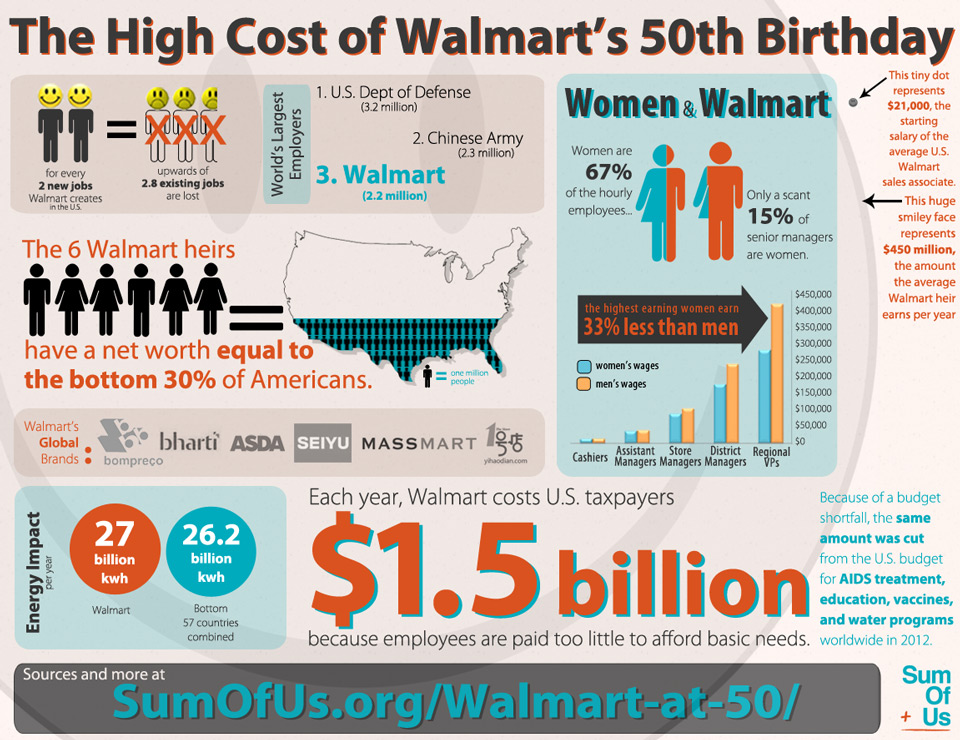
The Price of Cheap

Posted in Economics, economy, employment, Energy, gender, inequality, labor, poverty | Tagged | Leave a comment

BIG BROTHER

The expansion of the American police state continues at an accelerated pace. There seems to be an urgency to consolidate government authority and wipe out long-established and constitutionally mandated civil liberties. Since there hasn’t been any major terrorist attacks on American soil since 2001, some questions need to be asked: Why is the government seizing this kind of authoritarian control and who is standing up to this unprecedented power grab? — BPR Editor

Obama gives himself control of all communication systems in America

RT.com/ July 10, 2012

US President Barack Obama quietly signed his name to an Executive Order on Friday, allowing the White House to control all private communications in the country in the name of national security.

President Obama released his latest Executive Order on Friday, July 6, a 2,205-word statement offered as the “Assignment of National Security and Emergency Preparedness Communications Functions.” And although the president chose not to commemorate the signing with much fanfare, the powers he provides to himself and the federal government under the latest order are among the most far-reaching yet of any of his executive decisions.

“The Federal Government must have the ability to communicate at all times and under all circumstances to carry out its most critical and time sensitive missions,” the president begins the order. “Survivable, resilient, enduring and effective communications, both domestic and international, are essential to enable the executive branch to communicate within itself and with: the legislative and judicial branches; State, local, territorial and tribal governments; private sector entities; and the public, allies and other nations.”

President Obama adds that it is necessary for the government to be able to reach anyone in the country during situations it considers critical, writing, “Such communications must be possible under all circumstances to ensure national security, effectively manage emergencies and improve national resilience.” Later the president explains that such could be done by establishing a “joint industry-Government center that is capable of assisting in the initiation, coordination, restoration and reconstitution of NS/EP [national security and emergency preparedness] communications services or facilities under all conditions of emerging threats, crisis or emergency.”

“The views of all levels of government, the private and nonprofit sectors, and the public must inform the development of NS/EP communications policies, programs and capabilities,” he adds.

On the government’s official website for the National Communications Systems, the government explains that that“infrastructure includes wireline, wireless, satellite, cable, and broadcasting, and provides the transport networks that support the Internet and other key information systems,” suggesting that the president has indeed effectively just allowed himself to control the country’s Internet access.

In order to allow the White House to reach anyone within the US, the president has put forth a plan to establish a high-level committee calling from agents with the Department of Homeland Security, Pentagon, Federal Communications Commission and other government divisions to ensure that his new executive order can be implemented.

In explaining the order, the Electronic Privacy Information Center (EPIC) writes that the president has authorized the DHS “the authority to seize private facilities when necessary, effectively shutting down or limiting civilian communications.”

In Section 5 of his order, President Obama outlines the specific department and agency responsibilities that will see through his demands. In a few paragraphs, President Obama explains that Executive Committee that will oversee his order must be supplied with “the technical support necessary to develop and maintain plans adequate to provide for the security and protection of NS/EP communications,” and that that same body will be in tasked with dispatching that communiqué “to the Federal Government and State, local, territorial and trial governments,” by means of “commercial, Government and privately owned communications resources.”

Later, the president announces that the Department of Homeland Security will be tasked with drafting a plan during the next 60 days to explain how the DHS will command the government’s Emergency Telecommunications Service, as well as other telecom conduits. In order to be able to spread the White House’s message across the country, President Obama also asks for the purchasing of equipment and services that will enable such.

Boldface added by BPR editor
Posted in Barack Obama, civil liberties, government, law, media, Terrorism | Tagged , , , , , , | Leave a comment

THOSE WHO FAIL TO LEARN FROM HISTORY….

Weimar America: Four Major Ways We’re Following In Germany’s Fascist Footsteps

What happens when a mature industrial nation turns its back on democracy and lets its right-wing elite destroy the middle class? We’ve seen this movie before.

By Robert Cruickshank/ AlterNet/ July 5, 2012

What happens when a nation that was once an economic powerhouse turns its back on democracy and on its middle class, as wealthy right-wingers wage austerity campaigns and enable extremist politics?

It may sound like America in 2012. But it was also Germany in 1932.

Most Americans have never heard of the Weimar Republic, Germany’s democratic interlude between World War I and World War II. Those who have usually see it as a prologue to the horrors of Nazi Germany, an unstable transition between imperialism and fascism. In this view, Hitler’s rise to power is treated as an inevitable outcome of the Great Depression, rather than the result of a decision by right-wing politicians to make him chancellor in early 1933.

Historians reject teleological approaches to studying the past. No outcome is inevitable, even if some are more likely than others. Rather than looking for predictable outcomes, we ought to be looking to the past to understand how systems operate, especially liberal capitalist democracies. In that sense, Weimar Germany holds many useful lessons for contemporary Americans. In particular, there are four major points of similarity between Weimar Germany and Weimar America worth examining.

1. Austerity. Today’s German leaders preach the virtues of austerity. They justify their opposition to the inflationary, growth-creating policies that Europe desperately needs by pointing to the hyperinflation that occurred in 1923, and became one of the most enduring memories of the Weimar Republic. Yet the austerity policies enacted after the onset of the Depression produced the worst of Germany’s economic crisis, while also destabilizing the country’s politics. Cuts to wages, benefits and public programs dramatically worsened unemployment, hunger and suffering.

So far, austerity in America has largely taken place at the state and local levels. However, the federal government is now working on undemocratic national austerity plans, in the form of so-called “trigger cuts” slated to take effect at the end of 2012. In addition, there’s the Bowles-Simpson austerity plan to slash Medicare and Social Security benefits along with a host of other public programs; and the Ryan Budget, a blueprint for widespread federal austerity should the Republicans win control of the Congress and the White House in November.

2. Attacks on democracy. Austerity was deeply unpopular with the German public. The Reichstag, Germany’s legislature, initially rejected austerity measures in 1930. As a result, right-wing Chancellor Heinrich Brüning implemented his austerity measures by using a provision in the Weimar constitution enabling him to rule by decree. More notoriously, Hitler was selected as Chancellor despite his party never having won an election — the ultimate slap at democracy. Both these events took place amidst a larger backdrop of anti-democratic attitudes rampant in the Weimar era. Monarchists, fascists and large businesses all resented the left-leaning politics of a newly democratic Germany, and supported politicians and intellectuals who pledged to return control to a more authoritarian government.

Democracy is far older in the United States today than it was in Germany during the early 1930s. But that doesn’t mean that democracy is actually respected in practice today; it only means that attacks on it can’t be as overt as they were in Weimar Germany. From the Supreme Court’s Citizens United ruling to Republican voter ID laws to austerity proposals that bypass the normal legislative processes (remember the Supercommission?), American democracy is under similar direct threats now.

3. Enabling of extremists. Well before Hitler was made chancellor in 1933, leading conservatives and business leaders had concluded that their interests would be better served by something other than the democratic system established in 1919. During the 1920s, they actively supported parties that promoted anti-democratic ideologies, from monarchism to authoritarianism. Nazis were just one of the many extremist groups that they supported during the Weimar era. In fact, initially, many on the German right had attempted to exclude the Nazis from their efforts; and as chancellor, Brüning had tried to marginalize the Nazi party. However, his successor, the right-wing Franz von Papen, believed he could control Hitler and needed the support of the Nazi members of the Reichstag. Conservative German leaders ultimately decided their hunger for power was more important than keeping extremists at bay — and their support finally gave the Nazi Party control of the country.

Tea Party activists aren’t Nazis. But with roots in the 20th-century radical right, the Tea Party’s attack on the public sector, on labor unions, on democratic practices, and on people who aren’t white mark them as the extremist wing of American politics; and they bear many of the hallmarks that characterize fascist movements around the world. In recent years, Republican leaders have been enabling these extremists in a successful bid to reclaim political power lost to Democrats in 2006 and 2008. We don’t yet know where this enabling is going to lead the country, but it’s hard to imagine it will be anywhere good.

4. Right-wing and corporate dominance. One of the the most prominent German media moguls in the 1920s was Alfred Hugenberg, owner of 53 newspapers that reached over a majority of German readers. The chairman of the right-wing German National People’s Party, Hugenberg promoted Adolf Hitler by providing favorable coverage of him from the mid-1920s onward. Major German corporations such as Krupp, IG Farben and others spent money in the 1920s and early 1930s to support the rise of right-wing political parties, including the Nazis, as part of a strategy to undermine democracy and labor unions. Even if Hitler had never taken power, that strategy had already achieved significant returns on their substantial investment.

Here in the United States, one only needs to look at Charles and David Koch, Fox News and other right-wing funders and their media outlets to see the analogy. By funding right-wing politicians who promote austerity, undermine democracy and support extremism, they are active agents in the creation of Weimar America.

The Road Not Taken

None of this means that the United States is about to fall victim to a fascist coup d’etat as Germany did in January 1933. Remember that no outcome is inevitable. Nor would it be accurate to say that the United States is repeating the exact same events and taking the same course as Germany did during the 1930s, because many other important details are different. For example: Germany was a nation saddled with huge debts and lacking the global political power it needed to reverse its situation; but even with today’s high unemployment rates, the United States remains the globe’s largest economy, and therefore doesn’t face the same fiscal constraints Weimar Germany faced. In fact, a better current analogy may be Greece, which is in a far more similar predicament now.

Yet the underlying similarities ought to be troubling — and are enough to give us pause. The combination of austerity and well-funded right-wing political movements hostile to democracy destroyed Weimar Germany. And Spain and Italy both experienced a similar situation in their slide into authoritarianism in the 1930s. In those cases — and in ours — as people saw their own financial position weaken, and as their democratic rights were increasingly limited in favor of giving more power to the large corporations, the future of a democratic society with a strong middle-class was increasingly jeopardized. Fascism is what happens when right-wing plutocrats weaken the middle class, and then convince it to turn its back on democracy.

Will Weimar America face the same disastrous fate Weimar Germany did? On our current path, democracy and shared prosperity are both in serious trouble. We owe it to ourselves, to our children, and to our world to look to the lessons of history, find a way to change course, and get to work building something better.

Robert Cruickshank is a political activist and historian, and a senior advisor to Seattle Mayor Mike McGinn. The views expressed here are his own.

Posted in civil liberties, Economics, economy, government, inequality, law, media, poverty, Wall Street | Tagged , , , , , , , , , | Leave a comment

History of Our World in Two Minutes

World history for people with short attention spans…..created for a high school video productions class.

Posted in media | Tagged , | 2 Comments

The Strangling of Traditional Agriculture

Seeds of Freedom, narrated by Jeremy Irons, charts the story of seed from its roots at the heart of traditional, diversity rich farming systems across the world, to being transformed into a powerful commodity, used to monopolise the global food system.The film highlights the extent to which the industrial agricultural system, and genetically modified (GM) seeds in particular, has impacted on the enormous agro-biodiversity evolved by farmers and communities around the world, since the beginning of agriculture.

seedsoffreedom.info

Posted in environment, Food, law, poverty, science | Tagged , , , , , | Leave a comment

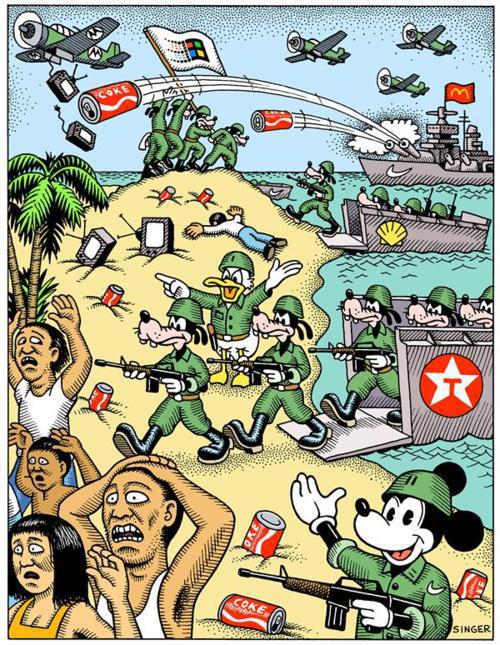
Exporting Democracy–American Style

Posted in Economics, economy, foreign policy, humor, military | Tagged | Leave a comment

Big Brother On The March

Glenn Greenwald delivered a powerful speech last week at the Socialism 2012 conference about the growth and danger of the American surveillance state. This is a scary but important examination of the pervasiveness of the growing violations of our privacy and civil liberties by government and by corporations. The speech is long but well worth reading, as this kind of information will certainly not be found anywhere in the corporate media. If this doesn’t convince you we are descending (or have descended) into an intimidating police state, then you probably don’t want to know. – BPR Editor

How America’s Surveillance State Breeds Conformity and Fear

Once the government is able to monitor everything we do and say, we will be unable to fight back.

By Glenn Greenwald/ AlterNet/ July 4, 2012

Seal of Information Awareness Office, 2002-2003

Last year was my maiden trip to the Socialism 2012 world. I started off by standing up and saying — I was actually surprised by this, pleasantly surprised, because I didn’t know what to expect — how amazingly inspirational I actually found this conference to be. The energy of activism and the sophisticated level of the conversation and the commitment that people displayed and the diversity of the attendees, really is unlike any other conference. And so when I was asked back this year, I was super excited to come back and accept. Not only because of that, but also because the conference organizers asked if I could speak about challenging the Surveillance State.

The reason that I was so eager to come and do that is because I really think that this topic is central to all of the other activism that’s being discussed here this weekend.

The Surveillance State hovers over any attacks that meaningfully challenge state-appropriated power. It doesn’t just hover over it. It impedes it, it deters it and kills it.  That’s its intent. It does that by design.

And so, understanding what the Surveillance State, how it operates — most importantly, figuring out how to challenge it and undermine it, and subvert it — really is, I think, an absolute prerequisite to any sort of meaningful activism, to developing strategies and tactics for how to challenge state and corporate power.

To begin this discussion, I want to begin with a little story that I think is illustrative and significant in lots of ways.

The story begins in the mid-1970s when there were scandals that were erupting, arising out of the Watergate investigation in the Nixon administration and/or scandals surrounding the fact that, as it turned out, the Nixon administration and various law enforcement officials in the federal government were misusing their eavesdropping powers. They were listening in on people who were political opponents, they were doing so purely out of political self-interest, having nothing to do with legal factors or the business of the nation, and this created a scandal, and unlike today, a scandal 40 years ago in the mid-1970s resulted in at least some relatively significant reactions.

In particular, a committee was formed in the Congress and the Senate, and it was headed by someone named Frank Church, who was a Democratic Party of the United States senator from Idaho who had been, in the Senate, at this time, for 20 years as one of the most widely regarded senators, and was chosen because of that. And he led this investigation into these eavesdropping abuses and tried to get into the scandal. One of the things that he discovered was that these eavesdropping abuses were radically more pervasive and egregious than anything that had been known at the start of the investigation.

It was by no means confined to the Nixon administration. In fact, it went all the way back to the 1920s, when the government first began developing the detective audio capability to eavesdrop on American citizens and heightened as the power heightened through the 1940s, when WWII would justify it; into the ’50s when the Cold War did, and the 1960s when the social unrest justified surveillance. What Senator Church found was that literally every single administration under both Democratic and Republican presidents had seriously abused this power.

And not in isolated ways, but systematically. This committee documented all the ways in which that was true, and the realization quickly emerged that, allowing government officials to eavesdrop on other people, on citizens, without constraints or oversight, to do so in the dark, is a power that gives so much authority and leverage to those in power that it is virtually impossible for human beings to resist abusing that power.  That’s how potent of a power it is.

But the second thing that he realized beyond just the general realization that this power had been systematically abused was that, there was an agency that was at the heart of this abuse, and it was the National Security Agency. And what was really amazing about the National Security Agency was that it had been formed 20 years ago back in 1949 by President Truman, and it was formed as part of the Defense Department. It was so covert that literally, for two decades, almost nobody in the government even knew that it existed, let alone knew what it did. Including key senators like Frank Church.

And part of his investigation — and actually, it was a fairly radical investigation, fairly aggressive even looking at it through cynical eyes and realizing that the ultimate impact wasn’t particularly grand, but the investigation itself was pretty impressive — and he forced his way into the National Security Agency and found out as much as he possibly could about it.

And after the investigation concluded, he issued all sorts of warnings about the Surveillance State and how it was emerging, and the urgency of only allowing government officials to eavesdrop on citizens, that they have all kinds of layers of oversight in the courts and Congress, but he issued a specific warning about the National Security Agency that is really remarkable in terms of what he said. And this is what he said — and you can find this anywhere online, in the New York Times, everywhere — he said, as part of a written report, and in an interview:

The National Security Agency’s capability at any time could be turned around on the American people, and no American would have any privacy left, such is the capability to monitor everything: telephone conversations, telegrams, it doesn’t matter.

He continued,

There would be no place to hide. If a dictator takes over the United States, the NSA could enable it to impose total tyranny, and there would be no way to fight back.

Now, there are several things that I find extraordinary about that statement. For one, the language that he uses. I mean, this is not somebody who is a speaker at the Socialism conference 2012. This was literally one of the people who was the most established institutional figures in American politics. I mean, he was in the liberal way of the Democratic Party but very much, he was mainstream for many years [ … ] And here he is warning the country of the dangers, not just of the U.S. government but specifically about the National Security Agency using words like “dictator” and “total tyranny” and warning of the way in which this power can be abused such that, essentially it would be irreversible. That once the government is able to monitor everything we do and everything we say, there’s no way to fight back because fighting back requires doing it away from their prying eyes.

And if you look now, 30 years later to where we are, not only would you never, ever hear a U.S. senator stand up and insinuate that the National Security State poses this great danger or use words like “tyranny” and “dictators” to describe the United States the way that Frank Church did only 30 years ago. Now it’s virtually a religious obligation to talk about the National Security State and its close cousin, the Surveillance State, with nothing short of veneration.

Just a few weeks ago, Chris Hayes, who’s an MSNBC host on the weekends, used the opportunity of Memorial Day to express this view in this very tortured, careful and pre-apologetic way that maybe it’s the case that not every single person who has ever served as an American soldier or enlisted in the American military is a hero. Maybe we can think about them in ways short of that. And this incredible controversy erupted, condemnation poured down on him from Democrats and conservatives, liberals and the like, and he was forced in multiple venues in the course of the next week to issue one, increasingly sheepish apology after the next. That’s how radically our discourse has changed, so that you cannot talk about the National Security State or the Surveillance State in these kinds of nefarious terms, the way that Frank Church, who probably knew more about it, did just a few decades ago.

The second remarkable aspect of that story, of that quote to me, is that the outcome of that investigation was a series of laws that were grounded in the principle that, as I said earlier, that we cannot allow government officials to eavesdrop on American citizens or in any way to engage in surveillance without all kinds of oversights and checks. The most illustrative of which was the FISA law, which said that no government official can eavesdrop on the occasion without first going through a court and proving to a court that we’re actually doing something wrong and getting the court permission before they can eavesdrop.

There was a similar controversy in the mid 2000s and in 2005 when the New York Times revealed that the Bush administration had been using the NSA to do exactly what Frank Church warned against — which is spying on the communication of American citizens. And the outcome of that was not new laws or new safeguards to constrain these sorts of abuses, it was exactly the opposite. In 2008, the Democratic-led Congress, with the support of President Obama, most of his supporters in the Democratic party and almost all Republicans basically gutted that law. Repealed it in its core and made it much, much easier for the government to eavesdrop on American citizens without constraint, and then immunized the nation’s telecoms that had participated in that illegal program.

So you see the radically different attitudes that the United States has to surveillance just some 30 years ago, when abuses resulted in a whole variety of a weak, but still meaningful legal constraint, versus what we do now when we find out that the government is lawlessly spying on us, which is act as quickly as possible to make it legal.

But the third part of why I think Church’s statements are so remarkable and important: If you look at what he said, he phrased his warning in a conditional sense. He said, If A happens, then B. A was: If the NSA starts using its eavesdropping capabilities and not directing them at foreign, nationals we suspect of spying, but instead at the American people, then B will happen. B being, we’ll essentially live under a dictatorship. There will be total tyranny where the American people will be unable to fight back because this net of surveillance will cover what we do.

And what’s really remarkable is that that conditional that he warned against — the apparatus of the NSA being directed domestically and inwardly rather than outwardly — has absolutely come to pass. That is the current situation, that is the current circumstance of the United States. The NSA, beginning 2001, was secretly ordered to spy domestically on the communications of American citizens. It has escalated in all sorts of lawless, and now lawful ways, such that it is now an enormous part of what that agency does. Even more significantly, the technology that it has developed is now shared by a whole variety of agencies, including the FBI, so that this surveillance net that Frank Church warned so stridently about, in a way that if we stood up now, we’d be immediately be branded a sort of shrill, submarginalized radical, has come to be, in all sorts of entrenched and legal ways.

Now there’s a few ways to think about the Surveillance State and try to understand its scope and magnitude. I think the most effective way to do that is to look at a couple of numbers. And to use the most mainstream sources to do that in terms of where we are, in terms of the American Surveillance State.

In 2010 the Washington Post published a three-part series called “Top Secret America” written by their Pulitzer Prize-winning investigative reporters Dana Priest and William Arkin. The first installment in that series looked at the National Security State and the Surveillance State, how it functions in the United States, and this was one of the sentences that appeared in this article. Listen to this, it said, “Every day — every day, collections systems at the National Security Agency intercept and store 1.7 billion e-mails, phone calls, and other types of comunication.”

That’s every day, they intercept and store, and keep for as long as they want, 1.7 billion e-mails and other forms of telephonic communications.

(Continued Here)

Boldface added by BPR Editor
Posted in civil liberties, government, law, law enforcement, media, military, Terrorism | Tagged , , , , , , , , , , , | Leave a comment

And John Boehner Is No Wizard

Posted in government, humor | Tagged , , , | Leave a comment