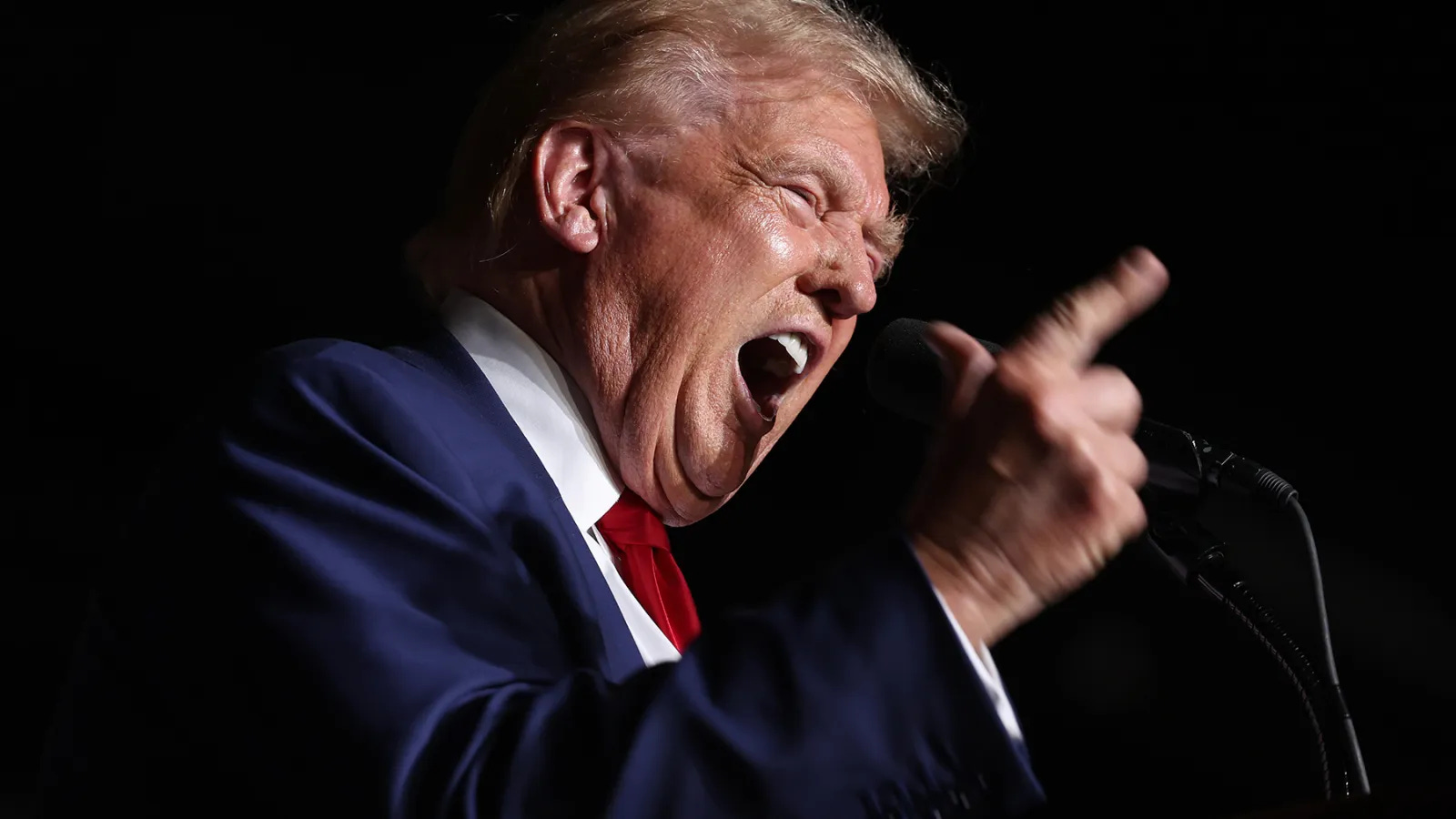
Robert Reich sees democracy on the line this week. How far will Trump go to nail down a full-on Fascist dictatorship? If he openly defies the Supreme Court to stop Kilmore Abrego Garcia from returning to the U.S.from El Salvador, where he was mistakenly imprisoned, and secondly, if he sends American citizens to foreign prisons without an independent review, then we have crossed over to an indisputable dictatorship.
Tuesday’s Halitics YouTube/Facebook videocast features host Hal Ginsberg and regular Tuesday guest Arlen Grossman discussing the fast-moving chaos from Trump and friends and what can be done to stop it. Hal thinks the Democrats have a lot to answer for, while I see Trump and his cohorts gleefully destroying what democracy we have left.
I wouldn’t intrude on your day for a second time if this weren’t deadly serious.
The Trump regime is on the cusp of a showdown with the Supreme Court. Depending on what the Court does and how the regime responds, it could openly become a dictatorship two ways.
1. The first way the Trump regime clearly becomes a dictatorship is by directly defying a Supreme Court order.
Last Thursday, the Supreme Court ordered the Trump regime to “facilitate” the return from an El Salvador prison of a Maryland man, Kilmar Abrego García whom the administration admitted it mistakenly deported there (given a court order specifically banning his deportation to El Salvador because of the possibility he faced torture from the government there if returned).
Trump officials said Sunday that the Supreme Court’s ruling requires only that the Trump regime allows Garcia to return —and only if he’s released by the government of El Salvador.
President Nayib Bukele of El Salvador, in a visit to the Oval Office today, said that the idea that he would send Chavez back was “preposterous.”
So, what happens now if the Supreme Court clarifies that the Trump regime must use every means possible to get Chavez back to America, but the regime chooses to defy that order?
JD Vance is a proponent of the view that a president can defy a Supreme Court order. In 2021, when he was then running for a Senate seat in Ohio, Vance said that if the courts stopped Trump, he should “stand before the country like Andrew Jackson did and say: ‘The chief justice has made his ruling. Now let him enforce it.’”
On February 8 of this year, after being sworn in as Vice President, Vance declared that “judges aren’t allowed to control the executive’s legitimate power” (without acknowledging that it’s up to the Supreme Court to determine the extent of a president’s “legitimate power.”)
2. The second way we officially become a dictatorship is if the Trump regime can accuse any American citizen of being so dangerous as to justify being sent to a foreign prison, without any independent court review of the regime’s evidence.
If the answer is yes, none of us is safe from the Trump regime.
This isn’t as far-fetched as it may seem.
During Bukele’s visit today, Bukele and Trump celebrated their joint crackdown on immigration and gangs. Bukele told Trump: “You have a crime problem and a terrorism problem that you need help with. And we’re a small country, but we can help.”
In response, Trump made clear he’s also considering sending American citizens to prison in El Salvador. “The homegrowns are next,” Trump told Bukele. “You gotta build about five more places. … It’s not big enough.”
Justice Sotomayor, joined by Justices Kagan and Jackson, argued in a statement accompanying Thursday’s Court’s order that if Garcia can be abducted and handed over to El Salvador, no American citizen is safe: “The Government’s argument … implies that it could deport and incarcerate any person, including U. S. citizens, without legal consequence, so long as it does so before a court can intervene.”
The possibility of arbitrary abduction by a sovereign and imprisonment abroad is one criterion that separates democracies from dictatorships. One of the grievances the Founders of the United States listed in the Declaration of Independence was “transporting us beyond Seas to be tried for pretended offences.”
***
What does the American public think?
A Reuters/Ipsos poll from late last month showed that 82 percent of Americans, including a majority of Republicans, believe a president “should obey federal court rulings even if the president does not want to.”
Yet in the same poll, 76 percent of Republicans agreed that “the Trump Administration should continue to deport people they view as a risk despite the court order.”
The poll was completed before the Abrego Garcia case came to public attention, so Republican opinion about presidential obedience to a court order in a case of someone whom the administration admits they erroneously deported remains unclear.
How close do you believe we’re coming to these tipping points?
NEW YORK/WASHINGTON, April 11 (Reuters) – Less than 48 hours after dining with a negotiator sent by Russian President Vladimir Putin in Washington last week, Steve Witkoff, the U.S. special envoy leading talks with Moscow, sat down with President Donald Trump in the White House and delivered a clear message.
The fastest way to broker a ceasefire in Ukraine, said Witkoff, was to support a strategy that would give Russia ownership of four eastern Ukrainian regions it attempted to annex illegally in 2022, two U.S. officials and five people familiar with the situation told Reuters.
It was a point Witkoff had made previously – and publicly in a podcast interview with conservative media personality Tucker Carlson last month – but one that Kyiv has repeatedly rejected and that some U.S. and European officials have dismissed as a maximalist Russian demand.
In the meeting with Trump, General Keith Kellogg, the president’s Ukraine envoy, pushed back against Witkoff, saying Ukraine, though willing to negotiate some terms related to disputed land, would never agree to unilaterally cede total ownership of the territories to Russia, said two of the sources.
The meeting ended without Trump making a decision to change the U.S. strategy. Witkoff traveled to Russia Friday to meet Putin.
Trump administration officials are increasingly at odds over how to break the deadlock between Ukraine and Russia, with Witkoff and Kellogg – who favors more direct support for Ukraine – disagreeing on the best course forward, according to the U.S. officials and people familiar with the matter and four Western diplomats who are in touch with administration officials.
Witkoff’s office, the National Security Council, the State Department, Ukraine’s Foreign Ministry and the Russian Embassy in Washington did not respond to requests for comment.
In a break with normal security procedures, Witkoff had invited Kirill Dmitriev, the Russian envoy who is under U.S. sanctions following Russia’s invasion, to his personal residence for dinner before the White House meeting.
That set off alarms inside the White House and the State Department, according to two people familiar with the situation. U.S. officials avoid hosting officials from Russia – which has sophisticated intelligence capabilities – to their homes.
The dinner was rescheduled and took place at the White House instead.
Witkoff, an old friend of Trump’s who has helped secure key diplomatic victories for the president, has garnered some support from the Republican Party’s Ukraine skeptics but his proposals have stoked outrage among other Republicans who believe the administration has turned too sharply toward Moscow.
Some Republicans on Capitol Hill were so concerned about Witkoff’s apparent pro-Russia stance in the Carlson interview that several called National Security Adviser Mike Waltz and Secretary of State Marco Rubio afterward to complain, according to a person familiar with the calls.
Since taking office in January, Trump has upended U.S. foreign policy, pressing Ukraine to agree to a ceasefire while easing many of the measures the Biden administration had taken to punish Russia for its 2022 full-scale invasion of its neighbor.
Some U.S. and European officials worry that as Witkoff pursues Trump’s strategy, the Russians are taking advantage of his lack of experience at the negotiating table, according to the two U.S. officials and more than a dozen other people familiar with the administration’s internal deliberations, including Western diplomats.
“Witkoff must go, and Rubio must take his place,” read a March 26 letter from Eric Levine, a major Republican donor. The letter, sent to a group including Republican donors and seen by Reuters, was written after the Carlson interview and a Fox News appearance, and criticized Witkoff for praising Putin.
Trump has repeatedly said that he wants to broker a ceasefire in Ukraine by May, arguing the U.S. must end a conflict that has killed hundreds of thousands and risks a direct confrontation between the U.S. and nuclear-armed Russia.
But two partial ceasefire deals – one on energy infrastructure and one in the Black Sea – have stalled and the president has become frustrated over the lack of progress.
Russian President Vladimir Putin meets with U.S. President Donald Trump’s special envoy Steve Witkoff in Saint Petersburg, Russia April 11, 2025. Sputnik/Gavriil Grigorov/Pool via REUTERS
A GROWING ROLE FOR WITKOFF
Witkoff plays a central – and expanding – role in the Trump administration’s foreign policy. Even before Trump took office, Witkoff had helped secure a long-sought Gaza ceasefire – which has since unraveled – and later negotiated the return of a U.S. citizen, Marc Fogel, from Russia.
He traveled to Russia on Friday to meet Putin and is expected in the Middle East for talks with Iran on Saturday, effectively leading yet another top priority national security assignment.
Witkoff first publicly floated the idea of handing over to Russia the four Ukrainian regions – Luhansk, Donetsk, Zaporizhzhia and Kherson – in the March 21 interview with Carlson.
“They’re Russian-speaking,” he said of the eastern territories. “There have been referendums where the overwhelming majority of the people have indicated that they want to be under Russian rule.”
Witkoff’s comments shocked many U.S. national security officials – the special envoy’s rhetoric mirrored that of Russian officials. Western governments have called the hastily organized referendum votes a sham and pledged not to recognize their results.
Just a few days after the Carlson interview, the Wall Street Journal, owned by Rupert Murdoch’s News Corp, published an op-ed titled “Steve Witkoff Takes the Kremlin’s Side.”
Democrats have weighed in, too.
“Witkoff and Trump have committed a cardinal sin of diplomacy: they have put their desperation for a deal on full display,” said Ned Price, a former spokesperson for the State Department under President Joe Biden.
Witkoff has plenty of defenders within the administration, who say he has been unfairly maligned by foreign policy officials who hold hawkish views in a Republican Party that has increasingly renounced foreign intervention. Witkoff and Trump still maintain a strong personal relationship, according to multiple people familiar with their relationship.
“Special Envoy Witkoff has brought a wealth of private sector negotiating experience and urgency to the diplomatic stage and we’re already seeing results in just a few weeks,” National Security Adviser Mike Waltz told the Hill in a statement.
ALLIES SEE PRESSURE TO GET RESULTS
For U.S. allies, the arguments and lack of progress toward a peace deal contribute to a sense that the U.S. lacks a clear plan to end the war in Ukraine.
Two European officials, who have had recent contacts with the administration, said there was pressure for the negotiating team to quickly get results, which worried them that the U.S. might not only accept moves that could undermine Ukraine, but Europe’s own security architecture.
The officials, who spoke on condition of anonymity, said they had not come away reassured from their discussions and did not feel there were clear final objectives on the American side.
Despite frequent conversations between Witkoff and Kellogg, the administration has not established a coordinated Ukraine policy process. Contrary to standard practice, the National Security Council has hosted only one principals’ meeting – a meeting that includes all or most of the president’s top national security advisers – on the issue, a person familiar with the matter said, leading to greater confusion inside the administration and among allies in Europe about the direction of the peace talks.
Two senior Western diplomats who are in touch with the administration said they believe Washington lacks a “clear plan” on how to move forward and what to do if Russia continues to delay.
“We sometimes hear contradictory things from different parts of the administration,” one of the diplomats, speaking on the condition of anonymity, said. “That also adds to the sense that there is no real plan here.”
In the last week, Trump has gone wild on the global economy, saying tariffs are the key to American prosperity.
As a result, global stock and bond markets tanked.
Today — telling reporters that “you have to be flexible” and conceding that “over the last few days it looked pretty glum” — Trump paused his tariffs for most countries for the next 90 days, backing down on his policy that had sent markets into a tailspin and threatened to upend global trade.
The reversal prompted the S&P 500 stock index to climb over 7 percent in just minutes.
Traders with inside information about what Trump was about to do — some of them, presumably, Trump family members and cronies — just made a fortune. (bold emphasis by TBPR Editor)
It looks like chaos but Trump’s chaos always creates winners and losers, and Trump makes sure he’s on the winning side.
The mayhem that Trump’s cuts in the federal workforce is creating have nothing to do with efficiency or with reducing the federal budget deficit.
Trump and Musk just gutted the IRS at the height of tax season by firing thousands of employees – and is planning to downsize the agency even more.
Recent estimates show that the richest 1 percent of Americans already underpay their taxes by as much as $205 billion each year. And for each $1 the IRS invests in auditing the tax returns of the richest 1 percent, it collects $13 in additional tax revenue.
So the tax revenue our government loses every year is way higher than the amount of taxpayer dollars DOGE claims to have “saved” by cancelling contracts and grants for vital government programs – of which only a small portion can actually be verified.
The truth is: Gutting the IRS has everything to do with making it easier for billionaires like Elon and Trump to evade taxes.
It all feels like chaos until you look more closely
Trump’s unpredictability also makes him seem particularly powerful and dangerous.
In 1517, Niccolò Machiavelli argued that sometimes it is “a very wise thing to simulate madness.” Wise, that is, for the manipulative ruler. Trump is simulating madness, but it’s all about increasing his wealth and power.
An increasing number of so-called “leaders” – in the private, public and non-profit sectors, and around the world – are telling their boards, overseers, trustees or legislatures: “We have to give Trump whatever he wants and even try to anticipate his wants, because who knows how he’ll react if we don’t?”
My strong recommendation to anyone in a position of leadership here or abroad: Do not give in to Trump’s feigned madness. Do not surrender. Do not capitulate. Join forces and fight back.
It’s hard to keep up with the quick pace of news from Washington daily. On Tuesday’s YouTube videocast “Halitics,” Hal Ginsberg and I talk about the hundreds of nationwide and worldwide protests against Trump’s antidemocratic policies and failing economy. I reported a huge demonstration in Monterey Saturday and was gratified at the response from protestors and hundred of passing cars honking in appreciation. We both agreed the Gaza atrocities and the situation in Ukraine seem to be afterthoughts for this administration. I talked about a Tom Friedman article about how technically advanced the Chinese government is, while Trump/Musk policies are decimating science, technology and medical research, allowing other countries to advance while we retreat. And we discussed how the Democratic Party can regain its popularity. And we discussed how the Democratic Party can regain its sagging popularity.
Huge turnout–estimated at over a thousand–protested Saturday at Window-on-the-Bay in Monterey, with hundreds of creative signs poking fun at Trump and Musk and their disastrous policies. Multitudes of cars were driving by honking and shouting their support. There were hundreds of such rallies nationwide and all over the world, letting the president know we won’t stand for him destroying the government, abandoning Ukraine, turning a blind eye to Netanyahu’s war crimes, assaulting American democracy, and crashing the world economy. The people are aware now and the blowback is just beginning!
The letter to the Editor that the Monterey County Herald doesn’t want their readers to see (at least not yet):
Did the Herald happen to stop by the Tesla dealership in Seaside on Saturday? I was one of at least several hundred noisy and motivated protestors lining both sides of Del Monte Avenue for over two hours, expressing our negative feelings about Elon Musk’s Teslas, The honking cars and waving passengers driving by understood they should refuse to buy the billionaire’s cars as a protest against his harmful activities in Washington.
Then I was disappointed the next day when the Herald posted a photo of six protestors and writing about the “approximately 50 people” in front of the Tesla dealership on Saturday. If the Herald wasn’t there when the height of the protest was happening, they should not pretend they were.
Arlen Grossman
Del Rey Oaks
Top 2 photos by Arlen Grossman
Monterey Herald version, March 31(bottom photo and text below)
Approximately 50 people gathered in front of the Tesla dealership Saturday afternoon in Seaside as part of a nationwide protest against Elon Musk’s role with DOGE. Even as some protestors began to leave, a smaller group stayed for longer. Over 200 ‘Tesla Takedown’ protests took place on ‘Global Day of Action.’ (David Timonera – Special to the Herald)
Continued here……“Preserving and Protecting the Integrity of American Elections,” will require every American who registers or re-registers to vote to prove their citizenship. The justification: Trump claims that the Democratic Party has registered three to five million non-citizen voters. But after four years of intense hunting by his Justice Department, they haven’t found three.
The Brennan Center for Justice of the New York University School of Law warned, when Trump first suggested this plan, that “the lie of non-citizen voting…could lead to the purging of hundreds of thousands of voters from the rolls.” But that statement wildly underestimated Trump’s and Musk’s ambitions. “Hundreds of thousands” could be purged in a single state.
The GOP isn’t waiting. In a pre-dawn call, Gerald Griggs, the President of the NAACP of Georgia, told me that the Georgia Secretary of State is about to remove 466,000 voters from the rolls, notably, four times Trump’s “victory” margin last year.
This follows Georgia’s request for access to the Department of Homeland Security’s immigration database — so Georgia can supposedly match its voter rolls to a list of non-citizens. Florida once used the DHS database to remove 172,000 “alien” voters. Only one (an Austrian Republican) was convicted of this crime — but thousands of “Luis Garcia’s” lost their vote.
“We tried to warn you, America,” said Griggs. “Jim Crow 2.0 has roared out of Georgia and is going national.”
The Brennan Center reports that 21 million Americans, otherwise legal voters, don’t have access to citizenship ID, a very low estimate. All will lose their vote if they attempt to register or RE-register (as 31 million Americans do each year).
Key facts:
Only 42% of white Americans — and only 34% of Black Americans — have passports to prove citizenship.
69 million women who took their husband’s last name cannot use their birth certificate as proof of citizenship.
Military ID is NOT proof of citizenship.
A driver’s license is NOT proof of citizenship (except in 5 states that permit you to add citizenship to the “Real” ID card.
According to Barbara Arnwine, founder of the Transformative Justice Coalition, who taught voting rights law at Columbia University, Trump and Musk are trying to get around the 10th Amendment to the Constitution which requires an act of Congress to make these changes to voting law by putting the citizenship proof requirement into the national mail-in federal registration form. This was tried in 2016 by Kris Kobach as Secretary of State of Kansas, who admitted in court that none of the 36,000 Kansans barred from voter rolls were non-citizens.
The Order also threatens the return of the infamous Interstate Crosscheck purge program. Courts had already struck down Crosscheck because it wildly tagged over three million Americans as potential “multiple” voters. Trump’s order authorizes Musk’s DOGE hounds to go into the voter files and cross check names between the states to tag potential double voters. But, according to Prof. Lorraine Minnite, author of The Myth of Voter Fraud, the chance of someone voting twice is far less than the chance of being killed by lightening. Nevertheless, a revived Crosscheck system would block the ballot to several hundred thousand voters.
But don’t count on the courts, newly Trump’d, to defend your right to vote.
After a two-week break Arlen joins Hal Ginsberg Tuesday on the YouTube videocast Halitics. We talked about AOC and Bernie barnstorming the country trying their best to stir up opposition to the Trump/Musk agenda. I see the recent surge in protests and opposition among the public, which pleases me and is necessary in fighting back against Trump’s policies. Hal is not satisfied with AOC and Bernie’s message and wants them to condemn Democratic Party policies more vigorously, especially their pro-Israel stance. I think it’s early and the Democrats need more time to figure out how to get the country behind them.
Hal is upset that the Israeli onslaught against Gaza civilians is not being noticed enough or cared about. I agree, but point out the Ukraine war is getting more attention as Americans and the world worry about how far Trump will go in appeasing his buddy Putin.
We also spend time examining the anti-Tesla activity and differ about its value.