
{I shake my head when anybody claims our country to be a “Democracy.” How can we be one when a candidate with the most votes for president can and has lost several presidential elections? It’s happened a number of times because our Constitution says we must use an Electoral College to determine our leader. The popular vote does’t matter. It’s only gotten worse with the Supreme Court decisions allowing corporations to have the same rights as people. Even worse, there are not any realistic limits on campaign donations, allowing corporations and millionaires to essentially buy elections. Jess Bidgood of the NY Times does a good job explaining the role of money in our elections.--TBPR Editor}
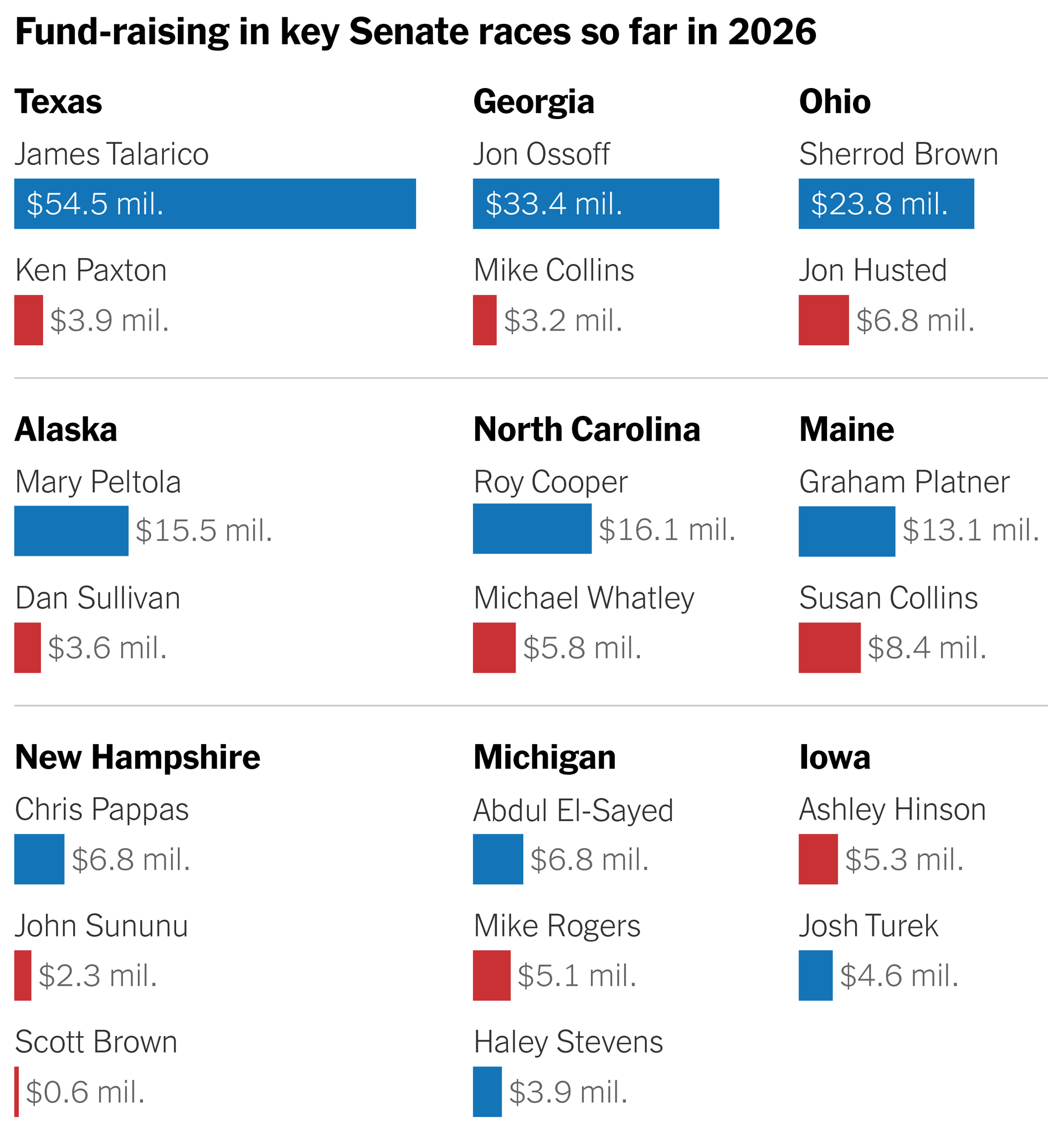
There was a lot of good news for Democratic candidates in this week’s fund-raising filings.
You can see the Democrats’ windfall in the graphic at the top of this page.
Analyses by Politico and Punchbowl News show that lots of Democratic House candidates are handily out-raising their opponents, too.
It would be easy to look at these Democratic candidates’ whopping cash advantage over their opponents and think they’re sitting pretty, flush with money and confident that they’ll swamp Republicans with paid advertising and other costly forms of campaigning in the midterm homestretch.
But candidate fund-raising is only part of the story — and the real race for cash is a lot tighter than it might seem. To explain more, I asked my colleague Teddy Schleifer, who was up well past midnight on Wednesday combing through fund-raising filings, to pull a few numbers.
Republicans, he told me, have two major advantages, both of which have to do with their spending from outside groups. “One is that their super PACs are better funded than those of the Democrats,” he said. “The second is that their national party committees are, as well, and the recent Supreme Court decision is going to make it a lot easier for candidates to tap into that cash.”
Let’s go to the numbers.
The super PACs
Republicans have $380 million in the two main party super PACs they’ll use for Senate and House races. Democrats have at least $193 million in theirs. (Their House super PAC has not yet reported its June fund-raising.)
The parties
The Republican National Committee has $125 million in the bank. The Democratic National Committee, which has been rived by infighting and other problems, is more than $3 million in debt. That’s right — it has less than $0.
That’s especially alarming for Democrats because a recent Supreme Court ruling has lifted lots of previous restrictions on how party money is spent. “That means the parties’ cash matters more than it did before,” Teddy said — and Democrats don’t have it.
The MAGA money
Here’s another important number: $382 million, which is the amount of money in President Trump’s super PAC, MAGA Inc. It has continued to raise enormous sums in Trump’s second term, in part from wealthy donors and corporations looking to curry favor with his administration.
“Republican outside groups are definitely advantaged by being in power,” Teddy said.
There is no Democratic equivalent to MAGA Inc. — and Republicans haven’t really started spending this money yet.
This, Teddy says, has “particularly freaked out Democrats because they know to expect it somewhere at some point, but they don’t know when and where.”
What it all means
Democrats would seem to have a lot going for them this cycle. Trump is unpopular, and he’s historically been a huge motivator for their voters. That’s helped Democrats attract small-dollar donations — but it hasn’t translated to an overall fund-raising advantage because Republicans are doing so well with big donors and corporations.
There’s a lot of money washing around this election. But it’s in different buckets — and the rules about how to use it are changing in real time. That makes it difficult to say who’s really ahead.
“I’d have said I’d rather be a really well-funded Democrat a month ago,” Teddy said, “but now I don’t know given the Supreme Court decision and how the R.N.C. takes advantage of it.”

